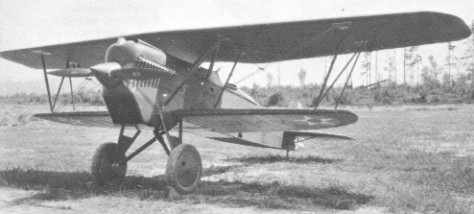
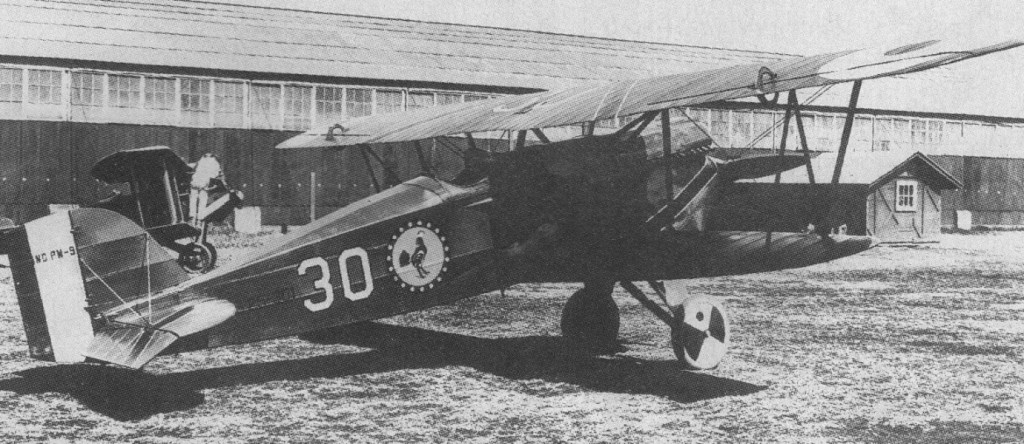
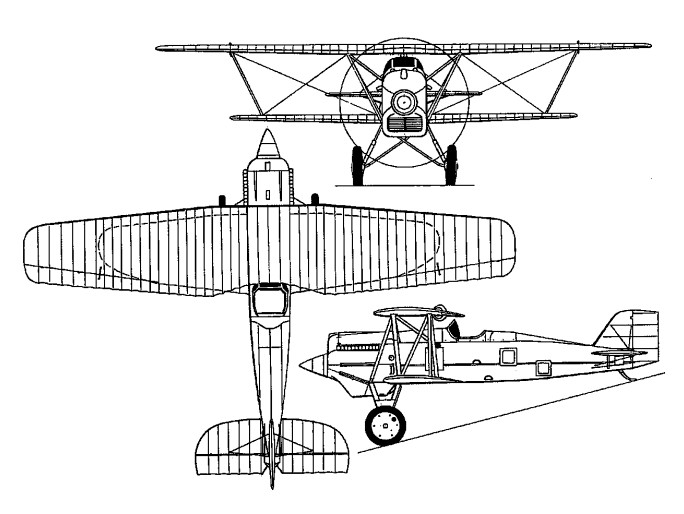
With experience gained from sub-contract production of a aircraft designed by other manufacturers, in particular, the Thomas-Morse MB-3A, Boeing began the private-venture development of a single-seat fighter under the designation Boeing Model 15. First flown on 2 June 1923, it was a single-bay biplane with wings of unequal span, the lower wing also being of reduced span and chord. The wings were of wooden construction, fabric-covered, but the fuselage was of welded steel tube. The braced tail unit was also of wood, and incorporated a variable-incidence tailplane that could be adjusted in flight. Landing gear was of fixed tailskid, with through-axle main units, and power was provided by a 324kW / 375 hp Curtiss D-12 inline engine. The design featured an underslung sloping core radiator with small frontal area, and an elliptical lower wing and tapered upper wing. The US Army became interested in the Model 15 before it was flown, and was evaluated by the US Army at McCook Field, under the designation XPW-9. It was flown in competition against a Fokker XPW-7 and Curtiss XPW-8A, wining an order for two extra XPW-9s for more extensive evaluation; these were delivered in May 1924. The third of the aircraft differed by having divided-axle instead of through-axle main landing gear units, and it was this type of landing gear that was chosen for the 30 examples of the production PW-9 ordered in two batches (12 and 18) in September and December 1925 respectively.
PW-9 25-301
The US Navy was as keen as the US Army to acquire examples of Boeing’s new fighter, and the first of an order of 14 for service with the US Marine Corps, under the designation FB-1, were delivered on 1 December 1925 to the shore-based fighter squadrons VF 1M, 2M and 3M. They were used in 1927 and 1928 by the US Expeditionary Force in China. Only 10 were produced as FB-1s, these being virtually identical to the US Army’s PW-9 (Boeing Model 15), having the same 435 hp Curtiss D 12 engine and two gun armament. The 11th and 12th aircraft on this order introduced the 380kW Packard 1A-1500 inline engine, and were equipped with through-axle landing gear and an arrester hook for operation from aircraft-carriers. The change resulted in redesignation by the US Navy to FB-2 (Boeing Model 53); the 13th aircraft was identical to the FB-2, except for twin, float landing gear, and was designated FB-3 (Boeing Model 55); and the 14th and last of the US Navy’s initial order also had twin floats, but introduced a 336kW Wright P-1 radial engine, becoming redesignated FB-4 (Boeing Model 54) or FB-6 with the 298kW Pratt & Whitney Wasp. The development ultimately led to the FB-5 produced during 1926-27. The FB 5 for the US Navy (Boeing Model 67), differed from the FB 1 in having a 520 hp Packard 2A 1500 engine, increased wing stagger, and a balanced rudder. Twenty seven were deli¬vered in January 1927 to Marine fighter squadrons VF 1B and VF 6B for service aboard the Langley.
Boeing Model 15 / XPW-9 Engine: 324kW / 375 hp Curtiss D-12 inline
Boeing Model 15 / PW-9 / FB-1 Engine: 435 hp Curtiss D 12 Span: 9.75 m (32 ft) Length: 7.14 m (23 ft 5 in) Empty Weight: 1,936lbs (878kg) Maximum Take-Off Weight: 3,120lbs (1,415kg) Maximum Speed: 159mph (256kmh; 138kts) Maximum Range: 390miles (628km) Service Ceiling: 18,924ft (5,768m) Armament: 1 x 7.62mm mg, 1 x 12.7mm machine gun Accommodation: 1
PW-9C Engine: One 400 h.p. Curtiss D.12 Length 23.6ft (7.2m) Wingspan 32ft (9.75m) Weight 3,043 lb (1,380 kg) Seats: 1 Max speed: 163 mph (262 kph) Ceiling: 20,000 ft (6,000m) fully loaded.
Boeing Model 53 / FB-2 Engine: 380kW Packard 1A-1500 inline Length 23.6ft (7.2m) Wingspan 32ft (9.75m) Seats: 1
The first product, B & W Seaplane of 1916, was designed by William Boeing in conjunction with Conrad Westervelt. The company secured the first of many military contracts in June 1916, when it received an order from the Navy Department to build 50 HS-2L flying boats. First production order was for Model C seaplane trainer for U.S. Navy (first flown 1916), followed by Model EA land trainer of 1916 for U.S. Army. Name changed to Boeing Airplane Company April 26,1917. Improved Model C of 1918 was first mass-produced Boeing aircraft, built alongside Boeing-constructed Curtiss HS-2L flying-boats. First post-First World War design was the B-1 three-seat flying-boat (first flown December 1919), while in 1920 the first flight took place of the first of many Boeing-built DH-4s (based on British Airco D.H.4). Built ten U.S. Army-designed GA-1 armored ground attack triplanes (first flown May 1921) but just two GA-2s, followed by 200 Thomas-Morse MB- 3A pursuit aircraft (first flown 1922). The Boeing company has contracted with Thomas Morse to build the MB-3 fighter. With this experience Boeing undertook the development of their own PW-9 pursuit aircraft. Bid successfully for the San-Francisco-Chicago airmail route in 1927 and formed subsidiary Boeing Air Transport to operate the route. In 1928, Boeing Airplane and Transportation Corporation went pub¬lic and the stock sold quickly. As other airlines were acquired, this became Boeing Air Transport System. Merged with Pratt & Whitney, Standard Steel Propeller Co, and two small aircraft manufacturers to form United Aircraft & Transport Corporation in 1929. All continued to operate under original identities. Encouraged, Boeing formed the United Aircraft and Transport Corporation, which included Boeing Airplane Company, Pratt & Whitney, Chance Vought, Sikorsky, Hamilton Propeller, Pacific Air Transport. First real success with own-design military aircraft came in 1923, with the PW-9/FB-1 series, which had a fabric-covered welded-steel-tube fuselage. Other aircraft followed in quick succession, types of particular note including the Boeing Model 40, designed for carriage of airmail plus two (and later four) passengers, used by new Boeing Air Transport. Model 80 12-passenger transports with three Pratt & Whitney Wasp engines introduced by Boeing Air Transport in 1928. World’s first airline stewardesses introduced on these aircraft 1930. In 1929 Lloyd Stearman sold his Stearman Aircraft Company to the ‘United Aircraft and Transport Corporation’. Model 80A with more powerful Hornet engines and seats for 18 passengers followed. Biggest military order to that date (other than MB-3As) came in 1931, when U.S. Army ordered 135 P-12E single-seat fighters, and U.S. Navy 113 of the similar F4B-3: total of 586 aircraft in this series built by 1933 (prototype Model 83 for P-12 series had flown June 1928). Boeing Model 200 Monomail, mail/cargo aircraft, first flew May 1930; revolutionary aircraft with cantilever allmetal monoplane wing, retractable main landing gear and a specially designed antidrag cowling for its single Hornet engine. A second Monomail, Model 221, had six-seat passenger cabin. Military development of this aircraft resulted in YB-9 bomber (first flown April 1931), forcing evolution of new fighter types. Boeing produced P-26 single-seat all-metal monoplane fighter (first flown March 1932), of which 136 bought by U.S. Army. Biggest step forward came with the Model 247 (first flown February 1933), most advanced conception of a transport aircraft anywhere in the world at that time. Introduced wing and tail unit leading- edge de-icing, control surface trim tabs and, in production aircraft, controllable-pitch propellers and autopilot. It was the first twin-engined monoplane transport that could climb with a full load on the power of one engine. In 1934 legislation prevented aircraft and engine manufacturers from operating airlines. Boeing resigned as chairman, sold out his stock and the corporation was divided into three new companies in September 1934 United Air Lines to handle air transport, United Aircraft Corporation to take over the eastern manufacturing firms and Boeing Airplane Company to manage Western operations, together with Stearman, a wholly owned subsidiary. The name Boeing Airplane Company was readopted in 1948. In May 1961, following acquisition of Vertol in 1960, became known as The Boeing Company, which remained the name in 1999. Changes in the company structure took place in 1996, when on December 15 it was announced that a merger had been agreed with McDonnell Douglas. The two large organizations began operating as a single company from August 4,1997, under the Boeing name. Also in December 1996 Boeing purchased Rockwell International’s aerospace and defense units, these being retitled Boeing North American Inc. and subsequently becoming part of Boeing’s Space Systems business unit. Several internal restructures of the Boeing organization followed, the set-up comprising three main groups, namely, Information, Space, and Defense systems Group (ISDS), Boeing Commercial Airplane Group (BCAG), and Boeing Shared Services Group; the latter for information management and computing resources. Within ISDS are various business units comprising Aircraft and Missile Systems (to undertake Boeing’s military airplane and helicopter programs, plus oversee tactical missile development), Boeing Space Systems (to oversee Boeing’s space programs for DoD and NASA), Information and Communication Systems (programs include AWACS surveillance systems, communications systems and more), Phantom Works (a previous McDonnell Douglas unit for advanced research and development, with programs including research into hypersonic aircraft), and Business Resources. BCAG is headquartered at Renton but has units in various other locations. This group comprises Customer Services, Douglas Products Division (for manufacturing airliners that originated from McDonnell Douglas, such as the MD-80, MD-90, MD-11, and B717), Engineering Division, Fabrication Division (constructing components), Materiel Division (made responsible for materials and subcontracted components), Propulsion Systems Division (engine preparation for airliners), 737/757 Programs, 747/767 Programs, 777 Program, and Wichita Division (components and subassemblies). Significant military aircraft since the early 1930s have included the B-17 Flying Fortress bomber (first flown July 1935), of which 12,731 examples were built; B-29 Superfortress bomber (first flown September 1942); B-47 Stratojet medium jet bomber (first flown December 1947); B-52 Stratofortress intercontinental strategic bomber (first flown April 1952); E-4 National Airborne Operations Center aircraft (first flown June 1973); E-3 Sentry airborne early warning and control system aircraft (delivered from March 1977); E-6 Mercury survivable airborne communications system aircraft for the U.S. Navy (first flown February 1987); and EC-18 advanced range instrumentation and cruise missile control aircraft. The B-52H Stratofortress continues to form a major component of the USAF, and proposals were made in 1998 to re-engine 71 examples of this eight-engined bomber with four very powerful Rolls- Royce RB211-535E-4 turbofans each. Continuing military programs in 1999 include work in developing the AL-1A Airborne Laser aircraft based on the Model 747 Freighter; development of Boeing’s contender for the Joint Strike Fighter program to produce a multipurpose combat aircraft with CTOL/STOVL flight characteristics to replace a range of present warplanes from about the year 2008; new AWACS aircraft for export based on 737 and 767 airframes (first flight of an E-767 AWACS with structural AWACS features for Japan, August 1996); and production of the F-15 Eagle, F/A-18 Hornet and Super Hornet, Harrier II and II Plus, and T-45 Goshawk (all ex-McDonnell Douglas). Aircraft which have made important contributions to global air transport, in addition to those previously mentioned, include the Model 314 flying-boat (first flown June 1938); Model 307 Stratoliner with pressurization (first flown December 1938); Model 377 Stratocruiser (first flown November 1944 as XC-97 military transport); Model 367-80 turbojet transport (first flown July 1954) which was put into production as a military tanker-transport for the USAF as the KC-135 Stratotanker and as the Model 707 commercial airliner; Model 727 tri-jet short/medium-range airliner (first flown February 1963); Model 737 twin turbofan short-range airliner (first flown April 1967 and still in production in 1999 in advanced and Next Generation versions, with development continuing and over 4,000 sold); Model 747 four-jet wide-body high-capacity airliner (first flown February 1969 and given the press nickname “Jumbo Jet”; still in production in 1999 in latest 747-400 series versions, with new versions under development); Model 757 twin-jet medium-range airliner (first flown February 1982); Model 767 twin-jet wide-body medium/longrange airliner (first flown September 1981); and Model 777 twin-jet wide-body long-range airliner.
Since the merger with McDonnell Douglas, the Boeing aircraft range also includes the Model 717 (first flown 1998; formerly the McDonnell Douglas MD- 95), C-17A Globemaster III military heavy-lift and longrange transport (first flown September 1991; commercial version proposed as the MD-17); MD-11 medium/long-range tri-jet airliner (first flown January 1990); MD-80 twin-jet short/medium-range airliner (first flown October 1979 as follow-on to similar but older DC-9); MD-90 twin-jet medium-range airliner (first flown February 1993 as longer and advanced development of MD-80); F-15 Eagle; F/A- 18 Hornet and Super Hornet; Harrier II and II Plus; T-45 Goshawk; and various helicopters. Since taking over Rockwell International’s aerospace and defense units, the B-1B Lancer long-range variable-geometry strategic bomber is technically also a Boeing type, although production of 100 ended in 1988. Since the merger of Boeing and McDonnell Douglas, Boeing’s helicopter range has grown. However, Boeing took the strategic decision to concentrate on military helicopter programs and sold its 49% share in the Model 609 civil tilt-rotor transport to its development partner Bell Helicopter Textron (now called BA 609; the MD 500/520/530/Defender and MD 600N helicopter ranges thereafter (plus MD 900/902 Explorer/Combat Explorer not selected by Bell) remained for sale elsewhere, some using the unique NOTAR antitorque system. Boeing has sold its civil helicopter production line, formerly manufactured by McDonnell Douglas, to Dutch company MD Helicopters on 19 February 1999. The sale, coming only two years after Boeing themselves purchased the range through a merger. The sale includes the MD500E, 520N, 530F and 600N models, as well as the twin-engined MD Explorer and the licence to incorporate the no tail rotor (NOTAR) system on future aircraft. Boeing does, however, keep the ownership of the NOTAR technology. Boeing continued to produce the machines, under contract to the new Dutch owners, until early 2000. However, Boeing continued its partnership with Bell over development and production of the V-22 Osprey military tilt-rotor transport and multipurpose aircraft for the U.S. forces (first flown March 1989). Not for sale was the inherited AH-64 Apache attack helicopter, produced also in the U.K. in AH-64D Apache Longbow form. Boeing’s own H-47 Chinook continued in production, and Boeing remained partnered with Sikorsky in the development of the RAH-66 Comanche multirole battlefield helicopter for the U.S. Army (first flown January 1996).
Boeing enhanced its space prowess through the merger in 1997 with McDonnell Douglas and the acquisition the year before of the defense and space units of Rockwell International.
In 1998 Boeing was under contract to the United Space Alliance for shuttle orbiter production, modifications and operations, and for overall shuttle system and payload integration services, with additional responsibility for launch and mission support.
In 1999 Boeing operations were located in 27 states, and the company had employees in more than 60 countries. The company was organized into three major business segments: Boeing Commercial Airptane Group, Military Aircraft and, Missile Systems Group, and Space and Communications Group.
In 1930 Avions Bodiansky produced an advanced two-seat light monoplane, the Bodiansky 20 monoplane, which featured a welded steel-tube fuselage structure, as well as manually and automatically operated leading-edge slots and trailing-edge flaps.
France In 1930 Avions Bodiansky produced an advanced two-seat light monoplane, the Bodiansky 20 monoplane, which featured a welded steel-tube fuselage structure, as well as manually and automatically operated leading-edge slots and trailing-edge flaps.
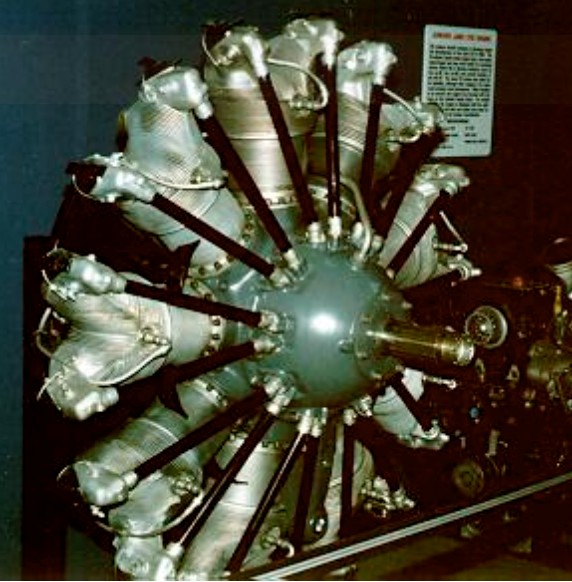
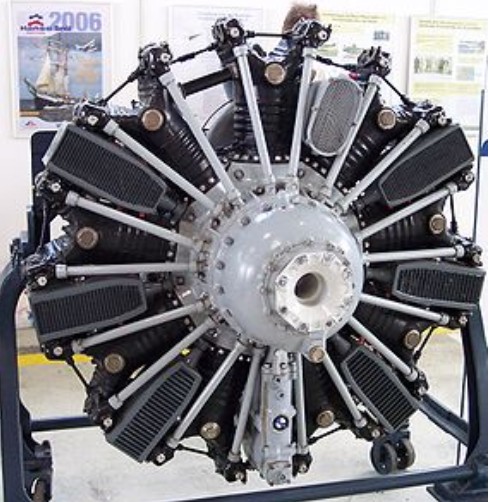
BMW took over the license for manufacturing air-cooled radial engines from US aircraft manufacturer Pratt & Whitney Aircraft Company on 3 January 1928. The nine-cylinder model Pratt & Whitney Hornet was initially manufactured virtually unchanged under the designation BMW Hornet. Soon BMW embarked on its own development. The result was the BMW 132 that went into production in 1933, which was essentially an improved version of the Hornet engine. A number of different versions were built. Aside from the carburetor designs used mainly in civilian aircraft, versions with direct fuel injection were manufactured for the German Luftwaffe. The engines had a displacement of 27.7 liters and generated up to 1,200 PS (880 kW)[citation needed], depending on model.
The 132 found widespread use in the transport role, remaining the primary powerplant of the Junkers Ju 52 for much of its life, turning the BMW 132 into one of the most important aero-engines for civilian aircraft during the 1930s.
Numerous pioneering flights were undertaken with the BMW 132. The most impressive was the first direct flight from Berlin to New York in a Fw 200 S-1 Condor equipped with four BMW 132 engines. It covered the distance to New York in 24 hours and 57 minutes on 10 August 1938.
Over 21,000 were built.
Applications: Arado Ar 196 Arado Ar 197 Blohm & Voss Ha 140 Blohm & Voss BV 141 Blohm & Voss BV 142 Fieseler Fi 98 Heinkel He 114 Heinkel He 115 Henschel Hs 123 Junkers Ju 160 Junkers Ju 52 Junkers Ju 86 Junkers W34
Specifications:
132A 725 PS (715 hp, 533 kW)
132 Dc Type: Nine-cylinder single-row supercharged air-cooled radial engine Bore: 155.6 mm (6 1⁄8 in) Stroke: 161.9 mm (6 3⁄8 in) Displacement: 27.7 l (1,690 in³) Length: 1,411 mm (55.55 in) Diameter: 1,380 mm (54.33 in) Dry weight: 525 kg (1,157 lb) Valvetrain: Two overhead valves per cylinder Supercharger: Single-speed centrifugal type supercharger Fuel system: Hobson carburetor Fuel type: 87 octane rating gasoline Cooling system: Air-cooled Reduction gear: Farman epicyclic gearing, 1.61:1 Power output: 589 kW (789 hp) for takeoff 581 kW (779 hp) at 2,290 rpm at 2,900 m (9,515 ft) Specific power: 21.26 kW/l (0.47 hp/in³) Compression ratio: 6.5:1 Specific fuel consumption: 322 g/(kW•h) (0.53 lb/(hp•h)) Oil consumption: 8-11 g/(kW•h) (0.21-0.28 oz/(hp•h)) Power-to-weight ratio: 1.12 kW/kg (0.68 hp/lb)
The BMW 116 and BMW 117 were piston aircraft engines derveloped by BMW in the 1930s. Development work stopped in 1937. The BMW 116 engine was initially known as the BMW XII and the BMW 117 engine was initially known as the BMW XV/.
BMW 116 Type: V-12 Bore: 130 mm Stroke: 130 mm Displacement: 20.7 L Length: 1637 mm Width: 740 mm Height: 915 mm Dry weight: 470kg Supercharger: radial supercharger Fuel system: carburettor Cooling system: Liquid cooled Power output: 620 HP Compression ratio: 6.50
BMW 117 Type: V-12 Bore: 155.6 mm Stroke: 158 mm Displacement: 36.0 L Length: 1809 mm Width: 740 mm Height: 985 mm Dry weight: 525kg Supercharger: radial supercharger Fuel system: injection Cooling system: Liquid cooled Power output: 905 HP at 2320 rpm Compression ratio: 6.50
The BMW 114 was a nine-cylinder air-cooled diesel radial engine intended for military aircraft use. Developed in 1935 from the BMW 132, with which it could be interchanged, work did not progress beyond experimental prototype engines.
The supercharged BMW-Lanova 114 V-4 was a liquid-cooled diesel engine variant which was also not produced in numbers.
BMW 114 Type: 9-cylinder radial engine Bore: 155.5 mm Stroke: 162 mm Displacement: 27.7 L Supercharger: single speed supercharger Cooling system: Air- and Liquid-cooled Power output: 510 HP
The BMW X was a small five-cylinder radial engine for sport and training aircraft first run in 1927. Although this engine proved successful at several large-scale events in 1930, including that year’s round-Europe flight, only a few were built.
The successor model to the BMW X five-cylinder radial engine, the BMW Xa, was introduced in 1931, with the swept volume increased from 2.2 to 2.9 liters. Power output went up from 50 to 68 hp. The Xa was also not built in any quantity either, and was mainly installed in training and sports aircraft.
Applications: BFW M.23 BFW M.31 Klemm L25
BMW Xa Type: 5 cylinder radial engine Bore: 90 mm (3.54 in) Stroke: 92.5 mm (3.64 in) Displacement: 2.94 L (179.6 cuin) Diameter: 740mm Dry weight: 73kg Fuel system: carburettor Cooling system: Air cooled Power output: 51 kW (68 hp) Compression ratio: 5.7:1
The BMW VIIa was a water-cooled Vee twelve-cylinder engine derived from the successful BMW VI. Unlike the BMW VI unit, it had the magnetos arranged in front of the cylinder banks in order to simplify maintenance. The BMW was employed for the first forced-aspiration experiments with a “mixture blower” (a radial fan located behind the carburettor); this led in due course to the development of the BMW IX aircraft engine. Only a few examples of the BMW VII went into operation, in the single-engined version of the Junkers Ju 52, for example, and in the Dornier Wal which Wolfgang von Gronau flew around the world in 1932.
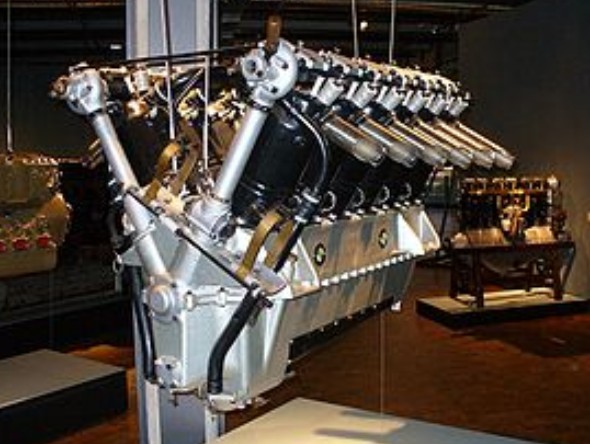
The first twelve-cylinder engine built by the Bayerische Motorenwerke AG, with a 60-degree included angle between the cylinder banks. The BMW VI was developed from the BMW IV by doubling the number of cylinders, through the additional cylinder bank. Series production commenced in 1926 after type approval had been granted. From 1930 on, after 1000 engines of the BMW VI type had already been delivered, Germany was again permitted to construct military aircraft. The sudden additional demand resulted in the production figures increasing rapidly. In 1933 the BMW VI was used for BMW’s first experiments with direct fuel injection.
The BMW VI was the chosen source of power for numerous record-breaking and long-distance flights, including an east-to-west crossing of the Atlantic in 1930 and a round-the world flight in 1932, both by Wolfgang von Gronau in an open Dornier Wal flying boat powered by two BMW VI engines.
The BMW VI was put to unusual use as a power unit for the “Rail Zeppelin” high-speed railcar. Many versions of the BMW VI engine were developed, and it was built under license in Japan and the Soviet Union. This was further evidence of the reliability of an engine with which BMW made a fundamental contribution to the build-up of German air transport. At least 9,200 were built between 1926 and 1938.
The engine was license-built in the Soviet Union under the supervision of Mikulin, who then further developed it as the M-17. More license built engines were produced by Kawasaki Heavy Industries in Japan as the Kawasaki Ha-9.
Applications: Albatros L 77 Arado Ar 64 Arado Ar 65 Arado Ar 68 Arado SSD I Dornier Do 10 Dornier Do 17 Focke-Wulf Fw 42 Heinkel He 45 Heinkel He 51 Heinkel He 59 Heinkel He 60 Heinkel He 70 Kawasaki Type 92 Tupolev TB-3 Mikulin M-17
BMW VI Type: V-12 Bore: 160 mm (6.3 in) Stroke: 190 mm (7.48 in) Displacement: 45.84 L (2,797.5 cuin) Length: 1810 mm (71.26 in) Width: 859 mm (33.82 in) Height: 1103 mm (43.43 in) Dry weight: 510 kg (1124 lb) Fuel system: 2 x Zenith 60 DCL Fuel type: min. 87 octane gasoline Cooling system: Liquid-cooled Power output: 650 HP 641 hp Compression ratio: 5.50