BOK / Bureau of Special Constructions BOK-5 / TsKB-13

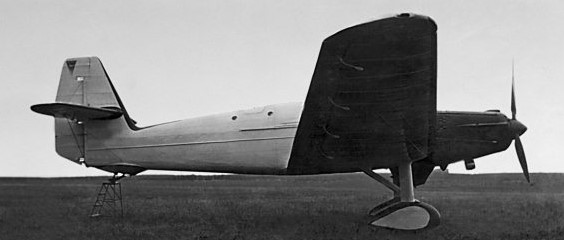
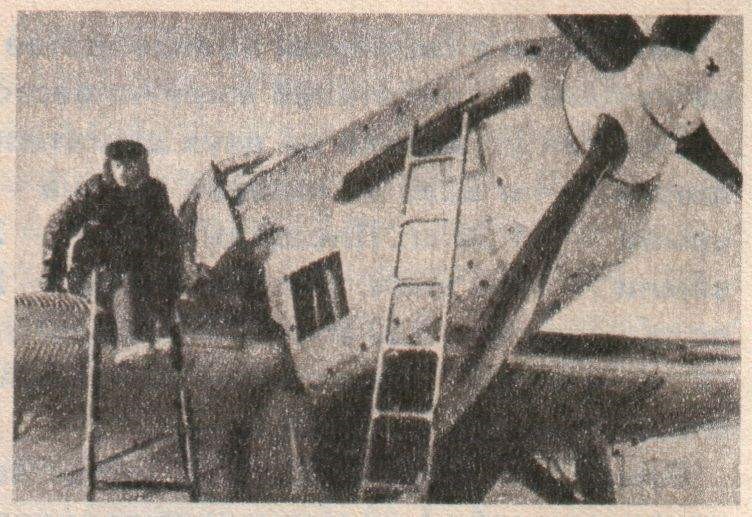
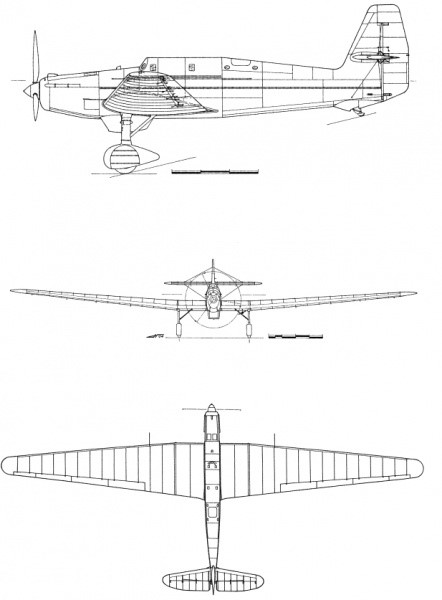
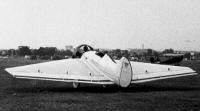
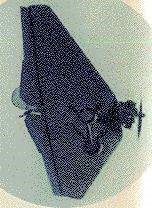
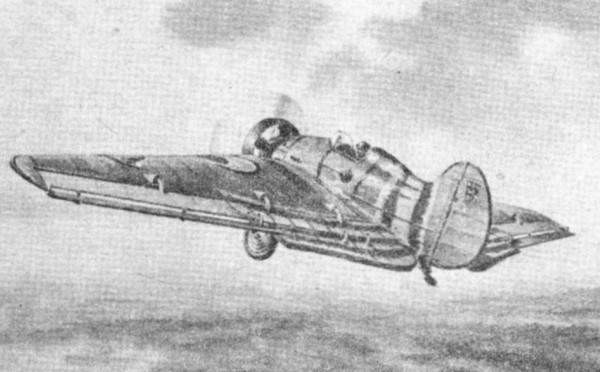
The BOK-5 or TsKB-13 (Russian: БОК-5 or ЦКБ-13) was designed by VA Chizhevski based on the Cheranovski BICH-7A of 1932. His initial idea was to develop a small single-engine aircraft with a flying wing scheme capable of improving the flight characteristics of the Cheranovski models. At the same time, this development would serve as a test bed for the conception of a twin-engine bomber with a similar scheme propelled by two M-34s.

The BOK-5 was conceived as a low-wing monoplane with the vertical empennage located in the fuselage and propulsion propeller. Only in these features did it resemble the Cheranovski BICh-7A. The construction of the BOK-5 was fully metal with fabric coating. The entire fuselage, with an oval section, was built in aluminum and had a semi-monocoque structure.

The fuselage structure was made up of duralumin frames linked by cockpits. The first frame was conveniently reinforced to fix the engine support bench and behind it was located the fuel tank. The entire fuselage was covered with duralumin sheets.

In its central part was the cockpit with a front windshield. Just behind the cockpit was the empennage that ended in a spar to which the rudder was attached. In the lower part the tail skate was fixed.

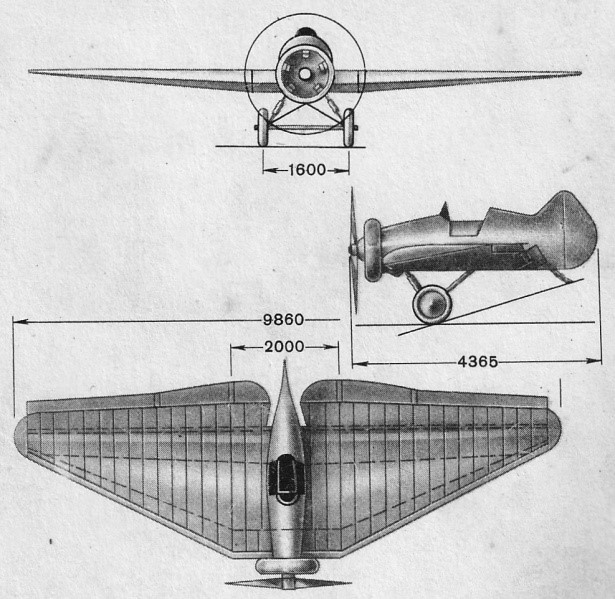
The BOK-5 wing had a trapezoidal and non-parabolic shape, with a 28º wing loosening at the leading edge and a straight trailing edge.

A distinctive feature of Chizhevski’s design was the conception of a wing with a relative thickness in the lower centroplane of only 15% and 13% towards the ends. The flight experience of the Cheranovski BICh-14 showed that the relative thickness of 22% generated a disruption of the airflow that was reflected in a worsening of the effectiveness of the rudder at low flight speeds.
To be able to make the landing, it was necessary to make the descent with great angles of the elevons and elevator rudders, which resulted in an increase in the landing speed.

The double spar wings featured TsAGI-890 profile. The centroplane was integrated into the fuselage. The wing spars cut through the fuselage. The bases of these stringers were made of steel tubes and the walls of duralumin slats. A third auxiliary spar made of duralumin but with a rectangular section was located in the tail section, at the fixing height of the wing movable elements.

Each wing console featured 6 reinforced ribs, constructed of duralumin tubing. Steel stringers were located between these ribs and the spars to reinforce the wing structure. In addition to the 6 reinforced ribs, the wing had 24 normal ribs. The wing and control surfaces were covered with fabric. The central part of the wing, at its junction with the fuselage, had a 0.5 mm thick corrugated duralumin sheet coating.

Along the entire wing span, behind the second spar, there was a movable surface that acted as a stabilizer. The structure of this mobile section was made up of duralumin frames and longitudinal beams. The coating was made of 0.5 mm thick duralumin sheets. At the rear edge were the fixings for the control surfaces.

With the help of an attachment, located on the left wall of the cockpit, the pilot could set positions of these surfaces in the range of -5º to + 3º, which allowed regulating the balance of the aircraft and therefore the force to be applied. at the controls. Ailerons and elevator rudders were attached to these surfaces. In the BOK-5 the aileron functions were performed only by the external surfaces. Pulling the joystick activated the ailerons and elevator in unison. Chizhevski concluded that by shifting the aircraft’s center of gravity back and using this control system he could achieve excellent stability, both in the longitudinal and lateral axis.
The control of the moving part of the wing, the elevator, the ailerons and the rudder were operated by cables. The tail skid was steerable and operated according to the direction of the rudder.

The BOK-5 was powered by an M-11 radial engine with the piston heads covered by an annular bonnet to decrease aerodynamic drag.
The landing gear was fixed, of the conventional type with tail skid. The main landers featured rubber shock absorbers. Attachments from a Po-2 Polikarpov were used in the construction of the landing gear. The wheels had dimensions 100 x 700 mm.

The structure of the plane was calculated to withstand 8 g, so the BOK-5 was capable of aerobatics.

The BOK-5 was painted in the colours of the “Firebird” (Zhar-ptitsa): a combination of green, red and blue bands. The annular bonnet was painted silver, the propeller red, the engine cylinders and the landers black. The triangular BOK logo was located on the empennage, also painted with stripes.

The construction work of the BOK-5 began in 1934 and Chizhevski used all the experience gained during the flights of the Cheranovski models. Construction was carried out at Factory No.35 in Smolensk.

The factory tests were carried out in 1937 in conjunction with the state tests in the NII VVS. At the beginning they were declared unsatisfactory. During takeoff, the aircraft had a marked tendency to deviate to one side, preventing takeoff. This problem was quickly solved by modifying the tail skid to an adjustable configuration. After this modification, the aircraft was returned for testing.

In September 1937 the test pilot of the NII VVS I. Petrov made the first flight. The BOK-5 was also flown by pilots P. Fedrovi, P. Stefanovski, M. Nyuxtikov in a total of 65 flights with a total duration of 20 hours and 42 minutes. They all concluded that this model behaved positively in all flight regimes, did not have a tendency to slow down and its handling did not differ much from other traditional aircraft. The BOK-5 was considered in the report to be affordable to low- and mid-time pilots.

The negative aspect reflected the desire of the pilots to increase the effectiveness of the rudder and achieve a better amortization system for the landing gear.

Initially, there was a strong engine vibration which prevented the tests from being carried out effectively, but this problem was soon solved.

In 1938 Chizhevski presented the military with an improved version of the BOK-5. This version had somewhat larger dimensions and a certain angle of inclination of the fuselage during takeoff operations.

The surface of the ailerons was decreased to achieve better control coordination and the surface of the rudder, on the contrary, was increased. As a result of the modifications, the weight of the aircraft increased by 32 kg.

In August 1938, during the aerial demonstration in Túshino, the BOK-5 made three flights.

The subsequent state assessments on the NII VVS were rated as successful. The report concluded:
“ The BOK-5 tailless plane is easy to pilot, presents good stability and maneuverability at speeds up to 150 km / h and allows the execution of high-school piloting figures. “
The evaluation of the characteristics of the BOK-5 during the piloting maneuvers is described in the memoirs of P. Stefanovski, who was very impressed by the results obtained during the first flight of execution tests of these figures.

After completing the tests in September 1938, the management of the NII VVS recommended to the Narkomat of the Defense Industry requesting Chizhevski to develop the BOK-6 twin – engine bomber with the same conceptual scheme. The development of this model was stopped due to the arrest of Chizhevski in early 1939 under the accusation of “enemy of the people.” After this all work on the BOK-5 was suspended.

БОК-5
Engine: 1 x М-11 100 hp
Wingspan: 9.86 m
Wing area: 23.15 m²
Length: 4.37 m
Height: 2.00 m
Elevator and aileron surface area: 4.3 m²
Empty weight: 596 kg
Normal takeoff weight: 764 kg
Wing loading: 33 kg / m²
Power load: 7.6kg / hp
Fuel capacity: 90 kg
Payload: 168 kg
Maximum speed at sea level: 155 km / h
Maximum speed at altitude: 174 km / h
Landing speed: 85 km / h
ROC: 2 m / s
Range: 600 km
Ceiling: 4850 m
Endurance: 4 hours
Take-off run: 120 m
Landing run: 200 m
Seats: 1
BOK / Bureau of Special Constructions BOK-3 / Executive Airplane / IS / TsKB-9

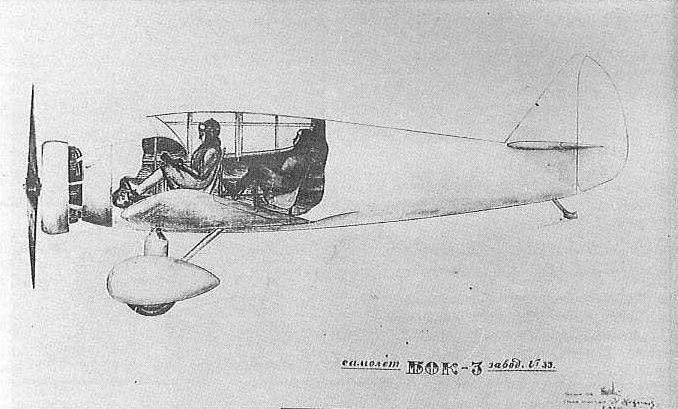
The development of the Executive Airplane or IS (Russian: Исполкомовскый Самолет “- ИС), designated BOK-3 by BOK (Russian: БОК-3, ИС or ЦКБ-9), began in 1933 at the TsKB of Factory No.39 Menzhinski, which is why it was also known as TsKB-9. The works were transferred to the BOK’s new location at Factory No.35 located in Smolensk.

The conceptual drawings of the original version of the model are preserved, signed by II Tsiebrikov, at that time a recent graduate who was already directing the general types section of the BOK.

Original BOK-3 design with inverted-angle cockpit glazing.

The prototype completed in Smolensk in 1936 basically differed from the original concept design in the shape of the cockpit cover. The original angled front led to a more streamlined and modern shape. Other differences were the bracing of the tail planes in the produced model with their transfer to a higher position on the empennage and the absence of a fairing on the landing gear. The rudder and tail skid were also modified.

The BOK-3 was designed as an all-wood cantilever low-wing monoplane. As a remarkable detail, the wingtips were folded to reduce the area during transport or parking in hangars.

The fuselage had a monocoque structure. Both the wing and the tail were made of wood with a textile coating. The ailerons and the empennage featured a fabric-covered duralumin frame. The tailplane sat high on the empennage and was braced by inverted V posts.

The landing gear was of the conventional type with fixed and tail skid.

The BOK-3 was designed to use an M-48 radial engine protected by a Townend ring. This engine was also installed in the U-3 experimental aircraft and only a few units were built.

The BOK-3 was designed for short-distance shuttle service, but other possibilities of use such as pilot training and agricultural tasks were possible. The training version provided for the installation of double flight control and a PV-1 machine gun firing through the propeller shaft, another machine gun in a rear defensive position, a camera for aerial photography and the ability to install supports for a general capacity of 100 kg.

In agricultural versions the BOK-3 could have a chemical spraying system installed.

Only one prototype was built and successfully flown in 1936 but the development of the BOK-3 was abandoned.

Powerplant: 1 x М-48 piston engine
Wingspan: 11.00 m
Length: 7.10 m
Fuel capacity: 190 liters
Endurance: 3 hours
Accommodation: 2

BOK / Bureau of Special Constructions BOK-2 / TsKB-5 / RK              

The BOK-2 (RK or TsKB-5) (Russian: БОК-2, РК or ЦКБ-5) was one of the three BOK designs not related to stratospheric flight and was characterized by the implementation of a high lift sectional wing design and hence it was known as RK – Razreznoe Krylo or Section Wing (No. confuse with the RK – Razdivizshnoye Krylo of Pashayev).

Designed by S. Krichevski the BOK-2 was conceived as an experimental type single-seater cantilever-wing monoplane with an M-11 engine. The distinctive feature of this aircraft was the long, sectioned wing with a special profile. The airplane was conceived to fly with different positions of the section. Each movement of the rudder and flaps caused a variation of the wing profile, so the pilot had the possibility to adjust the wing to the most practical regime for the real flight conditions.

The development of the BOK-2 brought with it a large amount of studies and tests in the wind tunnel with the aim of studying the wing aerodynamics in the different configurations.

A single example was built at the TsKB of Factory No.39 Menzhinski, as the TsKB-5. Its construction was very clean equipped with an M-11 engine. The plywood overlay was polished to a smooth, shiny surface.

The BOK-2 was tested between 1935 and 1936, being flown successfully. The development of the model was interrupted by the death of its designer.

BOK / Bureau of Special Constructions BOK-1 / TsKB-2

The project of the “stratospheric” aircraft (as they were commonly called at that time) SS or BOK-1 was conceived using as a base the long-range monoplane ANT-25 developed by the Sujoi brigade in the collective led by AN Tupolev. Basically the BOK-1 was an ANT-25 with reduced wingspan and fixed landing gear fairing and was the first work of the Bureau of Special Constructions (BOK) under the leadership of Chizhevski.

BOK-1 or SS (acronym for Stratospheric Plane from Russian Стратосферный Самолет) was a 1935 experimental aircraft designed to test flight capability at heights between 12000 and 13000 meters.

A single prototype was built which was successfully flown and the first pressurized cockpit manufactured in the USSR was testad.

Construction of the BOK-1 was started at the TsAGI’s Experimental Construction Factory (ZOK) in late 1932. This factory had been created at the beginning of that same year, after the unification of the constructive capacities of the TsKB and the TsAGI.

In February 1933 the BOK was transferred to the TsKB of Factory No.39, under the direction of SV Ilyushin. The roughly 60 workers under Chizhevski’s leadership became Brigade No.3 and BOK-1 received the TsKB-2 designation. A short time later, in the summer of 1934 the group was again transferred, this time to Smolensk, to the base of Factory No. 35 dedicated to automotive repair and maintenance.

Despite the low qualification of the personnel and the lack of management cadres, Chizhevski managed to concentrate the group towards the main task and in this way the production of the BOK-1, begun in Moscow in 1932, could be completed three years later.

The BOK-1 was conceived entirely in metal. The wing consisted of the centroplane and removable three-spar consoles. The removable consoles have 16 ribs, the upper edge of which is exposed on the wing surface. The first two stringers of the consoles up to the middle of the span were made of steel tubes with a chromium-molybdenum alloy and from there up to the wing end were made of duralumin. The third stringer, to support less load, was built entirely of duralumin. The wing skin was corrugated metal, similar to that used on the ANT-25. During the tests, the corrugated surface of the wing surface was covered with glued calico, which was then polished and painted.

The fuselage was made up of three sections: bow, center (built integrally with the center plane) and tail. The front of the aircraft could be easily removed to allow the installation of different power plants. The central section was built in such a way that the pressurized cabin could be installed from above.

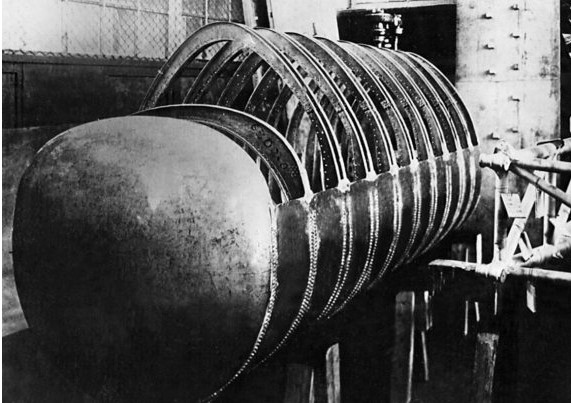
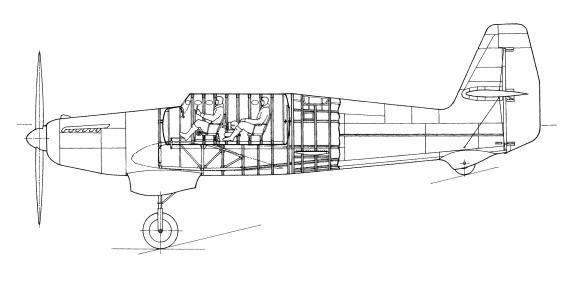
The pressurized cabin was calculated to accommodate two crew members and conceived as an independent element, not forming part of the aircraft’s structure. It was built in the shape of an oval cistern, made up of 11 metal frames and covered by a 2 mm sheet of duralumin. The pilots’ access was through a hatch similar to those used in submarines, located in the upper part of the center of the aircraft that gave access to a cylindrical area. There it was necessary to leave the parachutes and then go to the cockpit, which was accessed through another hermetic hatch located in the rear wall. Space was tight and the cabin uncomfortable.

Structure of the pressurized cabin used in the BOK-1

Felt layers were placed between the top of the cabin and the fuselage skin. This coating functioned as a thermal insulator for the cabin, while providing acoustic insulation, so that the crew could converse without the need for headphones.

The cabin was located above the water cooling radiator of the engine. In flight, the temperature in the cabin as a result of the heating received from below reached 40ºC. To regulate the heating there was a small hatch governed from the cabin.

To guarantee a certain degree of visibility, seven windows similar to the skylights of the boats were fitted. The pilot had five windows and the observer had two. Each window was double glazed. The 15-16mm outer glass was tempered. The interior was 3-4 mm thick and was constantly blown with hot air. Mechanisms were created inside the cabin to absorb carbon dioxide produced by respiration and inject fresh oxygen at a constant rate of 120 liters per hour. The two crew members had oxygen masks for emergencies.

The landing gear of the BOK-1 was of the fixed and conventional type, with oleo-pneumatic dampers and drop-shaped aerodynamic fairings on the main landings. The wheels had dimensions 900 x 200 mm.

Structural drawing of the BOK-1 clearly showing the location of the crew in the cockpit.

The BOK-1 in its original version used an AM-34RN engine designed by Mikulin, capable of developing 800 hp at a height of 4000 meters. This engine was later replaced by turbocharged versions. The cooling radiator was located at the bottom of the fuselage and featured adjustable gates. A little forward was the oil cooler. During the first flights, a 4.0-meter diameter four-bladed wooden propeller was used, which was later replaced by a 4.35-meter double-bladed propeller and finally by a 4.1-meter diameter metal one.

The total fuel capacity reached 500 kg and was distributed in 4 cylindrical tanks located between the first and second spars of the centroplane.

The BOK-1 was painted in a combination of two colours: red and silver. In the empennage it wore the triangular outline, symbol of the BOK.

The 13 of December of 1935 the IF test pilot Petrov and chief engineer for testing (and one of the developers of the model) NN Kashtanov, made the first flight in the BOK-1.

The BOK-1 “stratospheric” aircraft, equipped with an AM-43FRN engine with a three-bladed propeller, was the first Soviet aircraft to have a pressurized cabin. During the first flight it was found that at 9000 meters the pressure inside the cabin corresponded to a height of 2 – 3 km above the ground and the temperature oscillated around 25ºC.

The flight program was continued in 1936. IF Petrov was forced to constantly move from Moscow (where he worked at the NII VVS) to Smolensk for the development of these tests, so the decision was made to continue them with PM Stefanovski, who in the summer of 1936 moved to Smolensk on secondment.

During the tests the 25 of June of 1936 Stefanovski and Kashtanov reached a height of 10,875 meters flying. At this point, two problems were manifested: the exterior glass of the windows was completely fogged, impeding the vision and the wing ailerons were frozen, losing all effectiveness.

The BOK-1 was transferred to Moscow, to the NII VVS test airfield . The fight for the dominion of the heights entered a new stage. It was a question of the tests to determine the maximum ceiling. To this end, the plane was especially lightened. On Stefanovski’s first flight on the NII VVS a ceiling of 14,100 meters was reached.

In the fall of 1936 the BOK-1 flights on the NII VVS were canceled. The atmosphere was getting too cold. By that time, 42 flights had been made reaching speeds of 230 km / h at sea level and 242 km / h at 400 meters with a normal takeoff weight of 4162 kg.

The results obtained so far were recorded in the report presented by the head of the NII VVS Korobov on December 10, 1936. These results are summarized in the following:

  • The feasibility of using the pressurized cabin for high-altitude aircraft was verified.
  • The design of the selected cabin was shown to be functionally correct, so that it was possible to go from experimental construction to the development of specific objectives.
  • The BOK-1 experimental aircraft proved to be an excellent research device that could be used as a flying bed for future experimental developments of pressurized cabins, equipment and weapons tests in the conditions of the stratosphere.
  • The tasks to be solved in the short term were:
    BOK-1 flight ceiling increase
    Fixing the problem with glass hatches
    Improved visibility
    Weapons installation and testing
    Creation of defensive firing points operable from the watertight cockpit
    Armor of the cabin to prevent its de-sealing due to the impact of projectiles.

As conclusions, the Narkomat of the Defense Industry was asked to create military aircraft with a hermetically sealed cabin, improve the working conditions of the BOK, develop the BOK-7 version in a military version as a high-altitude bomber and force preparation in the TsIAM of the AM-34TN turbocharged engine to locate in the BOK-1.

On December 22, the report was signed by the head of the VVS Ya. I. Alksnis, who requested to raise the ceiling to 20 thousand meters.

The new AM-34RNB-TK engine was installed in the BOK-1 in the spring of 1937. After the ground set-up tests, the test flights were continued. In the period between June 6 and October 1, the new engine worked for 5 hours 40 minutes on the ground and 24 hours 1 minute in the air.

The 27 of August of 1937 Stefanovski, with Reno as an observer, reached a ceiling of 14100 m before the turbocharger is damaged. Repairs continued until February 1939. In April 1939, a new AM-34FRNV engine with TK-1 turbocharger was installed in the BOK-1, with which several flights were made without exceeding 14,000 meters.

In the second half of the 1930s, the BOK-7, BOK-8 and BOK-11 models were created on the basis of the BOK-1, in which the concept of a pressurized cabin and the use of turbochargers were developed. Some of these models were designed with remotely controlled weaponry, which was a major technological achievement.

The BOK-1 development versions include:

BOK-7 – Originally conceived as a stratospheric reconnaissance aircraft, it ended up being developed as a record-setting aircraft. It began to be projected in 1935 as a development of the OKO-1. It was used on the ground for crew training for the BOK-15.
BOK-8 – Conceived as an armed development of the BOK-7 (the second copy). It was not built, but it became the BOK-11.
BOK-10. Exploration version project on the BOK-7. High altitude bomber developed on the BOK-7. It was used on the ground for crew training for the BOK-15.
BOK-12. Project for a twin – engine version of the BOK-7 conceived as an experimental flying laboratory. A large aperture camera for exploration was planned to be installed in the BOK-12 fuselage. It was never realized.
BOK-13. High altitude passenger plane project with capacity for 6 people developed on the basis of the BOK-7.
BOK-15. A powerful stratospheric plane conceived in 1937 to set a new world record for flight distance. Two copies were built in 1939. The start of the Great Patriotic War brought about the cancellation of flights.

Retired in 1939, the BOK-1 served as the basis for a series of experimental developments.

BOK-1
Engine: 1 x Mikulin AМ-34RN 830 hp
Wingspan: 30.00 m
Wing area: 78.80 m²
Length: 12.86 m
Height: 5.50 m
Wheelbase: 5.19 m
Empty weight: 3481 kg
Normal takeoff weight: 4600 kg
Maximum takeoff weight: 4880 kg
Maximum speed SL: 240 km / h
Maximum speed at 9000 m: 315 km / h
ROC: 500 m / min
Landing speed: 85 km / h
Practical ceiling: 12000 m
Maximum ceiling (lightened): 14,100 m
Seats: 2

BOK / Bureau of Special Constructions / Bureau Osobykh Konstruktsii

Bureau Osobykh Konstruktsii – Russian: Бюро Особых Конструкций – БОК

The Bureau of constructions created in 1931 as an operating unit within the Central Aero-Hydrodynamic Institute (TsAGI) with VA Chizhevski as director. This group was mainly focused on the development of unusual and record-setting aircraft.

In December 1930, the need to create a special department or a construction bureau for the projection of these aircraft was discussed.

By order of the RevVoyenSoviet of the USSR of the 27 of January of 1931 it was created a new department within the structure of the TsAGI which became designated Bureau of Special Constructions (BOK). The 32-year-old engineer Vladimir Antonovich Chizhevski was appointed head of the new department. As Chizhevski’s assistants were selected NN Kashtanov, BI Karmanov, A. Ya. Lievin, II Tsiebrikov, VI Lapinski, VG Florov.

Among the BOK’s working directions were the projection of autogyros, the investigations of airplanes with canard surfaces (known in the USSR as the “utka” (duck)), airplanes without a tail or flying wings and in a special way the creation of airplanes for the realization of stratospheric flights. In this sense, the main directions of work were:
Studies of the aerodynamics of high altitude aircraft;
Creation of pressurized cabins for the crew;
Development of the controls and organs of direction of the cabin;
Development of instrumentation for the cockpit;
Creation of comfort conditions for the crew;
Creation of a power plant capable of working reliably in rarefied air conditions and temperatures down to -70ºC.

The first works of the BOK were linked to the creation of the stratospheric plane SS and the sealed gondola for the luggage of the “USSR” stratocrat.

The creation of the BOK practically coincided with the restructuring of the experimental building in the USSR. The 27 of August of 1931 the TsKB and TsAGI were merged into one organization which was named TsKB-TsAGI and controlled directly by the OGPU. ES Paufler was appointed by the control structure and SV Ilyushin as technical director.

For the BOK, this new structure resulted in a problem of territoriality that led to not a few conflicts, since the productive decisions were approved in two territories separated from each other in Moscow. For this reason, the preparation of the gondola for the “USSR” stratostat was developed from October 1931 at Factory No.39 Menzhinski, while the stratospheric plane began to be built at the end of 1932 at the newly created Factory of Experimental Constructions (ZOK) of the TsAGI.

In February 1933 the BOK was fully transferred to the TsKB on the territory of Factory No.39, where construction of the aircraft was continued. The group of workers led by Chizhevski became Brigade No.3 of the TsKB.

In the summer of 1934 again the BOK was forced to move. On this occasion Chizhevski’s group was transferred to Smolensk, to the base of Factory No.35, where finally and not without great difficulties, the SS could be finished.

In February 1938 the BOK was again transferred from Smolensk to the Moscow suburb of Podlipki, on the territory of KB-29. The Flight Experiment Station (LIS) KB-29 was dedicated to the development of flight tests and implementation of improvements in the VVS bomber fleet and was subordinated to the People’s Commissariat for the Military Industry.

With the BOK’s relocation to Podlipki, Chizhevski was appointed lead builder of the KB-29 and NN Kashtanov his replacement. At the same time in KB-29 the “Z” brigade led by the constructor VS Vaxmistrov was organized for the development of combined aircraft and the “D” brigade led by Privalov, dedicated to the study of transferring and launching loads from airplanes, with parachutes or without them.

In 1938 Podlipki continued the development of the BOK-7, BOK-11 and BOK-15 models. At the end of that year Chizhevski began the projection of a passenger variant based on the Ilyushin DB-3 bomber, equipped with a pressurized cabin. A short time later the NKAP proposed to use a Lisunov Li-2 (licensed version of the Douglas DC-3) for this purpose. Ultimately none of the variants came to be realized.

In February 1939 Chizhevski was arrested. Temporarily at the head of KB-29 was designated NN Kashtanov. In March 1939, as head of KB-29, PN Golubkov was appointed, who until then had served as director of Factory No.21. NN Kashtanov was appointed chief builder.

A short time later from Factory No.1 he was assigned to Podlipki A. Ya. Scherbakov, author of the pressurized cockpits for the Polikarpov I-15 and I-153 fighters. From that moment the KB-29 became the experimental organization for the projection and construction of airplanes with pressurized cabins.

In late 1939 the KB-29 was renamed NKAP Factory No. 289 under the leadership of PN Golubkov. The works related to the pressurized cabins were once again the subject of the BOK brigade.

In the first half of 1940, Pavel Osipovich Sukhoi’s group moved to Factory No. 289 to develop the I-135 (Su-1) fighter. At this time also Scherbakov modified glider SK-9 of Sergei Korolev to adapt him a liquid reagent RDA-150 engine, making the rocket plane RP-318-1.

In 1940, government decisions cut off various experimental development jobs. By decision of the substitute of the NKAP commissioner for experimental aviation AS Yakovlev, received by the director of Factory No. 289 Golubkov on June 4, 1940, the preparation work for long-haul flights with BOK-15 aircraft was cancelled.

As of June 5, all investigative work related to the pressurized cabins was suspended, with the exception of the covers for the cabins of the BOK-15 copies. The last job related to “special” topics at Factory No.289 was the preparation of the I-153GK fighter.

In 1941 the BOK was dissolved and its employees assigned to the OKB of Pavel Osipovich Sukhoi.

Among the fundamental works of the BOK between 1935 and 1939 we can highlight:
BOK-1. Construction completion and testing;
BOK-2 (TsKB-5). Small experimental aircraft built by S. Krichevski and equipped with an M-11 engine. The BOK-2 was a sectioned wing design and hence it was known as RK or Razreznoe Krylo. This design tested the high lift wing. The BOK-2 was tested between 1935 and 1936.
BOK-3 (TsKB-9). This aircraft began to be built as a passenger plane for short lines with the name IS. Its construction was completed in Smolensk, at the BOK-3 factory, with variations in the exterior shape in relation to the initial project and M-48 power plant.
BOK-4. The information on this tailless aircraft model is unknown for sure. It is said to have been built as a scale model of the Kalinin K-12 tailless aircraft, despite exhibiting little overall resemblance to it.
BOK-5 (TsKB-13). Light flying wing with M-11 powerplant developed by Chizhevski. The BOK-5 projection work began in 1934. A prototype was built which demonstrated excellent flying qualities during tests carried out in 1937 – 1938. Development of the BOK-5 was abandoned after Chizhevski’s arrest.
BOK-6. Twin-engine bomber project created using the flying wing formula tested on the BOK-5. The BOK-6 was conceived to use two M-34 radial engines and had to be armed by 6 ShKAS 7.62 mm machine guns and a load of 2000 kg of bombs. The development of this model was stopped due to the arrest of Chizhevski in early 1939.
BOK-7. Originally conceived as a stratospheric reconnaissance aircraft, it ended up being developed as a record-setting aircraft. It began to be projected in 1935 as a development of the BOK-1. It was used on the ground for crew training for the BOK-15.
BOK-8. Conceived as an armed development of the BOK-7 (the second copy). It did not occur.
BOK-10. Exploration version project on the BOK-7. It did not pass the project stage. With this name, a special fabric diving suit was also developed for high altitude flight. Work started in 1935
BOK-11. High altitude bomber developed on the BOK-7. It was used on the ground for crew training for the BOK-15.
BOK-12. Project for a twin – engine version of the BOK-7 conceived as an experimental flying laboratory. A large aperture camera for exploration was planned to be installed in the BOK-12 fuselage. It was never realized.
BOK-13. Project for a high altitude passenger plane with capacity for 6 people developed on the basis of the BOK-7.
BOK-15. A powerful stratospheric plane conceived in 1937 to set a new world record for flight distance. Two copies were built in 1939. The start of the Great Patriotic War prevented the flights from taking place.

KB-29 works from 1939 until its dissolution
Completion of two copies of BOK-15
Experimental modifications to two standard Ilyushin DB-3s with pressurized cabs
Development of pressurized cabins for the Polikarpov I-15 and I-16.
Modifications to the BOK-1.
New landing gear for the BOK-5.
Ski train for the BOK-7.
Armament installation in the BOK-11.
Design of a new wing for the BOK-15.
Development of the BOK-17 project based on the Ilyushin DB-3.

Bohemia B.5

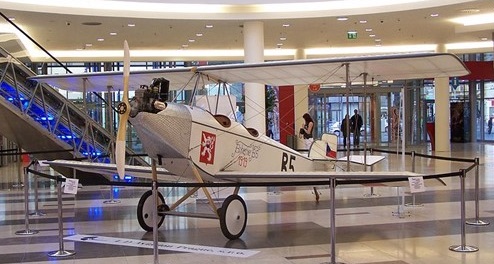
The Bohemia B.5 was a single engined, two seat, light sport aircraft designed and built in Czechoslovakia shortly after World War I.

The B.5 was the first aircraft designed and built in Czechoslovakia at the end of the First World War. Designed and constructed at the Bohemia Pilsen works the B.5 had one engine and two seats in separate, tandem open cockpits. The B.5 was a typical biplane sport/trainer aircraft of the period, with staggered upper and lower wings; the lower wing attaching directly to the lower fuselage between the two cockpits and the one piece upper wing supported on cabane and inter-plane struts.

The structure of the fuselage and wings was entirely conventional with fabric and/or plywood skinning and wooden structure. Conventional fin and tailplane were sited at the rear of the fuselage and were fitted with fin and elevators of generous area for yaw and pitch control. Roll control was effected by ailerons fitted to the upper wings only. The undercarriage consisted of bungee sprung main-wheels on a live axle supported by wire-braced struts and a sprung tail-skid at the extreme end of the fuselage.

Power was supplied by a Neue Automobil-Gesellschaft mbH NAG 4-cyl in-line piston engine, rated at 40 hp (30 kW), turning a two-blade wooden propeller counter-clockwise as viewed from the cockpit.

Colours and markings were simple with the fabric covering being left in its natural colour doped with a clear varnish. Large black letters across the span of the lower wing bottom surface spelt out BOHEMIA.

The prototype first flew from Pilsen aerodrome on 27 April 1919, but due to its lacklustre performance it was not a commercial success with few sales. The prototype B.5 crashed on Saturday, 17 May 1919, killing the student, Joseph Klíbr, and slightly injuring the instructor in the rear cockpit, Rudolf Polanecký. The remains of the B.5 were swiftly resurrected in just six weeks.

The B.5 kept flying until 1923 when it was owned by Chrudim J. Wiesner. By this time the NAG engine was completely worn out and unsafe. Wiesner and a test pilot from the Aero factory, Rudolf Valenta, converted the B.5 to a glider by removing the engine, modifying the front fuselage and replacing the wheeled undercarriage with skids. Results of attempts to fly the glider by Valenta Kbelská were mediocre due to the poor aerodynamic qualities and lack of a suitable launching area.

No complete B.5 exists today, but the fuselage is on display at the Prague Aviation Museum, Kbely.

Engine: Neue Automobil-Gesellschaft mbH NAG, 30 kW (40 hp)
Wingspan: 8.00 m (26 ft 3 in)
Length: 6.68 m (21 ft 11 in)
Wing area: 18.05 sq.m (194.3 sq.ft)
Height: 2.8 m (9 ft 3 in)
Empty weight: 340 kg (750 lb)
Gross weight: 520 kg (1,147 lb)
Maximum speed: 110 km/h (68 mph)
Service ceiling: 1,500 m (4,921 ft)
Range: 120 km (74 miles)
Endurance: ca 3 hours
Seats: 2

Boeing PB / XPB / 50

Boeing PB-1

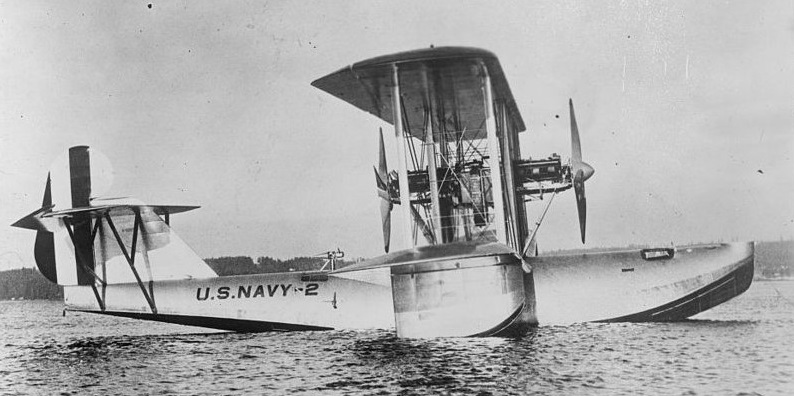
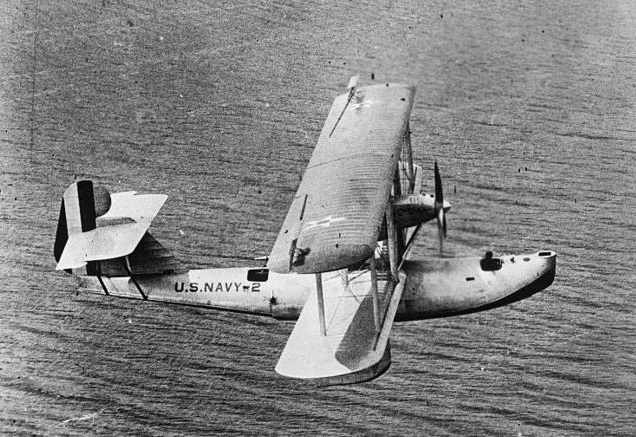
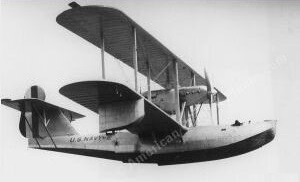
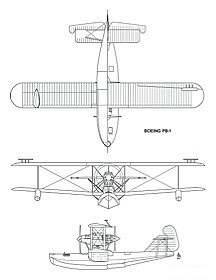
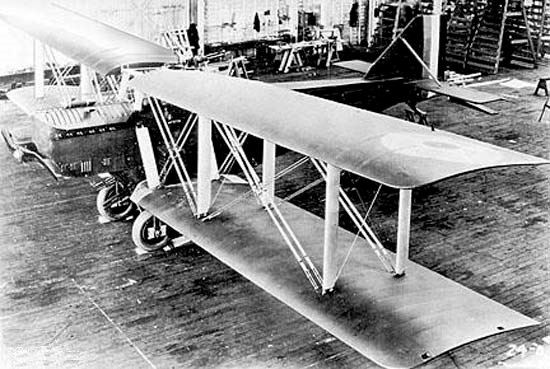
In September 1924, the Naval Aircraft Factory was tasked with designing a long-range twin-engined flying boat, capable of flying the 2,400 mi (3,860 km) between San Francisco and Hawaii. The initial design was carried out by Isaac Laddon, an employee of Consolidated Aircraft, and then passed to Boeing for detailed design and construction. The new flying boat, the Boeing Model 50, was a two-bay biplane of very streamlined design for flying boats of the time. The wings were of metal construction, with wooden wingtips and leading edges. The fuselage had a metal lower part, with the upper half made of laminated wooden frames with a wood veneer covering. Two 800 hp (600 kW) Packard 2A-2500 V12 engines driving four-bladed propellers were mounted in tandem between the wings above the fuselage.

The Boeing Model 50, designated PB-1 by the US Navy, made its maiden flight in August 1925 as A6881. It was intended to use it to lead a pair of Naval Aircraft Factory PN-9s in an attempt to fly to Hawaii on 31 August 1925, but engine trouble led to its participation in the flight being cancelled.

PB-1

In 1928, the aircraft was modified by the Naval Aircraft Factory, its Packard engines were replaced by two 500 hp (370 kW) geared Pratt & Whitney R-1690 Hornet radial engines, leading to the new designation PB-2.

Although the aircraft was a prototype the U. S. Navy did not distinguish between experimental and operational aircraft at that time so the aircraft was never designated XPB-1 or XPB-2.

XPB-1
Engines: 2 × Packard 2A-2500, 800 hp (600 kW) each
Length: 59 ft 4.5 in (18.098 m)
Wingspan: 87 ft 6 in (26.67 m)
Wing area: 1,801 sq ft (167.3 m2)
Airfoil: Clark Y
Height: 20 ft 10 in (6.35 m)
Empty weight: 11,551 lb (5,239 kg)
Gross weight: 26,882 lb (12,193 kg)
Maximum speed: 97 kn; 180 km/h (112 mph)
Cruise speed: 82 kn; 151 km/h (94 mph)
Service ceiling: 9,000 ft (2,700 m)
Range: 2,172 nmi; 4,023 km (2,500 mi)
Rate of climb: 4,000 ft/min (20 m/s)
Armament: none fitted
Crew: 5

Boeing GA-2

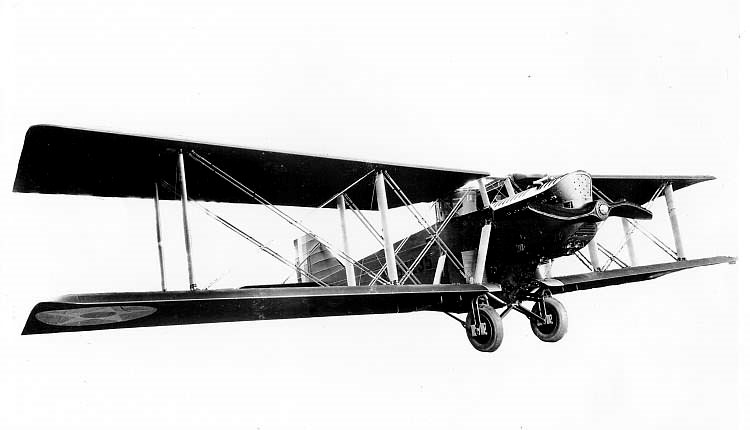
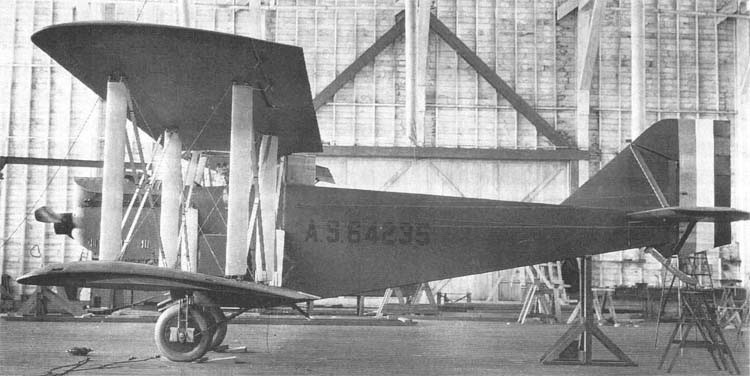
After the failure with the construction of GA-1 (and it was considered the refusal of the military to purchase a large series), Boeing decided to change the design of its attack aircraft while preserving the concept itself. The next model that received the designation GA-2 was already a single-engine armoured biplane that was also tested on the basis at McCook Airbase.

The GA-2 was initially seen as a prototype for a new three-engine attack aircraft with 700 hp engines, but as a result, the military ministry ordered two prototypes. The reservation remained approximately identical to GA-1, but due to the reduction of the crew and the number of engines, the mass of it decreased. The weapons were also changed, the gun remained in the same place, and two machine guns were placed in the turret instead of the turrets in front of the nacelle.

Both aircraft were left at the McCook airbase where they flew until 1926.

GA-2
Engine: Engineering Division W-18, 750 hp
Wing span: 16.47 m
Length: 11.25 m
Height: 3.60 m
Wing area: 258.00 sq.m
Empty weight: 2934 kg
Normal take-off weight: 3941kg
Maximum speed: 206 km / h
Cruising speed: 182 km / h
Range: 364 km
Maximum climb rate: 220 m / min
Ceiling: 3505 m
Crew: 3
Armament: one 37-mm Baldwin cannon, 6×7.62 mm Browning machine guns

Boeing 6 / B-1    

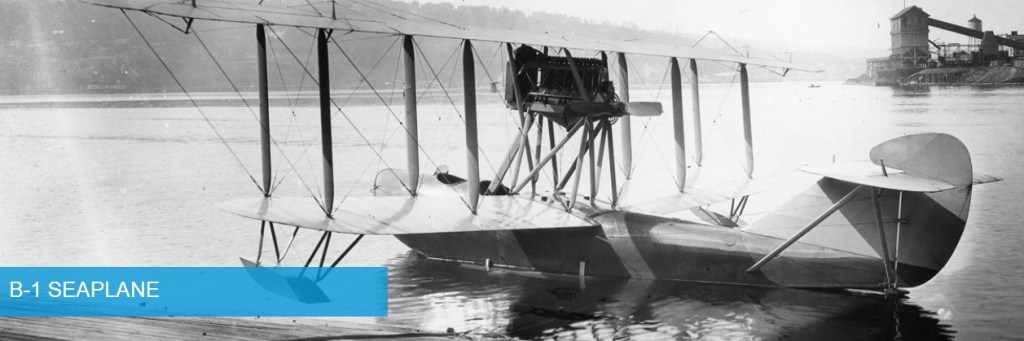
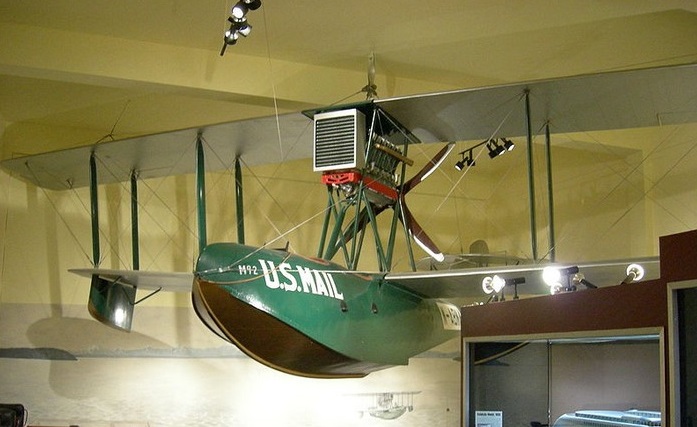
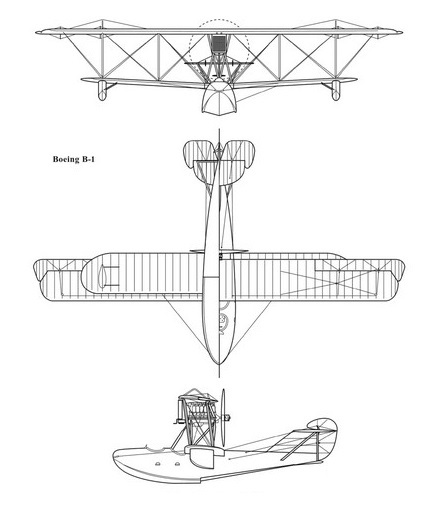
The Boeing Model 6, also known as the B-1 was a small biplane flying boat designed by William Boeing shortly after World War I. The Model 6 was the first commercial design for Boeing (as opposed to military or experimental designs), hence the B-1 designation. Its layout was conventional for its day, with a Hall-Scott engine driving a pusher propeller mounted amongst the cabane struts. The pilot sat in an open cockpit at the bow, and up to two passengers could be carried in a second open cockpit behind the first. The hull was laminated wood veneer, and the wing frames were spruce and plywood. The design was reminiscent of the Curtiss HS-2L that Boeing had been building under license during the war.

Only a single aircraft was built, first flying on 27 December 1919, as Boeing had trouble selling it in a market flooded with war-surplus aircraft. In 1920, it was purchased by Edward Hubbard, who used it to carry air mail between Seattle, Washington and Victoria, British Columbia. Air mail service began on 27 December 1919, and continued for eight years. The B-1 mail flights took off from Lake Union in Seattle. It outlasted six engines in eight years of international airmail runs between Seattle, Wash., and Victoria, British Columbia. Flown by Eddie Hubbard, the B-1 covered 350,000 miles (563,000 kilometers).

The plane flew until 1930 before being preserved and put on display at Seattle’s Museum of History and Industry in 1954.

Model 6 on display at the Museum of History and Industry in Seattle

Engine: 1 × Hall-Scott L-6, 200 hp (149 kW) 6 or 400-hp Liberty
Prop: 4 blade wooden fixed pitch
Wingspan: 50 ft 3 in (15.32 m)
Wing area: 492 sq.ft (45.7 sq.m)
Length: 31 ft 3 in (9.53 m)
Height: 13 ft 4 in (4.06 m)
Empty weight: 2,400 lb (1,089 kg)
Gross weight: 3,850 lb (1,746 kg)
Maximum speed: 90 mph (145 km/h)
Cruise speed: 80 mph (128 km/h)
Range: 400 miles (640 km)
Service ceiling: 13,300 ft (4,050 m)
Crew: one pilot
Capacity: 2 passengers

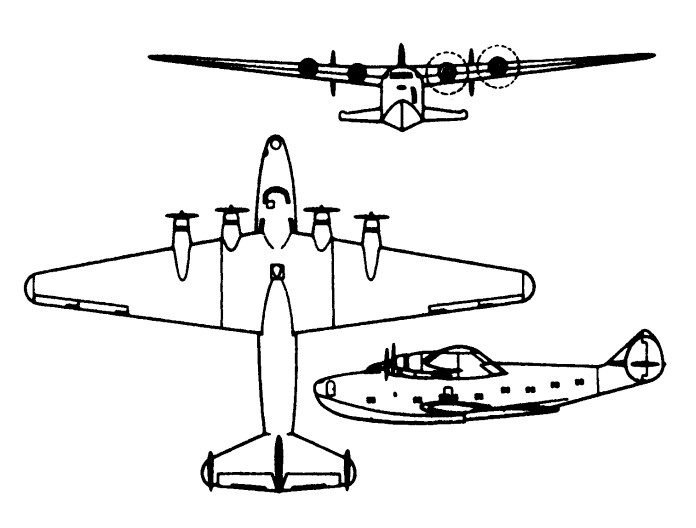
Boeing 314 / C-98

As early as January 1935, Pan American Airways had signified to the US Bureau of Air Commerce its wish to establish a transatlantic service and, the airline wanted a new aircraft for the route.

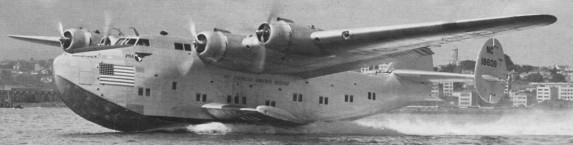
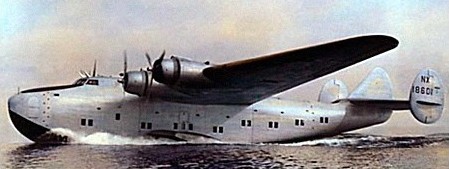
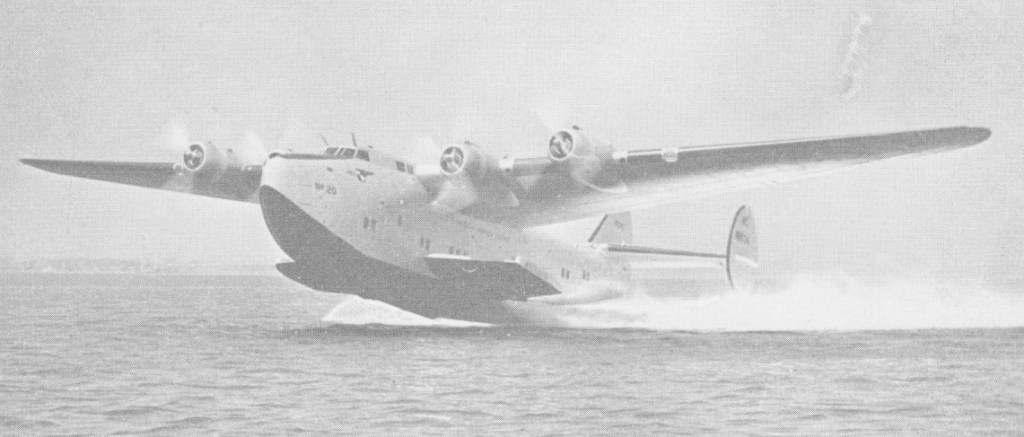
Boeing submitted a successful tender to the Pan American specification and a contract for six Boeing Model 314 flying-boats was signed on 21 July 1936. They used features of the XB-15 heavy bomber, adapting the wing and horizontal tail surfaces for its 37421kg gross weight flying-boat, which could accommodate a crew of 8 and up to 74 passengers in four separate cabins. The engines 1119kW Wright GR-2600 Double Cyclones which gave the machine a maximum speed of 311km/h. The fuel capacity of 15898 litres giving a maximum range of 5633km. Some of the fuel was stored in the stabilising sponsons, which also served as loading platforms.
The first Boeing 314 made its maiden flight on 7 June 1939, this original version having a single fin and rudder, later replaced by twin tail surfaces to improve directional stability. These proved to be inadequate, and the original centreline fin was restored, without a movable rudder.

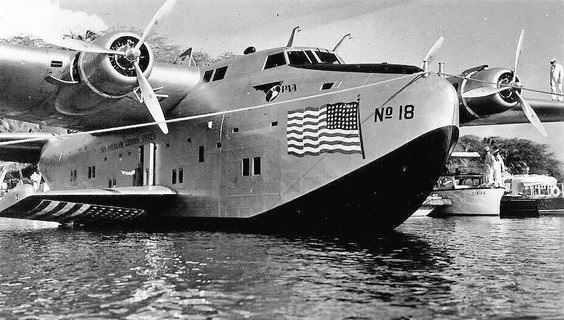
The aircraft was awarded Approved Type Certificate No. 704 and entered transatlantic airmail service on 20 May 1939. PAA Boeing 314 ‘Yankee Clipper’ flew by way of the Azores to Spain and then on to Southampton. On June 17 ‘Atlantic Clipper’ made first passenger crossing, carrying reporters and airline officials. Regular passenger service commenced on 28 June 1939, when ‘Dixie Clipper’ carried twenty-two paying passengers. One passenger having booked his seat in 1931. At that time the Model 314 was the largest production airliner in regular passenger service.

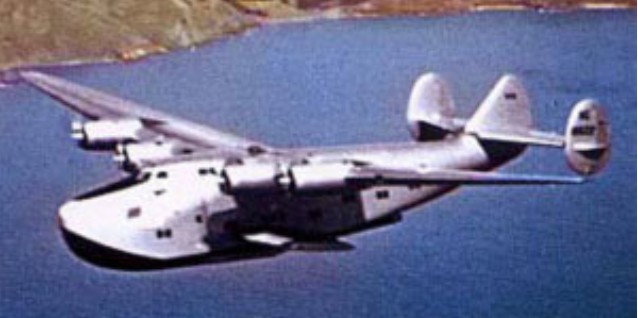
Known as “California Clippers” they operated over the South Pacific Ocean routes for Pan American Airlines. One such “California Clipper” flew from Los Angeles Harbor to Auckland, New Zealand, an 8,000-mile, 50-hour route with night layovers at Honolulu, Canton Island, and Noumea, New Caledonia. On two decks—an upper or control deck and a passenger deck—there were accommodations for a crew of 11 and 68 passengers or 36 sleeping passengers. The passenger deck was divided into nine sections, including a lounge, six separate passenger compartments, a specially furnished deluxe compartment, a galley and restrooms.

Clippers were in service with distinguishable names from 1939 through 1951 and were represented as the Honolulu Clipper, Cape Town Clipper, Anzac Clipper, Pacific Clipper, American Clipper, Yankee Clipper, California Clipper and the Atlantic Clipper – all operated by Pan Am.

Pan American ordered another six aircraft which were designated Model 314A, improved by the installation of 1193kW Double Cyclones with larger-diameter propellers, and additional 4542 litres of fuel capacity, and a revised interior. The first Model 314A flew on 20 March 1941 and delivery was complete by 20 January 1942. Five of the original order were retrospectively converted to Model 314A standard in 1942. Three of the repeat order were sold, before delivery, to BOAC for transatlantic service and operation on the Foynes-Lagos sector of the wartime ‘Horseshoe Route’. The three Boeing 314As, G AGBZ Bristol, G AGCA Berwick, and G AGCB Bangor, with fuel capacity of 5,448 US gallons giving a range of over 3,600 miles, were acquired by the British Government and delivered new from Boeing’s Seattle factory specifically to provide the UK West Africa ‘lifeline’. The three Boeings commenced operation UK West Africa in May 1941. It transpired that a valuable, albeit irregular, trans Atlantic service was an incidental development due to the necessity for them to return to their Baltimore base for certain overhauls after every 120 hours flying, and Atlantic flights were therefore interpolated into the schedules to permit this to happen. BOAC operated its last B.314A on January 17, 1948.

Of Pan American’s nine Model 314/ 314As, four were requisitioned by Army Transport Command and given the military designation C-98. They were little used, however, and in November 1942 one was returned to the airline. The other three were transferred to the US Navy to join two acquired direct from Pan American; the airline provided crews for the US Navy’s B-314 operations and the aircraft were partially camouflaged but operated with civil registrations.

BOAC and Pan American terminated Boeing Model 314 services in 1946 and the surviving aircraft were sold to American charter airlines

Only 12 were ever built.

Gallery

Boeing 314 Clipper
Engines: 4 x Wright R-2600 Double Cyclone, 1,500 hp

Boeing 314A Clipper (C-98)
Engines: 4 x Wright R-2600 Cyclone 14, 1193kW, 1600 hp
Props: full-feathering constant-speed
Length: 32.31 m / 106 ft 0 in
Height: 8.41 m / 27 ft 7 in
Wingspan: 46.33 m / 152 ft 0 in
Wing area: 266.34 sq.m / 2866.86 sq ft
Maximum Take-Off Weight: 83,776lbs (38,000kg)
Empty Weight: 48,281lbs (21,900kg)
Fuel capacity: 5408 USG
Max. speed: 311 km/h / 193 mph
Cruise speed: 295 km/h / 183 mph
Maximum Range: 3,664miles (5,896km)
Ceiling: 4085 m / 13400 ft
Passengers: 74