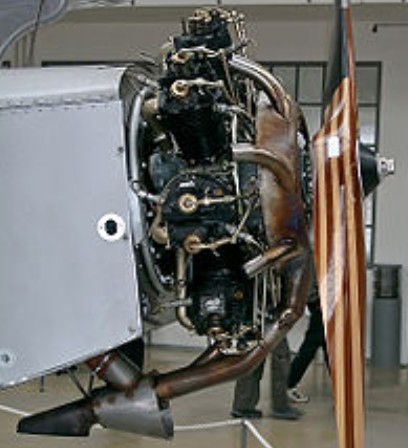
Bramo Sh.14 / Siemens-Halske 7 / Sh 14

The Siemens-Halske Sh 14 was a seven-cylinder air-cooled radial engine for aircraft produced in Germany in the 1920s and 30s. First run in 1928, it was rated at 93 kW (125 hp).
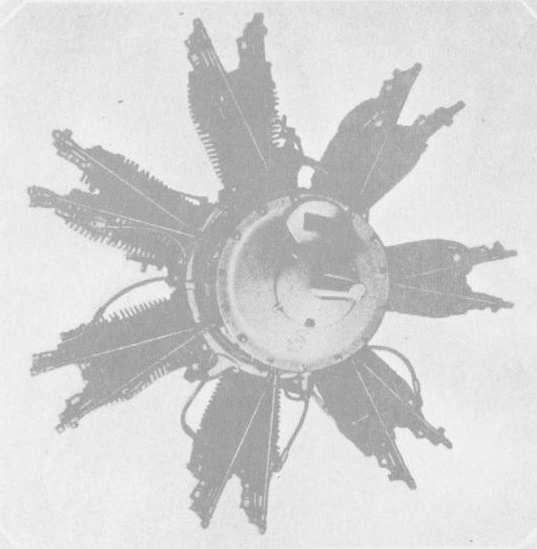
The Sh 14 is low pressure due to the engine being completely ball bearings. Cylinders are all of steel barrel with aluminium alloy ribs being cast on by special process, with aluminium alloy heads held down by six studs and are removable.

Intake pots are at the rear and exhaust ports on the side. The crankshaft assembly is composed of two major castings and front and rear cover plates all of aluminium alloy.

The crankshaft is a two piee single throw and all connecting rods are tubular. The master rod is on two ball bearings. The aluminium alloy pistons have two compression ringa and two oil rings in each. Both the exhaust and intake valves are tulip shaped.

Applications:
Albatros L 82
Ambrosini SAI.3
Ambrosini SAI.10
BFW M.23
BFW M.29
BFW M.35
Bücker Bü 133 Jungmeister
Flettner Fl 185
Flettner Fl 265
Flettner Fl 282
Focke-Wulf C.20
Focke-Wulf C.30 Heuschrecke
Focke-Wulf Fw 44
Focke-Wulf Fw 61
Heinkel He 72
LWD Szpak
LWD Zuch
Nuri Demirağ Nu D.38
RWD-17W
Rogozarski SIM-VIII
Rogozarski SIM-XI
SIM-II
VL Viima

Specifications:

Type: 7 cylinder air cooled radial
Dept Commerce Approved Type Certificate
Military Rating: 113 hp at 1720 rpm
Commercial Rating: 113 hp at 1720 rpm
Displacement: 443 cu.in
Compression ratio: 5.3
Bore: 4.133 in
Stroke: 4.724 in
Length: 32 in
Diameter: 39 1/4 in
Weight: 308 lb
Fuel consumption: not more than .52 lb/hp/hr
Oil consumption: not more than .027 lb/hp/hr
Lubrication: Dry sump, force feed, low pressure
Ignition: 2 Siemens or Scintilla magnetos
Carburation: 2 Sum or Special Low Sum Carburetor
Spark plugs: 2 per cylinder Siemens
Price: $2100

Sh 14A
Type: seven-cylinder air-cooled radial engine
Bore: 108mm (4.25 in)
Stroke: 120mm (4.72 in)
Displacement: 7.69 L (469.6 cu in)
Length: 975mm (38.39 in)
Diameter: 936mm (36.85 in)
Width: mm (in)
Height: 936mm (36.85 in)
Dry weight: 135 kg (297.6 lb)
Valvetrain: 1 inlet and 1 exhaust valve per cylinder
Fuel type: 80 octane
Cooling system: air
Power output: 160 hp at 2,200 RPM
Compression ratio: 6.0:1
Bramo 323 Fafnir / BMW 323 / Siemens Bramo 323 Fafnir 

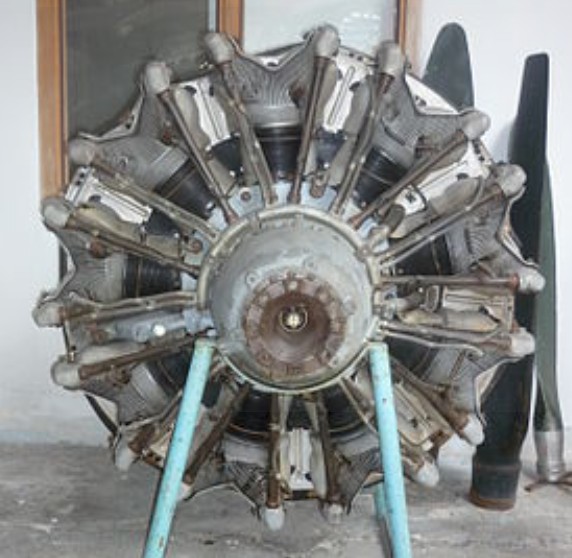
Development of the 323 was the end result of a series of modifications to the original Jupiter design, which Siemens licensed in 1929. The first modifications were to “Germanize” the dimensions, producing the Sh.20 and Sh.21. The design was then bored out to produce the 950 hp (708 kW) Sh.22 in 1930. Like the Jupiter, the 9-cylinder radial Sh.22 featured prominent valve pushrods on the front of the engine. In the mid-1930s the Reich Air Ministry (RLM) rationalized engine naming, and Bramo was given the 300-block of numbers, the Sh.14 and Sh.22 becoming the Bramo 314 and 322 respectively. The 322 never matured and remained unreliable.

The team continued work on the basic design, adding fuel injection and a new supercharger. The resulting 323 was just under 27 l in displacement, and produced 900 PS at 2,500 rpm for takeoff, improving slightly to 1,000 PS at 10,200 ft. The reduced power at sea level was inevitable for engines with one-speed mechanically driven superchargers when they were regulated to a constant maximum boost pressure below their critical altitude.

The Fafnir powered a number of German pre-war designs, including the Focke-Wulf Fw 200, Henschel Hs 126, Dornier Do 24 and Dornier Do 17, as well as the Focke Achgelis Fa 223 Drache helicopter. Its fairly poor fuel economy kept it from more widespread use, and most designs chose the similar BMW 132 instead, whose specific fuel consumption varied between 0.50 and 0.54 lb/(hp·h) depending on model, whereas the early versions of the Fafnir got about 0.57 lb/(hp·h), a poor figure for the era. The C/Ds, where the supercharger used less power, improved this to 0.51 lb/(hp·h), but were only useful at lower altitudes.

BMW bought Bramo in 1939 and continued production to supply the small number of designs that already used it, notably the Do 17. The naming at this point becomes somewhat confusing, with BMW, Bramo and Fafnir being used almost interchangeably. 5,500 were produced before the lines were shut down in 1944.

The original 323 design was produced in A and B models, differing in the direction they turned. The engines were intended to be installed in A/B pairs, thereby eliminating engine torque across a twin-engine aircraft. The similar C and D models featured a lower supercharger gearing for better performance at lower altitudes, improving takeoff power to 1,000 PS, but reducing the critical altitude.

The final versions, P, R and T, featured a two-speed supercharger for better all-round performance. This allowed it to generate 1,000 PS at sea level as in the C/D models, but improved altitude performance considerably, delivering 940 PS at 13,120 ft (4,570 m). The R-2 subtype added MW 50 water-methanol injection for added low-altitude performance, boosting power to 1,200 PS at 2,600 rpm. Approximately 5500 were built in total.

Applications:
Arado Ar 196
Arado Ar 232
Dornier Do 17
Dornier Do 24
Focke Achgelis Fa 223
Focke-Wulf Fw 200
Henschel Hs 126
Junkers Ju 252
Junkers Ju 352

Specifications:

BMW 323A
Type: 9-cylinder supercharged air-cooled radial engine
Bore: 154 mm (6.06 in)
Stroke: 160 mm (6.30 in)
Displacement: 26.82 litres (1,636.8 in³)
Length: 1,420 mm (55.9 in)
Diameter: 1,388 mm (54.6 in)
Dry weight: 550 kg (1,210 lb)
Valvetrain: Pushrod-actuated overhead valve
Supercharger: Gear-driven
Fuel system: Fuel injection
Fuel type: 87 Octane petrol
Cooling system: Air-cooled
Power output:
670 kW (900 PS) at 2,500 rpm at sea level for take-off
745 kW (1,000 PS) at 3,100 m (10,200 ft)
Specific power: 27.8 kW/L (0.61 hp/in³)
Compression ratio: 6.4:1
Specific fuel consumption: 0.348 kg/(kW·h) (0.572 lb/(hp·h))
Power-to-weight ratio: 1.36 kW/kg (0.83 hp/lb)

Bramo 322 / Siemens-Halske Sh 22 / SAM 22

The Siemens-Halske Sh 22 (also known as SAM 22) was a nine-cylinder aircraft radial engine manufactured by Siemens & Halske in Germany in the 1930s. Following the reorganization of its manufacturer and change in military nomenclature, the engine became known as the Bramo 322.
It was a result of a series of modifications to the original Bristol Jupiter IV design, which Siemens licensed in 1929. The first modifications were to “Germanize” the dimensions, producing the Sh.20 and Sh.21. The design was then bored out to produce the 950 hp (708 kW) Sh.22 in 1930. Like the Jupiter, the Sh.22 featured a rather “old” looking arrangement with rather prominent valve pushrods on the front of the engine. In the mid-1930s the Reich Air Ministry (RLM) rationalized engine naming, and Bramo was given the 300-block of numbers, the Sh.14 and Sh.22 becoming the Bramo 314 and 322 respectively. The 322 never matured and remained unreliable. It became a base for the more successful Bramo 323.

Applications:
Dornier Do 19 (proposed)
Fieseler Fi 98
Heinkel He 46
Henschel Hs 122
Junkers W 34
Junkers Ju 86ab1 prototype

Specifications:

SAM 22B
Type: Nine-cylinder single-row supercharged air-cooled radial engine
Bore: 154 mm (6.06 in)
Stroke: 160 mm (6.3 in)
Displacement: 26.82 l (1,636.8 in³)
Length: 1,285 mm (50.59 in)
Diameter: 1,324 mm (52.13 in)
Dry weight: 465 kg (1,025 lb)
Valvetrain: Two overhead valves per cylinder
Supercharger: Single-speed centrifugal type supercharger
Fuel system: Carburetor
Fuel type: 80 octane rating gasoline
Cooling system: Air-cooled
Reduction gear: Farman epicyclic gearing, 1.6:1
Power output: 442 kW (592 hp) at 2,100 rpm for takeoff
Specific power: 16.49 kW/l (0.36 hp/in³)
Compression ratio: 5.2:1
Power-to-weight ratio: 0.95 kW/kg (0.58 hp/lb)

Bramlingham Gliding Club 1934 Glider

A single seat glider was designed by two members (both aged 16) of the Bramlingham Gliding Club, near Luton, Bedfordshire, in 1934.

The 9.14m / 40 ft span wing was parasol mounted, with two bracing struts each side, from half span to the fuselage. This, and the small tail unit, were similar in appearance to the Abbott-Baynes Scud 2.

Bowlus Paper Wing SP-1

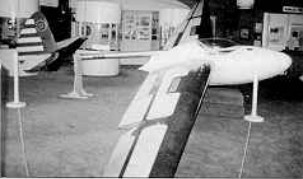
The wood and fabric Paper Wing, so called because it used paper webbed ribs, first flew in 1929. The wingspan was later increased to 14.33 m. / 47.0 ft principally by extending the ailerons. It was first U.S. built sailplane to fly for more than 1 hour. A replica of the Paper Wing belongs to the San Diego (CA) Museum of Flight.

Wing span: 13.4m / 44ft
Wing area: 16.63sq.m / 179sq.ft
Empty Weight: 73kg / 160lb
Payload: 66kg / 145lb
Gross Weight: 139kg / 305lb
Wing Load: 8.36kg/sq.m / 1.7lb/sq.ft
Aspect ratio: 11
Airfoil: 35-A
No. of Seats: 1
L/DMax: 20

Bowlus Super Albatross BS-100

A development of the Baby Albatross, the Super Albatross used the BT-100 Baby Albatross pod and tail, with the boom moved down. The wing is the outer section of the BT-100, mounted in a shoulder position. One belongs to the National Soaring museum.
The BS-100 was constructed with wood and fabric wings and tail, a wood pod, and metal tail boom.

Wing span: 13.72m / 45ft
Wing area: 11.61sq.m / 125sq.ft
Empty Weight: 197kg / 435lb
Payload: 95kg / 210lb
Gross Weight: 292kg / 645lb
Wing Load: 25.15kg/sq.m / 5.25lb/sq.ft
No. of Seats: 1
No. Built: 2
L/DMax: 29 @ 76 kph / 41 kt / 47 mph
MinSink: 0.76 m/s / 2.5 fps / 1.96
Aspect ratio: 15.7
Airfoil: Go 549 tip symmetrical

Bowlus Senior Albatross 1-S-2100

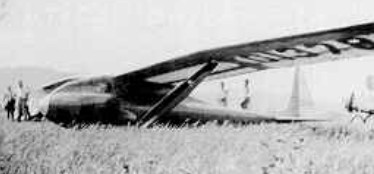
A development of the Bowlus Super Sailplane built by the Curtiss Wright Technical Institute in Glendale, CA in 1932, the senior Albatross had a slightly extended spar and gull wing. No two were completely alike, with flaps on at least one version. The design dominated the U.S. Nationals and held many U.S. records through the 1930’s. Senior Albatrosses were owned and/or flown by notables such as Warren Eaton, Richard du Pont and Chet Decker.
Examples belong to the Smithsonian Air & Space Museum and the National Soaring Museum.
The Senior Albatross has a wood monocoque fuselage, single strut braced wood D-tube wing, wood tail group, and is fabric covered

Wing span: 18.82m / 61.75ft
Wing area: 19sq.m / 204.75sq.ft
Empty Weight: 154kg / 340lb
Payload: 82kg / 180lb
Gross Weight: 236kg / 520lb
Wing Load: 12.42kg/sq.m / 2.54lb /sq.ft
Aspect ratio: 18.72
Airfoil: Go 549 root, symmetrical at tip
No. of Seats: 1
No. Built: 6
L/DMax: 22 @ 64 kph / 35 kt / 40 mph
MinSink: 0.59 m/s / 1.95 fps / 1.56 kt

Bowlus Baby Albatross BA-100

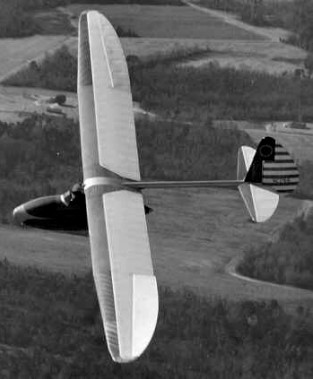
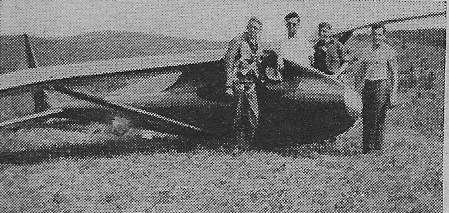
The Baby Albatross, first flown in 1937, was a production design by Hawley Bowlus for both kits and complete sailplanes. Bowlus produced kits until 1942, and in 1944 Laister-Kauffmann bought the rights but produced no aircraft before going out of business. The pod is a molded plywood unit, and no spoilers are provided, but some have been modified by owners. Many other modifications were carried out, including one Baby with a steel tube pod built by Schweizer. Many soaring notables had a Baby Bowlus as their first ship, including Dick Johnson, Dick Schreder and Joe Lincoln, and flights of more than 402 km / 250 miles have been made.

Bowlus Baby Albatross Article 1938

1938

One example belongs to the National Soaring Museum.
The Vintage Sailplane Association has plans and the Baby Albatross is Air Transport Certifie

Wing span: 13.56 m / 44.5ft
Wing area: 13.93sq.m /150sq.ft
Empty Weight: 136kg /300lb
Payload: 93kg /205lb
Gross Weight: 229kg /505lb
Wing Load: 16.44kg/sq.m/ 3.3lb/sq.ft
MinSink: 0.69 m/s / 2.25 fps
L/DMax: 20
Aspect ratio: 13.2
Airfoil: Go 535 (mod)
No. of Seats: 1

No. Built: 156