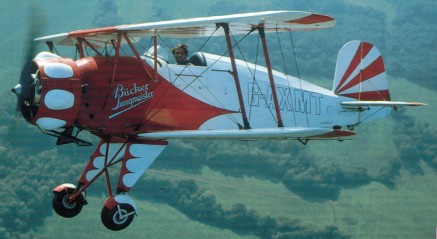
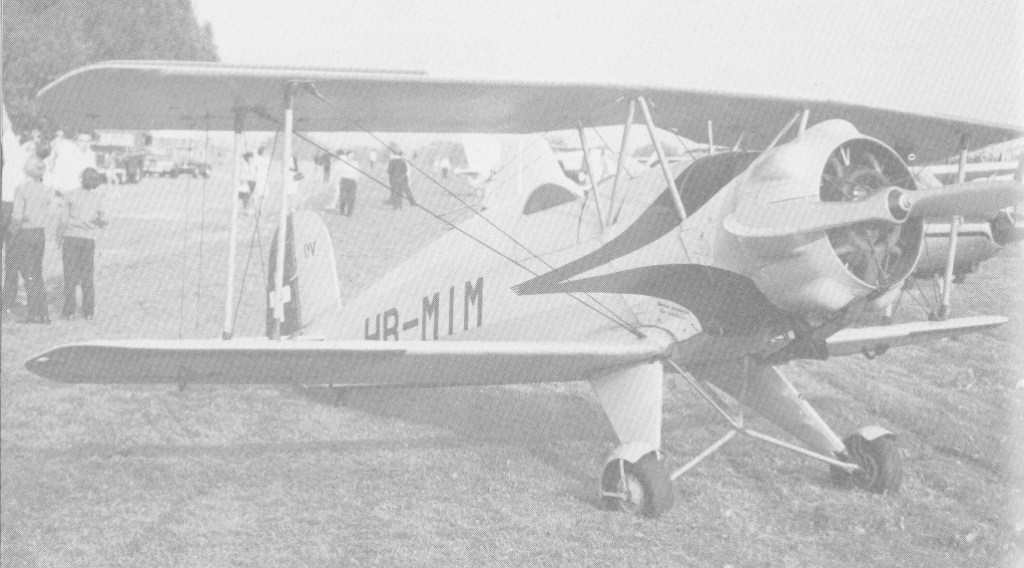
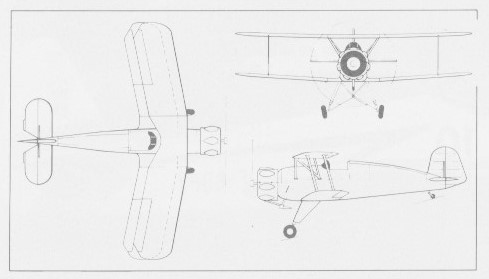
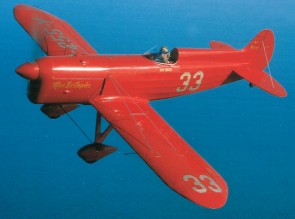
The success of the Jungmann led Bucker to open a second factory where a single-seat derivative could be produced in parallel with the original two-seater. The single-seater was the Jungmeister (young champion) advanced trainer, essentially a scaled-down Jungmann. First introduced in 1935, quickly developed an international reputation for its outstanding aerobatic capabilities.
The initial Bu 133A had the 101-kW (135-hp) Hirth HM 6 inline but better performance than the higher-powered Bu 131. Quantity production was undertaken for the Luftwaffe, though precise details are lacking. The Bu 133B export version was produced to the extent of some 100 aircraft by Dornier in Switzerland and CASA in Spain with the 119-kW (160-hp) Hirth HM 506 inline. The definitive version, however, was the Bu 133C with a radial engine: this had excellent agility and performance, and was used as a fighter lead-in trainer as well as for advanced flying training. This model too was built in Switzerland and Spain.
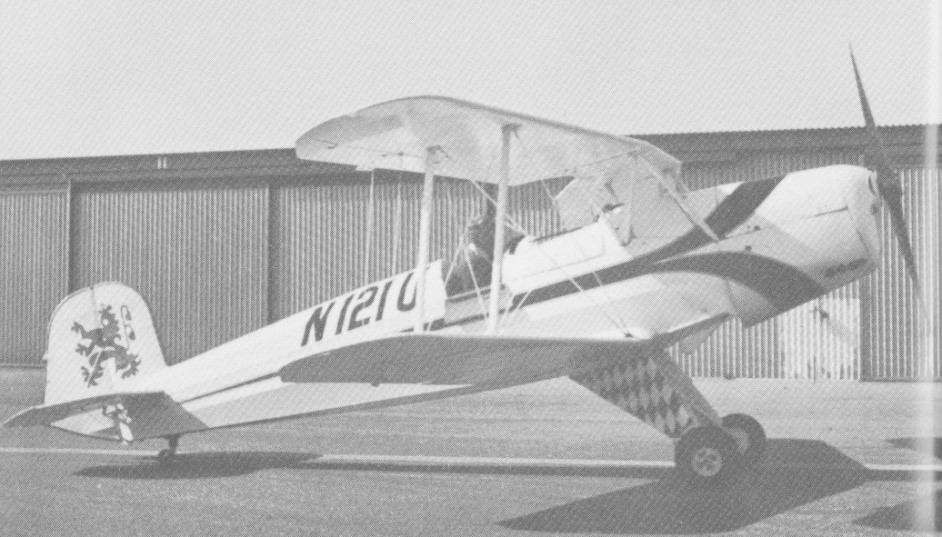
Bu 133C Jungmeister
The Bu 133 was built be Construcciones Aeronauticas S.A. in Spain for the Spanish Air Force under the designation ES-1, and 47 were built in Switzerland by the former Dornier-Werke for the Swiss Air Force.
In 1968, the Aero Technik Canary in Munich, Germany, began production of the BU-133 D-1, also called the Jungmeister. Its engine is a remanufactured Siemens-Halske Sh-14A4; however, due to this engine’s limited availability and demand for more power, a new version, the BU-133F, was built by Wolf Hirth GmbH with a 220 hp Franklin engine.
The Bu-133D-1 is basically as the Bu-133C but engine, optimised for constant inverted flight, Goodyear tyres, wheels and brakes, and US instruments.
Bucker Prado Sl offered kits to build the former German Jungmann two-seat aerobatic biplane using original Bucker/CASA Bu 131 jigs, plus Jungmeister single-seat aerobatic biplane.
Bu 133A Engine: Hirth HM 6 inline, 101-kW (135-hp)
Bu 133B Engine: Hirth HM 506 inline, 119-kW (160-hp)
Bu 133C Jungmeister Engine: l x Siemens Sh 14A-4, 119kW (160hp) Span: 6.6m (21 ft 7.75in) Length: 6m (l9ft 8.25 in) Empty weight: 420 kg / 925 lb Max T/O weight: 585 kg (1,290 lb) Max speed: 134 mph / 116 kt / 215 kph at sea level Max cruise: 108 kt / 124 mph / 200 kph Climb to 3300 ft / 1000m: 2 min 50 sec Service ceiling: 19,685 ft / 6000 m Operational range: 311 mi / 269 nm / 500 km Optional fuel: 8.6 ImpGal / 39 lt
Bu 133 D-1 Engine: Siemens Sh-14A-4 Bramo, 158 hp Length: 19.751 ft / 6.02 m Height: 7.71 ft / 2.35 m Wingspan: 21.654 ft / 6.6 m Wing area: 129.168 sq.ft / 12.0 sq.m Max take off weight: 1411.2 lb / 640.0 kg Weight empty: 992.3 lb / 450.0 kg Max. weight carried: 419.0 lb / 190.0 kg Max. speed: 113 kts / 210 km/h Initial climb rate: 1082.68 ft/min / 5.5 m/s Service ceiling: 12467 ft / 3800 m Wing load: 10.87 lb/sq.ft / 53.00 kg/sq.m Range: 205 nm / 380 km Endurance: 2 h Crew: 1
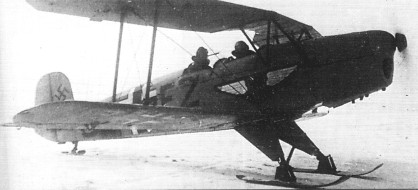
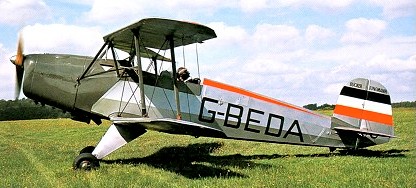
Bücker Flugzeugbau first design, designed by Anders Andersson, was the Bü.131A Jungmann powered by a 4 cylinder Hirth in line engine. A light two-seat biplane trainer specially developed for school and other training purposes, the prototype “D-3150” flew first 27 April 1934 with a 60-kW (80-hp) Hirth HM 6CR inline engine. The Jungmann was ordered by the Deutsche Luftsport Verband (The German Air-Sports Association). In 1936, the Luftwaffe adopted the Jungmann as one of its primary trainers.
Power was provided by a 60kW Hirth H.M.60R engine in the Bü.131A and a 78kW Hirth H.M.504A inverted engine in the Bü.131B.
Bu.131B
Before the outbreak of World War II the trainer was being used in 21 countries and licence-built in Holland, Czechoslovakia, Spain and Switzerland.
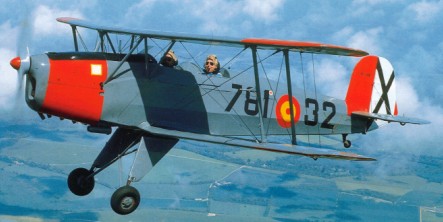
Spain was one of the earliest customers. Over a hundred German-built Jungmanns were delivered to the Spanish Nationalist side in the civil war. A total of 500 Jungmanns were built by the Construcciones Aeronauticas S.A. (CASA) in Spain. The first 200 had German Hirth HM504 engines but the remainder were powered by versions of the Spanish ENMA Tigre G-IV. In Spain production started 1938 and the CASA I-131 remained in production until the end of the fifties. The CASA E3B is a licence-built example.
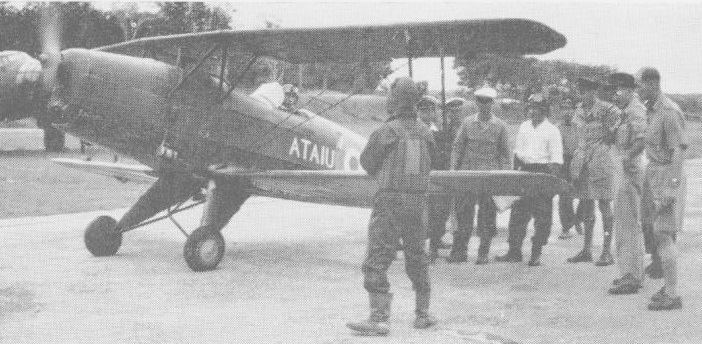
Some 1,254+ were built in Japan by Watanabe and Kyushu as the army’s Kokusai Ki-86A (1,037) and the navy’s K9W1 Momiji (Maple) (217+). Later models had 110 hp Hitahi Ha.47 engines. The code name was Cypress, applied to both the Navy Type 2 Momiji and Army Type 4.
The prototype was originally delivered to Japan in 1939, and Navy production began in August 1941.
K9W1 Cypress
Production figures have not survived, but some indication of scale is provided by the fact that Hungary took 100 and Romania 150, while Switzerland built 75. The Bucker Bü.131B Jungmann was also built under license pre-war in Switzerland by Dornier, and Czechoslovakia as the Tatra T.131. In Czechoslovakia the post-war version of the Bu.131B was the C.4. The C.104 was as the C.4 but with a 105 hp Walter Minor 4-III engine.
CASA 1-131E
Bucker Prado Sl offered kits to build the former German Jungmann two-seat aerobatic biplane using original Bucker/CASA Bu 131 jigs, plus Jungmeister single-seat aerobatic biplane.
Bu 131A Engine: 1 x Hirth HM60R, 59kW / 80 hp Max Take-off weight: 630 kg / 1389 lb Empty weight: 280 kg / 617 lb Wingspan: 7.4 m / 24 ft 3 in Length: 6.7 m / 21 ft 12 in Height: 2.3 m / 7 ft 7 in Wing area: 13.5 sq.m / 145.31 sq ft Max. speed: 170 km/h / 106 mph Cruise speed: 150 km/h / 93 mph Ceiling: 3500 m / 11500 ft Range w/max.fuel: 680 km / 423 miles Crew: 2
Bu 131B Engine: Hirth HM 504 A-2, 104 hp, 78kW Wingspan: 24 ft 3.25 in / 7.4 m Wing area: 145.314 sq.ft / 13.5 sq.m Length: 21 ft 8in / 6.62 m Height: 7.776 ft / 2.37 m Max take-off weight: 1477.4 lb / 670.0 kg Weight empty: 882.0 lb / 400.0 kg Max. weight carried: 595.4 lb / 270.0 kg Max. speed: 93 kts / 173 km/h / 114mph at sea level Initial climb rate: 748.03 ft/min / 3.8 m/s Service ceiling: 11483 ft / 3500 m Wing load: 10.25 lb/sq.ft / 50.0kg/sq.m Range: 216 nm / 400 km Endurance: 3 h Crew: 2
Bucker Flugzeugbau GmbH Bücker Flugzeugbau was founded by Carl Bücker in 1932, its first aircraft was the Bu 131 Jungmann trainer, designed by Swede Anders Andersson. The prototype first flew on April 27,1934. It was followed by the Bu 133 Jungmeister in 1935 and by the extensively built Bu 181 Bestmann in 1936. Production of the latter continued after Second World War by Zlin in Czechoslovakia and, under Czech license, by Egypt’s Heliopolis Aircraft Works in the 1950s.
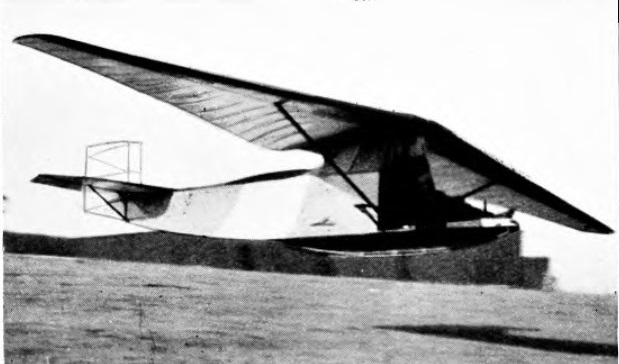
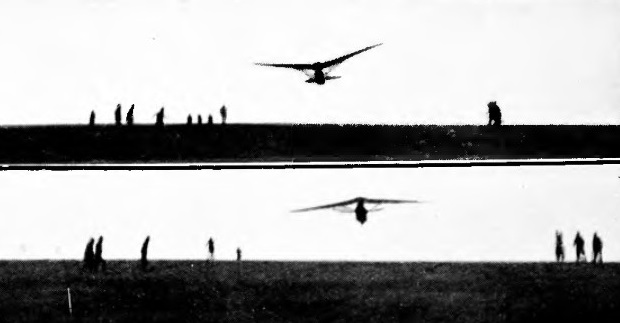
Erhard Brunsmann had built a flapping machine with which short flights were made during 1925. Encouraged by this, he built a sailplane of 44 ft span with a wing area of 130 sq.ft by 1928.
The machine has tapered wings and a usual tail unit, but the main planes are hinged at the centre ao allow up and down movement and are braced by a pair of struts, one to each wing, attaching just behind and below the pilot.
No lateral control was provided, but side movement of the control column actuated the rudder.
The sailplane was first tested as a normal glider, and had similar performance, after which flapping flights were carried out, which increased the speed and about doubled the distance possible with fixed wings.
The machine was being tested at Wasserkuppe in 1931.
In 1928 the Brunner-Winkle Aircraft Corporation was founded to manufacture a three-seat open cockpit commercial biplane known as the Bird biplane. In March 1929 the Bird Aircraft Corporation was incorporated, with William E. Winkle as vice-president, to continue production of the Bird biplane with a variety of engines ranging from 100- 165 hp.