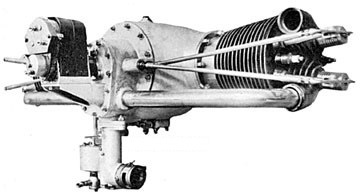
The Cato C-2 / O-270 horizontally opposed two-cylinder, air-cooled engine of 1919 produced 72hp@1800rpm from 272.3ci. The dry weight was 154 lb.
The Cato C-2 / O-270 horizontally opposed two-cylinder, air-cooled engine of 1919 produced 72hp@1800rpm from 272.3ci. The dry weight was 154 lb.
Since 1936 the French firm of Etablissements Fouga et Cie operated an Aircraft Department which built aircraft to the designs of its Director, Pierre Mauboussin, and the Technical Director, Robert Castello, as Castel-Mauboussin or just Castel and later as Fouga designs. These included a number of sailplanes culminating in the postwar CM 10 military glider which could carry up to 35 fully armed troops or two jeeps, and the V-tailed CM 8R-13 and CM 8R-15 Sylphe each powered by a dorsally-mounted Turbomeca Pimene jet for flight testing and research; the two latter types led directly to the Fouga CM 170R Magister jet trainer.
An eight-passenger biplane of 1927 (also used by Deutsche Luft Hansa as freighter)
1926 seaplane training biplane
1925 series of light aircraft designed by Karl Theiss
1923, a two-seat high-wing cabin monoplane.
1922 seaplane prototype for detachable-wing biplanes to be carried by submarines.
Zentral-Aviatik Und Automobil Gmbh
Hansa-Flugzeugwerke
Hansa Und Brandenburgische Flegzeugwerke Gmbh
Hanseatische Flugzeugwerke Karl Caspar AG
Caspar Werke AG
Founded as the Zentrale fur Aviatik at Hamburg-Fuhlsbiittel in late 1911; began by building Etrich/RumplerTaube monoplanes. In 1913 renamed Hansa-Flugzeugwerke, merging shortly before the First World War with Brandenburgische Flugzeugwerke of Igo Etrich, becoming the Hansa and Brandenburgische Flugzeugwerke. This partnership dissolved in 1916, the Hamburg factory being renamed Hanseatische Flugzeugwerke Karl Caspar AG. Next two years spent mainly in license-building other companies’ aircraft, though an interesting cannon-armed twin-engined fighter prototype by Caspar appeared in late 1918.
With Ernst Heinkel as chief designer, this company produced the most important German seaplanes of the First World War, commencing with the KDW single-seater developed from the D1 landplane, followed by the W.12 with characteristic Hansa upswept fuselage and “upside-down” tail arrangement. The W.29 monoplane set the pattern for Heinkel’s later designs, outperforming Allied aircraft in combat from introduction in April 1918. The larger W.33 was delivered before the Armistice, and continued in production in Finland and Norway as the A-22 until the mid- 1928, as did the W.29 in Denmark.
Before end of First World War company acquired the ex- Fokker factory at Travemiinde, eventually closing the Hamburg works and transferring its activities there. Here, in 1921, the Caspar Werke AG was formed.
Established in 1921 in ex-Fokker factory at Travemunde to continue business of Hanseatische Flugzeugwerke Karl Caspar AG. of Hamburg. Started with manufacture of seaplanes, including S.1 twin-float monoplane and Heinkel-designed LJ.1 and U.2, 1922 prototypes for detachable-wing biplanes to be carried by submarines. A four-seat open-cockpit light transport was followed by the CLE.11 in 1923, a two-seat high-wing cabin monoplane. In 1925 came the CT-1 -5 series of light aircraft designed by Karl Theiss, and CLE.12 eight-seat single-engined transport. Lightplane designs C.17, 23, 24, and 26 followed; then in 1926 the C.27 seaplane training biplane; C.30 reconnaissance aircraft; C.32 agricultural biplane (one of the world’s first) with payload of 1,984 Ib (900 kg); the C.35 Priwall eight-passenger biplane of 1927 (also used by Deutsche Luft Hansa as freighter); and the C.36 reconnaissance aircraft. Lack of orders for these types caused the factory to close in 1928.
Construcciones Aeronauticas SA formed 3 March 1923, with a factory at Getafe, to produce all-metal aircraft for the Spanish Air Force. Began by license-building Breguet XIX reconnaissance-bomber biplanes, followed by other aircraft of foreign design including Dornier Wai flying-boats (at Cadiz), Vickers Vildebeest torpedo-bombers, Gotha Go 145C biplane trainers, Junkers Ju 52/3m transports, Bucker Bu 131, and 133 aerobatic trainers and Heinkel He 111 medium bombers. Opened a design department after the Second World War; first series product was Dornier Do 27 general-purpose lightplane, followed by CASA-201 Alcotan, CASA-202 Halcon and CASA-207 Alcotan twin-engined transports of own design. Completed 70 Northrop F-5 fighters under license for Spanish Air Force. In 1972 took over Hispano Aviacion, followed by the ENMASA aero- engine concern in June 1973. Currently has three divisions, namely Aircraft, Maintenance, and Space: Aircraft division activities include design of aircraft and integrated structures; share in international Airbus, Eurofighter, and FLA programs; manufacture of structural parts and components for Boeing, Eurocopter, Northrop Grumman, and Saab aircraft; continuing development and production of C-101 Aviojet advanced and lead-in jet trainer/light attack aircraft (first flown June 1977), C-212 Aviocar (first flown March, and currently offered in Series 400 form as first flown April 1997) in transport and maritime versions, and development of the new ATX family of advanced trainers and light combat aircraft; and production of CN 235 via international Airtech company.
The Carden-Ford was a British aero-engine modified from a Ford motor car engine by Carden Aero Engines, first run in 1935. The company saw a need for a cheap low-powered propulsion unit for ultralight aircraft and the engine was an adaptation of the well-proven and reliable Ford 10 Model C motor car engine. The engine was reversed, and a thrust bearing fitted to what was now the front of the engine. The chain drive was replaced by lightweight fibre gears, an Elektron aluminium alloy sump fitted, and dual ignition if requested. There were two cylinder head variants, one with an ‘L’ shape, the other with a low-profile flat head which required a separate header tank. This latter design was adapted for the Chilton Aircraft Ltd Chilton D.W.1 Monoplane of 1936.
Variants:
Carden-Ford 31 hp 4-cyl
A much modified Ford 10 car engine.
Carden-Ford S.P.1
Further development of the 31 hp engine, with a centric supercharger, 1.1:1 gear ratio, splined propeller shaft extension and horizontal mounting for flush wing mounting. Used exclusively on the Carden-Baynes Bee.
Application:
Broughton-Blayney Brawney
B.A.C. Drone
Chilton D.W.1 monoplane
Carden-Baynes Bee
Kronfeld Monoplane
Mignet HM.14 (Flying Flea)
Perman Parasol
Taylor Watkinson Dingbat
Specifications:
Carden-Ford 31hp 4-cyl.
Type: 4-cyl, upright, in-line,
Bore: 63.5 mm
Stroke: 92.5 mm
Displacement: 1.17 l
Designer: Sir John Carden
Righthand rotation, direct-drive tractor, Poppet valve
Cooling system: Liquid
Dual magnetos
Power output: 31 hp
Compression ratio: 6.6:1

