Formed 1927 at Melbourne, the first overseas holding by DH, as service agent, assembling imported Moths. Moved to Sydney in 1929. Between 1939 and 1942 built 1,085 Tiger Moths and 87 Dragons; 212 Mosquitoes (1942-1947); 120 Vampires (1948-1961). Local designs were the DHA G2 troop-carrying glider and the post-war DHA 3 Drover three-engined transport. Acquired CAC Lidcombe (1959); Bristol Aeroplane Company (Australia) Pty. Ltd. (1962); Fairey Aviation Company of Australia Pty. Ltd. (1963). In 1960 became Australian Hawker Siddeley Company, the name changing in 1963 to Hawker de Havilland Australia Pty. Ltd.
Produces aerostructures for Airbus and Boeing, supports RAAF F-111 and P-3 improvement programs, and is a team member under Raytheon Systems Company proposing the Airbus A310 for the RAAF’s AEW&C requirement. Previously, in 1980s, having bought Australian Aircraft Consortium and formed it into the Trainer Aircraft Division of HDH, continued development for short time of A10B turboprop-powered two-seat basic trainer.
Inter-Wars
de Havilland DH 95 Flamingo / Hertfordshire
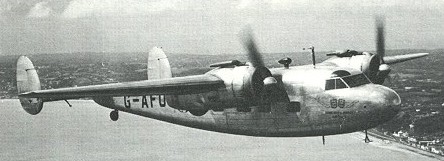
De Havilland’s first all-metal stressed-skin aircraft, the de Havilland D.H.95 Flamingo, was designed by R. E. Bishop as a medium range passenger transport to carry 12-17 passengers and a crew of three. It featured hydraulically retractable landing gear, split trailing-edge flaps and was powered initially by two 664 kW (890hp) Bristol Perseus XIIc radial engines.
The prototype was first flown by Geoffrey de Havilland Jr at Hatfield on 28 December 1938 and during subsequent flight testing a third, central fin was fitted temporarily. In May 1939 this aircraft was delivered to Guernsey & Jersey Airways Ltd for route-proving trials, linking Heston and Southampton’s Eastleigh Airport with the two principal Channel Islands.

The outbreak of war precluded commercial use on these services, but the Royal Air Force had ordered two Flamingoes for communications duties with No. 24 Squadron and one for The King’s Flight, the last being delivered to RAF Benson on 7 September 1940 as the Hertfordshire. It was transferred to No. 24 Squadron in February 1941, the unit having acquired also the prototype, two aircraft ordered by civilian customers and the fifth airframe which had been used by the manufacturer for development of the Bristol Perseus XVI radial. This engine was fitted to all subsequent examples, including one used by the Royal Navy’s No. 782 Squadron at Donibristle for communications flights to the Orkney and Shetland Islands and to Northern Ireland, and eight flown by BOAC on Middle East services, based at Cairo. The Royal Navy’s Flamingo was the only aircraft to return to civil use after the war, seeing limited service with British Air Transport at Redhill where it was scrapped in 1954. Flamingo production totalled 16 aircraft.
D.H.95
Engine: 2 x Bristol Perseus XVI radial, 694kW / 917 hp
Take-off weight: 7983 kg / 17600 lb
Empty weight: 5137 kg / 11325 lb
Wingspan: 21.34 m / 70 ft 0 in
Length: 15.72 m / 51 ft 7 in
Height: 4.65 m / 15 ft 3 in
Wing area: 59.36 sq.m / 638.95 sq ft
Max. Speed: 385 km/h / 239 mph
Cruise speed: 296 km/h / 184 mph
Ceiling: 6370 m / 20900 ft
Range: 1947 km / 1210 miles
Service ceiling : 20899 ft / 6370 m
Wing loading: 27.68 lb/sq.ft / 135.0 kg/sq.m
Crew: 3
Payload: 17pax

de Havilland DH 94 Moth Minor
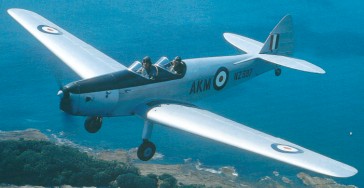
On 24 August 1931 the company had flown the only example of the de Havilland D.H.81 Swallow Moth, a low wing open-cockpit two-seater powered by a 60 kW (80hp) Gipsy IV engine. With production capacity filled by orders for various models of the Moth the project was discontinued, to be resurrected some years later when advantage could be taken of-some structural techniques used in the Comet and Albatross. Of wooden construction throughout, the prototype D.H.94 Moth Minor was first flown by Captain Geoffrey de Havilland at Hatfield on 22 June 1937. Unlike the earlier Moths, it was flown from the front seat, and incorporated a large perforated air brake under the centre section.
de Havilland DH 94 Moth Minor Article
Production followed and by the outbreak of World War II 71 examples had been completed, including nine Moth Minor Coupe aircraft with built-up rear fuselages and hinged cabin tops. Over 100 had been built by September 1939, but early in 1940, when Hatfield’s production capacity was required urgently for aircraft more vital to the war effort, the Moth Minor drawings, jigs, components and finished but undelivered airframes were delivered to de Havilland Aircraft Pty Ltd at Bankstown, Sydney. More than 40 were supplied to the Royal Australian Air Force.
The total production was about 150.

Five were impressed by the RNZAF 1940-46 for general duties.
D.H.94
Engine: 1 x de Havilland Gipsy Minor, 67kW / 90 hp
Max take-off weight: 703 kg / 1550 lb
Empty weight: 446 kg / 983 lb
Wingspan: 11.15 m / 36 ft 7 in
Length: 7.44 m / 24 ft 5 in
Height: 1.93 m / 6 ft 4 in
Wing area: 15.05 sq.m / 162.00 sq ft
Max. speed: 190 km/h / 118 mph
Cruise speed: 161 km/h / 100 mph
Ceiling: 5030 m / 16500 ft
Range: 483 km / 300 miles
Endurance: 6 hr
de Havilland DH 93 Don
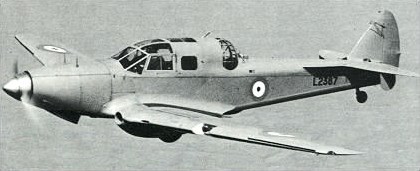
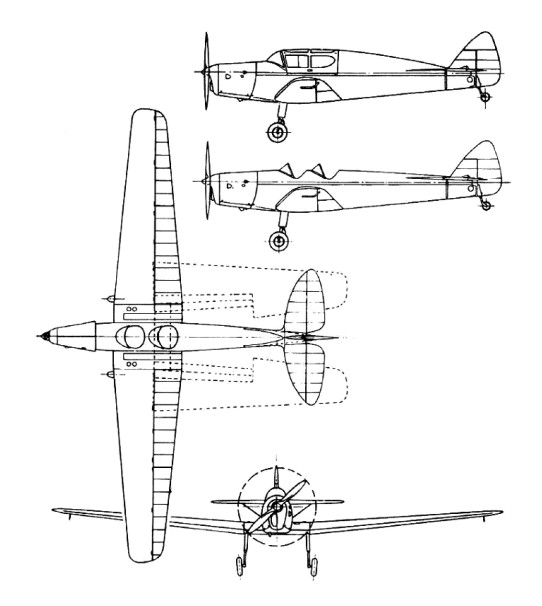
With details outlined in Military Specification T.6/36, the Don was to be a three seat, low wing, general purpose trainer, with the same flying characteristics as the new monoplane fighters and bombers then entering service. In the interests of economy, it was to be a combination trainer, suitable as an advanced pilot trainer as well as radio operator and gunnery training.
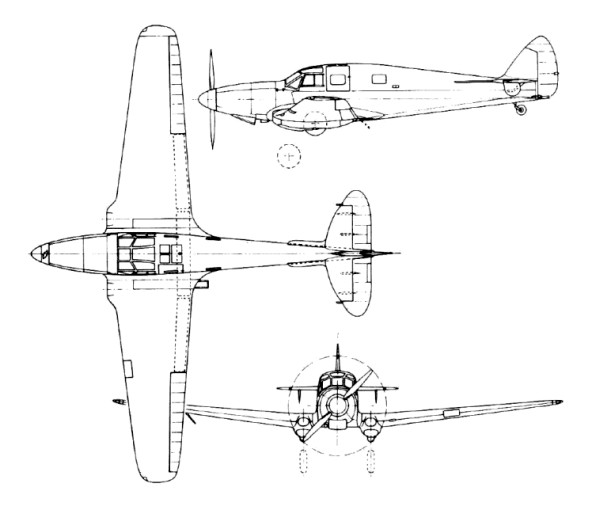
Arthur E. Hagg designed an aircraft that had four welded steel tube frames bolted together, and attached to a wooden monocoque fuselage which consisted of four resin impregnated moulded plywood sections. The top and bottom sections were curved in heated moulds, while the middle fuselage sections were flat. These sections were strengthened along the joints by wooden stringers which gave the fuselage two distinct lines were the panels overlap.
The wings were built in three sections. The front and rear spars were plywood box structures overlain by two thin layers of diagonal spruce planking, the leading edge being plywood covered.
The de Havilland Gipsy Twelve engine installed originally in the D.H.91 Albatross was renamed Gipsy King for military use and selected to power Air Ministry Specification T.6/36. Fitted with one inverted V-12-cylinder D.H. Gipsy King 1 air-cooled engine producing 525 BHP at 2,400 rpm, Hagg incorporated the ductd reverse-airflow cooling system he had designed for the Albatross. The air intakes. were built into the leading edges of the wings, the air ducted over the top of the engine inside the cowl, down past the cylinders to exit via the centre of the inverted Vee, and out through the back of the engine. This to intake the Don aerodynamically very clean in order to achieve a high performance from a relatively low-powered engine. Maximum speed was 216 mph (348 km/h) at 8,000 ft (2438 in) arid a service ceiling of 21,500 ft (6401 m) and a range of 855 miles (1376 km), stretching out to 890 miles (1432 km) could be attained when configured as a purely communications aircraft.
The Air Ministry dictated that the fuselage had to be big enough for the instructor and air gunner to be able to change seats in flight, arid that two men had to be able to remove and replace the engine in two hours. A variable pitch propeller was to be fitted. The Pupil and instructor were to sit side-by side and have a standard set of instruments for blind flying, while the gunner had to be completely sheltered front the wind, which meant the Don had to be fitted with a turret.
The Air Ministry dictated that the fuselage had to be big enough for the instructor and air gunner to be able to change seats in flight, arid that two men had to be able to remove and replace the engine in two hours. A variable pitch propeller was to be fitted. The Pupil and instructor were to sit side-by side and have a standard set of instruments for blind flying, while the gunner had to be completely sheltered front the wind, which meant the Don had to be fitted with a turret. Extra pressure to finish the aircraft came when the RAF ordered 250 Don Trainers but, just as Hagg was making progress, the Air Ministry sent pages of amendments to Hatfield. These were dated 25th July 1936.
Without warning, in February 1937, the de Havilland Aircraft Company announced that Hagg had resigned, he eventually being replaced by another of the design team, Ronald E. Bishop.
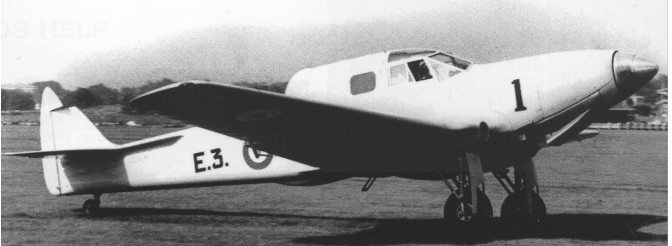
Bishop and his team finished the Don prototype L23871 and it was first flown at Hatfield 18 June 1937. Eight days later Flt/Lr E. R.Symonds flew it at the S.B.A.C. air show.
Following manufacturer’s initial trials, during which small auxiliary fins were fitted beneath the tailplane, the aircraft was transferred to Martlesham Heath on 14th September for official evaluation but fell short of what the Air Ministry had by then decided they wanted.
The prototype was flown by three pilots, who found that “unusual” force was needed to stall the aircraft, for the control column got progressively heavier as the speed slowed and the stick was pulled back. With the flaps up the Don stalled marked with a sharp wing drop. With the flaps down, the wing drop was less marked, but was accompanied by a snatching of the ailerons so that, although control was quickly regained when the nose dropped, for a moment the wing could not be raised with the ailerons. The Don prototype was returned to de Havilland’s where the stalling problems were improved with the addition of a four-foot long strip to the wing leading edge. Small fins were fitted near the ends of the tail plane and thereafter the Don stalled without the vicious wing drop. On 19th January 1938 a pilot from Martlesham came over to Hatfield to retest the aircraft and he considered that the handling was now acceptable provided a spring loaded elevator control system was fitted to reduce the load on the control column during take-off.
A three bladed propeller was fitted to the second Don to improve the take-off, but to achieve a satisfactory climb rate, the engine supercharger had to be boosted to get the revs up to the required level. More changes were made and the mass balances on the elevator, as well as new undercarriage oleo struts, finally produced a satisfactory landing and take-off roll. The test pilots acknowledged that the handling had improved, but criticised the poor view, difficulty in getting in and out, excessive take-off distance, and heavy elevator controls.
Armament consisted of one Lewis gun with three magazines, in an enclosed rotating turret, one fixed Browning gun in the wing and provision for 16 practice bombs tinder wing. llowever the Brownin, machine gun tended to fire erratically and several modifications were made to improve this, but to no avail. The changes needed to satisfy the RAF were still as elusive as ever and then, on 24th June 1938, the Air Ministry told de Havilland’s that the Don was no longer required and the order for all 250 machines was cancelled.
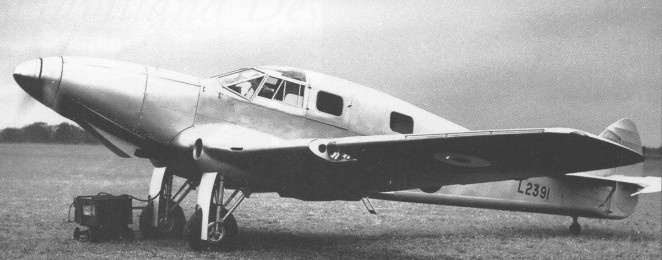
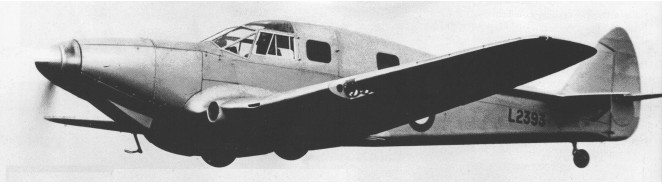
The Air Ministry had selected the Miles Master for advanced pilot training and the Avro Anson and Airspeed Oxford for twin-engine, navigation, radio and air gunnery training. But when it was pointed out that when they cancelled the Don, the RAF would end up with a large number of Gipsy Twelve (renamed Gipsy King for the Don) engines from the production line with no aircraft to put them in. To settle this dilemma de Havilland’s were given an order for 50 three-seat communications aircraft to be converted from the Don Trainer. The first conversion, L2391, went to Martlesham in September 1938 with the turret removed to test its suitability of carrying three people with parachutes. Accessibility for less agile passengers, such as senior officers, was fixed by adding an external step on the fuselage and an internal step with a hand grip. However the pilot’s seat was considered uncomfortable because the fixed back was not high enough and the safety harness prevented the pilot from leaning forward to reach the instruments. In addition there was no cockpit heating and the emergency exit in the roof was difficult i to open if the pilot stayed seated. On 22nd September 1938, the first communications Don, L2391, was completing a fuel consumption test at 10,000 ft (3048 m). The pilots came down to 3,000 ft (914 m) but when they opened the throttle nothing happened, they then tried all sorts of combinations of throttle and propeller settings to no avail. They attempted a cross-wind landing with the undercarriage down but stalled and the undercarriage was torn off and the fuselage then broke near the rear spar.
Only 30 Dons ever flew and even in the communications role the aircraft had a very short service life, with most converted to instructional airframes. Of this total 20 were delivered as engineless airframes and the remainder converted for communications duties with No. 24 Squadron and a number of station Flights.
D.H.93
Engine: 1 x de Havilland Gipsy King 1, 391kW
Max take-off weight: 3112 kg / 6861 lb
Empty weight: 2291 kg / 5051 lb
Wingspan: 14.48 m / 47 ft 6 in
Length: 11.38 m / 37 ft 4 in
Height: 2.87 m / 9 ft 5 in
Wing area: 28.24 sq.m / 303.97 sq ft
Max. Speed: 304 km/h / 189 mph
Ceiling: 7100 m / 23300 ft
Range: 1432 km / 890 miles
de Havilland DH 92 Dolphin
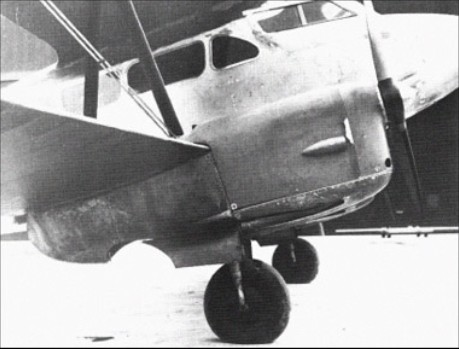
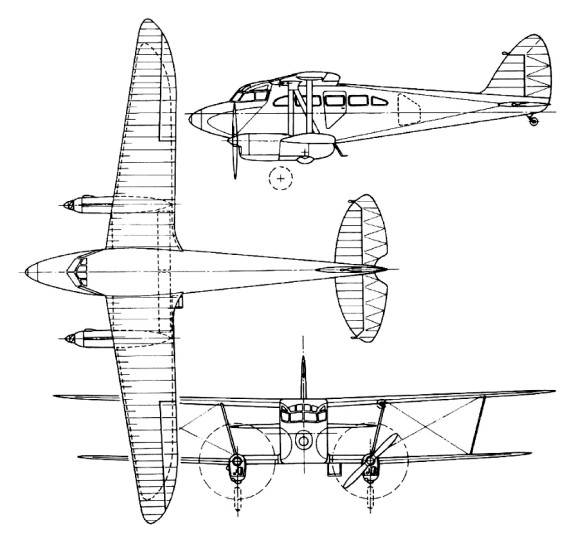
de Havilland DH 91 Albatross
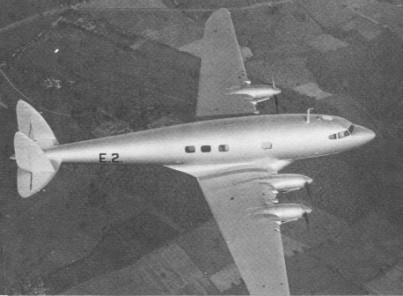
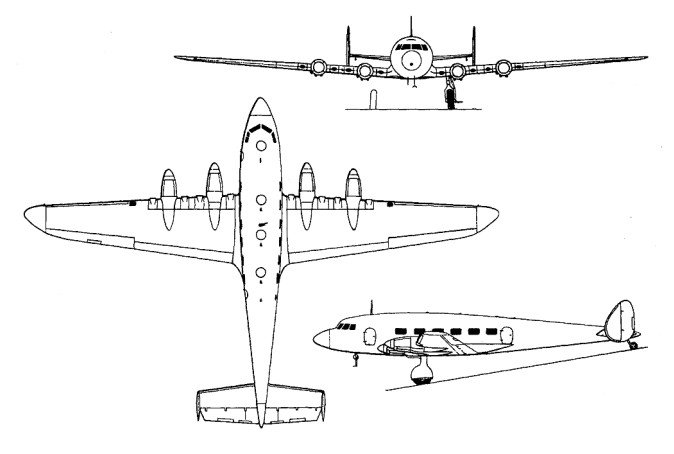
Designed by A. E. Hagg to an Air Ministry specification for a transatlantic mailplane, the de Havilland D.H.91 Albatross fuselage was made of laminations of cedar ply and balsa wood, built as a monocoque in which the skins bore the load, and had a one-piece wing.
Powered of four de Havilland Gipsy Twelve engines driving constant-speed propellers, and with the landing gear main units electrically retractable, the prototype, initially with twin fins mounted at mid-span on the tailplane, was flown for the first time at Hatfield on 20 May 1937. Directional instability saw a change to more traditional endplate fins with unbalanced rudders and trim tabs. Passenger entry was through a door just 1m tall and the rear fuselage was particularly cramped. In general the cabin was noisy and the ride was uncomfortable.
Problems with the landing gear retraction system resulted in a wheels-up landing for the first prototype on 31 March 1938, and a structural weakness in the rear fuselage was revealed when the second prototype broke into two a few months later when landing during overload trials. Effective modifications were soon evolved and the two prototypes were repaired and used experimentally by Imperial Airways.
Their range made them particularly useful for a shuttle service between the UK and Iceland, and they were impressed for RAF use with No. 271 Squadron in September 1940.
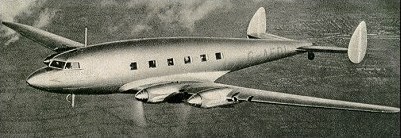
Five Albatrosses, with reduced capacity, additional cabin windows and slotted flaps replacing the split trailing edge flaps, were delivered to Imperial Airways between October 1938 and June 1939. With accommodation for 22 passengers and a crew of four, they saw wartime service on the Bristol-Lisbon and Bristol-Shannon routes until, with their numbers reduced to two by enemy action or accidents, the survivors were scrapped in September 1943.
D.H.91
Engines: 4 x de Havilland Gipsy Twelve, 391kW/ 525 hp
Max take-off weight: 13381 kg / 29500 lb
Empty weight: 9630 kg / 21231 lb
Wingspan: 32.00 m / 105 ft 0 in
Length: 21.79 m / 71 ft 6 in
Height: 6.78 m / 22 ft 3 in
Wing area: 100.15 sq.m / 1078.00 sq ft
Wing loading: 27.47 lb/sq.ft / 134.00 kg/sq.m
Max. speed: 362 km/h / 225 mph
Cruise speed: 338 km/h / 210 mph
Ceiling: 5455 m / 17900 ft
Max range: 3,300 miles (5,300 km)
Range: 1674 km / 1040 miles
Crew: 4
Passengers: 22
de Havilland DH 90 Dragonfly
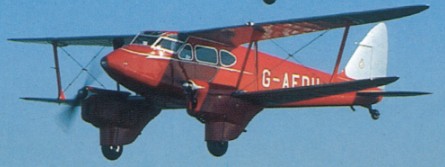
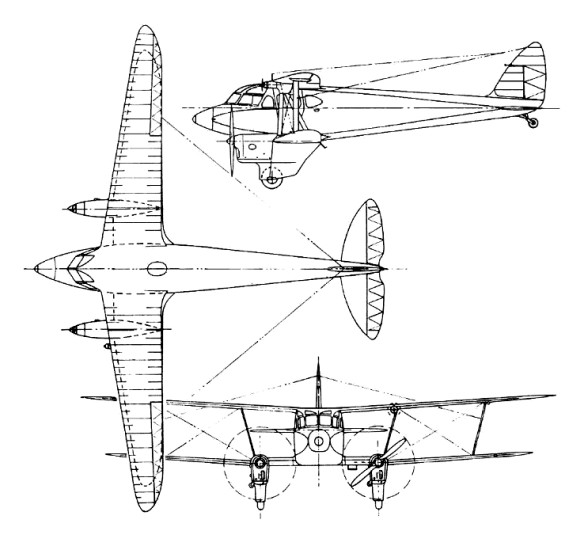
Similar to the D.H.89 Dragon Rapide, the de Havilland D.H.90 Dragonfly has a pre-formed plywood monocoque shell strengthened with spruce stringers. The lower wing centre section was strengthened, making possible deletion of the nacelle/wing root bracing struts and inner bay rigging wires, and so providing easy access to the cabin, with its accommodation for a pilot and four passengers. Powered by two de Havilland Gipsy Major engines, the prototype made its first flight at Hatfield on 12 August 1935 and the first D.H.90A production aircraft, with Gipsy Major II engines, flew in February 1936.
Production totalled 66.

Military purchasers included Canada, Denmark and Sweden.
D.H.90 Dragonfly
Engines: 2 x de Havilland Gipsy Major inline, 97kW, 130 hp
Max take-off weight: 1814 kg / 3999 lb
Empty weight: 1134 kg / 2500 lb
Wingspan: 13.11 m / 43 ft 0 in
Length: 9.65 m / 31 ft 8 in
Height: 2.79 m / 9 ft 2 in
Wing area: 23.78 sq.m / 255.97 sq ft
Wing loading: 15.58 lb/sq.ft / 76.00 kg/sq.m
Max. speed: 125 kts / 232 km/h / 144 mph
Cruise speed: 109 kts / 201 km/h / 125 mph
Service Ceiling: 5515 m / 18100 ft
Range: 543 nm / 1006 km / 625 miles
DH90B
Engines: 2 x Gipsy Major.
Seats: 5.
Cruise: 125 mph.
Stall: 63 mph.
de Havilland DH 89 Dominie Rapide / Dominie / Dragon Six / Breda Ba.44

In 1930, the owner of a London bus company, Edward Hillman, opened air services from London to the seaside. He used an aircraft especially designed for him, the de Havilland Dragon, carrying eight passengers.
de Havilland DH 89 Dominie Article
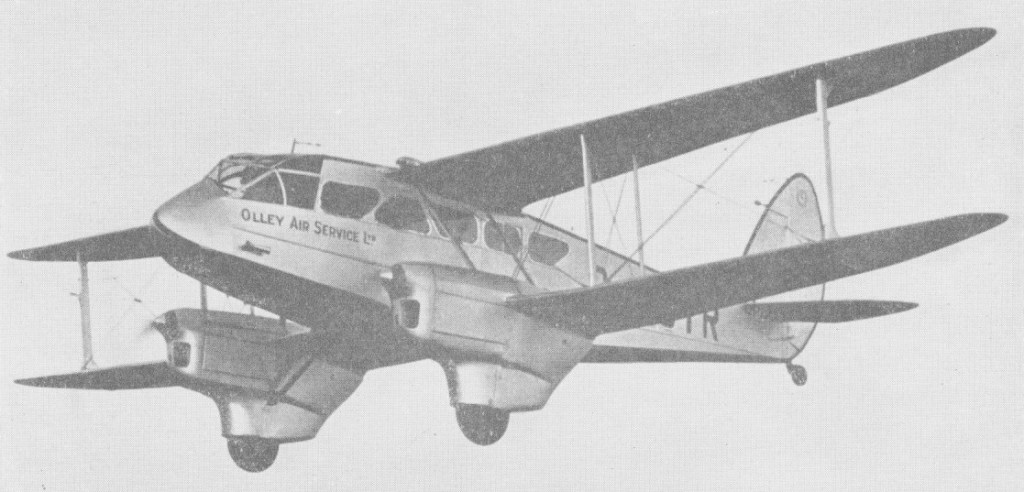
The Dragon Rapide was a direct development of the Dragon, employing the same structure but having tapered wings, 149kW Gipsy Six engines and a faired-in undercarriage. Known originally as the Dragon Six, it was first (E-4, later CH287) was flown on 17 April 1934 at Hatfield, put in production in 1934, and remained in production for more than ten years.
Construction consisted of a boxlike structured fuselage with plywood panelling on the inside and fabric covering on the outside. Wings had wooden spars and fabric covering.
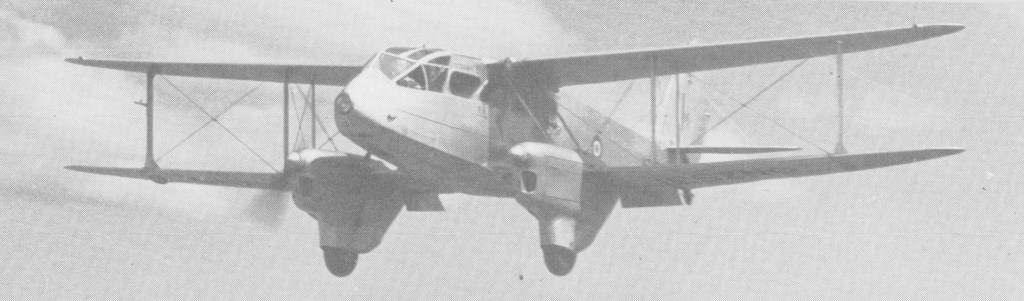
In 1935, a military Dragon Rapide lost to the Anson as the RAF’s future Coastal Command reconnaissance machine. In 1938, the first RAF Dragon Rapide was delivered for communications duties, and eventually it became a mass production wireless (radio) trainer as well as a utility transport. It received the RAF name Dominie in 1941. Total production for the RAF and Fleet Air Arm was 521, the last being delivered in 1946.
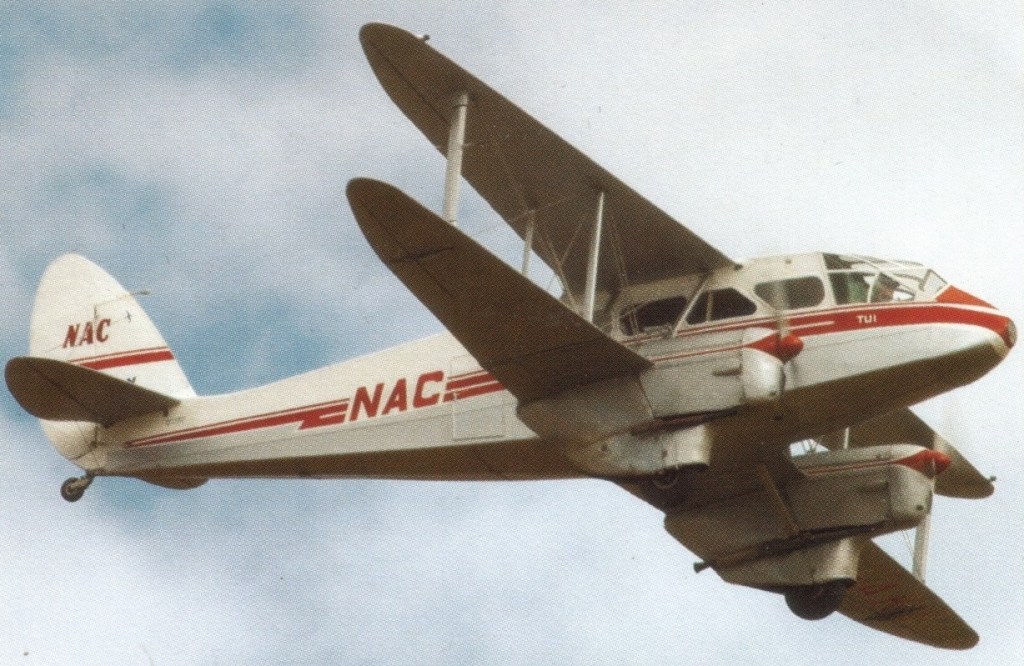
The 48 ft spruce and fabric wings have ailerons on all four and split trailing-edge flaps are on the bottom wings between the engines and fuselage.
It remained in production until 1945 and a total of 738 were built. After the war the Rapide served for several years as interim equipment of BEA, Iraqi Airways, Jersey Airways, KLM and other airlines until more modern equipment became available.
Fine pitch props were often fitted to enable an extra 200 lb payload and better short field and climb performance. The DH Rapide were slightly slower than the original flapless DH.89s. The DH89A was produced in 1935 to Capt Fresson’s requirements (of Highland Airways, Inverness) and incorporated landing flaps, a landing light in the nose, and cabin heating.
In addition many military models were exported, some (for Iraq and Spain) being of the DH 89M armed variant. Typical armament was three machine guns (one fixed, and manually aimed dorsal and ventral) and a bombload of up to 127 kg (280 lb).
A number of Dragon Rapides were also operated on Fairchild-produced floats by Canadian airlines, produced in Canada by de Havilland’s Toronto-based company.
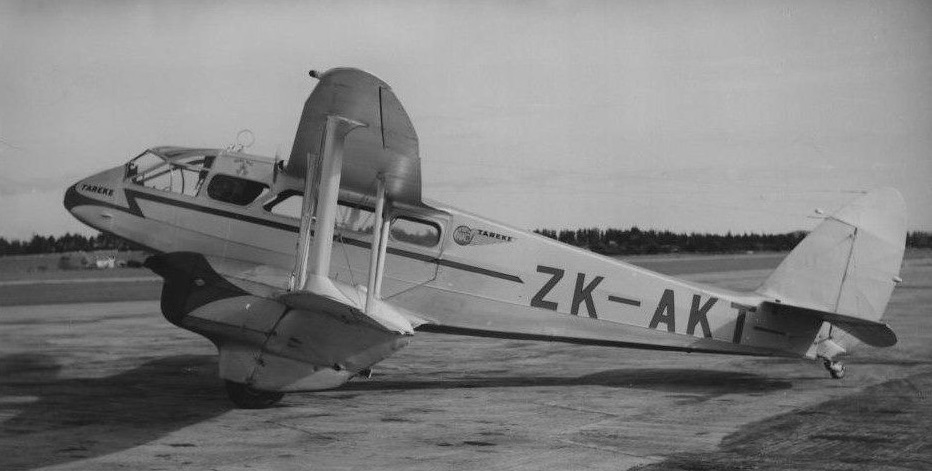
One example of the DH89A Dragon Rapide was owned by the NZ National Airways Corp (ZK-AHS Mokai) 1948-57 and five were impressed from civil airlines by the RNZAF 1939-45 and used as patrol and navigation aircraft. Fourteen DH89B Dominie served with the RNZAF for training and reconnaissance during 1943-53. The NZ National Airways Corp operated six DH89B 1947-64 (ZK-AKS Teoteo; ZK-ALB Tikaka; ZK-AKU Tawaka; ZK-AKT Tareke; ZK-ALC Tiora; ZK-AKY Tui).
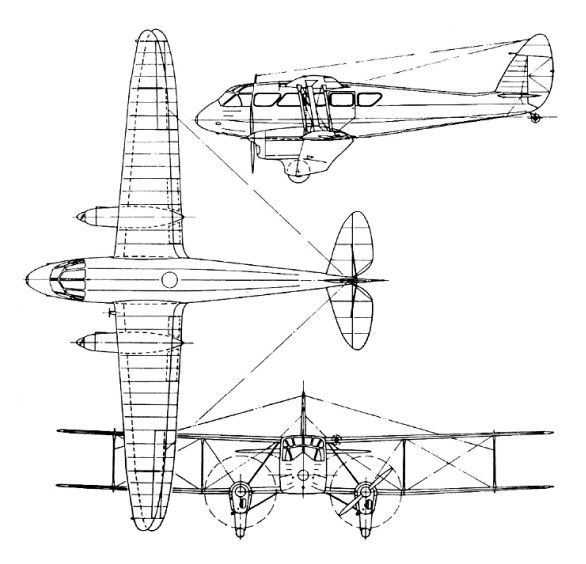
The Breda Ba.44 was a 1934 licence-built DH.89 Dragon Rapide. The prototype (MM.267) had 2 x 155 hp Colombo S.63 inline 6-cylinder engines mounted on lower, revised wing plan. Production Ba.44 were powered by 2 x 200 hp DH Gipsy Six in lowered position.
DH.89 Rapide
Engines: 2 x de Havilland Gipsy Six, 205 hp.
Prop: 2 blade metal.
Wing span: 48 ft 0 in (14.63 m).
Length: 34 ft 6 in (10.51 m).
Height: 10 ft 6 in.
Wing area: 336.0 sq.ft. (31.22 m).
Gross weight: 5,550 lb (2:517 kg).
Empty wt. 3,230 lb.
Fuel capacity 76 ImpG.
Maximum speed: 135 kts / 253 km/h (157 mph).
Typical cruising speed: 132 mph (212 km/h) at 2.000 ft (610 m).
Initial climb rate 867 fpm.
Service ceiling: 19029 ft / 5800 m
Takeoff run 870 ft.
Landing roll 510 ft.
Typical range: 578 miles (930 km).
Seats: 8
Price new: £3500
DH89A Dragon Rapide
Engines: 2 x DH Gipsy Six, 200 hp
Wingspan: 48 ft / 14.63 m
Length: 34 ft 6 in / 10.51m
Max speed: 157 mph / 253 kph
Crew: 1
Passengers: 5
D.H.89A Mk 4
Engines: 2 x de Havilland Gipsy Queen 2, 149kW/ 200 hp
Max take-off weight: 2722 kg / 6001 lb
Empty weight: 1465 kg / 3230 lb
Wingspan: 14.63 m / 47 ft 12 in
Length: 10.52 m / 34 ft 6 in
Height: 3.12 m / 10 ft 3 in
Wing area: 31.21 sq.m / 335.94 sq ft
Max. speed: 241 km/h / 150 mph
Cruise speed: 225 km/h / 140 mph
Ceiling: 4875 m / 16000 ft
Range: 837 km / 520 miles
DH.89B Dominie
Engine: 2 x DH Gipsy Queen III, 200 hp.
Wingspan: 48 ft / 14.63 m
Length: 34 ft 6 in / 10.51m
Max speed: 157 mph / 253 kph
Crew: 1
Cruise: 132 mph.
Pax cap: 8.
de Havilland DH 88 Comet
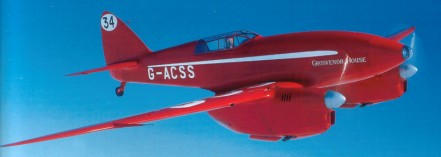
Sir Macpherson Robertson announced that he would put up the prizes for a race from Mildenhall, England, to Melbourne, Australia, to mark the Centenary of Victoria. de Havilland advertised that they were prepared to produce a 200 mph specially designed racer if anyone would put up the cash, and they received orders for three.
The de Havilland D.H.88 Comet attracted three orders before the February 1934 deadline which had been stipulated by the manufacturer for guaranteed delivery before the Race in October. Purchasers were Mr A. O. Edwards, managing director of the Grosvenor House Hotel, Bernard Rubin, and Jim and Amy Mollison. The Comet was of wooden construction throughout, the front section of the fuselage containing three large fuel tanks behind which were two tandem seats for the pilot and copilot. Two 230 hp high compression de Havilland Gipsy Six R engines were installed, driving Ratier two-position propellers which were set to fine pitch before each flight. These went into coarse pitch automatically at 241km/h, when a sealing disc in the spinner opened to release the unit’s internal pressure and thus activate the control mechanism. Other notable features included the provision of manually retractable landing gear and split trailing-edge flaps.
Designed and built in 7.5 months the first Comet was flown on September 8, 1934, only six weeks before the start of the race.
Hubert Broad flew the first Comet, intended for the Mollisons, at Hatfield on 8 September 1934. Its Certificate of Airworthiness was issued on 9 October and certificates for the other two aircraft on 12 October, just eight days before the Race.
Dawn on 20 October saw the departure of the first contestants, including the Mollisons’ Black Magic G ACSP, Owen Cathcart-Jones and Ken Waller’s G-ACSR (owned by Rubin) and C. W. A. Scott and T. Campbell Black in G ACSS Grosvenor House. Black Magic accomplished successfully the non-stop London-Baghdad leg but was forced to retire with engine trouble at Allahabad. Cathcart-Jones and Waller, after getting lost and being forced to land in Persia, struggled through to Melbourne to finish fourth in the speed section. They flew straight back, with mail and film, to set an out-and-return record of 131/2 days. Scott and Black were the speed section winners, covering the course in 70 hours 54 minutes; Grosvenor House is now preserved by the Shuttleworth Trust at Old Warden, Bedfordshire.
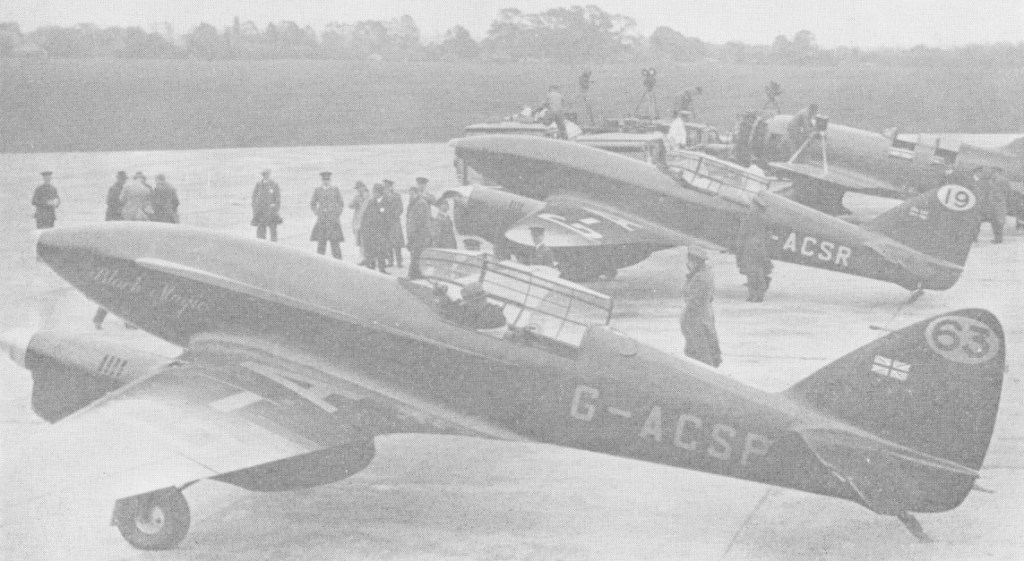
Two further Comets were built, one as a mailplane for the French government and the other for Mr Cyril Nicholson, who sponsored two unsuccessful attempts on the London-Cape record. During the second attempt the crew baled out over Sudan, on 22 September 1935.
Several more records were made, including a New Zealand and back record of 10 days 21.5 hrs.
DH 88 Comet G-ACSS Restoration
Replica
Turner, Bill DH88
D.H.88
Engines: 2 x de Havilland Gipsy Six R inline, 172kW / 230 hp
Max take-off weight: 2413 kg / 5320 lb
Empty weight: 1288 kg / 2840 lb
Wingspan: 13.41 m / 44 ft 0 in
Length: 8.84 m / 29 ft 0 in
Height: 3.05 m / 10 ft 0 in
Wing area: 19.69 sq.m / 211.94 sq ft
Max. speed: 381 km/h / 237 mph
Cruise speed: 354 km/h / 220 mph
Ceiling: 5790 m / 19000 ft
Range: 4707 km / 2925 miles at 220 mph
Crew: 2

de Havilland DH 87 Hornet Moth
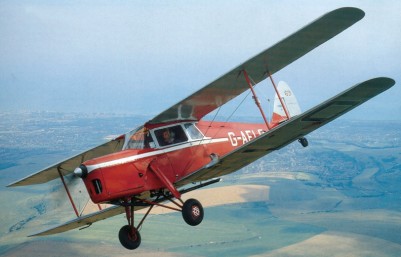
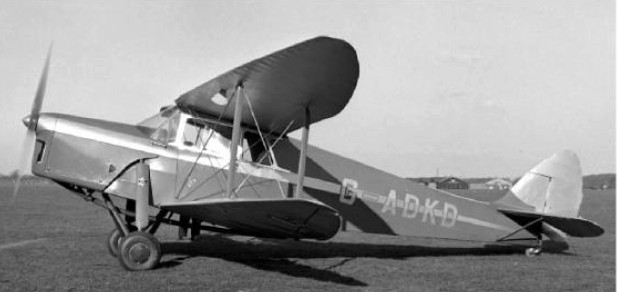
Structurally similar to the D.H.86, the D.H.87 Hornet Moth design philosophy was commercial rather than aerodynamic, and biplane wings could be manufactured far more economically than the more complicated box spars of monoplanes. An enclosed side-by-side two-seater, it had tapered wings and a spruce/plywood box fuselage with external longerons, stringers and fabric covering.
de Havilland DH 87 Hornet Moth Article
The prototype G-ACTA, first flown at Hatfield on 9 May 1934, was joined in a year-long test programme by two similar aircraft, preparing for production deliveries which began in August 1935 under the designation D.H.87A.
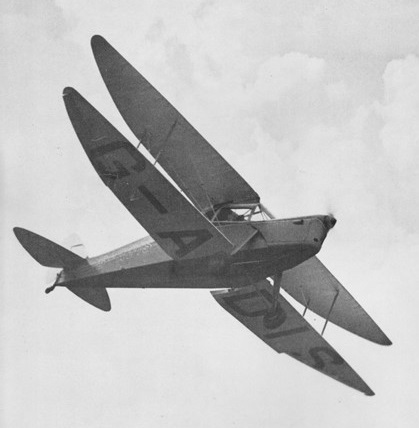
More than 60 aircraft were manufactured to this standard with wings of increased taper and span (9.93m), but in 1936 another set of wings was introduced, first fitted retrospectively to the second production Hornet Moth. These wings, virtually without taper and with almost square tips, were made available to existing owners on a trade-in basis and were fitted to almost 100 new aircraft designated D.H.87B.
Following development of a floatplane version by de Havilland Aircraft of Canada Ltd, four examples were acquired by the Air Ministry in 1937 for evaluation as seaplane trainers at the Marine Aircraft Experimental Establishment at Felixstowe, Suffolk.
Hornet Moth production, including the prototype, totalled 165 aircraft.
D.H.87B
Engine: 1 x de Havilland Gipsy Major inline, 97kW
Max take-off weight: 885 kg / 1951 lb
Empty weight: 563 kg / 1241 lb
Wingspan: 9.73 m / 31 ft 11 in
Length: 7.61 m / 24 ft 12 in
Height: 2.01 m / 6 ft 7 in
Wing area: 20.44 sq.m / 220.01 sq ft
Max. speed: 200 km/h / 124 mph
Cruise speed: 169 km/h / 105 mph
Ceiling: 4510 m / 14800 ft
Range: 998 km / 620 miles


