Detroit MI and Dayton OH.
USA
Circa 1919 and 1920 ultralights ascribed to Packard Co were in fact designed by Etienne Dormoy and built as off-hours experiments by Dormoy and his friends while employed there.
Detroit MI and Dayton OH.
USA
Circa 1919 and 1920 ultralights ascribed to Packard Co were in fact designed by Etienne Dormoy and built as off-hours experiments by Dormoy and his friends while employed there.
Based at lie de la Jatte from 1912, designing and building light, fast, single-engined flying-boats for the French Navy, RNAS and others. Total of 58 2/3-seat flying-boats acquired by U.S. Navy for coastal patrol in European waters in 1918, and two sent to U.S.A.
France
Operated under the name Hydravions J. Donnet at Neuillysur-Seine, after Percheron replaced Denhaut as designer in 1918. Did not long survive First World War, but some flying-boats used on the Antibes-Ajaccio service, 1921 -1928.
The Domrachiev D-2 (Russian: Домрачев Д-2) was designed as a two-seater aerobatic glider. Its construction was carried out in the LENOAX construction workshops in 1934 with the aim of participating in the X National Sailing Competitions to be held that year in Koktebel.
The D-2 was designed as a high-bridged, two-seater glider with long wings and a high tail bar. The wing was braced by means of steel tapes that started from the wing intrados towards the landing ski and from the extrados towards a raised structure located on the longitudinal axis of the glider. This configuration made it possible to build an extremely light wing without detriment to its structural rigidity.
Another significant detail was the wing attachment to a vertical pile located above the head of the second crew member, which allowed excellent visibility and easy access to the cabins. This vertical pile had as a distinctive feature the possibility of being moved forward or backward in order to modify the aerodynamic centering of the glider.
The landing gear consisted of a fixed ski located in the ventral region of the nacelle, following the line of the glider axis.
The gondola with the tandem cabins also featured an additional luggage area with a capacity of 80 kg. In the rear cabin a shelf was to locate a telephone set that could be used for communication with the tug aircraft.
Built in Leningrad in 1934 and first flying that September, it participated in the X National Sailing Competitions, held in Crimea, where it was aero-towed. The acrobatic two-seater Domrachiev D-2 glider arrived at the competitions in Koktebel by air, towed by a plane.
D-2
Wingspan: 18.10 m
Wing area: 19.80 m²
Length: 8.05 m
Height: 2.68 m
Empty weight: 230 kg
Optimal speed: 61 km / h
Glide ratio: 20
Minimum descent speed: 0.78 m / s
Wing loading: 19.70 kg / m²
Surface of the horizontal plane: 2.82 m²
Vertical plane surface: 1.58 m²
Ailerons area: 2.10 m²
Wing elongation: 16.5
Accommodation: 2
Soviet aircraft builder Yuri Vlarimirovich Domrachiev (Russian: Юрий Владимирович Домрачев) designed and built several gliders in Leningrad in the 1930s.
From 1931 Domrachiev began to work in the aeronautical construction section of the NIAI under the direction of IM Zharnilski. By 1934 this section separated from the NIAI, becoming an independent Special Construction Bureau (OKB), initially subordinate to the Institute’s Student Combined and later to the LII GVF.
In the OKB the Lisichkin, Bedunkovich, Krylov, Domrachiev and later Bakshayev brigades were created. Each developed their own aircraft, but in many cases they were combined to achieve the end result.
In 1933 and 1934 Domrachiev created two competition planners that participated in the national competitions at Koktebel.
When the Institute of Engineers of the Leningrad Civil Air Fleet was created, Domrachiev went on to work in the research department. In 1937, together with LS Vildgrube, he designed and built a transport glider with an M-11 engine.
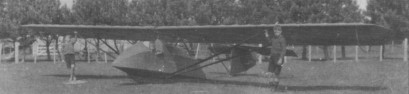
Circa 1932.
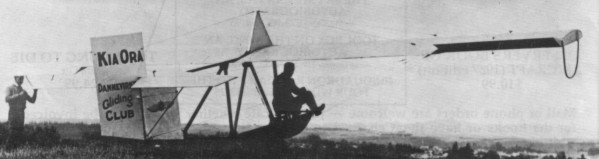
The Dominion Aircraft Company of Dannevirke, New Zealand, built a number of gliders in the early 1930s.
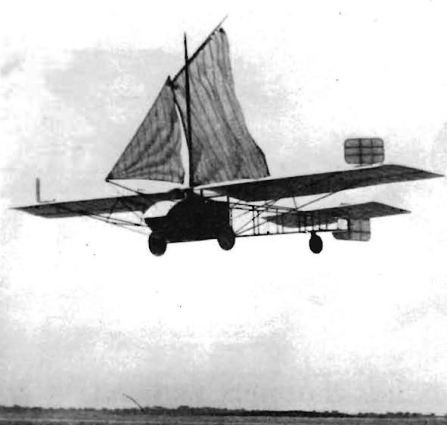
The Swiss (then) John Domenjoz was with Pegoud, the inventors of stunt flying; both were the first to complete a looping in 1913 while they worked at the Blériot School. By the late 20’s Domenjoz had got the idea to propel a glider by sail like the ancient ships. In 1930 he built at Pine Point, Maine, this glider; towed by a car at 50 mph it did reach an altitude of 200 feet above to sands at Old Orchard, but the sails proved to be utterly useless. The Domenjoz glider had an evident “Blériot connection” ….the Blériot XI type’s lattice fuselage and tail shape are all too obvious.
France
Les Etablissements Henri Dits founded in 1922 to build the designs of pioneer Breguet pilot Rene Moineau, starting with a small metal aircraft for tropical service. During First World War produced an aircraft with twin propellers driven by engine mounted transversely in the fuselage.

