Fouga

Fouga et Cie
Air Fouga
Potez Air Fouga

Fouga’s aircraft department formed 1936, subsequently building designs of M. Pierre Mauboussin who, with M. Castello, developed Castel-Mauboussin gliders and sailplanes. Operated postwar as Etablissements Fouga et Cie, becoming Air Fouga September 1956 when company was taken over, in equal shares, by Breguet, Dassault, Morane-Saulnier, Sud Est and Ouest Aviation.
Acquired by Henry Potez May 1958, renamed Potez Air Fouga. Early activities included production of Mauboussin 123 trainer, Castel C.25S, C.30S, and C.300S gliders. Castel- Mauboussin CM.10 transport glider built for French military forces, also CM.100 powered version with two Renault engines. In the latter CM-101R Renault engines augmented by two Turbomeca Pimene turbojets. Experience with CM.8-R.9 Cyclipe and with the Gemeaux led to development of the CM.170R Magister jet trainer, first flown 23 July 1952 and subsequently built in quantity for French Air Force and overseas customers.
The company operated as Potez Air Fouga until September 23,1961, when it was completely absorbed into Etablissements Henry Potez SARL. Continued development of CM.170 Magister and CM.175 Zephyr naval version, which were first flown as production aircraft on May 30,1959.

Foster-Wickner F / FW 1 / FW 2 / FW 3 / GM1

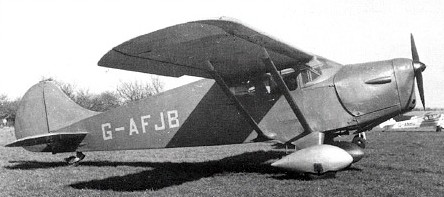
The Wicko was originally designed to use a Ford V8 car engine, and the first prototype two-seat Wicko FW1, with a modified Ford V8 engine known as the Wicko F, was completed in September 1936. This was later re-engined with a 90hp Cirrus Minor I as the FW2. A 150hp Cirrus Major installation, specifically for the 1937 King’s Cup race, resulted in the FW3, and this engine became the standard powerplant for all GMI production models.

Nine Wickos were built 1938-1939 at Southampton designated G.M.1 with the more powerful Gipsy Major engine, that being the total production.

Foster-Wickner

Established in 1934 by G. N. Wickner, V. Foster and J. F. Lusty, initially at the latter’s furniture factory at Bromleyby-Bow, London. Mr. Wickner’s earlier designs, built in Australia, included Wicko Sports Monoplane and Wicko Lion, both high-wing monoplanes on which the prototype Wicko F.W.1 was based. Of wooden construction, the F.W.1 was powered by a Ford V-8 engine, and became F.W.2 with Cirrus Minor and F.W.3 with Cirrus Major. Nine production aircraft built 1938-1939 at Southampton were designated G.M.1 with Gipsy Major engine.
The company ceased production at the outbreak of war.

Ford O-145

The 1927 Ford O-145 was a 36 hp, four-cylinder horizontally opposed air-cooled aero engine. With 143.1ci, it weighed 118 lb.

The only recorded use for flight was in the Ford Flivver lightplanes.

Henry Ford never pursued the idea of offering an aviation engine, although his models T and A auto motors were quite popular among home-builders in the ’20s.

Ford Executive

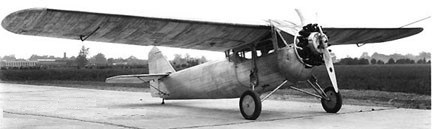
Ford Executive NX1085

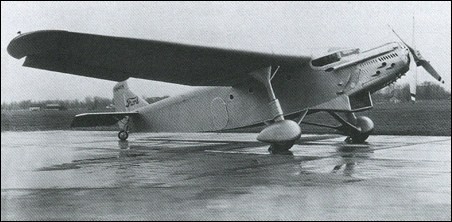
Designed by William Stout, Ford’s planned all-metal entry for the executive market was good for only one test flight. Piloted by Edward Hamilton, NX1085 proved to be tail-heavy to the extreme and was reportedly scrapped later that year.

Engine: 225hp Wright J-5
Wingspan: 45’0″
Gross weight: 3700 lb
Seats: 5

Ford 15-P

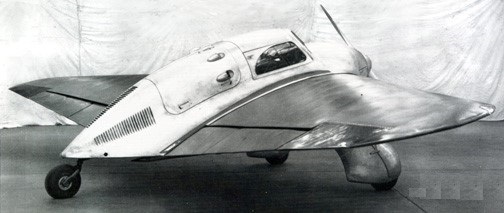
Ford 15-P NX999E

Designed by Henry Karcher the 1932 Ford 15-P was a tailless delta-wing experiment with rear-mounted motor, and a driveshaft running between the seats. Metal-clad fuselage, fabric-covered wings; full-panted gear. One was built, NX999E (some photos show NC402 which was a dummy registration), which made a few short test flights, but was damaged in an accident, and placed in storage. Although the license for this “flying wing” project was briefly renewed in 1936, there is no company record of further development.

15-P
Engine: Ford V-8, 115hp
Wingspan: 34’0″
Length: 14’0″
Range: 500
Seats: 2

Ford 14-A

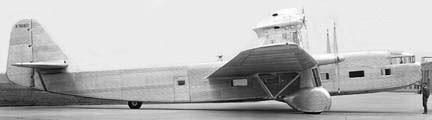
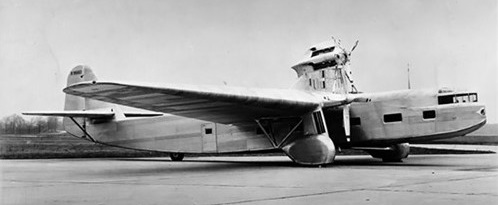
Ford 14-A N9660

The 1930 10-A design study only went as far as a wind-tunnel model with four engines, two of them pylon-mounted in a tractor-pusher configuration. The design continued in the 12-A of 1931. The 12-A was a modified 10-A design with three engines (planned for 1000hp Hispano-Suiza + two 575hp P&W Hornet). Not built, but design elements went into the 14-A.

The 1932 Ford 14-A, NX9660, involved elements from the 10-A and 12-A designs, and was the last of the Ford Tri-Motors. Pullman-style seats converted into berths in the four main, climate-controlled, eight-passenger compartments. Wing motors, with four-blade propellers, were buried, and the third was pylon-mounted atop the fuselage; compressed air starters.

It was completed by Stout Metal but never flew and was cut up in 1933.

Engines: 2 x 715hp/533-kW Hispano-Suiza, 1 x 1,100-hp/820-kW Hispano-Suiza
Wing span: 110’0″ / 33.5 m
Length: 80’10” / 24.4 m
Seats: 40

Ford Fliver

Ford Flivver #1

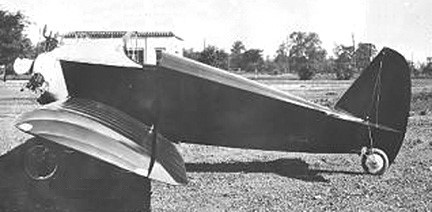
Ford demanded a one man airplane that would fit in his office. Otto Koppen took the measurements and locked himself up with one of Ford’s master craftsmen. The result was the 1926 Ford Flivver. The #1 unregistered Fliver single place open cockpit low wing monoplane was powered by a 36 hp Anzani, featured full-span combination flap/aileron, and cost $498 (original estimate).

The Fliver was flown only by two people; one was Charles Lindbergh, who saw it in Ford’s hangar during his triumphal tour of the United States.

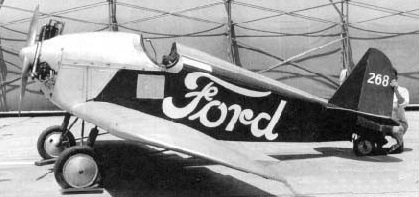
Ford Flivver #2 N268

Koppen designed a second Flivver, registered N268, a different craft in spite of its superficial resemblance to the first. In front was a Ford-developed 2-cylinder motor, created to break a world record in the 1,100 pound class. The 960 miles from Dearborn, Michigan to TitusAlle, Florida on 55 gallons of fuel. Unfortunately, the following day the pilot took it out for a short flight that turned out to be his, and the airplane’s, last. The engine quit and the airplane went into the ocean. It floated ashore the next day; matchsticks that had been stuck in the fuel vents to prevent condensation, were still in place.

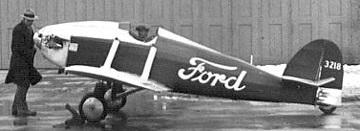
Ford Flivver #3 N3218 March 1928

Both the #3 and #4 were registered N3218, and were powered with Ford motors. On 25 February 1928, #3 crashed in Florida, killing test pilot Harry Brooks and Henry Ford was so shaken by the tragedy that he ordered further production of small planes halted.

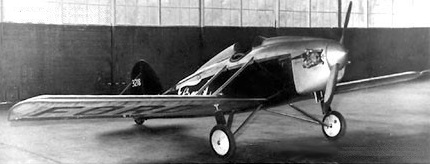
Ford Flivver #4

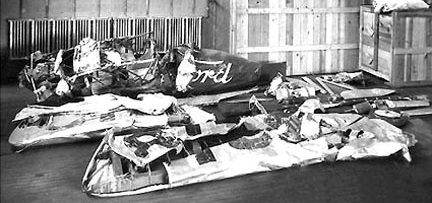
The wreckage of #3 was either restored or used as basis for restoration as #4 for display in the Ford Museum.

Wreckage of #3

1

Engine: 36hp Anzani
Wingspan: 21’9″
Length: 15’6″
Max speed: 85-95 mph
Cruise speed: 80 mph
Stall: 30 mph

Ford 8AT

Ford 8A

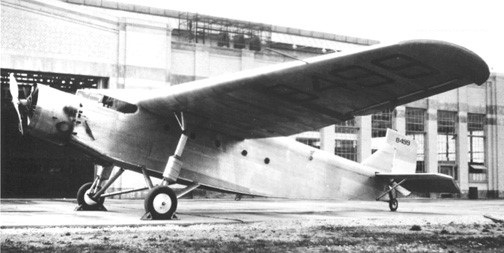
The 8AT variant (ATC 2-485) of 1931 was a single Model 5-AT-C converted as a freighter without the wing-mounted engines, seating 13. First flown on 30 July 1929 power was a 575hp P&W Hornet A and also tried were the Hornet B, 575hp Wright Cyclone, 715hp inline Hispano-Suiza, and 535hp Bristol Jupiter.

The one built was operated as a two place cargo Express with the Hispano-Suiza engine as N8499. It was refitted with a 700hp Wright Cyclone GR (2-485) in 1934 for Pacific Alaska Airways with the new registration NX/NC8499, moving to Colombia in 1938.

Ford 8-AT-S Cyclone GR NC8499

Gallery

AT-S Freighter
Engine: 715hp Hispano-Suiza
Useful load: 4900 lb
Max speed: 135 mph
Cruise speed: 110 mph
Seats: 2