The Type AA were followed by the larger Type AB of 43,000 cu ft (Navy H Class & Army No. 121), and the even larger Type AC of 185,000 cu ft (Army AC 1) delivered in 1922.
Inter-Wars
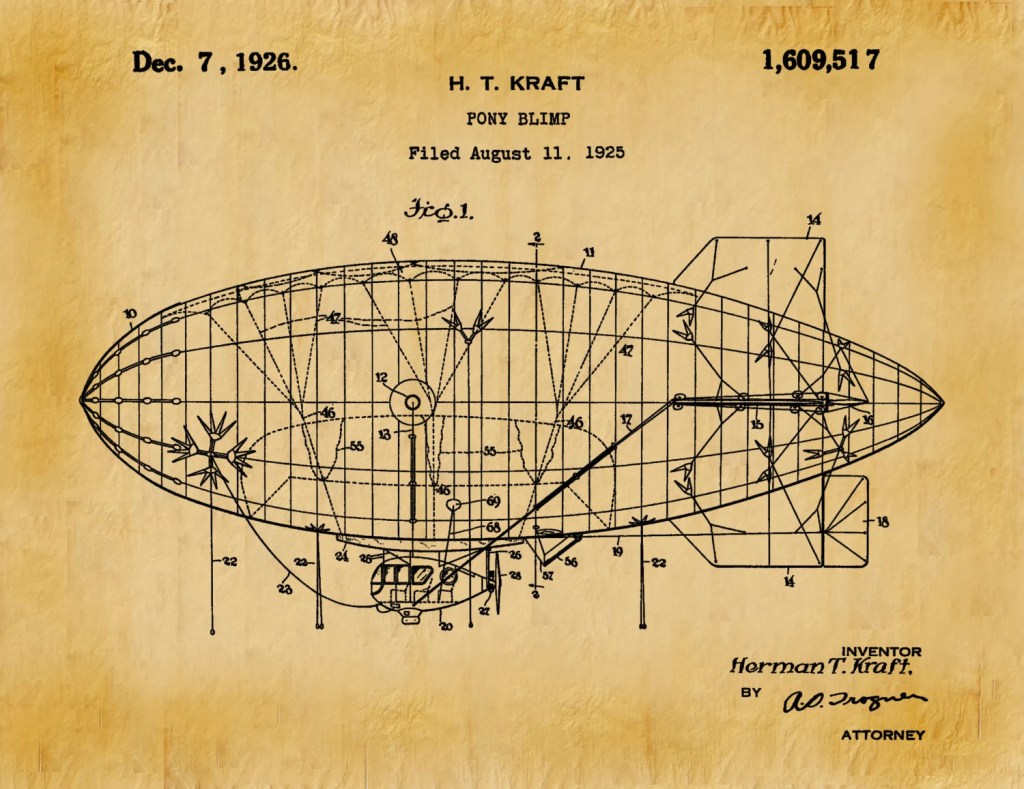
Goodyear Pony Blimp / Type A / Type AA
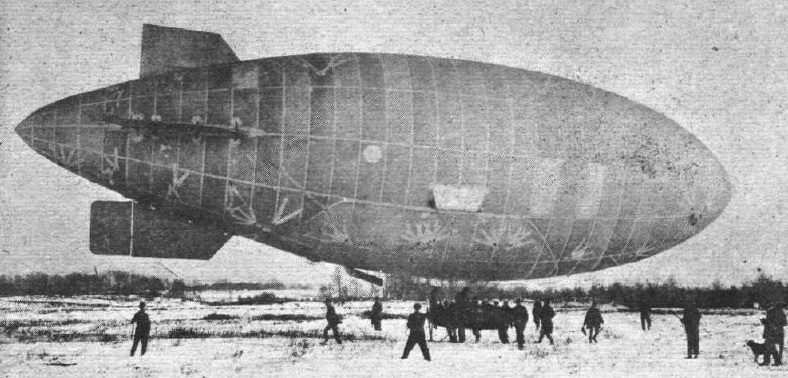
Although short lived, the FD was soon to be followed by three much smaller craft of 35,500 cu ft which were known as “Pony Blimps”. These were described as aerial runabouts, but their high initial cost and expense of operation precluded their large scale adoption by private owners.
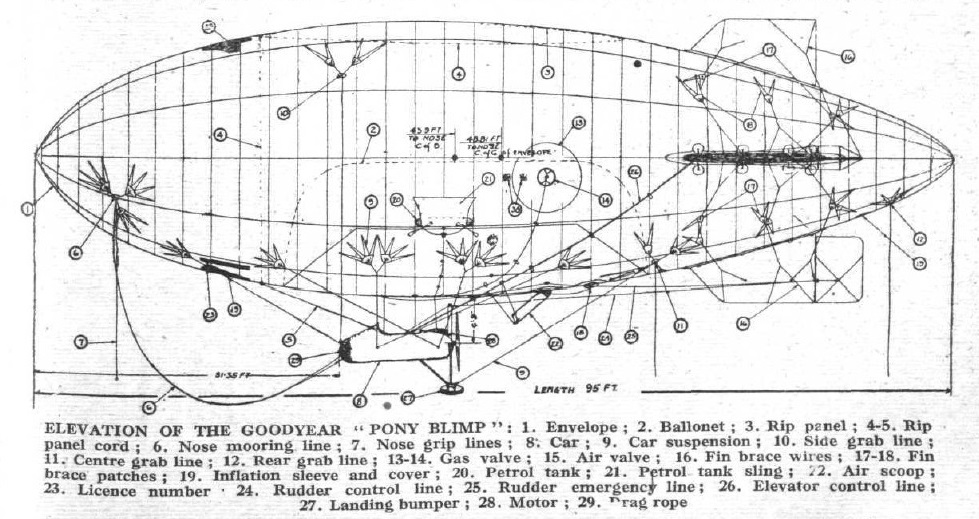
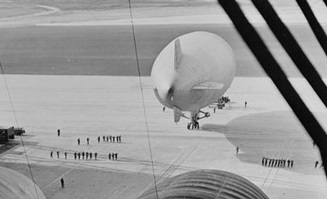
The first example was the Type A with a pusher engine built in December, 1919, the second and third being tractor engined Type AA, completed in April and June, 1920. No more of this type were built for civil use but the design attracted the interest of the military, with the result that the Army bought four Type AA in 1920 21, numbering them OA 1 to 4.
Engine: Water cooled, 40 hp
Length: 95 ft
Capaciy: 35,000 cu.ft
Ballonet capacity: 7000 cu.ft
Useful lift: 935 lb
Goodyear Type FD
The lack of military contracts caused Goodyear to look at the possibility of building commercial airships, and this led to a series of designs which were to become world famous. The first of these was the Type FD “Wingfoot Express”, of 95,000 cu ft, which first flew in June, 1919. Just over 160 feet long and capable of carrying five people, it was powered by two Gnome Le Rhone rotary engines which were suspended from the envelope above and behind the car. Although short lived, it was soon to be followed by three much smaller craft of 35,500 cu ft which were known as “Pony Blimps”.
Goodyear Type FC / ‘F’ Class / A-4
With the end of the war, large contracts for naval airships were cancelled but work continued on various military designs such as the Type FB (U.S. Navy E Class) and Type FC (Navy F Class and Army A-4), both of 95,000 cu ft capacity.
Goodyear Type FB / ‘E’ Class
With the end of the war, large contracts for naval airships were cancelled but work continued on various military designs such as the Type FB (U.S. Navy E Class) and Type FC (Navy F Class and Army A-4), both of 95,000 cu ft capacity.
Goodyear ‘D’ Class
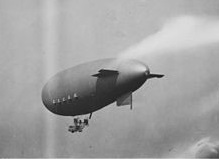
The BA contract was followed by others for C and D Class ships, each slightly larger and more improved than the preceding type. The D class blimp was a patrol airship used by the US Navy in the early 1920s. The D-type blimps were slightly larger than the C-type and had many detail improvements. The Navy continued the practice of dividing the envelope production between Goodyear and Goodrich. The control cars were manufactured by the Naval Aircraft Factory. The major improvements over the C-type blimps were a better control car design and easier, more reliable controls and instrumentation. The engines were moved to the rear to reduce noise and allow better communications between crew members. The fuel tanks were suspended from the sides of the envelope. The envelope was identical to the C-type, except an additional six-foot panel was inserted for a total length of 198 feet (60 m) and a volume of 190,000 cubic feet (5,400 m3). The last of the D-Class, D-6, had a different control car designed by Leroy Grumman who later founded the Grumman Aircraft Engineering Corporation.
The D-1 burned the day of its first flight, 13 July 1920, in the Goodyear hangar at Wingfoot Lake, Ohio. The D-2, D-3, D-4 and D-5 were transferred to the United States Army which the Air Ship Board had given the primary role of operating non-rigid airships after World War I. D-3 participated as an observation and photography aircraft at the famed “Mitchell” bombing test of 1921. D-3 also participated in the Mitchell bombing trials and tested experimental mooring masts. D-3 also participated in early “hook-on” experiments to see if it was possible for an airplane to fly up to and hook onto a trapeze hanging from an airship. No actual hook-ons were achieved, but approaches were practiced. D-4 also participated in the Mitchell trials, for observation and photography. The D-5 was never operated by the Army with that designation. After the loss of D-2, the D-5 was erected with more powerful 180 hp Wright V engines and flown as the D-2 (no. 2) D-2 (no 2 is a designation created by historian James Shock, never used by the Army). There is no evidence the airship flew for the Army with the designation “D-5”. D-5 is believed to have been renumbered “D-2” after the loss of that airship.
The Navy retained one additional D-type, the D-6. The D-6 was built by the Naval Aircraft Factory, Philadelphia, Pennsylvania, but her design was sufficiently different that she was distinct from the other five D-class airships. It featured a further improved control car (the “D-1 Enclosed Cabin Car” which had a water tight bottom for landings on water and internal fuel tanks. The D-6 was burned in the Naval Air Station Rockaway hangar fire of 31 August 1921 along with two small dirigibles, the C-10 and the H-1 and the kite balloon A-P.
The last operational D-type, the D-3 was decommissioned by the Army sometime in 1924.
Typical Specifications
Length: 198 ft 0 in (60.37 m)
Diameter: 42 ft 0 in (12.80 m)
Height: 58 ft 0 in (17.68 m)
Volume: 190,000 cu.ft (5,380 cu.m)
Useful lift: 4,340 lb (1,969 kg)
Powerplant: 2 × Union, 125 hp (93 kW) each
Maximum speed: 58 mph (93 km/h)
Cruise speed: 40 mph (64 km/h)
Range: 1,480 miles (2,380 km)
Endurance: 37 hours
Crew: Four
Armament: 1 × .303 Lewis gun
Bombload: 4 × 270 lb (122 kg) bombs
Gonzales Gil-Pazo GP II
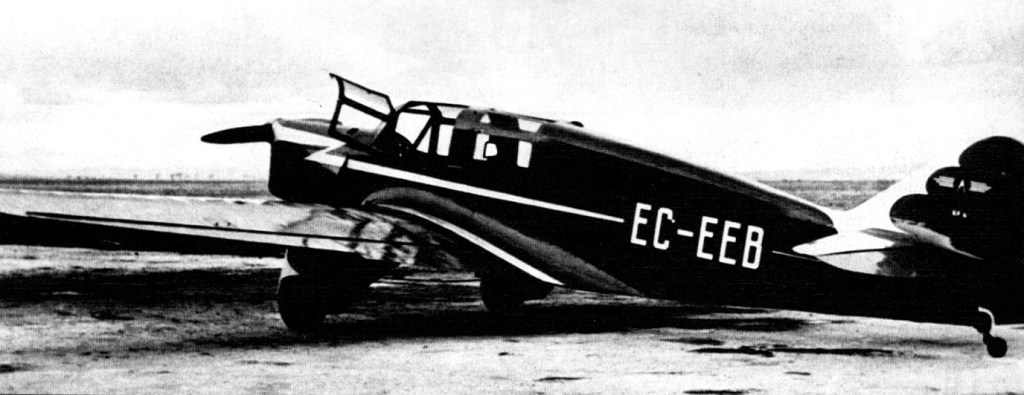
Gonzales Gil-Pazo GP II was built in Spain by Arturo Gil y Santibanez and Jose Pazo Montes. This special version was fitted with a single 130 hp engine. It took part in a record attempt from Barcelona to Senegal, piloted by Ramon Torres and Carlos Coll of the Aero Club Aero Popular de Barcelone, but landed in Morocco after cross winds affected its flight. It is photographed here at Madrid airport during test flights, where it proved it could average a speed of 250 kph with a range of 2000 km.
It was destroyed in an accident at Los Alcazares in January 1937.
Golden Eagle Chief
A high-wing two-seat training monoplane circa 1929. Three versions built with engines from 60-100 hp.
Golden Eagle Aircraft Corp
USA
Incorporated in 1929 at Inglewood, California, with F. M. Smith as chief engineer. Built Golden Eagle Chief high-wing two-seat training monoplane at that time. Three versions built with engines from 60-100 hp.
Gnome-Rhône
Société des Moteurs Gnôme was founded in 1905 by Louis Seguin. In 1915, this firm merged with the Société des Moteurs Le Rhône, founded three years earlier by Louis Verdet, to form Gnôme & Rhône. While Gnôme had continued to produce rotary engines in the 50 to 100 horsepower range, Rhône had refined its fixed-cylinder engines to produce 200 horsepower. However, both these lines of engines were being outclassed in terms of reliability, economy, or power by several contemporary engine manufacturers.
Seguin brothers of Gnome-Rhone Article
Nevertheless, the two merged companies were quite successful commercially, thanks to licensed production in Great Britain, Russia, the United States, Sweden, Germany, and Japan, as well as joint ventures in Italy and elsewhere.
A number of factors hit Gnôme & Rhône (G&R) hard after the war. A huge tax burden was levied based on the firm’s previous international success. At the same time, a mass of war surplus engines glutted the market.
Unlike its other domestic rivals, Gnôme & Rhône lacked experience in areas apart from aero engines, a market now glutted by thousands of surplus motors. A variety of schemes, from making sewing machines to engines for farm tractors or cars, all failed. In constant francs, the company’s sales in 1921 were almost half those of 1913, though the factories were five times larger, notes one scholar in the journal Entreprise et Histoire. In that year, the already legendary company reduced its employment from 6500 workers to 1200.
Production of motorcycles under the Gnôme & Rhône was one area that produced quite satisfactory results in the marketplace; in fact these machines gained a devoted following. In 1922 the English firm Bristol licensed to G&R the right to produce its powerful air-cooled radial engines producing up to 450 horsepower, as well as the freedom to sell them anywhere in the world except for the United States and the territories of the British Empire. With the support of its banks, G&R was able to retool its workshops to build engines, including the new Jupiter introduced in 1923. At the time, G&R had also taken a significant holding in a French-Romanian airline, which helped establish its engines in Eastern Europe.
Between 1924 and 1928, sales increased more than sixfold. At the same time, the air, sea, and land branches of the French military were deciding their outdated equipment was in need of replacement, hence, another blossoming market at home. Expanding commercial fleets produced still more demand. The radial Jupiter engines earned a reputation for being simple to run and easy to fix, even if in-line and V-8 engines made by Hispano-Suiza and Lorraine-Dietrich were more powerful. A novel program, instituted in 1924, allowed for the lease of the engines for a given number of flight-hours, which relieved designers and manufacturers some of the financial strain associated with bringing out new models of aircraft. The popular Jupiter engine was subsequently licensed for production in several European countries as well as the Soviet Union and Japan.
G&R introduced its K family of engines in 1928. In terms of power, this series culminated in the 750 horsepower 14K licensed to a Soviet factory for eventual use in Antonov transports. G&R’s designers evolved L, M, and N families of engines by 1939; one of the latter achieved 1150 horsepower.
Air power played a determining role World War II, and G&R engines had a significant part to play. The Soviet Union’s Molotov factory was producing 300 licensed G&R engines a month in 1940 for use in biplanes and Sukhoi fighters. In Japan, Mitsui illegally copied the 850 h.p. 14K engine, producing the “Suizei” powerplant found in the Mitsubishi Zeroes that attacked Pearl Harbor. During the Nazi occupation of France, G&R became a subsidiary of BMW. Emmanuel Chadeau writes in Entreprises et Histoire that G&R thereby influenced 16 manufacturers in 14 countries during the war; this off-shore production nearly equalled G&R’s own output of 8,000 motors a year, together accounting for a quarter of the worldwide market.
The high share price that G&R commanded prevented it from being nationalized before the war. However, this did come to pass after the Liberation. SNECMA, la Société nationale d’étude et de construction de moteurs d’aviation, was thus created on May 29, 1945. The company was an amalgamation of diverse design bureaus and workshops; it inherited a work force of 10,000 mostly part-time employees. Along with G&R, Snecma was given some of the factories of the Société des moteurs et automobiles Lorraine, formerly Lorraine-Dietrich, which had been nationalized as la Société nationale des moteurs and had been relegated to making parts for tanks. Some of Snecma’s other facilities had been devoted to the production of German Junkers engines by the thousands during the Nazi occupation. G&R also owned a factory of the Aéroplanes Voisin firm, which had gone bankrupt in 1938.

