
Gourdou-Leseurre B-3
Gourdou-Leseurre joined Nieuport in 1925 to become Loire-Nieuport.
Joint designers of a parasol-wing monoplane in 1918. Few built. Developed into C.1 fighter of 1922 with retractable landing-gear and Gnome-Bristol Jupiter engine. In 1925 became associated with the French dockyard Ateliers et Chantiers de la Loire, with change of name to Loire-Gourdou-Leseurre. In 1929 disassociated with LGL and returned to original title.

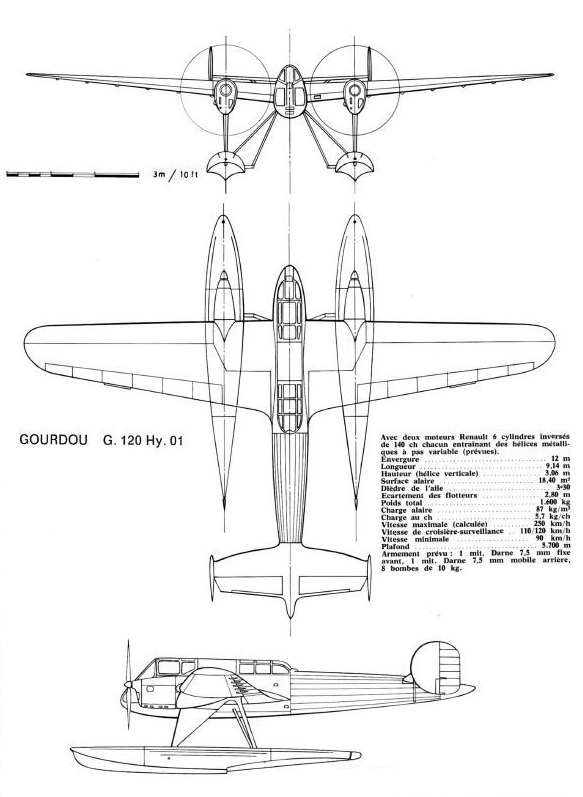
In 1937, the French Navy launched a program for a twin-engine, catapultable twin-engine seaplane for anti-submarine warfare. The aircraft should not exceed a weight of 1,600 kg, and carry 10 bombs of 10 kg. It needed a top speed of 250 km / h, a minimum speed of 90 km / h, and a cruising speed of 110 to 120 km / h. Gourdou proposed a plane equipped with high-lift devices.
In early 1938, the Technical Service of Aeronautics commissioned a life-size, rectangular wing with a constant profile, which passed the tests in the large Chalais-Meudon wind tunnel in June. This wing of 12 m wingspan and 18 sq.m wing surface, resulted in the order of a prototype.
The structure of the wing was two longitudinal members braced by oblique ribs lattice. The wing was fabric covered. The aircraft had a Fowler-type double-flap system, fitting one into the other. In the “out” position, the ensemble retreated by increasing its initial surface area by 50% and opening two slots. The slits obtained by this system were “convergent-divergent”. They differed from the converging slits of Handley-Page beaks and flaps of Bernard aircraft. Once the shutters returned, there were only small dents on the underside.
The fuselage was of welded steel-molybdenum tube structure. It had an advanced cockpit, and a firing point for the gunner behind a common fairing. This defensive post was equipped with a 7.5 mm Darne machine gun. A second machine gun of the same type, fixed, was installed in the nose. The cockpit roofs were glazed, and the front part of the fuselage was Plexiglas.
Both floats each had a volume of 1500 litres. Each float was located under the engine nacelles. They were held in the vertical plane by a triangular panel and a rear strut. Two slashes connected him to the fuselage. The floats were built in three elements, like those of the seaplanes Bernard H.52 C1 and H.110 C1.
The empennages were also made of welded steel tubes. To clear the shot in the rear weapon, the tail was twin fin.
The aircraft was subjected to static tests on a specially designed bench in the Parc Saint-Maur plant. At the beginning of the winter of 1939-1940, the seaplane was transferred to Chalais-Meudon where a special three-column support had been built on the balance plate of the large wind tunnel. In December 1939, the glider tests were carried out, flaps out. The results were disappointing. The lift was 30% lower than expected, the drag higher, the stability at depth mediocre. The director of the wind tunnel tests, Mr. Rebuffel, decided to visualize the flow on the wing with a thin stream of hot oil. The defect was a small oil cooler placed in the leading edge of the wing between the fuselage and the engine. The air intake was on the underside and the exit located on the rear. The smoke clearly indicated that this exit was prominent and caused air separation throughout the area between the fuselage and the engine. Once this radiator output changed, everything returned to normal. The exit and the return of the shutters, in 11 seconds, created a normal flow.
The powered tests began in February 1940, with test pilot Jean-Marie Le Borgne. The metal propellers that were not delivered on time were replaced by wooden pitch propellers. The results confirmed the calculations: the stability was good.
The G.120 was transported to Athis-Mons, in a rented shed on the banks of the Seine. It was launched on June 1, 1940. The test pilot Le Borgne made several hydroplanings, shutters closed, with a test engineer in the rear seat. Passing on his own wake, the pilot noticed a certain lack of rigidity in the behaviour of the floats. During another test, the flaps released, and at 70 km / h the G.120 took off by surprise, after 100 m and rose to 20 m of altitude. After a small flight of 200 m, the pilot landed without difficulty. The next day, the aircraft flew again in front of the STAé officials and flew 50 m above the water for more than 3 km. After this flight, the pilot pointed out the lack of effectiveness of the ailerons. He had been obliged to counter the lateral wind with the rudder. The flotation behaviour of the floats was remedied. This work could not be completed because of the German invasion. To prevent the prototype from falling into the hands of the enemy, Le Borgne destroyed it and sank the wreck in the Seine.
Gourdou G.120 Hy
Engines: 2 x Renault, 140 hp
Wingspan: 12 m
Length: 9.14 m
Height: 3.06 m
Wing area: 18,40 sq.m
Cruising speed: 110-120 km / h
Maximum speed: 250 km / h
Ceiling: 5,700 m
Wing load: 87 kg / sq.m
Load factor 5.7
Armament: 2 x Darne 7.5 mm machine guns
Bombload: 8 x 10 kg bombs
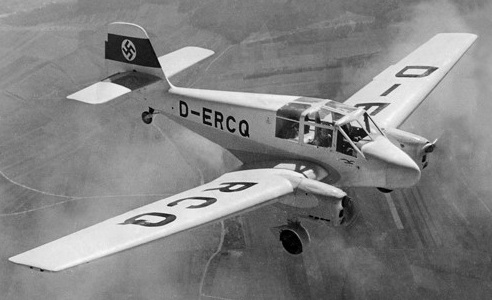
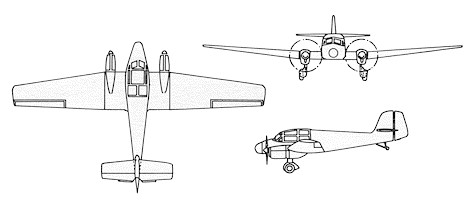
In January 1937 Major Werner Junck, chief of the LC II, the technical wing of the Reichsluftfahrtministerium responsible for the development of new aircraft, informed various minor aircraft manufacturers such as Gothaer Waggonfabrik, Bücker, Fieseler, Flugzeugwerke Halle and Klemm that they would not get any contracts for the development of military aircraft. He therefore advised them to concentrate in the development of a Volksflugzeug or a small twin-engined plane. As a result, Gothaer Waggonfabrik developed the Go 150.
The aircraft was a twin-engined monoplane with an enclosed cockpit, designed by Albert Kalkert.
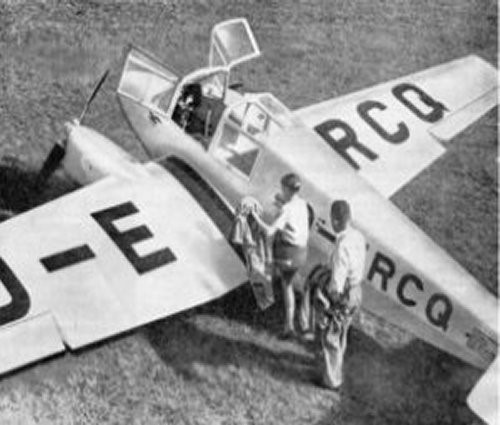
The first, D-ERCQ, first flew in 1937. The results of this flight were good, and production began. The aircraft was used to train both civilian and Luftwaffe pilots. The Go 150 was later also used in tests, where it was towed by a Heinkel He 46.
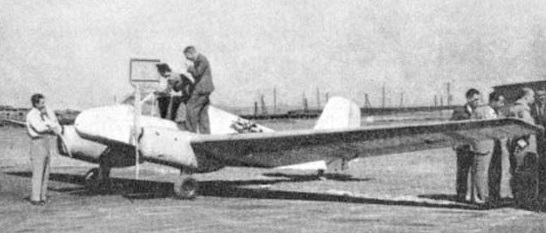
Two prototypes were built, followed by a series of 10. All of them received civil registration. Another series with 10 aircraft was planned but not fulfilled.
The Go.150 established flight altitude records in its class. Firstly, three test attempts in which the aircraft reached heights of 7100 m, 7500 and 7800 m were made. Only when there was full confidence in achieving the record, the Go.150 made the attempt.
On July 5, 1938, piloted by Fritz Platz, after 45 minutes he had reached 7,000 meters, but fell sharply in this rate of climb. At an altitude of 7100 meters, it was only 1m\sec, and in another 700 meters, it decreased to 0.5 m\sec. After 1.5 hours he reached an estimated height of 8,000 meters. After ascertaining the correct indication of the instrument pilot, and after 30 minutes, made a successful landing at its airport. This record was officially recorded FAI.
Engines: 2 × Zündapp Z 9-092, 37 kW (50 hp) each
Wingspan: 11.80 m (38 ft 9 in)
Wing area: 17.50 m2 (188 sq ft)
Aspect ratio: 8.1
Length: 7.15 m (23 ft 5 in)
Height: 2.03 m (6 ft 8 in)
Empty weight: 535 kg (1,179 lb)
Gross weight: 850 kg (1,874 lb)
Max takeoff weight: 1,036 kg (2,284 lb)
Fuel capacity: 80 kg
Oil capacity: 6 kg
Load: 315 kg
Fuel consumption: 12.7 l/100 km
Flying weight 48.5 kg/sq.m
Maximum speed: 200 km/h (124 mph; 108 kn)
Cruising speed: 185 km/h (115 mph; 100 kn)
Landing speed: 85 km/h
Range: 900 km (559 mi; 486 nmi)
Service ceiling: 4,200 m (13,780 ft)
Rate of climb: 2.74 m/s (539 ft/min)
Time to 1000m: 6min. 5sec.
TO dist to 20m: 400 m
Landing dist from 20m: 500 m
Crew: 1
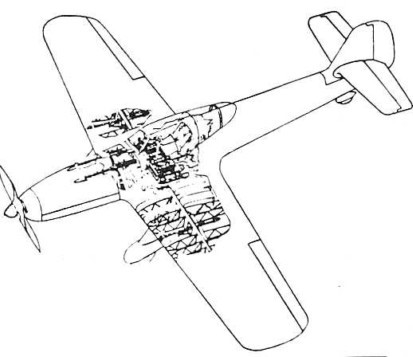
The Gotha Go 149 was a military aircraft developed in Germany in the mid-1930s for training fighter pilots. It was a conventional low-wing cantilever monoplane with tailwheel undercarriage, the main units of which retracted inwards. The wing was wooden, while the monocoque fuselage was metal. Two prototypes were constructed, and an armed version was also proposed as a light home-defence fighter (Heimatschutzjäger) armed with two 7.92 mm (.312 in) MG 17 machine guns, but the Luftwaffe did not purchase either version of the design, and no further examples were built.
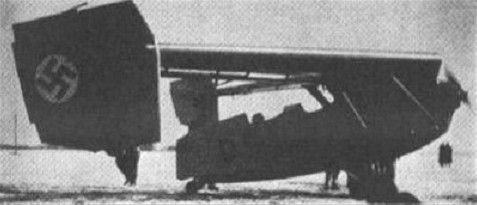
The Gotha Go 147 was a German experimental prototype reconnaissance aircraft designed in 1936. Designed by Gothaer Waggonfabrik and Albert Kalkert, construction of the two-seater aircraft was abandoned before the end of World War II.
Featuring an unconventional design, it was built to test how an aircraft without a tail would fly, with the hope of using the experience to produce a future version for military use. Construction was suspended after the prototype proved to have poor flight characteristics.
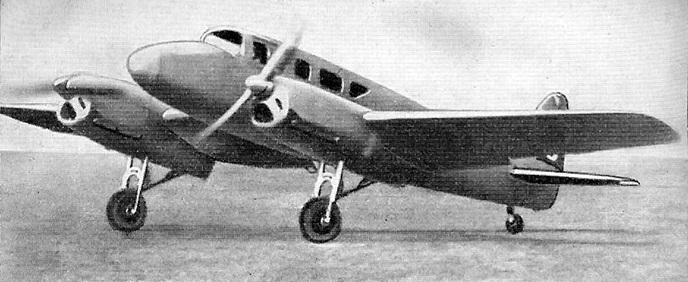
The Gotha Go 146 was a twin-engine utility aircraft developed in Germany in the mid-1930s. It was a conventional low-wing cantilever monoplane with tailwheel undercarriage, the main units of which retracted into the engine nacelles on the wings. It was offered to the Luftwaffe as a high-speed courier aircraft, but the Siebel Fh 104 was selected instead. With Gotha unable to attract other customers, no serious production was undertaken and a small number of prototypes were the only examples built.
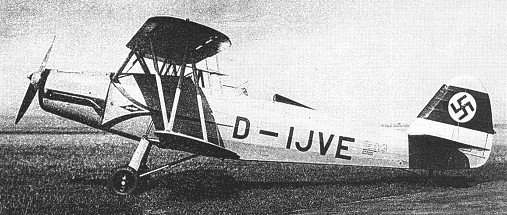
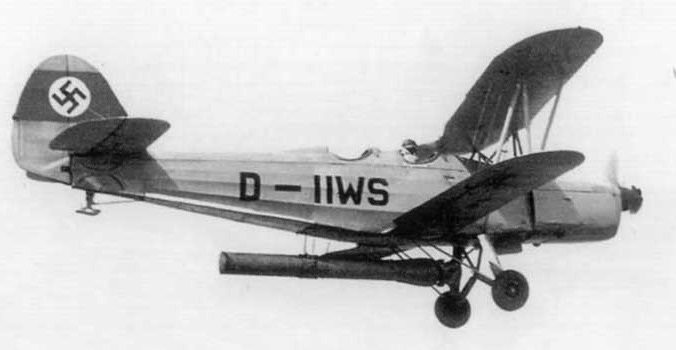
Gotha was closed by the terms of the Treaty of Versailles, but in 1933 the company resumed aircraft manufacture, and its first product was the Go 145 trainer. This first flew in February 1934 with a fabric-covered all-wood airframe, and was ordered into immediate production as a Luftwaffe basic trainer with the designation Go 145A. 9500-10,000 aircraft were built, including BFW and Focke-Wulf, and such was the utility of the type that in World War II large numbers were used by the Storkampfstaffefn (later Nachtschfachtgruppen) to harass the Soviet forces. The type was also built in Spain as the CASA 1115-L, and in Turkey. German variants were the Go 145B with an enclosed cockpit and landing gear spats, and the Go 145C gunnery trainer with a pivoted 7.92-mm (0.312-mm) machine-gun in the rear cockpit.
Go 145A
Span: 9.m (29ft 6.25 in).
Length: 8.7m (28 ft 6.5 in).
Powerplant: l x Argus As 100, 179kW (240 hp).
Armament: none.
Max TO weight: 1380 kg (3,043 lb).
Max speed: 132 mph at sea level.
Operational range: 391 miles.
Go 145B
Go 145C
Operated aircraft works and flying school at Gotha and seaplane school at Warnemunde in First World War. Manufactured large quantities of aircraft during the war, including seaplanes and twin-engine bombers. Closed by Versailles Peace Treaty. Reopened in mid-1930s with two-seat training biplane, Go 145. In Second World War built Bf 109 fighter and Do 17Z bomber, also Go 242 glider and a powered version designated Go 244.
A high-wing monoplane

