Gray & Buchanan Brokker

In August 1922 the Daily Mail newspaper offered a £1,000 prize for the longest duration flight by an unpowered, heavier than air aircraft. The competition was to be organized by the Royal Aero Club, who chose the site (Itford Hill, on the Sussex South Downs near Lewes) and the date (16–21 October). This gave competitors six weeks to design, build and transport their entries. Thirteen arrived in time and one of these was the aircraft nicknamed Brokker, competition number 31.

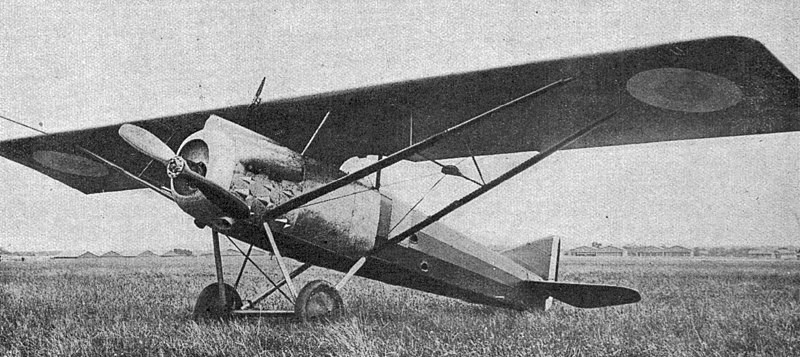
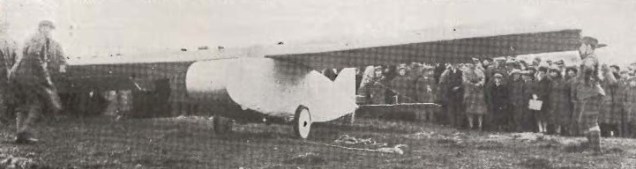
Built by Sqn. Ldr. Alec Gray and F/O W. J. Buchanan, the Brokker was, as its name suggested, a fusion of a Bristol and a Fokker aircraft. Specifically, the upper wing of a Fokker D.VII married to the engineless fuselage of a Bristol Fighter.

The Brokker was a glider which got its name from the fact that it was constructed from the wings of a Fokker D.VII and the fuselage (less engine) of a Bristol F.2B Fighter. It was put together from two of the cheap and unwanted airframes left at the end of World War I; the wings and fuselage each cost 5/- (25 p), with 8/6 (42.5 p) chiefly for dope and plywood, a total of 18/6 or 92.5 p.

The Fokker D.VII wing had advantages over most other World War I fighters as it was one of the few to use a thick airfoil. The merits of these only emerged towards the end of the war, and then only in Germany: structurally, they could be internally braced and more importantly they produced lower drag and higher lift, particularly at high angles of attack, than the usual thin wings.

On the Brokker, the D.VII wing was simply clamped to the top of the rectangular cross section Bristol fuselage, forming a high wing cantilever monoplane. Since there was no propeller to need ground clearance, the Fighter’s tall undercarriage was replaced with a pair of wheels mounted outside the lower longerons. The now empty nose of the Bristol was enclosed with a new, single curvature fairing.

It first flew on 21 October 1922 at Itford Hill, on the South Downs near Lewes, East Sussex.

The Brokker arrived late at the Iford meeting and was not flown until the final day. Its first launch was not successful but the next resulted in a flight of over 90 mins ended only by darkness, the third longest flight of the week. The relative steadiness of the heavy Brokker in the strong winds of the last day, compared with all other competitors with their low wing loadings, was noted. Gray received the Royal Aero Club prize of £50 third longest flight.

After the competition Gray took it to Salisbury Plain where he was to conduct tests for the Air Ministry on the suitability of gliders in pilot training programmes.

The aircraft was lost in a fatal glider accident on 28 August 1923. The pilot, Neville Charles Waltho, was thrown out of the cockpit when the Brokker stalled on a hillside near Pewsey.

According to a contemporary report in Flight dated September 6 1923:

“LAST week the first fatal glider accident in England occurred when Flight-Lieut. Neville Charles Waltho was piloting a monoplane glider at Milton Hill, near Pewsey, Wilts. It appears that Waltho had been gliding for several minutes and was about to land, when the machine went into a dive.

The pilot was thrown out and killed instantly. The machine used was, we believe, the ” Brokker,” flown by Squadron Leader Gray at Itford last year.”

It was the first fatal glider accident in England since Percy Pilcher’s death in 1899.

Wingspan: 29 ft 4 in (8.93 m)
Gross weight: 500 lb (227 kg) approx
Seats: 1
Granger Archaeopteryx

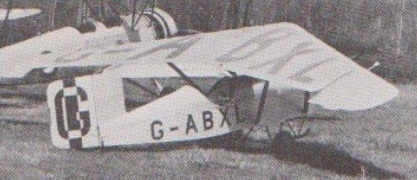
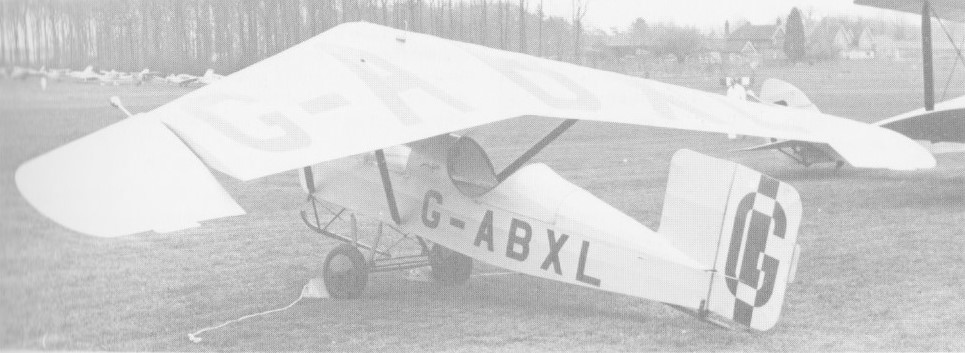
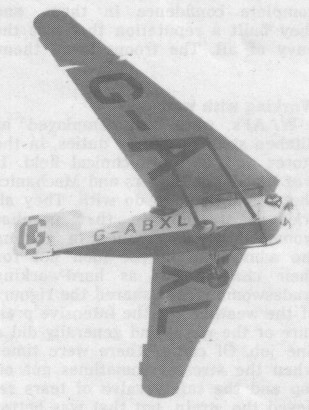
Designed in 1926 by R.F.T. and R.J.T.Granger and C.H.Latimer-Needham, the Archaeopteryx was built over the next four year at Attenborough, Notts. With a parasol configuration it retains a normal fin and rudder.

Granger Archaeopteryx G-ABXL, ailerons taking up the entire wing tips pivoting from a central point.

First flown in October 1930, it was flown regularly on short trial hops, mainly from Tollerton, Notts, before being officially registered on 3 June 1932 as G-ABXL cn 3A. The sole example built survived until stored through the war years at Chilwell, and after the war was presented to the Shuttleworth Trust.

It was restored to flying condition in 1971 and flown from Old Warden since.

Engine: Bristol Cherub I, 32 hp
Wingspan: 27 ft 6 in
Length: 15 ft
AUW: 612 lb
Max speed: 95 mph

Grahame-White E.7 Aero-Limousine

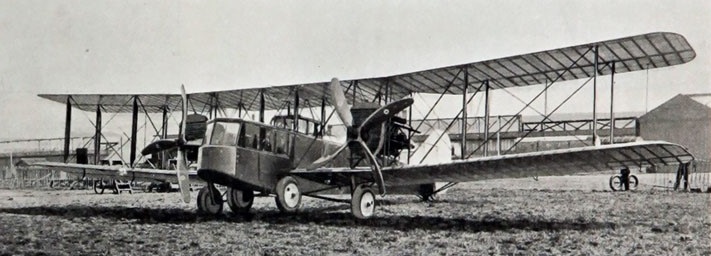
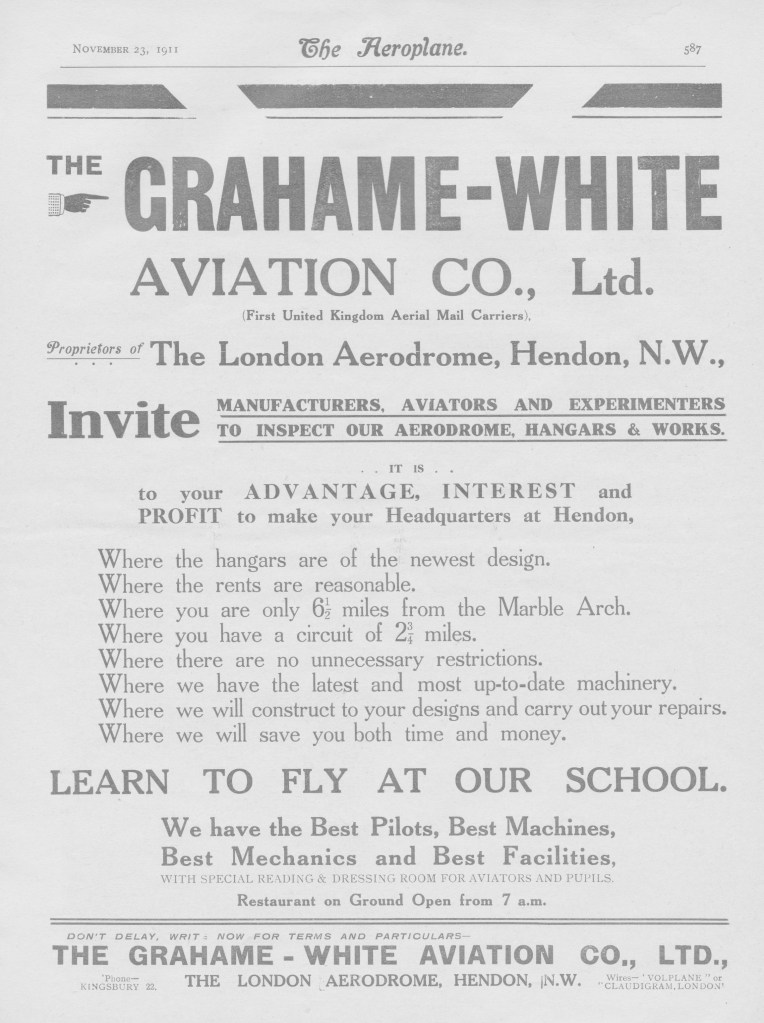
The Grahame-White G.W.E.7 was a twin-engined transport biplane, designed by M Boudot and built by Grahame-White Aviation Company at Hendon.

With folding wings, it seated four passengers in a glazed compartment between the centre section struts in the nose with the pilot behind. Powered by two 320 hp (239 kW) Rolls-Royce Eagle V piston engines.

Finally completed post-war, the only G.W.E.7, registered G-EALR was first flown in 1919.

It was damaged beyond repair in a forced landing at Hendon in the same year. The damaged remains were burned in 1920.

Engines: 2 × Rolls-Royce Eagle V, 320 hp (239 kW) each
Wingspan: 60 ft 0 in (18.29 m)
Length: 39 ft 0 in (11.89 m)
Empty weight: 5785 lb (2624 kg)
Gross weight: 7947 lb (3605 kg)
Maximum speed: 116 mph (186 km/h)
Crew: 2
Capacity: 4

Grahame-White E.6 Bantam

The Grahame-White G.W.E.6 Bantam was a single-seat sporting biplane, designed by M Boudot the Bantam was a conventional biplane powered by a nose-mounted 80hp (60kW) Le Rhône rotary engine with a single open cockpit.

Two examples were built of this small single-seat sporting biplane, and registered K.150 (G.W.E.6) and K.153 (G.W.E.6A), and a third example was flown in South Africa in the 1920s.

Two aircraft took part in the 1919 Aerial Derby at Hendon Aerodrome, but neither finished the race.

The E.6 was developed into the Express Air Mail aircraft.

Engine: 1 × Le Rhône 9C, 80 hp (60 kW)
Wingspan: 20 ft 0 in (6.1 m)
Length: 16 ft 6 in (5.03 m)
Empty weight: 640 lb (290 kg)
Gross weight: 995 lb (451 kg)
Maximum speed: 100 mph (160 km/h)
Crew: 1

Grahame-White

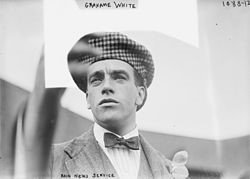
Claude Grahame-White (1879 – 1959)

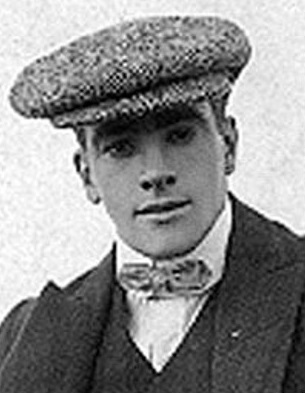
Grahame-White was born in Bursledon, Hampshire in England on 21 August 1879, and educated at Bedford Grammar School. He learned to drive in 1895, was apprenticed as an engineer and later started his own motor engineering company.

Grahame-White Article

Grahame-White’s interest in aviation was sparked by Louis Blériot’s crossing of the English Channel in 1909. This prompted him to go to France, where he attended the Reims aviation meeting, at which he met Blériot and subsequently enrolled at his flying school.

Founded by Claude Grahame-White in 1909, the company began operations with flying school at Pau, France.

Grahame-White was one of the first people to qualify as pilot in England, becoming the holder of Royal Aero Club certificate No. 6, awarded in April 1910. He became a celebrity in England in April 1910 when he competed with the French pilot Louis Paulhan for the £10,000 prize offered by the Daily Mail newspaper for the first flight between London and Manchester in under 24 hours. Although Paulhan won the prize, Grahame White’s achievement was widely praised.

On 2 July 1910, Claude Grahame-White, in his Farman III biplane, won the £1,000 first prize for Aggregate Duration in Flight (1 hr 23 min 20 secs) at the Midlands Aviation Meeting at Wolverhampton. In the same year he won the Gordon Bennett Aviation Cup race in Belmont Park, Long Island, New York, for which he was awarded the Gold Medal of the Royal Aero Club.

On 14 October 1910 while in Washington, D.C. Grahame-White flew his Farman biplane over the city and landed on West Executive Avenue near the White House. Rather than being arrested Grahame-White was applauded for the feat by the newspapers.

Claude Grahame-White in 1910

He is known for activities related to the commercialisation of aviation, and he was also involved in promoting the military application of air power before the First World War with a campaign called “Wake Up Britain”, also experimenting with fitting various weapons and bombs to aircraft. During the war itself he flew the first night patrol mission against an expected German raid on 5 September 1914.

Moved to England, acquired Hendon Aerodrome in 1911 and built factory. One of the designers, John Dudley North, became Boulton & Paul’s chief designer. In 1911 he established a flying school at Hendon Aerodrome. By now White had made a fortune and he invested it in 220 acres of pasture at Hendon, turning it into London’s first aerodrome. For 3 years up to the outbreak of WW1 the weekend flying displays there were the greatest attraction in London and the aircraft he designed, which were Boxkite, formed the backbone of his Flying School. They were also used for the first demonstration of aerial bombing, straffing and pioneering night flying.

In 1912 Grahame-White gave H.G. Wells his first flight.

Acquired agency in 1913 for Morane-Saulnier monoplanes and built these for War Office. Also built own design pusher biplane in 1914, adopted by Admiralty as standard school machine. On the outbreak of WWI Grahame-White joined the Royal Naval Air Service and took part in attacks on German held ports before resigning to manage his business, whose staff had increased from 20 to 1000 due to war contracts. The Aerodrome was lent to the Admiralty (1916), and eventually taken over by the RAF in 1919.

Three-engine Ganymede bomber of 1918 had two tractor and one pusher propeller with twin fuselages.

Grahame-White was out of favour by the end of the war and was forced to go to France looking for contracts. Company stopped producing aircraft in 1919.

Grahame-White was a co-founder of Aerofilms Limited in 1919.

Eventually he became so disillusioned by Britain that he sold Hendon to the Air Ministry and immigrated to California where he was a realtor. In 1959 he died in Nice on his 80th birthday.

Publications
As well as his success in aviation, Claude Grahame-White was a published author whose works include:
The Story of the Aeroplane
The Aeroplane, Past, Present, and Future, 1911
The Aeroplane in War
Aviation, 1912
Learning to Fly, 1914
Aircraft in the Great War, 1915
Air Power, 1917
Our First Airways, their Organisation, Equipment, and Finance, 1918
Books for Boys
Heroes of the Air
With the Airmen
The Air King’s Treasure
The Invisible War-Plane
Heroes of the Flying Corps Flying, an Epitome and a Forecast, 1930
He also contributed to newspapers, reviews, and magazines, dealing with aeronautics in the military and commercial fields.

Grahame-White’s aerodrome was purchased by the RAF in 1925, after a protracted legal struggle. After this he lost his interest in aviation, eventually moving to Nice in his old age, where he died on 19 August 1959 (aged 79) having made a fortune in property development in the UK and US.

White had been married twice, to Dorothy Caldwell Taylor (1912, dissolved 1916), and Ethel Levey (1916).

Hendon Aerodrome later became RAF Hendon but after flying ceased there in the 1960s it was then largely redeveloped as a housing estate which was named Grahame Park in tribute to Grahame-White. An original World War I Grahame-White aircraft factory hangar was relocated a few years ago to the Royal Air Force Museum London, where it houses the museum’s World War I collection and is named the Grahame White Factory.

Gourdou-Leseurre GL.30 / GL.31 / GL.32 / GL.40 / GL.529 / GL.60

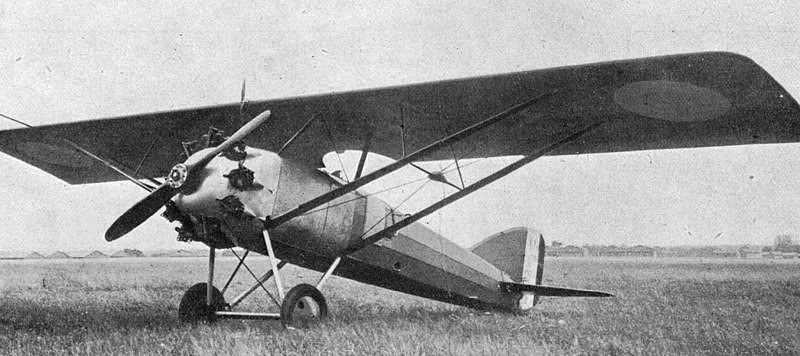
Gourdou-Leseurre GL-32 (LGL.32)

The GL-30 was a parasol-wing monoplane with retractable undercarriage and a Bristol Jupiter engine. Like most of Gordou-Lesserre’s earlier aircraft, it was a parasol wing design but its planform was trapezoidal rather than rectangular. In 1923 it flew the Coupe Beaumont course at an impressive 360 km/h (220 mph; 190 kn).

The GL.30 was the basis of a new fighter, the GL.31, which had a greater span, almost double the wing area, a fixed undercarriage, and a Gnome-Rhône 9A engine. It was armed with four machine guns, two in the forward fuselage and two in the wings. The GL. 31 was not flown until 1926 and then abandoned, overtaken by the GL.32, the company’s entry in a 1923 Aéronautique Militaire competition to select a new fighter. It returned to a rectangular plan wing.

By the time this prototype flew, the Gourdou-Leseurre had been acquired by Loire, and therefore the new aircraft was entered as the LGL.32. Placed second in the trials, the type’s performance was impressive enough to still result in an order in January 1927 for a small batch of aircraft – five evaluation aircraft and 20 preproduction machines. Eventually, 475 of this basic version, dubbed LGL.32C.1 in service, would be ordered by the Aéronautique Militaire and 15 more by the Aéronautique Maritime. Romania ordered a further 50 aircraft of the same design as the examples in French service, Turkey ordered 12 (these designated LGL.32-T) and another one may have been purchased by Japan.

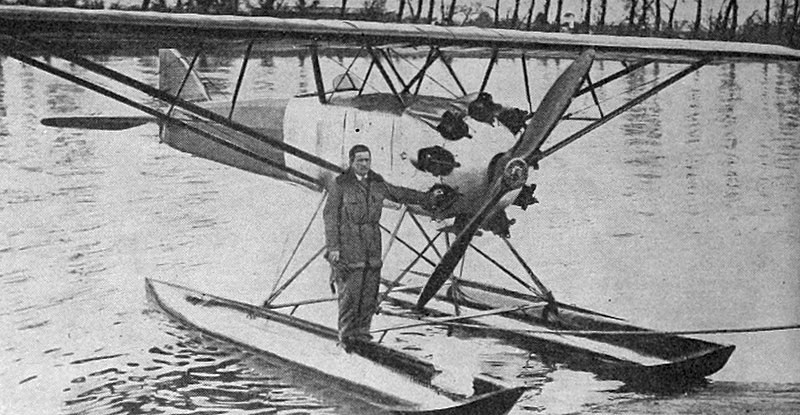
LGL.32 Hy May 1927

The LGL.32 Hy was a twin-pontoon floatplane version converted from the LGL.32 prototype. It set a world seaplane altitude record on 28 March 1927.

In French service, development turned from fighters to adapting the aircraft as a carrier-borne dive bomber. These featured general strengthening of the airframe, divided main undercarriage units, and a “fork” under the fuselage able to release a 50 kg (110 lb) bomb from under the fuselage while avoiding hitting the propeller.

While prolific, the GL.32 was not long-lasting, and attrition took a heavy toll on them. By 1934, all remaining examples were relegated to training and as instructional airframes; at the start of 1936, only 135 remained of the original 380 purchased. A number of these were sold to the government of the Second Spanish Republic and to the autonomous Basque Government. Another aircraft was supplied to the Basques in 1937, modified as a dive bomber along the lines of the previous French experiments. Designated the GL.633, this aircraft was used by Miguel Zambudio to attack the Nationalist battleship España, scoring decisive hits that contributed substantially to her subsequent sinking.

Gourdou-Leseurre LGL.33 C.1

Gallery

Variants:

GL.30
Racer with retractable undercarriage and
Engine: Bristol Jupiter
one built

GL.31 / GL.31C.1 / CL-I-3
Four-gun fighter prototype with fixed undercarriage
longer-span wings
engine: Gnome-Rhône 9A
one built

LGL.32 / GL.32C.1
Definitive two-gun fighter version
Powerplant: 1 × Gnome et Rhône 9A Jupiter VIII, 450 kW (600 hp)
Propeller: 2-bladed wooden fixed pitch
Wingspan: 12.2 m (40 ft 0 in)
Wing area: 24.9 m2 (268 sq ft)
Length: 7.55 m (24 ft 9 in)
Height: 2.95 m (9 ft 8 in)
Empty weight: 963 kg (2,123 lb)
Gross weight: 1,376 kg (3,034 lb)
Fuel capacity: 285 kg (628 lb) – (ca. 200 L (53 US gal; 44 imp gal))
Maximum speed: 270 km/h (170 mph, 150 kn) at sea level
Maximum speed: 260 km/h (160 mph; 140 kn) at 3,000 m (9,800 ft)
Maximum speed: 251 km/h (156 mph; 136 kn) at 5,000 m (16,000 ft)
Maximum speed: 215 km/h (134 mph; 116 kn) at 8,000 m (26,000 ft)
Landing speed: 90 km/h (56 mph; 49 kn)
Range: 500 km (310 mi, 270 nmi)
Service ceiling: 9,700 m (31,800 ft)
Time to 2,000 m (6,600 ft): 3 minutes 5 seconds
Time to 5,000 m (16,000 ft): 11 minutes
Time to 8,000 m (26,000 ft): 31 minutes
Wing loading: 54.8 kg/m2 (11.2 lb/sq ft)
Power/mass: 0.33 kW/kg (0.2 hp/lb)
Armament: 2x 7.7 mm (0.303 in) Vickers or Darne machine-guns – fuselage / 2x 7.7 mm (0.303 in) Darne machine-guns in wings
Crew: 1
ca. 490 built

LGL.32.01
The first prototype.

LGL.32T
Export version for Turkey
12 built

LGL.32 Hy
Twin-pontoon floatplane version converted from LGL.32 prototype.
one converted

LGL.321
LGL.32 converted to use 450 kW (600 hp) version of the Gnome & Rhône 9Ac
one converted

LGL.323
LGL.32 converted to use supercharged 373 kW (600 hp) Bristol Jupiter for unsuccessful altitude record attempts.
one converted

LGL.324
LGL.323 further modified and used by Pierre Lemoigne to set world landplane altitude record
500 kg payload of 9,600 m (31,500 ft) on 23 May 1929
Albert Lécrivain set world landplane altitude record
11,000 m (39,090 ft) on 24 October
one converted

LGL.33 / LGL.33C.1
Similar to LGL.32
revised wing struts, landing gear, and tail
Engine: Lorraine 12Eb
one built

LGL.34 / LGL.34C.1
Similar to LGL.32
Engine: Hispano-Suiza 12Gb
one built

LGL.341
similar to LGL.32
Engine: Hispano-Suiza 12Hb
two built, second with revised radiator arrangement

LGL.351
Engine: Renault 12J
one built

LGL.390
night fighter prototype
Engine: Hispano-Suiza 9Va
one converted from LGL.32

GL.410
modernised fighter with divided main undercarriage
one built

GL.430
strengthened carrier-borne dive-bomber prototype
one built

GL.432
dive-bomber variant similar to GL.430 used for operational testing
four built

GL.450
fighter version

GL-482
fighter version
Engine: Hispano-Suiza 12Xbrs
one built

GL.521
dive-bomber version
taller tail fin
Engine: Gnome-Rhône 9Kfr
two built

GL.633
dive-bomber similar to GL.432
one built