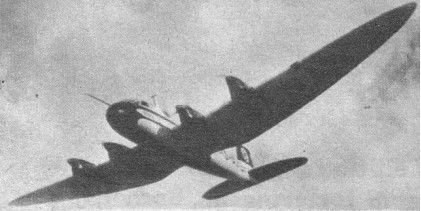
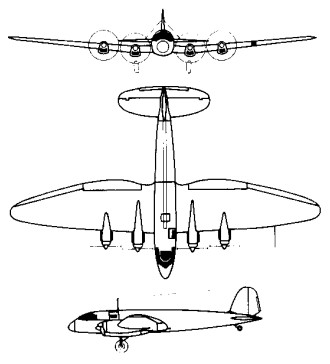
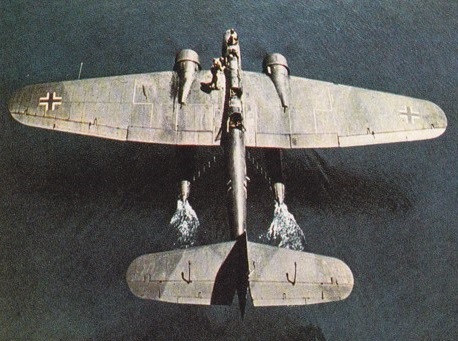
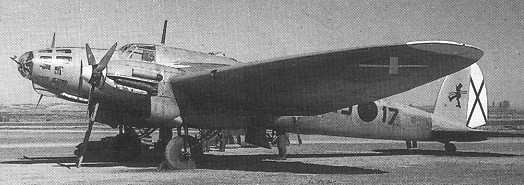
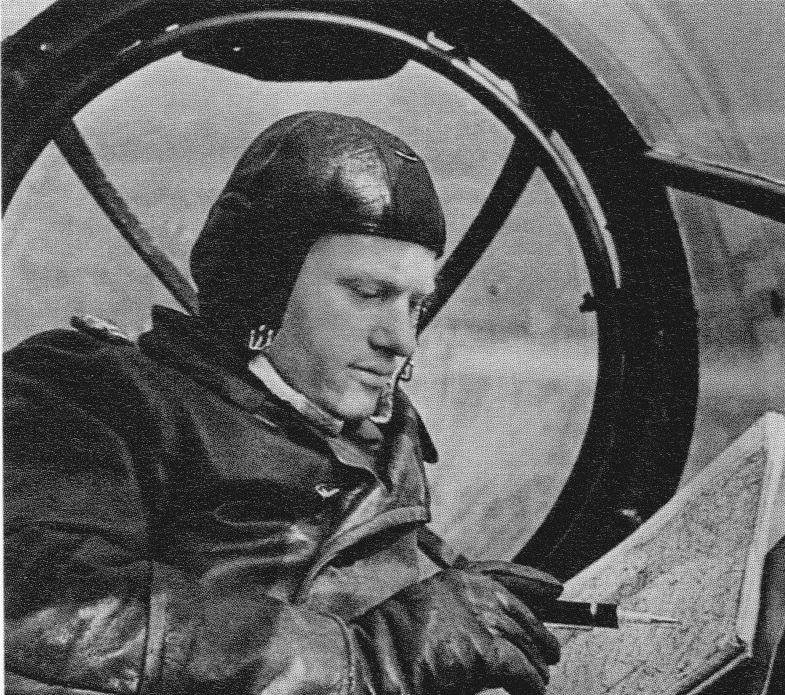
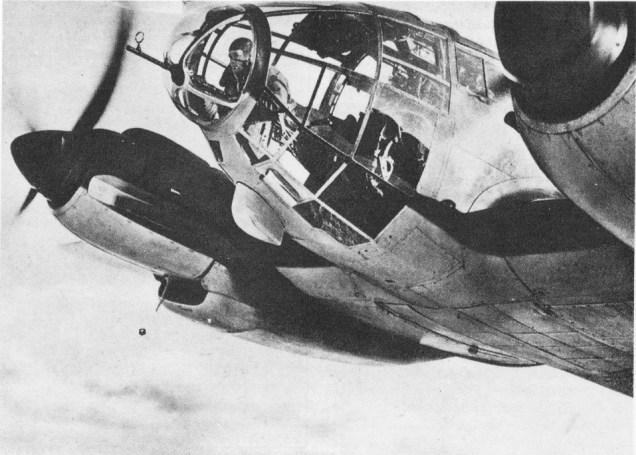
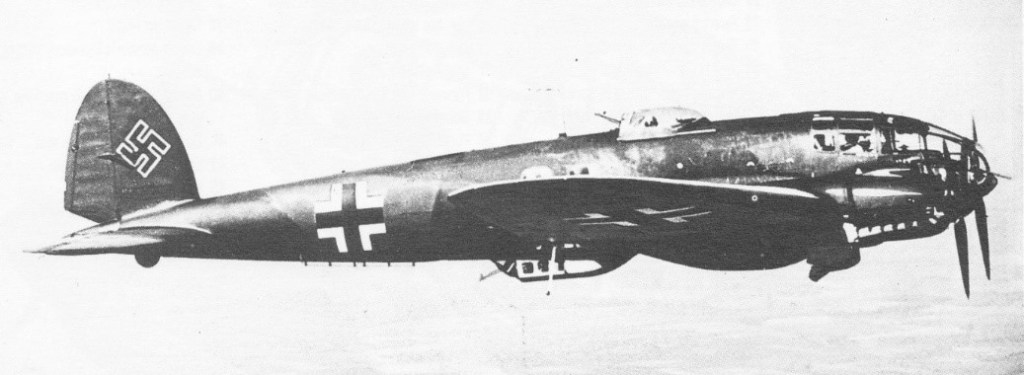
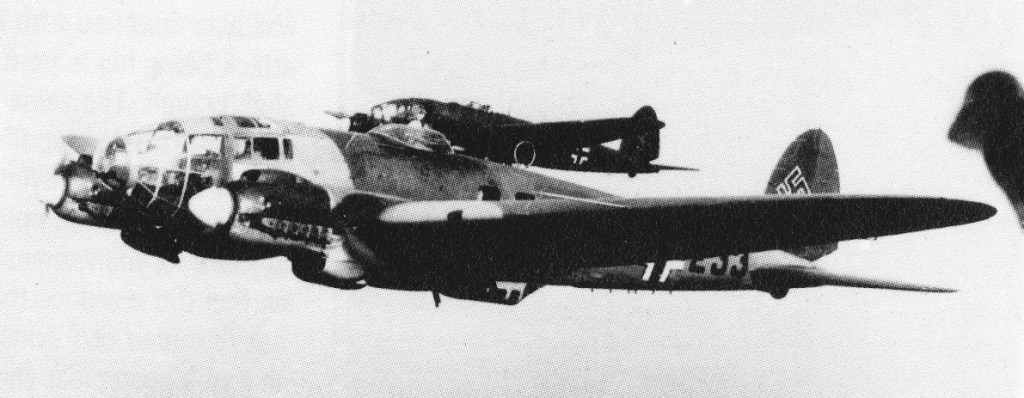
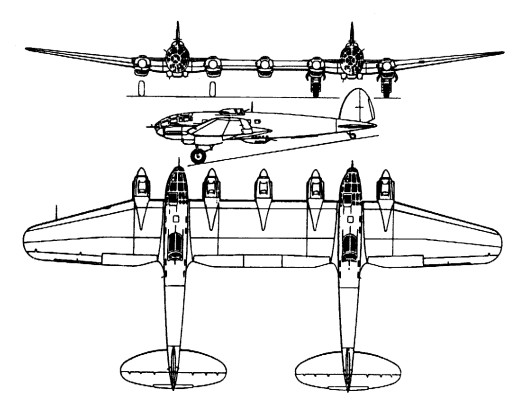
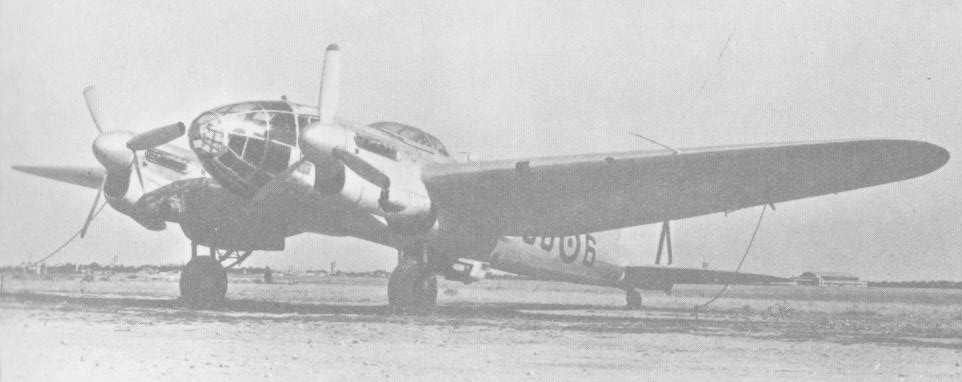
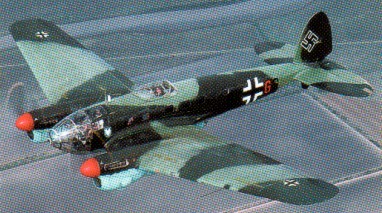
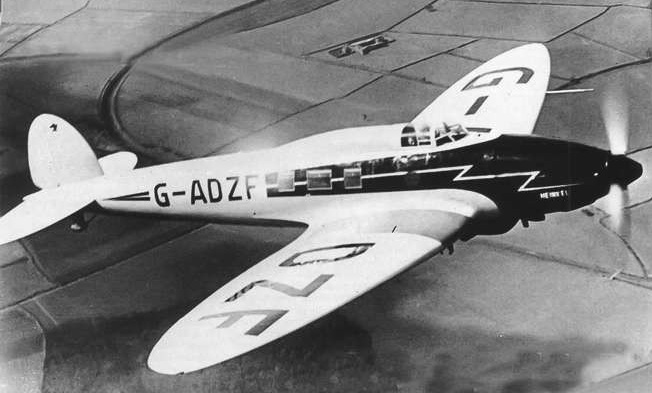
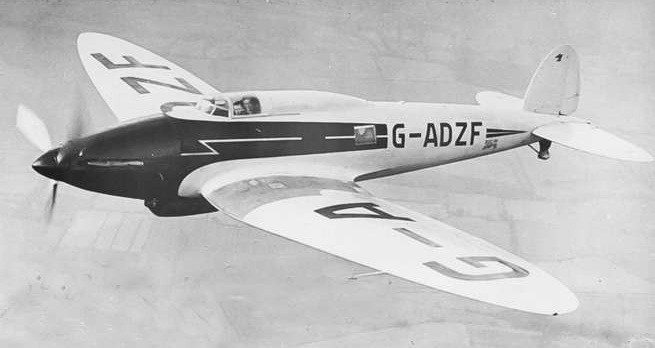
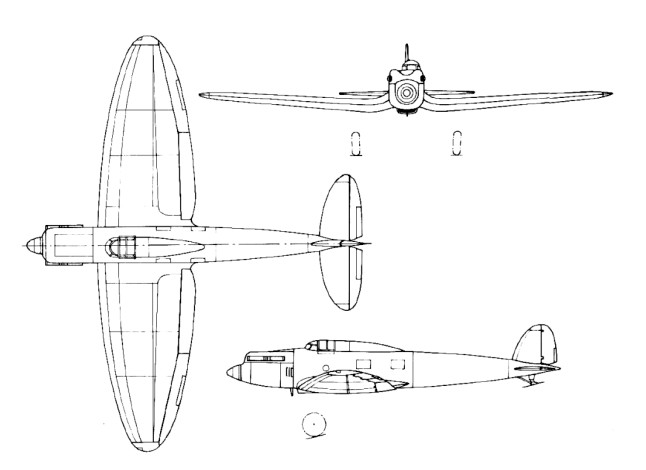
The He 116 was originally designed to fulfil a Deutsche Lufthansa requirement for a long range transport on its projected Far East mail route, fourteen aircraft of this type were built, five of them being military models. Building of the He 116 began in 1936. It had a metal fuselage and wooden framed large span wings, which accommodated four 270 hp Hirth HM 508C engines driving two-blade variable pitch propellers. The intention had been to use 500 hp Hirth engines, but these were not available in time. The first prototype, the He 116 V1, was completed in 1937, and an initial production series of eight machines was laid down. The first of these was the He 116 V2 (D AJIE “Schlesien”), all aircraft being allocated versuch or experimental numbers. The next four aircraft, also classed as prototypes were designated He 116A 0, the first making its maiden flight in the summer of 1937. Two of them were sold to the Japanese run Manchurian Air Lines with whom they remained in service until they were destroyed in late 1945. The two (J BAKD “Nogi” and J EAKF “Togo”) were purchased for use on mail services by Manchurian Air Lines. These reached Tokyo on April 29, 1938, having left Berlin six days earlier and completing the 9,532 miles (15 340 km) in a flying time of 54 hr 17 min, and subsequently served on the Tokyo Hsingking route. Another A series He 116 (D ARFD “Rostock”) was completed as a long distance record machine with 179kW / 240 hp Hirth HM 508H engines and an enlarged wing with a span and area of 82 ft (25 m) and 813.75 sq.ft (75.6 sq.m) respectively, and provision for rocket-assisted take-off equipment. Designated He 116R, on July 30, 1938, this aircraft established a new international record by flying 6,214 miles (10000 km) in 48 hr 18 min. During 1938 various powerplants and structural alterations were tried in two or three of the remaining aircraft in an attempt to fulfil the high speed potential of the design. One such experiment included the installation of four JATO rockets under the wings of the He 116R Rostock, formerly the A 03 or V3. Although the initial trial caused damage to the wings, another attempt was made on a closed circuit course and an inter¬national distance record of 10000 km (6214 miles) was achieved on July 30, 1938. The last two of the initial batch, the V7 and V8, were modified as prototypes for a military B series. Stripped of their civil fittings, and with a new glazed nose section, accommodation was available for two pilots, a radio operator and a navigator. Six He 116B 0 preproduction examples were ordered. Fitted with extensive photographic equipment, and joined by the similarly modified V7 and V8, they served within Germany with the Luftwaffe in the long range reconnaissance, aerial mapping and communications roles. They were unarmed, and were powered by 240 hp HM 508H engines. The R.L.M. began to evince interest in the aircraft as a long range photo reconnaissance aircraft and the ninth machine was built as the He 116B which was intended specifically for this role, and featured a completely redesigned and extensively glazed nose section. Five more He 116B aircraft (He 116 V10 V14) were built, and structurally these differed little from the commercial He 116A.
He 116A Engines: 4 x four 200kW / 270 hp Hirth HM 508C Max speed at sea level: 202 mph (325 kph) Max speed at 9,842 ft (3000 m): 233 mph (375 kph) Max speed at 16,400 ft (5000 m): 220mph (355 kph). Economical cruise at 9,842 ft (3000 m): 199 mph (320 kph) Economical cruise at 16,400 ft (5000 m): 186 mph (300 kph). Max range at 9,842 ft (3000 m): 2,237 mls (3 600 km) Max range at 16,400 ft (5000 m): 2,548 mls (4100 km). Climb to 3,280 ft (1 000 m): 4 min Climb to 6,562 ft (2 000 m): 8 min Climb to 13,120 ft (4000 m): 16.5 min. Service ceiling: 21,653 ft (6600 m). Empty wt: 8,929 lb (4 050 kg). Loaded wt: 15,719 lb (7130 kg). Wing span: 72 ft 2 in (22 m). Length: 44 ft 111/3 in (13.7 m). Height: 10 ft 10 in (3.3 m). Wing area: 677 sq.ft (62.9 sq.m). Crew: 3
He 116B 0 Span: 22m (72ft 2.25in) Length: 14.3 m (46ft 11 in) Gross weight: 7045 kg (15530 lb) Maximum speed: 325 km/h (202 mph).
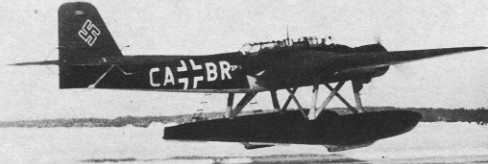
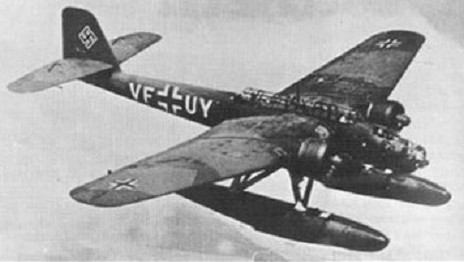
Design of this large seaplane started in 1935 as a faster and more manoeuvrable replacement for the He 59. It was an all metal mid wing monoplane with single step metal floats. For its size it handled well and gave good performance.
The prototype He 115 V1 (D AEHF) was first flown in August 1937, powered by two 800 hp BMW 132K nine cylinder radials. After further flight trials its two machine-guns were then removed, their positions faired over, and on 20 March 1938 the aircraft set eight payload/speed records.
This aircraft was followed by three more prototypes of which the He 115 V3 (D ABZV) was the first aircraft to be given the extensively glazed nose of the final production version. The field of view for two of the three man crew was increased still further by extended glazing of the canopy from the cockpit back to the mid-¬fuselage position. The fourth prototype was the production prototype with float/ fuselage bracing wires replaced by struts.
An evaluation batch of ten, designated He 115A 0, also produced in 1937-38, were followed in 1939 by 34 He 115A 1s, powered by uprated 960 hp BMW 132K engines. The He 115A 0s were armed with a single 7.9 mm (0.311 in) machine gun in the extreme nose while A 1 models were fitted with an extra MG 15 gun and were used as torpedo attack aircraft. Some A 1s were built for export and designated A 2: Norway bought six and Sweden 10.
The first large scale production version for the Luftwaffe derived from the V5 (itself modified from an A 0) which developed into the He 115B series. These aircraft had structural improvements to accommodate the heavier payload, an increased fuel capacity, and provision for up to five 250 kg (550 lb) bombs. Alternatively, two 250 kg (550 lb) bombs and an 800 kg (1760 lb) or 920 kg (2030 lb) torpedo or mine could typically be carried. Manufacture continued until 1944, by which time production totalled 138 air¬craft, excluding prototypes.
The B series was followed by the He 115C series, begun in 1940 and entering Luftwaffe service the following year. The C 1 had an additional under nose MG 151 cannon and two rearward firing MG 17 machine guns mounted in the rear of the engine nacelles. Subsequent C variants were generally similar, the C 2 having reinforced floats; the C 3s were fitted with mine-laying equipment; and the C 4s were used as torpedo bombers, armed with only three rearward firing machine guns.
A one off He 115A 1, converted to become the He 115D, was armed with one cannon and five machine guns, carried a fourth crew member, and was powered by two 1600 hp BMW 801MA radial engines. It was used operationally but did not go into series production.
The He 115 stayed in useful service until 1944, and was used mainly in Scandinavia, the North Sea and English Channel, the north of Germany, and to a lesser extent in the North African and Mediterranean theatres. Two of the Norwegian He 115A 2s escaped to the UK in 1940 and, together with an ex-Luftwaffe B-1, were used by the RAF to carry agents between Malta and North Africa. During their service lives, the He 115B and C models were fitted with a variety of Rustsatze (field conversion kits) comprising variations in the nature of the operational payload carried. The particular kit was indicated in a suffix to the main designation: thus, for example, the He 115B-1/R1 was a standard B-1 carrying a photo reconnaissance twin camera installation (R1), whereas the He 115B 1/R3 was equipped with one 920 kg (2030 lb) or two 500 kg (1100 lb) aerial mines and their release gear.
He 115C-1 Engines: 2 x BMW 132K, 960 hp / 872 kW Span: 22.3 m (73 ft 2 in) Length: 17.3 m (56 ft 9 in) Height: 21 ft 7.25 in / 6.59 m Wing area: 933.23 sq.ft / 86.70 sq.m Empty weight: 15,146 lb / 6870 kg Gross weight: 10680 kg (23550 lb) Maximum speed: 300 km/h (186 mph) at 3280 ft / 1000m Climb to 3280ft/1000m: 5 min 6 sec Service ceiling: 18,040 ft / 5500m Range: 1740 mi / 2800 km Seats: 3 Armament: 1 x 15mm cannon / 4 x 7.92mm mg Bombload: 2756 / 1250 kg or 1 x 1102 lb / 500 kg torpedo
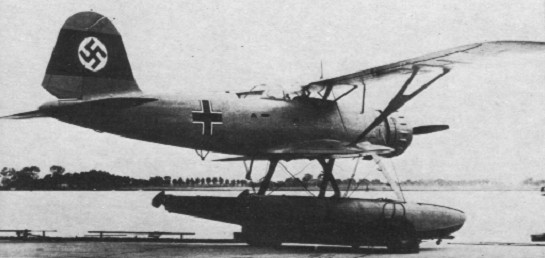
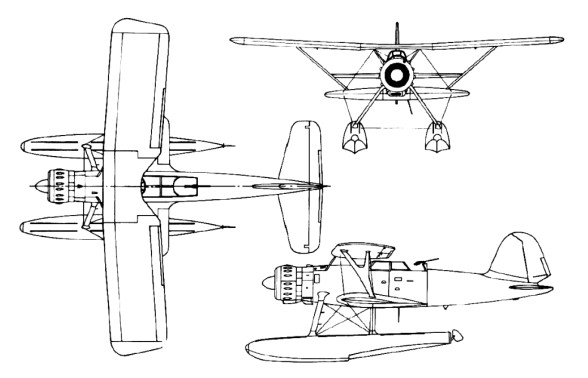
Begun by Heinkel under Luftwaffe contract at the beginning of 1936, the first of five variously ¬powered prototypes flew in the late spring of that year. It was a two seat, all metal two float seaplane of sesquiplane configuration, fitted with a 960 hp DB 600A engine driving a three blade wooden propeller.
The five prototypes, flown in 1936 and 1937, were powered by a variety of engines, including the 716kW Daimler-Benz DB 600, the 477kW Junkers Jumo 210, the 656kW BMW 132Dc and the 716kW BMW 132K.
These five, and the first of ten pre-production He 114A-0s, were delivered to the Luftwaffe during 1937, with the BMW 132Dc engine, which was adopted also for the 33 He 114A-1 trainers, though they were neither armed nor fitted with catapult hooks. Thirty three 865-hp BMW-132N engined A 1s were built as trainers by Weser. Earlier that year the German aviation ministry accepted the V9 (D IHDG) as prototype for the He 114A 2 series, which were powered by an uprated (960 hp) BMW 132K engine driving a three blade constant speed propeller and fitted with catapult gear. It flew for the first time on February 16, 1937 and a small batch of A 2s, again built by Weser, were delivered to the Luftwaffe later in the year. The He 114A-2 was the first operational version, armed with a fixed forward-firing 7.92mm MG 17 machine-gun and an identical weapon mounted in the observer’s cockpit.
They were equipped with catapult points and could carry two 50 kg (110 lb) bombs. The Luftwaffe pilots found their handling on the water and in the air to be somewhat unstable, and the He 114 never superseded the He 60 in service. The prewar A 2s were later converted by Weser for export to Sweden (14 as He 114B 1s) and Romania (six He 114B-2 aircraft, three with DB 600 engines and three with Jumo 210s). Romania also bought 12 He 114B-2S with BMW 132K engines. 14 He 114A-2s were exported to Sweden as the He 114B-1. Fourteen He 114C 1s were used by the Luftwaffe as commerce raiders, and four unarmed C 2s were delivered for use as trainers in December 1939, having the 865 hp BMW 132N engine. At the outbreak of the Second World War, the C l s and some other models were equipped with one or two additional MG 17 machine guns in the pilot’s cockpit, firing past the propeller. Some He 114s carried four 50 kg (110 lb) bombs for antisubmarine duties (only two when additional machine gun armament was carried). The He 114 was phased out during the first two years of the war, after limited Luftwaffe service. Production ceased in 1939.
He 114A 2 Engine: 1 x BMW 132K, 610kW Wingspan: 13.6 m (44 ft 7.5 in) Length: 11.65 m (38 ft 2.75 in) Height: 5.2 m / 17 ft 1 in Wing area: 42.3 sq.m / 455.31 sq ft Max take-off weight: 3420 kg / 7540 lb Empty weight: 2314 kg / 5102 lb Max. speed: 292 km/h / 181 mph Cruise speed: 265 km/h / 165 mph Ceiling: 4800 m / 15750 ft Range w/max.fuel: 1050 km / 652 miles Range w/max.payload: 910 km / 565 miles Armament: 1 x 7.92mm machine-guns Crew: 2
Shortly after the Nazi party came to power in Germany in 1933 a requirement was issued for an up to date single seat monoplane successor to the He 51 and Arado Ar 68 biplanes. Heinkel’s designers chose the comparatively easy task of refining the He 70 configuration to produce the He 112, which had an open cockpit, all metal fuselage and elliptical wings. The prototype VI (D IADO) was powered by a 518kW / 695 hp Rolls Royce Kestrel V engine and flew for the first time in late summer 1935. It was flown to Travernfinde for official tests in October that year, competing with the Arado Ar 80, Focke Wulf Fw 159 and Messerschmitt Bf 109.
Both it and Messerschmitt’s Bf 109 received orders for 10 aircraft.
November and December 1935 saw the appearance of second and third prototypes (V2 and V3), both later having the wing span reduced by 1 m (3 ft 3 in) and powered by 447kW / 600 hp Junkers Jumo 210C engines. The V3 was armed with two 7.9 mm (0.311 in) MG 17 guns mounted over the nose, and had an enclosed cockpit.
The He 112 V4, V5, V6 and V8 were built as prototypes for the projected He 112A production series.
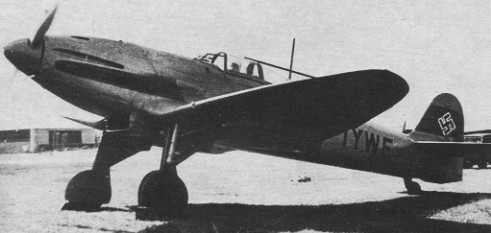
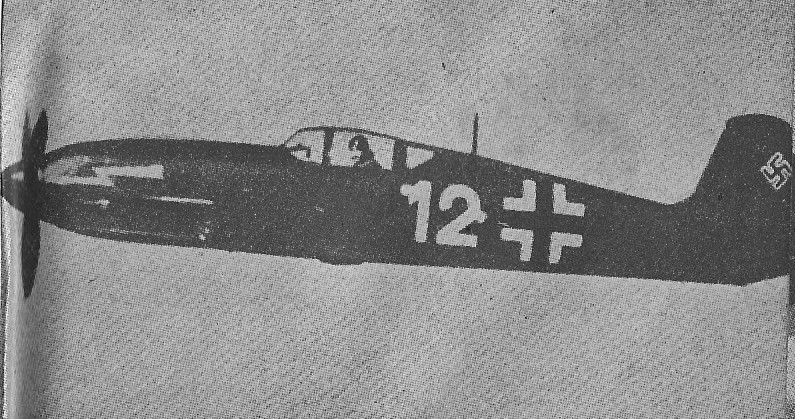
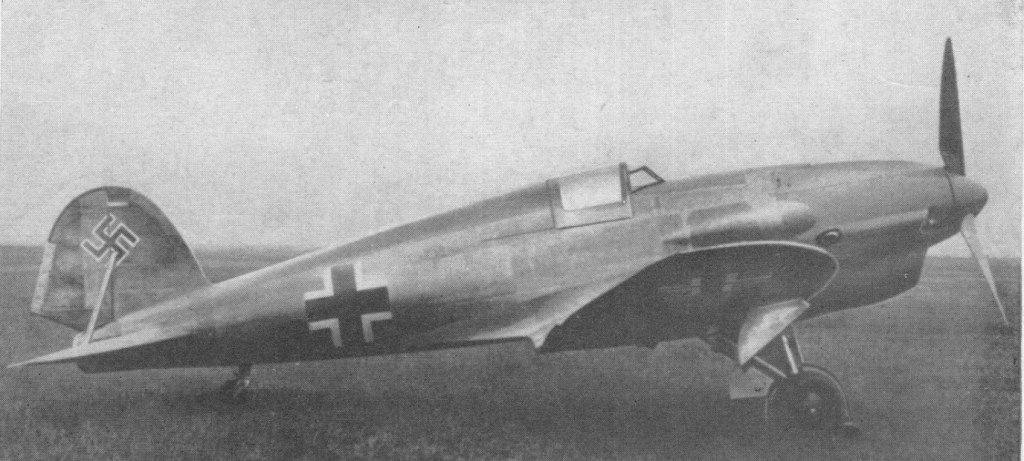
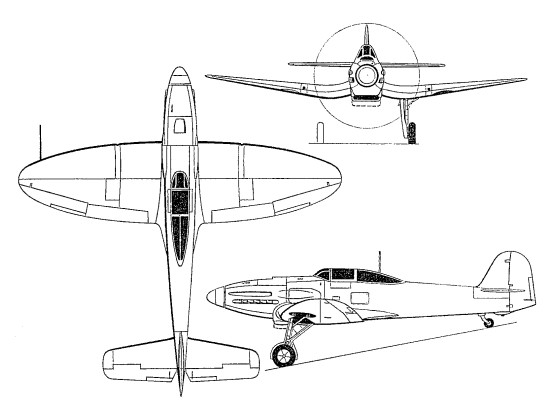
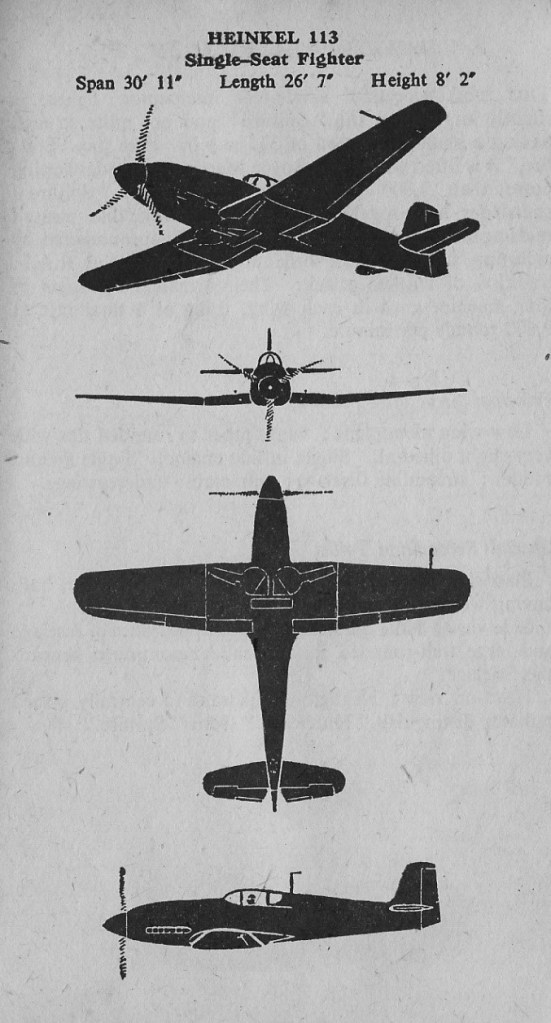
The fourth prototype, He 113, with a new, smaller, elliptical wing, was evaluated operationally with the Legion Condor in Spain in 1936, and was shown at the July 1937 Zurich International Flying Meeting.
He 113
The V8 was tried with a 1000 hp DB 600Aa powerplant, but no A series production order was received although the aircraft was well liked by its pilots. The proposed He 112A production aircraft was not adopted by the Luftwaffe, which received the Bf 109 instead, but work continued on the structurally-redesigned He 112B, the 507kW Jumo 210Ea-powered production prototype which flew in July 1937.
A batch of 43 He 112B 0s was, however, produced, based on the much modified V7 and V9 prototypes. Armament comprised two MG 17s, which were now fitted in the fuselage sides, plus two wing mounted 20¬mm (0.79 in) MG FF cannon. Powerplant was the 680 hp Junkers Jumo 210Ea 12-cylinder liquid cooled engine. In spring 1938 Japanese naval aviation had also received 12 of 30 He 112B 0s ordered in the spring of 1938 but pilots were not enthusiastic and the aircraft were used mainly for ground instruction; their Japanese designation was A7He1. They received the allied code name ‘Jerry’ although this was dropped when not met in combat.
A7He1
The next 12 were impressed for Luftwaffe use, although 11 of these and the final six were supplied later to the Spanish Nationalist air force in November 1938. Deliveries of 12 to the Luftwaffe commenced in mid 1938 for service trials, and later that year 17 flew with the rebel Spanish Nationalist forces in Spain. Fifteen survived the civil war to serve with the new Spanish air force in Morocco.
Hungary acquired the V9 and three B Is for evaluation in the spring of 1939, and the only other buyer for the He 112 was Romania, which ordered 24 (13 13 0s and 11 B 1s) , the order being completed in September 1939. They served briefly during the Second World War, the only He 112s to do so. In the fighter bomber role the aircraft could be fitted with underwing racks to carry six 10 kg (22 lb) antipersonnel bombs. Two further prototypes, the V10 and V11 with DB 601Aa and Junkers Jumo 210G engines respectively, were produced in the hope of encouraging further export orders, but none were forthcoming and Heinkel decided to use its workforce on producing types acceptable to the Luftwaffe. In 1937 one He 112 was fitted with an experimental 2200-lb thrust liquid-fuel rocket motor in its tail. This led to the He 176 of 1938.
Rocket powered He 112
He 112B Span: 9.1 m (29 ft 10.25 in) Length: 9.3 m (30 ft 6 in) Gross weight: 2250 kg (4960 lb) Maximum speed: 510 km/h (317 mph) Armament: 2 x 20mm MG FF cannon, 2 x 7.92mm MG 17 machine-guns
He-112B-1 Engine: 1 x Jumo 210G, 490kW Max take-off weight: 2250 kg / 4960 lb Empty weight: 1850 kg / 4079 lb Wingspan: 9.1 m / 29 ft 10 in Length: 9.3 m / 30 ft 6 in Height: 3.9 m / 12 ft 10 in Wing area: 17.0 sq.m / 182.99 sq ft Max. speed: 510 km/h / 317 mph Cruise speed: 475 km/h / 295 mph Ceiling: 9500 m / 31150 ft Range w/max.fuel: 950 km / 590 miles Range w/max.payload; 850 km / 528 miles Armament: Armament: 2 x 20mm MG FF cannon, 2 x 7.92mm MG 17 machine-guns Crew: 1
He 113 Engine: Mercedes-Benz DB601, 1200 hp Span: 30 ft 11 in Length: 26 ft 7 in Height: 8 ft 2 in Max speed: 375 mph Armament: 1 x cannon, 2 x mg
From the beginning, the He 111 was designed to fulfil the roles of both bomber and commercial aircraft. There were no basic structural differences between these two versions. Walter and Siegfried Gunter began work on the design of this all metal low wing monoplane in early 1934. The first prototype, the He 111 VI, appeared at the end of that year as an extremely clean looking and efficient aeroplane. Powered by two 447kW 660 hp BMW VI 6, OZ glycol-cooled inverted V engines, it was flown for the first time on February 24, 1935. It was equipped as a medium bomber, with provision for a 1000 kg (2200 lb) internal load of bombs (which were stowed upright), and had an armament of three 7.9 mm (0.311in) MG 15 machine guns: one each in nose and dorsal positions and one in a retractable ventral ‘dustbin’.
The wings were of semi-elliptical planform, fitted with hydraulically operated trailing-edge flaps, the tailwheel-type retractable landing gear also being hydraulically actuated. Very clean in appearance, the prototype (in bomber configuration) was able to accommodate an internal bomb load of 1,000kg, and was armed with three machine-guns in nose, dorsal and ventral positions. Flight testing proved that its performance equalled or even bettered that of contemporary fighters.
Of the new three prototypes, the V2 (D-ALIX) and V4 (D AHAO) were built as commercial transports, with accommodation for ten passengers and a cargo of mail. Heinkel tried to interest Deutsche Lufthansa in the He 111 as a commercial transport, and the idea that it was purely a civil type was fostered by the German government even after the existence of the military version officially became known in January 1936. The second prototype was completed as a civil transport and was handed over to Luft-Hansa following the termination of early testing. Subsequently, this aircraft reverted to being used by the Luftwaffe for secret high-altitude reconnaissance missions. Many such missions were flown prior to the outbreak of World War II, both by military and civil aircraft, so that long before wartime operational missions were flown, the Luftwaffe had acquired very detailed documentation of a vast number of important targets.
The fourth prototype, with accommodation for ten passengers in two cabins, named Dresden, was delivered to Luft-Hansa on 10 January 1936 by Heinkel’s test pilot Gerhard Nitschke. Six production airliners, He 111C named Breslau, Karlsruhe, Koln, Konigsberg, Leipzig, and Numberg, entered service from the summer of 1936.
Lufthansa did in fact operate small numbers of the He 111C and He 111G, but not until some time later. The V3 (D ALES) was the prototype for the first military version, and ten pre-production He IIIA 0s were constructed towards the end of 1935 at Rostock-Marienehe and delivered to the Rechlin test centre of the Luftwaffe during the spring of 1936. It inherited the elegant lines of its single engined forebear, the He 70, and had generally good handling characteristics, but the BMW engined He 111 was found to be insufficiently powerful for military use. The Luftwaffe therefore rejected the similarly powered He IIIA Is that had been completed, and the pre-production A 0 machines were sold to China.
The He 111A initial bomber variant was underpowered and lacked adequate performance, but this was rectified in the He 111B series by a switch from the 492-kW (660-hp) BMW 6,0Z to the Daimler-Benz DB 600, which not only boosted performance but also permitted the carriage of a heavier warload.
The first Luftwaffe versions, therefore, were the He 111B 0 and B 1, based on the He 111 V5 prototype (D APYS) and powered by DB 600A or C engines. B 1 deliveries to Kampfgeschwader (bomber group) 154 began in late 1936, followed in 1937 by the He 111 B2 which was powered by 950 hp DB 600CG engines and carried a short range bombload of 1500 kg (3310 lb). As with so many other Luftwaffe aircraft types of the period, the B2 was deployed by the Legion Kondor in Spain in early 1937, soon meeting with considerable combat success against the government forces. It gained a reputation of having the speed to outrun most enemy intercepters, which enabled it to operate without a fighter escort. (The He 111B 1, with 950 hp DB 600Ga engines, was faster than the B 2, but was built only in very small numbers and was not used operationally.) The type was soon slated for evaluation with Kampfgruppe 88 of the Legion Condor, and from February 1937 some 30 He 111B-1/2s were despatched for service with two of KG/88s three Steffeln.
Production of He 111 bombers continued with the He 11IE, although this had been preceded by the second major civil variant, the He 111G. This latter model did not attract many customers, but it was noteworthy in having introduced a redesigned wing with straight taper, which was easier to produce than the semi elliptical shape that characterized the previous models. The He IIIE retained the original wing form, but introduced another basic change the adoption of the Junkers Jumo 211 engine (in this series the 1010 hp Jumo 211A 1) in order to pre¬serve supplies of the DB 600 for fighter production. Sub types of the E series included the E 1, with 2000 kg (4410 lb) internal bombload; the E 3, similar except for equipment changes; and the most numerous E model, the E 4, which could carry 1000 kg (2200 lb) internally and equal load externally; and the E 5, with additional fuel tanks.
The type proved very successful in operational and maintenance terms, and from March 1938 some 45 He 111 E-1 s with a heavier warload were despatched for service with KG/88s four Staffeln, the He 111B-1/2s being passed to the Nationalists 10- and 11-G-25. At the end of the war the 58 surviving He 111s were given to Spain. The ‘straight’ wing was combined with the slightly more powerful 1100 hp Jumo 211A 3 to produce the He 111F, the prototype of which appeared in mid 1937. He 111Es also served in Spain and the combined total of Bs and Es sent to Spain was 75, of which 58 survived the civil war to form a part of the reconstituted Spanish air force. The main Luftwaffe F model was the He 111F 4. Exports at this time included 24 He 111F Is and five He 111G 5s to the Turkish air force.
One other Luftwafte variant with DB 600 engines was the He 111 J (with DB 600CGs), about 90 of which were completed. They were otherwise generally similar to the F 4, except that their bomb bays were deleted as they were intended for use as torpedo-bombers though they were, in fact, delivered for service on standard bombing duties.
The second generation He 111 bomber mated the entirely new wing introduced by the first generation He 111F and J with a completely revised forward fuselage. A major design change, one which gave the He 111 quite literally a new look, occurred in the He 111P, which began to enter service during the early part of 1939. This took the form of a complete redesign of the fuselage nose, eliminating the conventional ‘step’ created by the pilots’ flight deck windows in favour of an extensively glazed forward section which maintained the flow of the fuselage lines unbroken above and below the nose. The pilot was seated to port and all flight and engine instruments were mounted on a panel suspended from the roof.
Provision was made for elevating the pilot’s seat and controls for landing and taxying, his head projecting through a sliding panel and being protected from the slipstream by a small retractable windscreen. Although the cockpit glazing was criticised for mirror effect in aft sun, the new forward fuselage was standardised for subsequent production, these beginning to leave assembly lines in the winter of 1938-39.
At the tip of this new nose, and offset to starboard, was a ball type Ikaria universal mounting for the nose 7.9mm MG 15 machine gun. The P series comprised the P 1 and P 2, which differed only in their radio equipment; the P¬3, a conversion for dual control training; and the P 4 and P 6.
The He 111P-4 introduced some armour protection for the pilot and dorsal and ventral gunners, and heavier defensive armament, this being six 7.9mm MG 15s. The port bomb bay was blanked off and occupied by a supplementary fuel tank, bomb racks being introduced beneath the blanked-off bay.
Overall He 111 P production, shared by Arado, Dornier and Heinkel, was in the region of 400 aircraft. Early models had 1100 hp DB601A engines, three defensive machine guns, and the standard 2000 kg (4410 1b) bombload carried half internally and half externally. Need for better defence was reflected in the armour protection of the P 4 and P 6, the former also mounting up to six MG 15 machine guns (and, sometimes, an MG 17 in the tail). The P 6 (there was no P 5 built) was similar to the P 4 except for 1175-hp DB 60IN engines ten of this model were supplied in 1942 to the Hungarian air force.
Whereas the original wing had been of elliptical form, its complex structure inhibited large-scale production. Early in 1936 Siegried Günter began redesign of the wing, eliminating the ellipses in favour of a straight tapered planform, reducing the wing area in the process. Comparatively small numbers were completed with the new wing before, in the Summer of 1938, and entirely new forward fuselage was introduced on the assembly lines.
He 111P-6
Like other earlier models, however, the He 111P was drawing upon supplies of engines more urgently needed for fighter production, and so relatively few of this series were built.
The second generation bomber had been planed to take either Daimler-Benz DB 601A or Junkers Jumo 211 engines, The He 111P with the Daimler-Benz and the He 111H with the Junkers. Priority was given to the DB 601A-engined version owing to the supply situation.
Deliveries of the initial production model, the He 111P-1, began during the early spring of 1939, the first He 111H-1s following six weeks later. The H-1 being equipped to a similar standard with deliveries commencing in the same month (May).
The next model to enter production, and the most numerous of all, was the He 111 H. This combined the airframe of the early P models with the Jumo 211 powerplant. By the time He 111 production was phased out in the autumn of 1944 well over 7000 had been turned out, of which more than 6000 were sub types of the H series. Power plant of the He 111H comprised two Junkers Jumo engines, with power ranging from 752.6kW for the Jumo 221A to 1,323.5kW in the Jumo 213A-1 installed in the final production He 111H-23 paratroop carrier.
Production of the P-series was to be finally phased out early in 1940 with the He 111P-6, this reverting to the standard internal bomb stowage arrangement but having 1275 hp DB 601N engines. The He 111H-2 had similar armament to the P-4, the He 111H-3, which appeared in November 1939, being a dual-role version adding anti-shipping operations. The H-3 was fitted with a single forward-firing 20mm MG FF cannon in its ventral gondola. The H-3 had Jumo 211D-1 engines of 1200 hp for takeoff. These engines were retained initially by the He 111H-4 which began to come off the lines early in 1940, but were eventually to be supplanted by the Jumo 211F-1 of 1400 hp for takeoff.
By the beginning of WW2 the He 111-equipped Kampfgeschwader had virtually completed conversion to the second generation bomber which comprised the bulk of the equipment of 21 Gruppen and one Staffel with a total strength of 789 aircraft.
One shortcoming of the second generation He 111 was its inflexibility concerning bomb loading arrangements. The bombs were loaded into individual vertical cells, four on each side of the gangway, and this meant that the largest bomb that could be accommodated internally was a 551 lb / 250 kg. There was no increase in defensive armament which remained three 7.9mm MG 15 machine guns. The crew comprised pilot, navigator/bombardier, radio operator and ventral gunner. The DB 601A-1 engines of the He 111P were each rated at 1175 hp for takeoff and the Jumo 211A-1 engines of the He 111H each were 1075 hp for takeoff.
The He 111P was built by Heinkel’s Rostock-Marienehe and the NDW factories, these being joined by Arado at Warnemünde, while the He 111H was built in parallel by Heinkel’s Oranienburg facility, the Junkers plant at Dessau and the new ATG factory at Leipzig.
He.111H
Production of the He 111 had reached almost 1000 by the start of the Second World War, at which time 349 of those in Luftwaffe service were He 111Ps and 400 were He 111Hs of one model or another, all having been taken on charge over a period of less than six months.
It did not take long to destroy the illusion of security created by their easy passage during the Spanish Civil War. Committed to the Polish Campaign, the He 111 achieved generally favourable results, but attrition was higher than anticipated, a total of 78 bombers being lost.
For the onslaught on France and the Low Countries on 10 May 1940, Luftflotten 2 and 3 possessed a total of 1120 twin-engined bombers of which approximately half were He 111s. By then Kampfgruppen were converting to the Junkers Ju 88A. By Adler Tag only four Kampfgeschwader remained completely equipped with He 111s, these being KG 26 based in Norway, KG 27 operating from Tours, Dinard and Rennes, KG 53 at Lille-Nord and KG 55 at Chartres, Dreux and Hillacoublay.
After initial strikes across the Straits of Dover, the first sorties in force by He 111s took place on 15 August when 72 He 111H-4s of I and III Gruppen of KG 26 flew from Stavanger with the intention of attacking RAF bases at Dishforth, Ulswortg and Linton-upon-Ouse. The bomber force was escorted by Bf 110 fighters of I/ZG 76, but owing to a navigational error none were to find their target. Only 63 of the He 111s actually crossed the coast and eight fell to RAF fighters. Despite heavy operational attrition, daylight attacks by He 111 formations against the UK continued for a month.
The provision of Bf 109E fighter escorts barely alleviated the situation. From 16 September the He 111 was to be largely confined to nocturnal sorties.
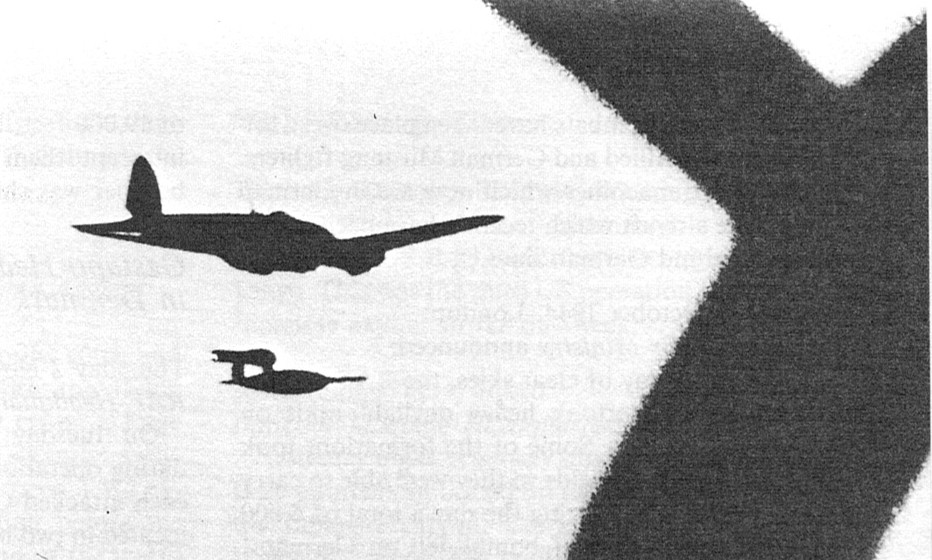
After experience of rough handling by the RAF’s Hurricanes and Spitfires during the Battle of Britain, moves were soon under way to increase the bomber’s defensive armament. This began with the addition of two 7.9 mm (0.311in) beam guns on the He 111 H 2; other typical variations in armament included the provision of a 20 mm (0.79 in) MG FF cannon in the under nose gondola of some H 3s, for anti-shipping attacks (Up to 2000 kg (4410 1b) of bombs could be accommodated); a combination of one MG FF, one 7.9 mm (0.311 in) MG 17, and either one 13¬mm (0.51 in) MG 131 or two 7.9 mm (0.311¬in) MG 81 guns on the H 10; and four MG 81s and three MG 131s on the He 111 H 20. In all, there were 23 sub types of the H series, of which the most numerous models were the H 3, H 6 and H 16. Most H sub types were powered by successive versions of the Jumo 211 engine, although the H 21 had 1750 hp Jumo 213Es and the H 23 was fitted with 1776 hp Jumo 213As. With such numbers available, it was inevitable that the He 111 should be called upon to undertake a wide variety of duties in addition to the standard bombing role. The H 3 and H¬6 became excellent anti-shipping aircraft, the latter becoming operational in the spring of 1942 and being able to carry bombs or mines internally and two externally slung torpedoes. A large fender to cut through or push aside the cables of barrage balloons was fitted to the He 111H 8. The H 10 and H 18 were night bombers; the H 12 was adapted as a carrier for a pair of Henschel Hs 293 glider-bombs; the H 14 served both as a pathfinder bomber and a glider tug; the H 15 was a carrier aircraft for Blohm und Voss glider-bombs; the H 22 was the version adapted as air launch aircraft for Fieseler Fi 103 (V1) flying bombs; and the final model, the He 111 H 23, was an assault or saboteur transport carrying eight paratroops.
He 111H-22
By 1 September 1944 the last of the ground launch ramps for the V-1s had fallen into Allied hands, so the Luftwaffe stepped up the use of He 111s as V-1 launch ramps. Soon more than 100 aircraft were being used on these missions, including a number of Heinkel He 111H-21s with powerful Jumo 221 engines. After brief training at Peenemunde and Oschatz, the 3rd Group of the German ‘Blitz Wing’ (3rd Bomber Wing) became 1st Group of the 53rd Bomber Wing (‘Condor Legion’) and started operations in mid-July 1944. The planes took off with their flying bombs from Dutch bases at Venlo and Gilze Rijen. By the start of September, large numbers of V-1s had been launched from He 111s, of these, 30 had landed in London, 90 in Southampton, and more than 20 in Gloucester. To avoid the powerful British anti-aircraft, most of the He 111 missions had to be carried out at night; the bomber also had to fly at low altitude in order to stay underneath the British radar screen. When they came within 35 miles of the British coast, they climbed to about 1500 ft, launched their V-1s and headed back to the Continent, flying just above the water’s surface. Operation Rumpelkammer, the German program to launch V-1s from aircraft, cost many casualties, for often the flying bombs would explode while taking off from the carrier plane.
By the end of September 1944, the He 111s of the 1st Group had fired a total of 177 flying bombs at England, mostly in night missions. 1st Group were now taking off from their new bases in Schleswig-Holsstein, Oldenburg and northern Westphalia. The German aircraft suffered heavy losses on V-1 launch missions. In one instance, 12 He 111s failed to return from two successive missions, after RAF night fighters and explosions after take-off. On Christmas Eve 1944, aa group of He 111s of 1st Group took off on a V-1 raid against Manchester. One of the flying bombs crashed over the city and 17 others went down within a 15-mile radius. At 4:30am on 14 January 1945, a V-1 exploded near Hornsea, Yorkshire. It was the last of some 1200 flying bombs launched from the air by Heinkel He 111 bombers of 1st Group, 53rd Bomber Wing. Only one out of ten V-1s came close to hitting its target; the rest fell victim to the Allied air defence or crashed prematurely dur to faulty guidance systems.
At noon on 8 May 1945, two Soviet fighters flown by G.A. Lobov, the commander of the Seventh Guard Division, and by Capt. Svidirov, ran into a solo-flying He 111 and shot it down. This ended the operations of Soviet fighters in the air war over Europe.
Although it was thought that Aichi produced radial powered He.111K under licence as the Type 98, the type never existed. One 1942 military recognition manual still stated a very few He.111s have been met in action.
The Heinkel He 111 Zwilling (Twin) consisted of two Heinkel He 111H-6 twin-engined medium bombers joined together. Created by ‘marrying’ two standard He 111H 6s or 16s by connecting them with a new wing centre section which mounted a fifth Jumo 211F-2 engine. This strange improvization came about through the need to develop a towing aircraft large enough to be compatible with the Messerschmitt Me 321 Gigant troop glider. The He 111Z was evolved during 1941-42 and carried a crew of seven. Piloted from the port fuselage, it performed its task well, but its role disappeared when the Me 323 self powered version of the Gigant replaced the Me 321.
He.111Z
First flown in Spring 1941, two prototypes and 10 He 111Z-1 production aircraft were built. For takeoff, 2 Jato rockets of 500 Kg were under each fuselage and 2 of 1500 kg under the central wing.
The adoption by the Spanish air force of those He 111Bs and Es which survived the civil war led, in 1941, to the Spanish government acquiring a licence to manufacture the later H 16 model at the CASA factory in Tablada, near Seville. Two hundred were ordered initially, but only 130 of these could be completed owing to the shortage in supply from Germany of the Jumo 211F engines to power them. Armed with a mixture of German and Italian guns (single MG 15s in the ventral gondola and in the rear of the crew cabin, and a 12.7 mm (0.5 in) Breda SAFAT in the nose blister) they were designated B.2H by the Spanish air force. These differed from the German built machines primarily in having a stepped crew compartment. Manufacturer’s designations divided them into C 2111A (bomber models), C¬2111C (reconnaissance bombers, with cameras in the starboard half of the bomb bay), and C 2111F (dual control bombing trainers). When the supply of Jumo engines ran out the eventual choice of a replacement fell upon the Rolls-¬Royce Merlin Mk 500 and 173 examples of this engine were purchased from Britain.
CASA 2111-D
These were used both to power additional CASA built aircraft (C 2111B bombers and C 2111D reconnaissance bombers, the latter having 1610 hp Merlins), and also to re-engine some of the earlier Jumo powered Heinkels. Spanish air force designation for all Merlin powered examples was B. 21; later, Jumo and Merlin powered bombers were included in 15 aircraft converted to T.8 (CASA C 2111E) nine passenger troop transports. The C 2111 series continued in Spanish air force service until the end of the 1960s.
CASA 2111
A total of around 7500 were built, including licence production in Romania and Spain (as the CASA 2111). 263 licence built Heinkel 111s were built by CASA as the 2111 as late as 1956.
Engines: 2 x 1,200 hp Junkers Jurno 211 D. Length: 54.6 ft. (16.63 m.) Wing span: 74.1 ft. (22.6 m.) Weight empty: 14,400 lb. (6,530 kg.) Armament: 1 x 20 mm cannon 6 x 7.9 mm machine guns. Max bomb load: 4,400 lb. (2,000 kg.) Max speed: 267 m.p.h. (430 kph). Range: 2,175 miles (3,500 km.). Crew: 5
He 111B-2 Span: 22.6m (74ft 1.75 in) Length: 17.5m (57 ft 5in). Engine: 2 x Daimler-Benz DB 600CG, 708kW (950 hp) Armament: 3 x 7.92-mm (0.312-in) mg, up to 1500 kg (3,307 lb) of bombs internally. Max T/O weight: 10000 kg (22,046 lb). Max speed: 230mph at 13,125 ft. Operational range: 1,030 miles. Crew: 4
He 111E Engines: 2 x DB 601A, 1150 hp Top speed: 254 mph Range: 1100 mi at 215 mph Armament: 6-8 mg / 1 x 20mm cannon
He 111E-A Engines: 2 x Junkers Jumo 211D, 1200 hp Top speed: 250 mph Cruise: 212 mph Range w/4000lb load: 760 mi Max range: 2640 mi Armament: 6-8 mg / 1 x 20mm cannon Max bombload: 5600 lb
He 111 E 3 Span: 22.6 m (74 ft 13 in) Length: 17.5 m (57 ft 5 in) Maximum speed: 420 km/h (260 mph). Height: 14 ft 7.25 in (4.4 m). Engines: 2 x Junkers Jumo, 1000hp. Max TO wt: 21,168 lb (9600 kg).
He 111H Engines: 2 x DB 601A, 1150 hp Top speed: 254 mph Range: 1100 mi at 215 mph Armament: 6-8 mg / 1 x 20mm cannon
He.111H-2 Engines: 2 x Junkers Jumo 211 F-2, 1340 hp.
He-111H-16 Engines: 2 x Jumo 211F-2, 1007kW Wingspan: 22.60 m / 74 ft 2 in Length: 16.40 m / 53 ft 10 in Height: 4.00 m / 13 ft 1 in Wing area: 86.50 sq.m / 931.08 sq ft Max take-off weight: 14000 kg / 30865 lb Empty weight: 8680 kg / 19136 lb Maximum speed: 405 km/h (252 mph). Ceiling: 6700 m / 22000 ft Range: 1950 km / 1212 miles Armament: 1 x 20mm cannon, 1 x 13mm machine-guns, 3 x 7.92mm machine-guns, 1000kg of bombs Crew: 1
He 111 P 4 Span: 22.6 m (74 ft 11 in) Length: 16.4 m (53 ft 91 in) Gross weight: 13500 kg (29,760 lb) Maximum speed: 320 km/h (200 mph).
He 111Z Twin Zwilling Engines: 5 x Junkers Jumo 211F, 1350 hp Propellers: three-bladed metal VDM variable Wingspan: 35,20 m Length: 16,60 m Height: 4,20 m Wingarea: 148 sq.m Fuel capacity: 8250 lt Empty weight: 21500 kg MTOW: 28200 kg Wing loading: 190,540 kg/sq.m Power loading: 4,177 kg/hp Max speed: 420 kph Cruise speed: 375 kph Climb rate:: 9000 m in 30 min Ceiling: 9600 m Range: 2400 km Armament: 4 MT MG 131 of 13 mm, 2 x 2 MT MG 81Z 7,92 mm and 5 MG 81J 7,92 mm
CASA 2111D Engine: 2 x RR Merlin 500, 1400 hp. Wingspan: 74 ft 3 in Wing area: 943 sq.ft Length: 54 ft 6 in Height: 13 ft 9 in MTOW: 30,865 lb Fuel capacity / wings: 760 gal Fuel capacity / fuselage: 185 gal Max speed: 260 mph Cruising speed: 233 mph Armament: 6 x 7.9 mm mg / 1 x 20 mm cannon Bombload: 5510 lb
CASA 2111H-16-L Wingspan: 74 ft 3 in Length: 54 ft 6 in Height: 13 ft 9 in Empty weight: 17,000 lb Loaded weight: 26,500 lb Max speed: 250 mph at 17,000 ft Service ceiling: 27,500 ft Range w/max fuel: 1750 mi
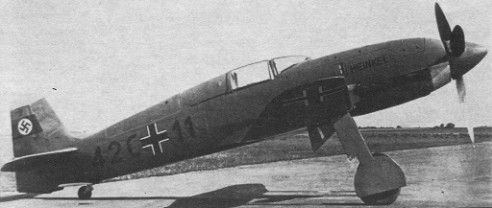
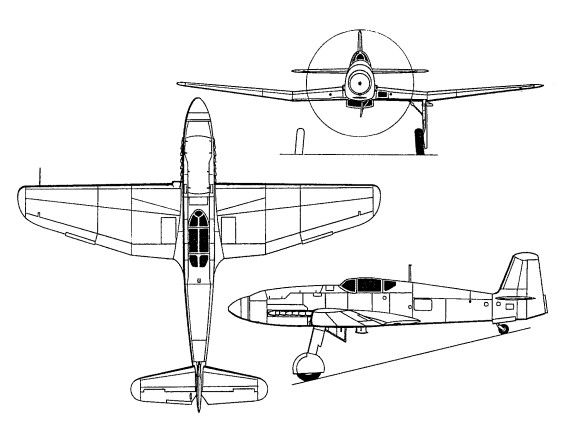
Ten prototypes were produced of the He 100, from designs by Siegfried Gunter and Heinrich Hertel, in an effort to produce a fighter which would replace the Messerschmitt Bf 109. Beginning as a private venture in 1937, the V I first prototype was powered by an 1100 hp DB 601A engine, and flew for the first time on January 22, 1938. On June 6 that year General Ernst Udet flew the V3, which had a boosted DB 601 and short span wings of 7.6 m (24 ft 1l.25 in) to an international 100 km (62 mile) closed circuit speed record of 643.7 km/h (400 mph). On 30 March 1939 He 100V8 set a new world absolute speed record of 746.604km/h (463.9 mph) at the hands of Flugkapitan Hans Dieterle. Despite these and other impressive performances the German authorities refused to select the He 100 as the successor to the Messerschmitt Bf 109. The only other examples built were three pre-production He 100D-0s and 12 production D Is which were completed by September 1939, preparatory to tests for the Russians for their own evaluation; Japan bought the three D 0s, and these aircraft did fly with Japanese naval aviation, designated AXHe1. Heinkel retained the 12 He 100B 1s for defence of its factory at Rostock Marienehe.
He 100D 1 Engine: 1 x Daimler-Benz DB 601M, 876kW Max take-off weight: 2500 kg / 5512 lb Empty weight: 2070 kg / 4564 lb Wingspan: 9.42 m / 30 ft 11 in Length: 8.19 m / 26 ft 10 in Height: 2.50 m / 8 ft 2 in Wing area: 14.50 sq.m / 156.08 sq ft Max. speed: 670 km/h / 416 mph Ceiling: 9890 m / 32450 ft Range: 1005 km / 624 miles Armament: 1 x 20mm cannon, 2 x 7.92mm machine-guns Seats: 1
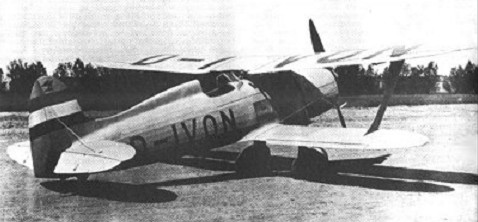
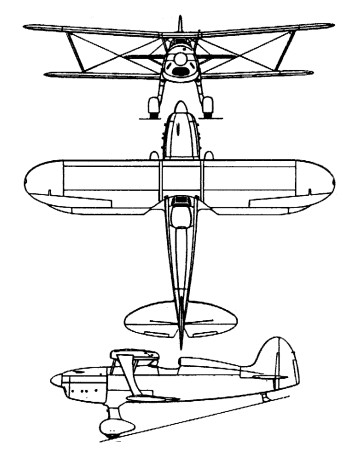
Scaled-down version of the He 51 biplane, intended as an advanced trainer and home defence fighter. The Fw 56 was selected for this requirement. Only three were built.
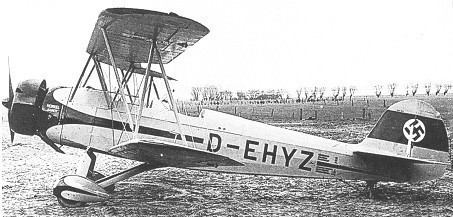
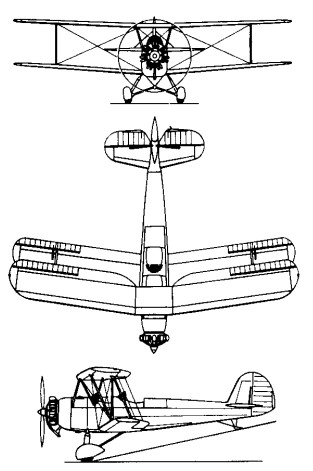
The Kadett (cadet) was a thoroughly conventional fabric-covered biplane trainer and liaison aeroplane of its period, and first flew in 1933 with the As 8B engine and nicely spatted main landing gear units. The type entered official service first with the training schools of the National Socialist Flying Corps, and then with the Luftwaffe. Comparatively large numbers were built, the production variants being the He 72A with the 104-kW (140-hp) Argus As 8B or later the 112-kW (150-hp) As 85 inlines, the He 72B major variant with a radial engine, and the He 72BW twin-float seaplane. Some 30 civil aircraft were built with the designation He 72B-2 Edelkadett (honour cadet), and there was a single He 172 with a NACA-cowled engine. Some aircraft were supplied to Slovakia during World War II, and these were even used as tactical reconnaissance machines during 1945.
He 72A Engine: Argus As 8B or As 8R, 104-kW (140-hp) or 112-kW (150-hp).
He 72B Engine: 1 x Siemens Sh 14A, 119kW / 160 hp Wingspan: 9.0 m / 29 ft 6 in Length: 7.50 m / 24 ft 7 in Height: 2.70 m / 8 ft 10 in Wing area: 20.70 sq.m / 222.81 sq ft Max take-off weight: 865 kg / 1907 lb Empty weight: 540 kg / 1191 lb Max. payload weight: 130.1 lb / 59.0 kg Fuel capacity: 27 gal / 101 lt Wing loading: 8.82 lb/sq.ft / 43.00 kg/sq.m Max. speed: 100 kts / 185 km/h / 115 mph Landing speed: 43 kts / 80 kph Cruising speed: 85 kts / 158 kph Take off distance: 591 ft / 180 m Service ceiling: 13780 ft / 4200 m Initial climb rate: 826.77 ft/min / 4.2 m/s Operational range: 295 miles / 475 km Maximum range: 443 nm / 820 km Armament: none. Seats: 2
In February 1932 design work was begun at the Heinkel factory on a high speed mailplane which could also carry four pas¬sengers. A top speed of 285 km/h (177 mph) was required by Deutsche Lufthansa who issued the specification. The Heinkel team, were inspired into setting their sights higher by the appearance in May that year of the Lockheed Orion, operated by Swissair. Maximum speed now required to compete with this aircraft was 322 km/h (200 mph).
The result was a low wing monoplane, tapered in chord and thickness and were of spruce construction, planked with plywood, having a retractable undercarriage, and it flew for the first time on December 1, 1932. It had an all metal oval semi monocoque fuselage, elliptical wings of wooden construction, and small rounded tail surfaces. The powerplant was a 469.5kW / 637hp BMW VI liquid cooled engine. When the Blitz was officially presented at Tempelhof field its speed of 362 kilometers per hour – made it not only the fastest commercial airplane of the time, but also faster than contemporary foreign fighters. An immediate production batch was ordered and 14 aircraft went into service with Lufthansa on domestic express routes during 1932 33 accommodating a pilot, navigator and four passengers.
Early in 1933 the aircraft also captured a number of international speed records. Further commercial developments of this model were the He 70B and the G 1, with lengthened fuselage; some variants were fitted with a 559kW / 750 hp BMW VI engine. Actual production of the passenger-carrying variants was 28.
The military potential of the He 70 was recognized by the embryonic Luftwaffe, and nine He 70B 0s, and an initial production batch of D Is, were delivered for high speed military communication and liaison duties. They retained the shorter fuselage, but were fitted with the uprated engine. The three-seat E 1 light bomber, developed from the D series, could carry up to 300 kg (660 lb) of bombs and was armed with one rear mounted MG 15 machine gun. Only limited E 1 production took place before the appearance of the three-seat F 1, F 2 and F 3 series long range reconnaissance bombers. Eighteen He 70F 2s were used by the Legion Kondor in Spain from late 1936. An additional 12 were transferred to the Spanish Nationalist forces.
The production total of nearly 300 military He 70 included 18 He 170A exported to Hungary during 1937-38, each of these powered by a 678kW Gnome-Rhone 14K Mistral Major radial engine and armed with two 7.8mm Gebauer machine-guns for defence.
He 70D 1
He-70D Crew: 1-2 Passengers: 4-5 Engine: 1 x BMW VI 7.3, 559kW Max take-off weight: 3640 kg / 8025 lb Empty weight: 2530 kg / 5578 lb Wingspan: 14.80 m / 48 ft 7 in Length: 11.70 m / 38 ft 5 in Height: 3.25 m / 10 ft 8 in Wing area: 36.51 sq.m / 392.99 sq ft Max. speed: 360 km/h / 224 mph Ceiling: 5485 m / 18000 ft Range: 1250 km / 777 miles
He 70F 2 Span: 14.8 m (48 ft 61 in) Length: 12 m (39 ft 41 in) Gross weight: 3460 kg (7630 lb) Maximum speed: 360 kmlh (224 mph).