De Bothezat who, after abandoning his first helicopter in 1923, had created a firm for the design and manufacturing of industrial fans, returned in 1937 to the helicopter: he created then the Helicopter Corporation of America and built a coaxial helicopter whose testing was entrusted to a Russian ace of World War I Captain Sergievsky.
Inter-Wars
Heinkel-Hirth HeS 011 / 109-011
Starting in 1936, Junkers started a jet engine development project under the direction of Wagner and Müller, who worked on axial compressor designs. By 1940 they had progressed to the point of having a semi-working prototype, which could not run under its own power and required an external supply of compressed air.
Meanwhile, Hans Mauch, in charge of engine development at the RLM, decided that all engine development should take place at existing engine companies. In keeping with this new policy, he forced Junkers to divest itself of their internal engine teams. Müller and half of the existing Junkers team decamped and were happily accepted by Ernst Heinkel, who had started German jet development when he set up a lab for Hans von Ohain in 1937. The two teams worked on their designs in parallel for some time, von Ohain’s as the HeS 8 (or 109-001), and the Junkers team as the HeS 30 (109-006). Heinkel’s efforts were later re-organized at Hirth Motoren.
Helmut Schelp, who had taken over from Mauch, felt that the BMW 003 and Junkers Jumo 004 would reach production at about the same power levels long before either would be ready, and cancelled both of the Heinkel projects. He had outlined a new development plan, with three engine classes, the 003 and 004 were “Class 1” engines of under 1000 kg thrust suitable for small fighters, but only really useful in twin-engine designs. Schelp was much more interested developing a “Class II” engine of 1000–2000 kg, larger designs able to power a full-sized fighter design with a single engine. Schelp was also interested in seeing one of his own pet projects, the diagonal compressor, adopted. Schelp had earlier convinced Heinkel to put some effort into another pet project of his, a twin-compressor single-turbine turboprop, but had given up on this and instead offered Heinkel his new concept as a consolation prize.
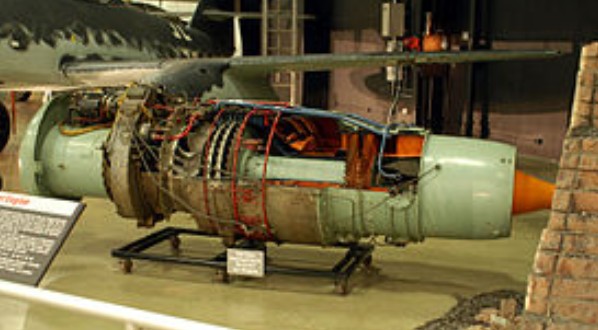
In some ways, the HeS 011 can be considered a combination of the two teams’ designs, a three-stage axial compressor from Müller’s team, combined with a single-stage centrifugal compressor from von Ohain’s, the two driven by a single two-stage turbine. It featured a unique compressor arrangement, combining a three-stage axial compressor with a “diagonal” stage similar to a centrifugal compressor directly forward of the three-stage axial compressor, along with a low-compression impeller in the intake, just ahead of the diagonal stage to smooth out airflow. The engine operated at somewhat higher thrust levels, about 2,700 lbf (12 kN), as opposed to about 1,750 to 2,000 lbf (7.8 to 8.8 kN) thrust for the 003 and 004 respectively. The 011 shared two features with the Jumo 004, with an engine-mounted Reidel two-stroke engine functioning as an APU to get the central shaft turning during engine startup, but mounted above the intake orifice within a Heinkel-crafted prefabricated sheet-metal intake passage instead of inside the intake diverter as the 004 had done, and also had a variable geometry exhaust nozzle, with a restrictive body of differing aerodynamic shape to the 004’s Zwiebel (onion) unit, that likewise traveled fore and aft in the nozzle to vary the thrust. Plans were also made for a turboprop version, the HeS 021, but the workload at Heinkel was so high that this project was later given to Daimler-Benz to complete.
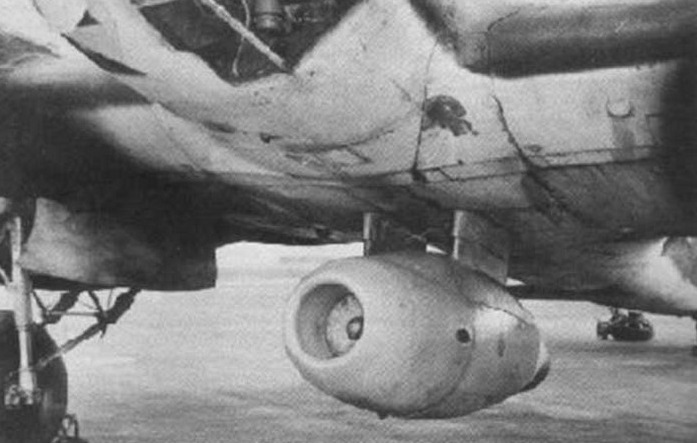
First run in September 1943, prototypes were available in 1944, and tested using a Heinkel He 111 bomber, mounting the engine on the external hardpoints under the fuselage.
Over the next year, practically all German aircraft designers based their projects on the 011. Like the nearly three hundred experimental examples built of the complex Jumo 222 piston engine, the HeS 011 turbojet never entered production, with only 19 prototypes built in total. One of these was mounted in the Messerschmitt Me P.1101 that was taken to the United States, forming the basis of the Bell X-5.
Two museum-preserved examples of the HeS 011 engine still exist in the United States, at the National Museum of the U.S. Air Force in Dayton, Ohio, and at the EAA AirVenture Museum in Oshkosh, Wisconsin.
Type: Turbojet
Length: 3450 mm (11 ft 3¾ in)
Diameter: 875 mm (34½ in)
Dry weight: 950 kg (2,094 lb)
Compressor: Diagonal + three stage axial
Combustors: 16 chambers
Turbine: Two stage axial.
Maximum thrust: 12.01 kN (2,700 lbf) at 10,000 rpm.
Thrust-to-weight ratio: 12.63 N/kg (1.29 lbf/lb)
Heinkel-Hirth HeS 1 / HeS 3 / HeS 6
In 1933, Hans von Ohain wrote his PhD thesis at the University of Göttingen on the topic of an optical microphone that could be used to record sound directly to film. Siemens bought the patent for RM 3,500, a princely sum. Ohain used the money to invest in his real interest, the gas turbine. In 1934 von Ohain contracted his mechanic, Max Hahn, to build a prototype of his concept. Later referred to as the “garage engine”, it quickly burned out due to the use of low-temperature metals. Nevertheless, it was successful and piqued the interest of his professor, Robert Pohl.
In February 1936, Pohl wrote to Ernst Heinkel on behalf of von Ohain, telling him of the design and its possibilities. Heinkel arranged a meeting where his engineers were able to grill von Ohain for hours, during which he flatly stated that the current garage engine”would never work but there was nothing wrong with the concept as a whole. The engineers were convinced, and in April, von Ohain and Hahn were set up at Heinkel’s works at the Marienehe airfield outside Rostock, Germany in Warnemünde.
Once moved, a study was made of the airflow in the engine, and several improvements made over a two-month period. Much happier with the results, they decided to produce a completely new engine incorporating all of these changes, running on hydrogen gas. The resulting Heinkel-Strahltriebwerk 1 (HeS 1), German for Heinkel Jet Engine 1, was built by hand-picking some of the best machinists in the company, much to the chagrin of the shop-floor supervisors. Hahn, meanwhile, worked on the combustion problem, an area he had some experience in.
The engine was extremely simple, made largely of sheet metal. Construction started late in the summer of 1936, and completed in March 1937. It ran two weeks later on hydrogen, but the high temperature exhaust led to considerable “burning” of the metal. The tests were otherwise successful, and in September the combustors were replaced and the engine was run on gasoline for the first time. This proved to clog up the combustors, so Hahn designed a new version based on his soldering torch, which proved to work much better. Although the engine was never intended to be a flight-quality design, it proved beyond a doubt that the basic concept was workable.
While work on the HeS 1 continued, the team had already moved on to the design of a flight-quality design, the HeS 3.
In some ways the HeS 3 design was simply a cleanup of the original HeS 1, converted to burn liquid fuel instead of the HeS 1’s hydrogen gas. von Ohain was also unhappy with the large external diameter of the HeS 1, and re-arranged the layout of the new engine to allow the parts to be “folded together” in a more compact layout.
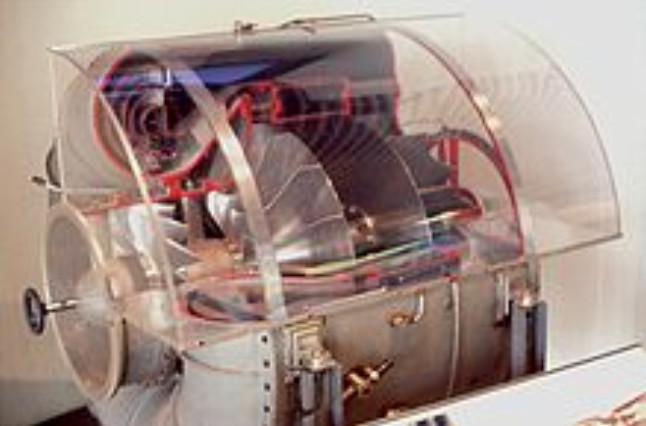
The first HeS 3 design was generally similar to the HeS 1, using a 16-bladed centrifugal compressor supported by an 8-blade impeller to smooth out the airflow in the intake. The compressed air flowed into an annular combustion chamber arranged to lie between the compressor and turbine, which were separated much more than in the HeS 1 to allow this arrangement. The first example was bench tested around March 1938, but the arrangement led to a smaller than useful compressor and poor combustion.
A redesign started as the HeS 3b, which dispensed with the “folded” arrangement and returned to simpler flame cans for combustion. In order to keep the dimensions small, the widest part of the cans were arranged in front of the engine, the compressed air first flowing forward into the cans, and then rearward to the turbine. Although not as compact as the original design, the 3b was much simpler. Designed to run on gasoline, the fuel flow was preheated by running it over the rear roller bearing.
The engine was completed in early 1939, and was flight-tested under one of the remaining Heinkel He 118 dive bomber prototypes. The flight tests were carried out in extreme secrecy, taking off and landing under propeller power, and only flying in the early morning before other workers had arrived. Testing proceeded smoothly, but the engine eventually burned out its turbine.
A second engine was completed just after completion of the He 178 airframe, so it was decided to move directly to full flight tests. A short hop was made on 24 August during high-speed taxi tests, followed by full flight on 27 August, piloted by Erich Warsitz, the first aircraft to fly solely under jet power. Testing continued and in November the aircraft was demonstrated to RLM officials in hopes of receiving funding for the development of a larger engine, but nothing seemed forthcoming.
Hans Mauch later told von Ohain the RLM was in fact extremely impressed, but he was concerned that Heinkel’s airframe team did not have the knowledge to undertake engine development. Instead he and Helmut Schelp secretly visited a number of aircraft engine manufacturers to try to start programs there. Mauch left his position in 1939 leaving Schelp in command. Schelp was not as concerned about where development was taking place, and immediately started funding Heinkel to produce a more powerful engine.
Work on a larger version, the HeS 6, started immediately, and was tested under a Heinkel He 111 late in 1939. While successful, notably in terms of vastly improved fuel economy, the weight was considered excessive and the design was abandoned in favour of the more advanced Heinkel HeS 8.
HeS 3b
Length: 1.48 m
Diameter: 0.93 m
Weight: 360 kg
Thrust: 450 kgf (4.4 kN) @ 13,000 rpm and 800 km/h
Compression ratio: 2.8:1
Specific fuel consumption: 2.16 gal/(lb·h) [18.0 L/(kg·h)]
HeS 6
Weight: 420 kg
Thrust: 550 kgf (5.4 kN) @ 13,300 rpm and 800 km/h
Specific fuel consumption: 1.6 gal/(lb·h) [13.4 L/(kg·h)]
Heinkel He 280
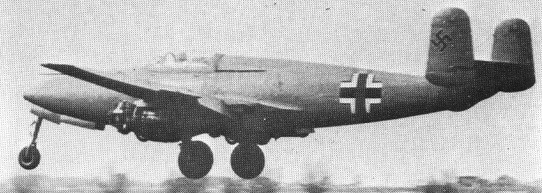
When work on the He 178 was discontinued in the autumn of 1939, effort was transferred to a more advanced twin-engined design which was to be powered by pairs of two new Heinkel turbojets, the HeS 8 and HeS 30. Design of the He 280, which started before the end of 1939, included a low wing with twin underslung turbojets tricycle landing gear and twin fins and rudders. Neither engine was ready for flight when the Heinkel He 280 prototype airframe was itself complete and first trial flights, which began on 22 September 1940, were unpowered, the aircraft being towed to release height behind a Heinkel He 111.
Despite the obvious need for low diameter engines, Dr von Ohain succeeded in developing the centrifugal flow HeS 8 (or 109 001) to produce 700 kg (1,543 1b) thrust installed in March 1941, and a pair of these engines powered the He 280 VI on its first powered flight on 2 April l941. For this first flight the engines were kept uncovered as during test runs fuel had gathered in the cowlings.
Fritz Schafer piloted the first powered flight, and the engines were producing little more than 500kg thrust, however, and although available thrust had risen to some 600kg by early 1943 when the second and third prototypes were flown, in April of that year BMW 109-003 engines were adopted.
A total of nine prototypes flew, including the He 280 V2 and He 280 V3 with HeS 8 engines (the former also being re engined with Jumo 109 004s). The He 280 V4 had BMW 109 003s and later with six Argus 109 014 pulsejets. The He 280 V5 flew first with HeS 8s and later with 109 003s. The He 280 V6 (as well as the V5) with three MG 151 20 mm can¬non, the He 280 V7 with 109 004s (and later tested as a high speed glider for aerodynamic research), the He 280 V8 with 109 004s and a V type tail unit, and the He 280 V9 with 109 003s.
Although production of the He 280 was planned, recurring complaints (which included structural weakness in the tail, together with tail flutter, and inadequate fuel and armament provision) caused the design to be abandoned in favour of the Messerschmitt Me 262,
It was from the He 280 V1 that the first ever bale out using an ejector seat was made when Argus test pilot Schenk abandoned the aircraft on 13 January 1942 when his controls locked from icing up during a towed test flight. This seat was powered by compressed air.
He 280 V5
Engines: two 750 kg (1,653 1b) thrust HeS 8A (109 001A) turbojets
Maximum short burst speed 900 kph (559 mph) at 6000 m (19,685 ft)
Normal max-speed 820 km/h
Initial climb rate 1145 m (3,755 ft) per minute
Estimated service ceiling 11500 m (37,730ft)
Range 650 km (404 miles)
Empty weight 3215 kg (7,088 lb)
Maximum take off weight 4310 kg (9,502 lb)
Wing span 12.20 m (40 ft 0 in)
Length 10.40 m (34 ft 1.5 in)
Height 3.06 m (10 ft 0.5 in)
Wing area 21.50 sq.m (231.5 sq ft).
Armament: three nose mounted 20¬mm MG 151 cannon.
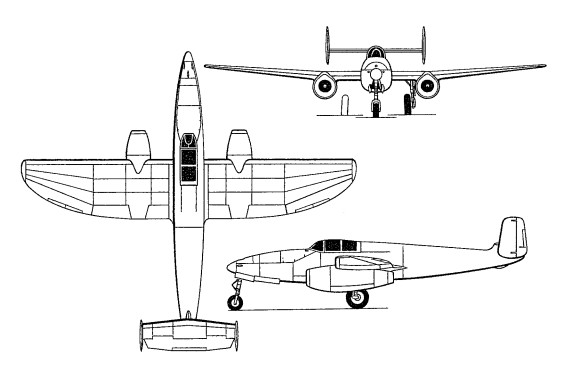
Heinkl He 270
The He 270 was essentially a private venture improvement of the He 70, in which a 1175 hp DB 601Aa engine was installed in an He 70F airframe. It flew in the spring of 1938, but no production was under-taken.
Heinkl He 178
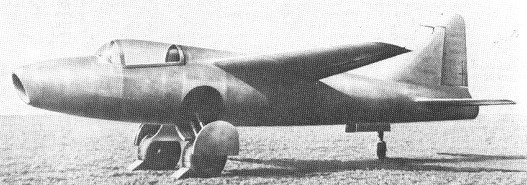
The first step in the development of this aeroplane was taken in March 1936 when Ernst Heinkel engaged the services of the German gas turbine pioneer Dr Hans Pabst von Ohain and his assistant Max Hahn. The first demonstration turbojet, the hydrogen-fuelled HeS 1, was bench running by September 1937, and a development of this engine, the HeS 3, was flight tested suspended beneath a Heinkel He 118 in 1938, using petrol as fuel, developing about 4.89kW.
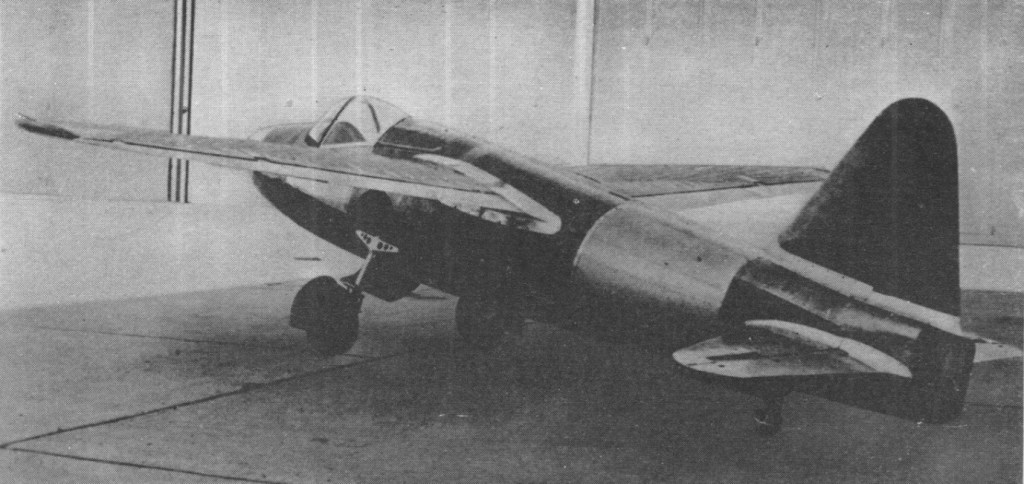
By 1939, it had been decided to install a new version, the HeS 3b, in a special aircraft, the He 178, which commenced building that year; it was a shoulder wing aircraft with wings made largely of wood but with a semi-monocoque metal fuselage with fully retracting and faired in undercarriage. Tailwheel landing gear was incorporated, and the engine drew its air from an inlet in the nose and exhausted through a long jet pipe which extended to the extreme tail.
The first flight test of a jet powered aircraft took place in the morning of 27 August 1939. The Heinkel He 178 lifted off Marienche aerodrome by Flugkapitan Erich Warsitz under jet power. The jet engine: Hans von Ohain’s third prototype, the HeS 3B. In the cockpit sat Heinkel’s test pilot, Erich Warsitz. The He 178’s landing gear wasn’t retracted, so Warsitz had to keep speed down to about 200 mph. The 178 was damaged on its first flight when the engine ingested a bird which caused it to flame out, but the aircraft made a safe landing. The He 178 touched gently and rolled to stop before taxiing to where Hans and Ernst Heinkel were waiting. Hans immediately began an engine check. Heinkel watched and then announced that once the checks were complete the He 178 was to be left untouched. Heinkel’s reasoning was that the first flight was a success and, if nothing was disturbed, he’d have a functional prototype to ‘sell’ to the Berlin Air Ministry bureaucrats. The big sedan reappeared and the first jet aeroplane was towed away to storage. Then Heinkel brought out the champagne. The Heinkel flew one more time in the November of 1939 with a 590 kg (1,301 lb) thrust HeS 6 engine, but a number of airframe defects limited the speed to about 600 km/h (373 mph). It was next put in a museum in Berlin where it (and its engine) was destroyed during a bombing raid in 1943.
Although two prototypes were built only the first (the V1) ever flew.
Features of the design were the wooden wing (which limited high speed runs) and the angular intake (which injested FOD at a high rate from the grass at rpm above idle).
Only one He 178 was built.
He-178 V1
Engine: One Heinkel HE S3B centrifugal flow turbojet, 992lb (450kg) thrust, later improved to 1,102 lb (500kg)
Wing Span: 7.2m / 23 ft 7 in
Length: 7.48m / 24 ft 7 in
Height: 2.1 m / 6 ft 11 in
Wing area: 9.1 sq.m / 97.95 sq ft
Empty Weight: 1,560 kg / 3,439 lb
Loaded Weight: 1950 kg / 4,400 lb
Max Speed: 435 mph / 700 kph
Cruise speed: 580 km/h / 360 mph
Landing speed 165 km/h / 103 mph
Crew: 1
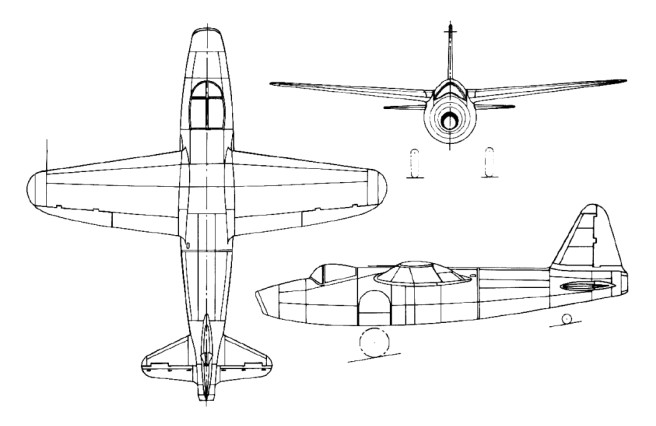
Heinkl He 176
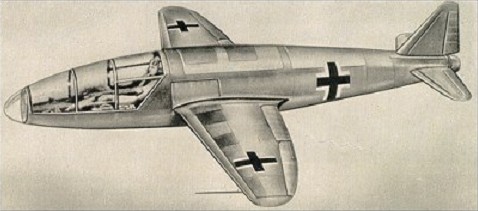
Ernst Heinkel initiated as a private venture the He 176, which was designed by Siegfried and Walter Gunter specifically for rocket propulsion. The span and area apply to the open cockpit, fixed undercarriage first prototype as originally designed; larger wings were fitted before the first flight. The speed and endurance of approx 171 mph (275 kph) and 50 sec. are those achieved on the first flight on 20 June 1939 powered by a 5.89kN Walter HWK-R1 203 liquid fuel rocket motor, although much better performances were achieved later.
The He 176 was demonstrated before senior German officials early in July 1939. They remained unconvinced of the potential of rockets for aircraft propulsion. The more advanced second prototype, with enclosed cockpit and retractable landing gear was never built.
Engine: One Walter HWK R 1 203 rocket, 1,323 lb (600 kg) thrust.
Wing span: 16 ft 4.75 in (5.00 m)
Length: 17 ft 0.75 in (5.20 m).
Height: 1.4 m / 4 ft 7 in
Wing area: 58.12 sq.ft (5.40 sq.m)
Gross weight: approx 3,530 lb (1600 kg).
Empty weight: 900 kg / 1984 lb
Max. speed: 750 km/h / 466 mph
Cruise speed: 700 km/h / 435 mph
Ceiling: 9000 m / 29550 ft
Range: 95 km / 59 miles
Crew: 1.
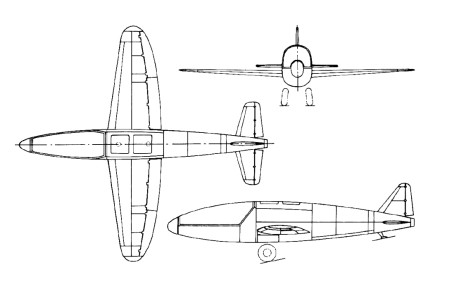
Heinkl He 170
From the basic He 70, Heinkel evolved the He 170A in 1936. This differed chiefly in having a 910 hp Gnome Rhone 14K Mistral Major radial engine. The new engine rather spoilt the aircraft’s elegant lines, but the extra power raised the top speed by 55 km/h (34 mph), and 20 were sold to the Hungarian air force.
Heinkel He 119
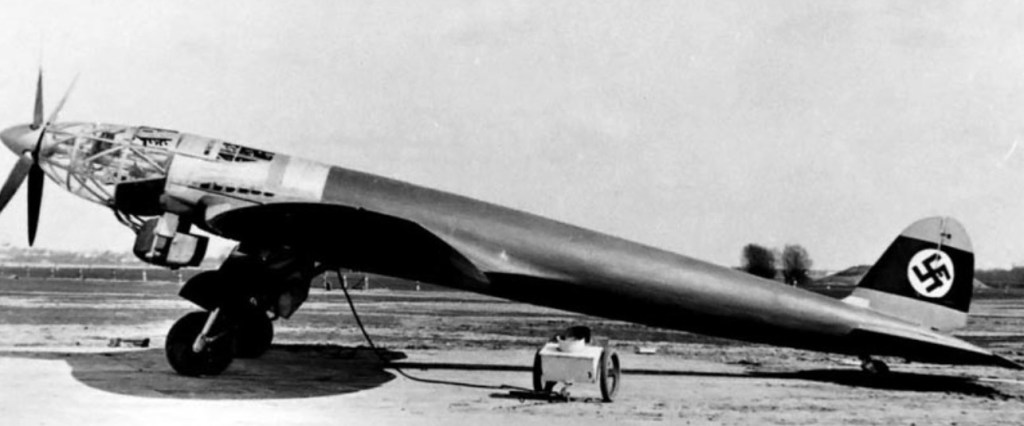
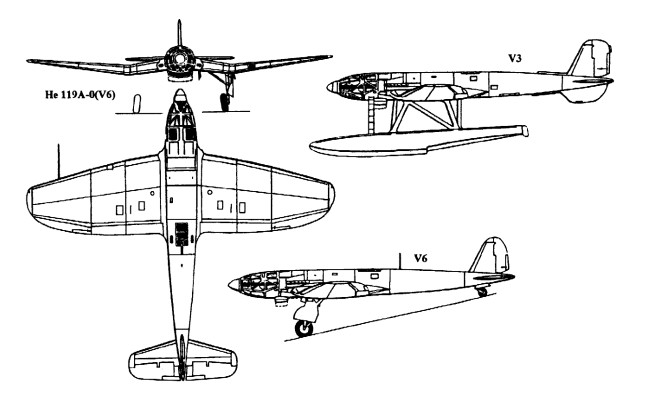
The He 119, by Ernst Heinkel A.G., was one of the designs to come out of the pre-war period: its streamlined fuselage was mated to a tandem engine arrangement promising considerable speed gains in the process. The aircraft was briefly considered for high-speed reconnaissance and bombing roles within the Luftwaffe but the project only matured as far as eight prototypes serving as experimental platforms.
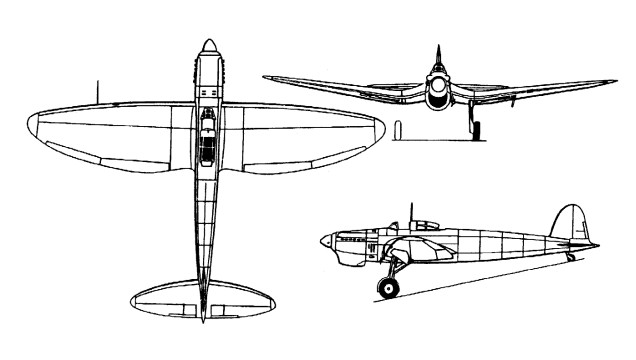
A two-seat aircraft, design work on the type began in 1936 and engineers selected the slimmest of profiles with no obvious physical protrusions to be had along the fuselage. This allowed the airframe to benefit from streamlining as even the cockpit was integrated into the clean lines of this aircraft, its position given away by heavy glazing near the nose and aft of the propeller spinner. To fit the twin engine arrangement, the powerplants were coupled aft of the cockpit and powered the nose-mounted propeller by way of a drive shaft. The propeller was a four-bladed design. The drive shaft ran between the two crewmembers. The engine of choice was the Daimler-Benz DB601 which, when coupled, formed the DB606A-2, a 24-cylinder, liquid-cooled inverted V12 monster outputting 2,350 horsepower. To streamline the aircraft even more, it used surface radiator cooling instead of conventional radiators.
The wing mainplanes were elliptical and the aircraft relied on a single, curved rudder with low-set horizontal planes. The undercarriage was of a retractable tricycle arrangement.
A first-flight by way of the V1 prototype was recorded during mid-1937 and the V2 followed with an experimental radiator fit. V3 was the same design though reworked as a seaplane and still able to retain the aircraft’s performance. V4 was set aside for speed trials and managed a record in 1937 of 314 miles per hour while carrying a load of 2,205lb over 621 miles.
Prototypes V5 through V8, added in 1938, were intended to serve as production-minded prototypes for operational reconnaissance and bomber aircraft (two of each form). These designs were all given a three-man crew and an MG15 machine gun fitted to a dorsal position (strictly for self-defense). The proposed bomber design was to carry up to 2,205lb of conventional drop stores.
While the He 119 never materialized into an operational combat aircraft, V7 and V8 went on to see extended testing in the hands of Japanese engineers as the pair were sold off to the German ally.
German propaganda designated the He 119 as the “He 111U”. The “He 519” was a related proposal of 1944 intended as a high-speed bomber. It was developed as a private venture by the company and was to rely on the DB613 engine (a larger version of the DB601). The end of the war in 1945 ended the He 519 in full.
Late in 1938, the Heinkel He 119 experimental high-speed reconnaissance aircraft was shown to a Japanese Naval delegation visiting Germany. The Japanese liked the speed and range of the He 119, and overall, were impressed by the aircraft. Based on the positive initial interest, the Japanese sent a group of technicians from the Yokosuka Naval Air Technical Arsenal (Yokosuka, also known as Kaigun Koku Gijutsusho or Kugisho) to Germany for a closer examination of the He 119. Eventually, Commander Hideo Tsukada was able to purchase two He 119 prototypes and a license to manufacture the aircraft in Japan.
The two He 119 prototypes were delivered via ship to Japan in 1941 (some say 1940). The aircraft were reassembled at Kasumigaura Air Field, and flight tests occurred at Yokosuka Naval Base. During an early test flight, one of the He 119s was badly damaged in a landing accident, and it is believed the other He 119 suffered a similar fate. Plans to produce the He 119 never moved forward, but the Japanese were still interested in a high-speed reconnaissance aircraft and felt the general configuration of the He 119 held promise.
Four were completed. Total production: 8 prototypes.
He 119 V1
Engines: 1 x Daimler-Benz DB660A-2, 2,350 hp
Propeller: metal three-bladed variable pitch
Overall Length: 48.56 feet (14.8 meters)
Overall Width: 52.17 feet (15.90 meters)
Overall Height: 17.72 feet (5.40 meters)
Empty weight: 5200 kg
Max weight: 7585 kg
Power loading: 3,227 kg/hp
Range: 3120 km.
Maximum Speed: 367 mph (590 kph; 319 knots)
Maximum Range: 1,942 miles (3,125 km)
Service Ceiling: 27,887 feet (8,500 meters)
Rate-of-Climb: 1,840 feet-per-minute (561 m/min)
He 119 V2
Equipped with standard radiator.
Engines: 1 x Daimler-Benz DB660A-2, 2,350 hp
Overall Length: 48.56 feet (14.8 meters)
Overall Width: 52.17 feet (15.90 meters)
Overall Height: 17.72 feet (5.40 meters)
Maximum Speed: 367 mph (590 kph; 319 knots)
Maximum Range: 1,942 miles (3,125 km)
Service Ceiling: 27,887 feet (8,500 meters)
Rate-of-Climb: 1,840 feet-per-minute (561 m/min)
He 119 V3
Two catamaran floats.
Engines: 1 x Daimler-Benz DB660A-2, 2,350 hp
Overall Length: 48.56 feet (14.8 meters)
Overall Width: 52.17 feet (15.90 meters)
Overall Height: 17.72 feet (5.40 meters)
Max speed: 570 km/h
Maximum Range: 1,942 miles (3,125 km)
Service Ceiling: 27,887 feet (8,500 meters)
Rate-of-Climb: 1,840 feet-per-minute (561 m/min)
He 119 V4
Destroyed after a flight achieving more than 595 km/h.
Engines: 1 x Daimler-Benz DB660A-2, 2,350 hp
Overall Length: 48.56 feet (14.8 meters)
Overall Width: 52.17 feet (15.90 meters)
Overall Height: 17.72 feet (5.40 meters)
Maximum Speed: 367 mph (590 kph; 319 knots)
Maximum Range: 1,942 miles (3,125 km)
Service Ceiling: 27,887 feet (8,500 meters)
Rate-of-Climb: 1,840 feet-per-minute (561 m/min)
He 119 V5
Reconnaissance prototype; three-man crew; 1 x MG15 machine gun armament.
Engines: 1 x Daimler-Benz DB660A-2, 2,350 hp
Overall Length: 48.56 feet (14.8 meters)
Overall Width: 52.17 feet (15.90 meters)
Overall Height: 17.72 feet (5.40 meters)
Maximum Speed: 367 mph (590 kph; 319 knots)
Maximum Range: 1,942 miles (3,125 km)
Service Ceiling: 27,887 feet (8,500 meters)
Rate-of-Climb: 1,840 feet-per-minute (561 m/min)
He 119 V6
Reconnaissance prototype; three-man crew; 1 x MG15 machine gun armament.
Engines: 1 x Daimler-Benz DB660A-2, 2,350 hp
Overall Length: 48.56 feet (14.8 meters)
Overall Width: 52.17 feet (15.90 meters)
Overall Height: 17.72 feet (5.40 meters)
Max spped: 367 mph
Empty weight: 11,465lb
Loaded weight: 16,678lb
Range: 1,940 miles
Altitude: near 15,000 ft
Maximum Speed: 367 mph (590 kph; 319 knots)
Maximum Range: 1,942 miles (3,125 km)
Service Ceiling: 27,887 feet (8,500 meters)
Rate-of-Climb: 1,840 feet-per-minute (561 m/min)
He 119 V7
Bomber prototype; three-man crew; 1 x MG15 machine gun armament; 2,205lb bomb load. Not completed.
He 119 V8
Bomber prototype; three-man crew; 1 x MG15 machine gun armament 2,205lb bomb load. Not completed.
Heinkel He 118
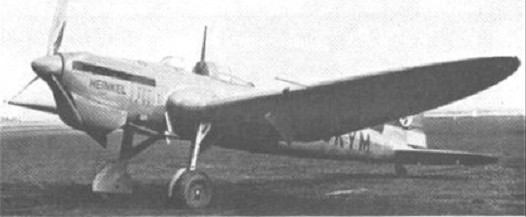
Two-seat monoplane dive bomber, with a quasi-elliptical wing. The He 118 was larger and more refined than its competitors, with an internal bomb bay and retractable landing gear. First flown in the summer of 1937, the He 118 could not safely exceed a diving angle of about 50 degrees, while the Ju 87 could be dived vertically.
Total production was 15 examples including 2 of the 4 prototypes, (V4 and V5), provided to Japan.
By early 1938 the Japanese Navy had also acquired the German He 118 V4 two-seat dive bomber aircraft, along with its production rights. This aircraft was powered by the DB 601A. The Heinkel’s spectacular performance impressed the IJN Naval Staff so much that the design of the Yokosuka D4Y Suisei (Allied reporting name “Judy”) carrier based dive bomber evolved from it.
Ten examples of the production He 118A-0 were built.
250 kg of bombs were carried internally or 500 kgs of bombs internal when flown solo.
The He 118 is best known for its role in the testing of jet engines.
He 118 V 1
Engine: 1 x Rolls-Royce Buzzard, 825 hp
Propeller: metal four-bladed variable pitch
Wingspan: 15,09 m
Length: 11,80 m
Height: 4,18 m
He 118 V2
Engine:1 x Daimler Benz dB 600C, 910 hp
He 118 V5
Engine: 1 x Daimler Benz dB 600C, 910 hp
He 118A-0
Engine: Daimler Benz dB 600C, 910 hp
Propeller: four-bladed metal variable pitch
Wingspan: 15,09 m
Length: 11,80 m
Height: 4,18 m
Empty weight: 2700 kg
Max weight: 4120 kg
Power loading: 4,527 kg/hp
Max speed: 385 kmh
Range: 1050 km
Armament: 2 MT MG 17 of 7,92 mm, 1 MT, 250 or 500 kgs bombs internal