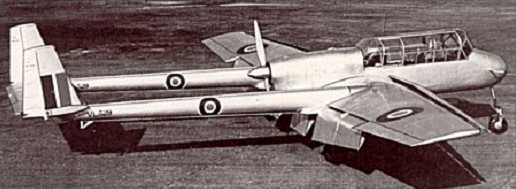
Prototype two-seat air observation post powered by a 179kW de Havilland Gipsy Queen 33 engine mounted as a pusher.
Prototype two-seat air observation post powered by a 179kW de Havilland Gipsy Queen 33 engine mounted as a pusher.
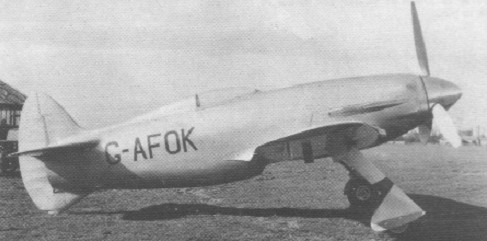
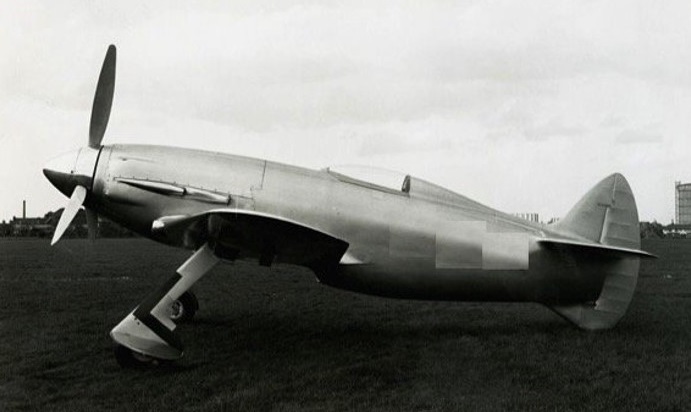
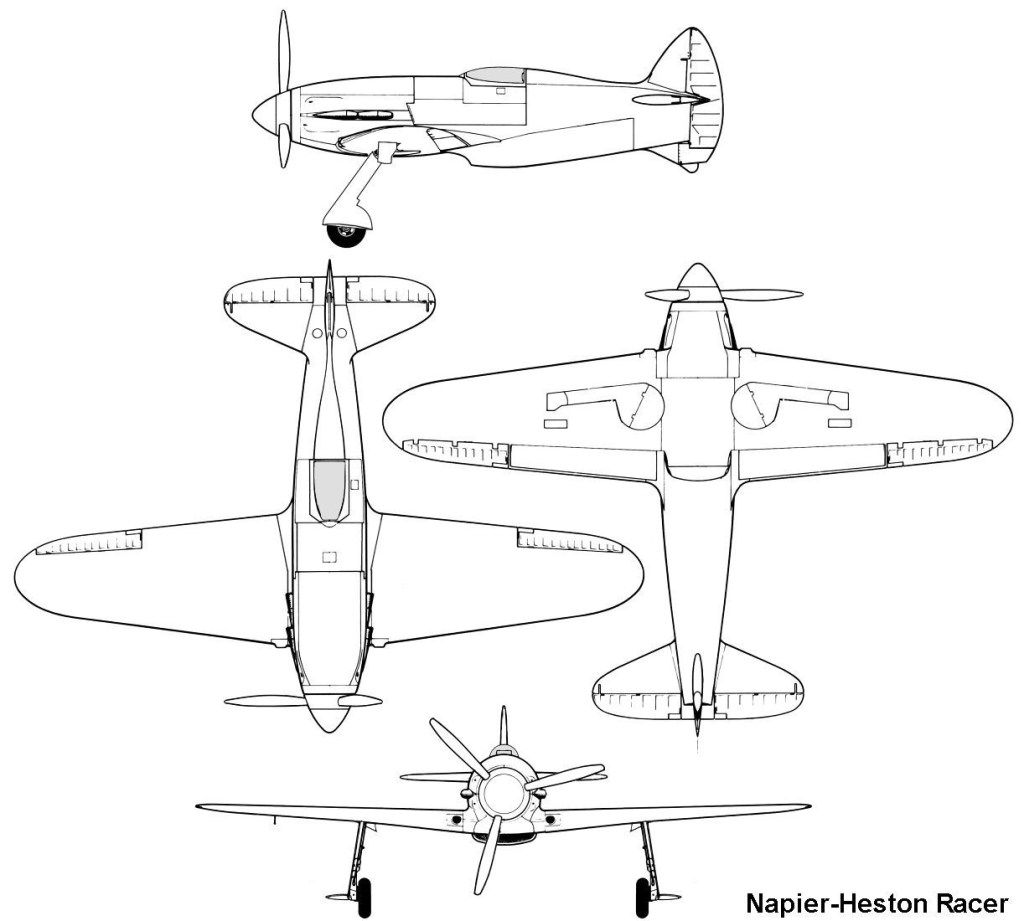
The Heston Type 5 Racer G-AFOK, designed by A.E.Hagg and G.Cornwell, was built at Heston during 1939-40, but crashed there on its maiden flight on June 12, 1940.
On June 12, 1940, the first aircraft for the record attempt, G-AFOK (Fox Oboe King), made its maiden flight at Heston Aerodrome, piloted by Squadron Leader G.L.G. Richmond, Heston Aircraft’s Chief Test Pilot. A heavy bump during the high-speed take-off run, with the canopy off, caused an unexpected early liftoff.
After an abrupt take-off, Richmond conducted a brief test flight with gear extended, but inadequate elevator control and engine overheating forced an emergency landing. Scalded by steam or coolant, he stalled the aircraft at 30 feet, crashing heavily. The undercarriage pierced the wings, and the tail detached. Richmond survived with minor burns.
The 2,300 hp Napier Sabre-powered racer was sponsored by Lord Nuffield for a British attempt on the world speed record. A second was never completed.
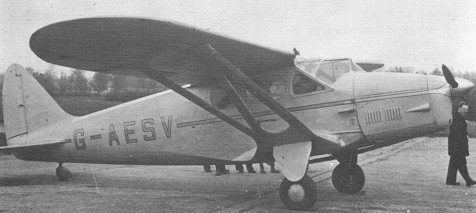
This 1935 five seat training aircraft featured hydraulically operated retractable landing gear. The main wheels retracted into a small stub wing which formed part of the wing bracing struts. The aircraft had a particularly quiet cabin which was also bigger than normal for its type. It was not, however, commercially successful.
The Heston Type 1 Phoenix was a five-seat cabin monoplane, the first on a British high-wing aircraft.
Engine: One 200 hp / 149kW D.H. Gipsy VI
Length: 30.1 ft (9.15 m)
Wing span: 40.3 ft (12.3 m.)
Weight empty: 2,000 lb (900 kg)
Passengers/Cargo: 1 pilot; 4 passengers.
Max. cruise: 135 mph (217 kph)
Ceiling: 20,000 ft (6,000 m) fully loaded
Range: 500 miles (800 km)
In March 1933 Comper Aircraft moved to Hooton to continue building Swifts and to produce the Mouse, Streak and Kite one offs. When the company folded in March 1934, Heston Aircraft Company Ltd was formed from its assets.
Heston Aircraft Co, Hounslow, Great Britain.
Alfred Herrmann, pioneer of the Belgian aviation, built the first Belgian two-seater in the Twenties. An all-metal biplane aircraft for hunting and reconnaissance. The plane was constructed under the aegis of Commander Fernand Jacquet, a hero of the First World War, with the help of a handful of mechanics from Ostend and some fishermen in a small workshop in the Zeebrugge harbor.
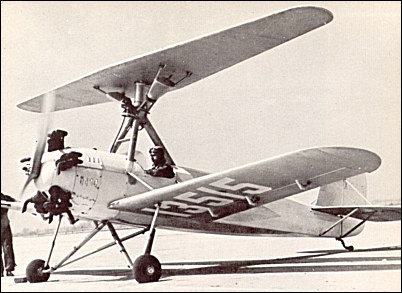
The Convertoplane, cross between an airplane and a rotorplane, was developed in the United States in the 1930s by the Gerard P. Herrick, aided by Ralph H. McClarren of Philadelphia’s Franklin Institute. Basically, the design was a biplane with an upper wing that could function either as a lifting surface or as a two-bladed teetering rotor.
Flown by test pilot George Townsend in 1937, the aircraft demonstrated successful conversions in flight from a biplane to a rotorplane. Herrick was striving for an aircraft that could achieve speed as an airplane while possessing ability to convert to rotating-wing configuration for landing and take-off in tight areas.
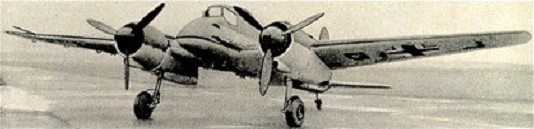
Henschel was one of four companies (the others being Focke-Wulf, Gotha and Hamburger Flugzeugbau) to which, in April 1937, the Technische Amt of the Reichsluftfahrtministerium (RLM) issued a specification for a twin-engine ground-attack aircraft. It was required to carry at least two 20 mm MG FP cannon and to have extensive armour plating protection for crew and engines. The two designs for which development contracts were awarded on 1 October 1937 were the Focke-Wulf Fw 189C and Henschel Hs 129.
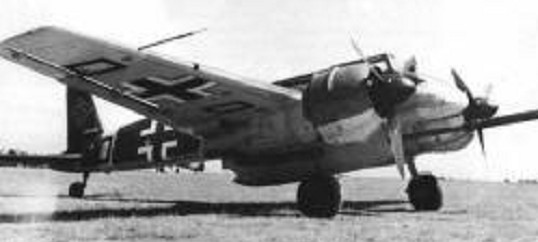
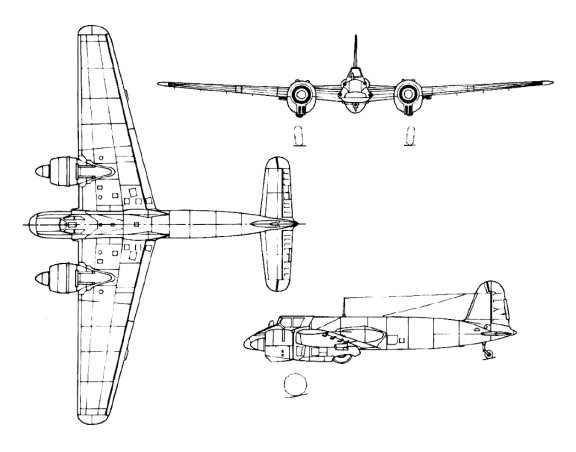
The Hs129 was another Friedrich Nicolaus design with a light alloy stressed-skin fuselage of triangular section.
It was designed around a single large “bathtub” of steel sheeting that made up the entire nose area of the plane, completely enclosing the pilot up to head level. Even the canopy was steel, with only tiny windows on the side to see out of and two angled blocks of glass for the windscreen. It contained a small cockpit with a restricted view, necessitating the removal of some instruments to the inboard sides of the engine cowlings. The windscreen was made of 75 mm (2.95 in) armoured glass and the nose section was manufactured from armour plating. Nose armament comprised two 20 mm MG FF cannon and two 7.92 mm (0.31 in) MG 17 machine guns. In order to improve the armor’s ability to stop bullets the sides were angled in forming a triangular fuselage, resulting in almost no room to move at shoulder level. The Revi C 12/C gunsight was mounted outside on the nose. The prototype flew in the spring of 1939, powered by two 465 hp (347 kW) Argus As 410A-1 engines, and two further prototypes were flown competitively against the modified Fw 189 development aircraft for the Fw 189C.
The entire nose section formed a welded armoured shell 6 mm to 12 mm thick around the pilot, with toughened 75 mm thick glass in the canopy. The total weight of the nose armour was 2,380 lbs (1080 kg).
In the end the plane came in 12% overweight and the engines 8% underpowered, and the controls proved to be almost inoperable as speed increased. The Fw design proved to be no better, both planes were underpowered with their Argus 410 engines, and very difficult to fly. In the end the only real deciding factor was that the Henschel was smaller and cheaper. The Focke-Wulf was put on low priority as a backup, and testing continued with the Hs 129A-0.
Two self-sealing wing tanks each holding 45 Imperial gallons (205 litres) and a single self-sealing fuselage tank of 44 Imperial gallons (200 litres). The Hs 129B-2 was capable of carrying a single droppable auxiliary fuel tank of 33 Imperial gallons (150 litres)
The company was awarded a contract for eight pre-production Hs 129A-0 aircraft, and these were issued initially to 5 (Schlacht)./LG 2 in 1940, but transferred to 4./SG 101 at Paris-Orly in 1941, with the exception of two which were converted at Schonefeld to accept Gnome-Rhone 14M 4/5 radial engines. It was with this powerplant that 10 Hs 129B-0 development aircraft were delivered from December 1941; improvements included a revised cockpit canopy and the introduction of electrically-actuated trim tabs. Armament comprised two 20 mm MG 151/20 cannon and two 7.92 mm (0.31 in) MG 17 machine guns, along with the ability to carry four 50kg bombs under the midline.
But even before the A-1’s were delivered the plane was redesigned with the Gnome-Rhone 14M radial engine, which were captured in some number when France fell. This engine supplied 700 hp (522 kW) for takeoff compared to the Argus at 465 hp (347 kW). The A-1 planes were converted into Hs 129B-0’s for testing (although some claim that some A’s were sold to Romania) and the pilots were reportedly much happier. Their main complaint was the view from the canopy, so a single larger windscreen and a new canopy with much better vision were added, resulting in the production model Hs 129B-1. The first flight of the Hs 129B was in October 1941.
B-1’s started rolling off the lines in December 1941, but they were delivered at a trickle. In preparation for the new plane, I./Sch.G 1 had been formed up in January with 109’s and Hs 123’s, and they were delivered B-0’s and every B-1 that was completed. Still, it wasn’t until April that 12 B-1’s were delivered and its 4th staffeln was ready for action. They moved to the eastern front in the middle of May, and in June they received a new weapon, the 30 mm MK 101 cannon with armor-piercing ammo in a midline pod.
The production Hs 192B-1 series became operational on the Eastern front, where the type was to be used most widely, although it served also in North North Africa, Italy and in France after the D-Day landings. Sub-variants of the M 129B-1 series included the Hs 129B-1/R1 with additional offensive armament in the form of two 110 lbs (50 kg) bombs or 96 anti-personnel bombs. The Hs 129B-1/R2 with a 30-mm MK 101 cannon beneath the fuselage. The Hs 129B-1/R3 with four extra MG 17 machine-guns; the Hs 129B-1/R4 with an ability to carry one 551 lbs (250 kg) bomb instead of the Hs 129B-1/R1’s bomb load; and the Hs 129B-1/R5 which incorporated an Rb 50/30 camera installation for reconnaissance duties.
By May of 1942 only 50 of the planes had been delivered when they started to deliver the new Hs 129B-2 model side-by-side with the B-1. The only difference between the two were changes to the fuel system – a host of other minor changes could be found almost at random on either model. As time went on these changes were accumulated into the B-2 production line until you could finally tell them apart at a glance, the main differences being the removal of the mast for the radio antenna, the addition of a direction-finding radio antenna loop, and shorter exhaust stacks on the engines.
In the field the differences seemed to be more pronounced. The R-kits were renumbered and some were dropped, and in general the B-2 planes received the upgraded cannon pack using a MK 103 instead of the earlier MK 101. These guns both fired the same ammunition, but the 103 did so about almost twice the rate.
The Hs 129B-2 series which was introduced into service in the early part of 1943. They included the Hs 129B-2/Rl which carried two 20 mm MG 151/20 cannon and two 13 mm (0.51 in) machine-guns; the generally similar Hs 129B-2/R2 introduced an additional 30 mm MK 103 cannon beneath the fuselage; the Hs 129B-2/R3 had the two MG 13s deleted but was equipped with a 37 mm BK 3,7 gun; and the Hs 129B-2/R4 carried a 75 mm (2.95 in) PaK 40L (‘L’ for Luftwaffe) gun in an underfuselage pod. Final production variant was the Hs 129B-3 of which approximately 25 were built and which, developed from the Hs 129B-2/R4, substituted an electro-pneumatically operated 75 mm BK 7,5 gun for the PaK 40 (Panzer Abwehr Kanone 40). The lethal capability of the Hs 129B-2/R2 was amply demonstrated in the summer of 1943 during Operation ‘Citadel’, the German offensive which was intended to regain for them the initiative on the Eastern Front after the defeat at Stalingrad. During this operation some 37,421 sorties were flown, at the end of which the Luftwaffe claimed the destruction of 1,100 tanks. However accurate these figures, not all of those destroyed could be credited to Hs 129s, but there is little doubt that the 879 of these aircraft that were built (including prototypes) played a significant role on the Eastern front. Inspite of its small numbers and deficiancies, proved extremely successful in the anti-role, however, it suffered heavy losses and not many examples survived the war.
Even by late 1942 complaints started about the MK103 against newer versions of the Soviet T-34 tanks. One solution would be to standardize on the larger 37 mm gun, itself adapted from an anti-tank gun that had recently been abandoned by the army. For some reason the Luftwaffe decided to skip over this gun (although it served perfectly well on the Ju 87), and install a gigantic 75 mm gun from the Panzer IV. A huge hydraulic system was used to damp the recoil of the gun, and an auto-loader system with twelve rounds was fitted in the large empty space behind the cockpit. The resulting system was able to knock out any tank in the world, but the weight slowed the already poor performance of the plane to barely flyable in this new Hs 129B-3 version.
B-3’s only started arriving in June 1944, and only 25 were delivered by the time the lines were shut down in September. A small number were also converted from older B-2 models. In the field they proved deadly weapons, but with only 25 of them they had no effect on the war effort.
During operation Citadel, on 8 July 1943, the new Henschel Hs 129s of the German 4th Antitank Group of the 9th Ground-Attack Wing under Capt. Meyer, virtually wiped out a Soviet armoured brigade.
The Hs 129B equipped three Staffeln of the 8th Assault Wing of the Royal Romanian Air Corps. On 23 August 1944 there was a coup in Romania, as a result of which the country changed from being an ally of Germany to becoming an enemy. These Hs 129Bs, accordingly were used against the German armies, finally being combined into a unit equipped with the Ju 87D Stuka.
In order to address the poor performance of the aircraft, plans had been underway for some time to fit the plane with newer versions of the Italian Isotta-Fraschini Delta engine that delivered 850 hp (634 kW). However the engine ran into a number of delays, and was still not ready for production when the plant was overrun by the Allies.
In late September 1944, the entire manufacturing programme was abandoned, along with virtually all other German aircraft production except the ’emergency fighter programme’. Total production had amounted to only 879, including prototypes. Because of attrition and other problems, the Hs 129 was never able to fully equip the giant anti-tank force that could be seen to be needed as early as winter 1941-42, an overall effect on the war was not great. Towards the end, in autumn 1944, operations began to be further restricted by shortage of high octane petrol, and by the final collapse of Germany only a handful of these aircraft remained.
The Hs 129B-1 and B-2 were the major production variants, the latter fitted to carry a drop-tank. Some were equipped experimentally with the SG 113A recoilless gun installation: a battery of six 75mm smooth-bore tubes, each 1.6m long, mounted in the fuselage at an angle slightly beyond the vertical to fire downwards and rearwards. The weapon was intended for use against tanks and was triggered automatically when the aircraft flew over a tank at low altitude. A total of more than 800 Hs 129 were built.
A-Series
Engines: Two 465 hp (347 kW) Argus As 410A-1
Maximum speed: 253 mph (407 km/h) at 12,565 ft (3830 m)
Service ceiling: 29,525 ft (9000 m)
Initial climb rate: 1,600 ft (486 m) per minute.
Hs 129A-0
B-Series
Engines: 2x Gnome-Rhone 14M, 700 hp / 522 kW
Propellers: Ratier Length: 32 ft / 9.75 m
Wingspan: 46 ft 7 in / 14.20 m
Height: 10 ft 8 in / 3.25 m
Wing area: 312 sq.ft / 29 sq.m
Empty equipped weight: 8,400 lb / 3,810 kg
Maximum take-off weight: 11,574 lb / 5,250 kg
Maximum speed: 253 mph / 407 km/h
Combat range: 348 miles / 560 km
Service ceiling: 29,525 ft / 9,000 m
Armament:
Guns: 2x 20 mm MG 151/20, 2x 7.92 mm MG 17
Bombs: 2x 110 lb, 4x 50 kg
Crew: 1
Hs 129B-0
Hs 129B-1
Range: 348 miles (560 km) on internal fuel.
Armament: Two 20 mm MG 151/20 cannon with 125 rounds per gun and two 7.92 mm (0.31 in) MG 17 machine guns with 500 rounds per gun.
Hs 129B-1/R2
Engine: 2 x Gnome Rhone 14M 4/5, 522kW
Max take-off weight: 5110 kg / 11266 lb
Empty weight: 3810 kg / 8400 lb
Wingspan: 14.2 m / 6 ft 7 in
Length: 9.75 m / 31 ft 12 in
Height: 3.25 m / 10 ft 8 in
Wing area: 29.0 sq.m / 312.15 sq ft
Max. Speed: 407 km/h / 253 mph
Ceiling: 9000 m / 29550 ft
Range: 560 km / 348 miles
Armament: 2 x 20mm cannons, 1 x 30mm cannon, 2 x 7.92mm machine-guns
Crew: 1
Hs 129B-2
Range: 427 miles (688 km) on internal fuel.
Armament: Two 20 mm MG 151/20 cannon with 125 rounds per gun and two 13 mm (0.51 in) MG 131 machine-guns with 250 rounds per gun (retained the 7.92 mm (0.31 in) MG 17 machine guns).
Hs 129B-2/Wa (Waffentrager)
Hs 129B-3/Wa (Waffentrager)
Hs 129C
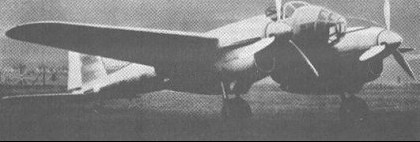
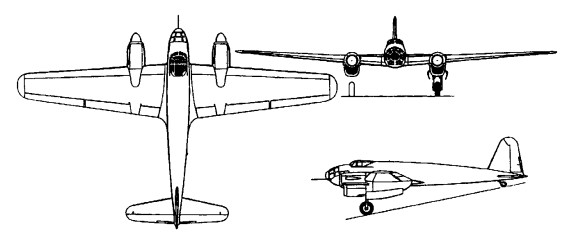
An unsuccessful competitor for the Ju 88.
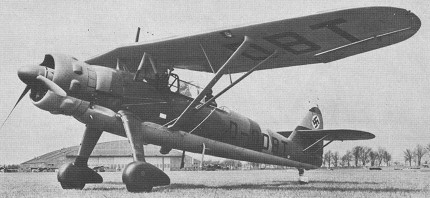
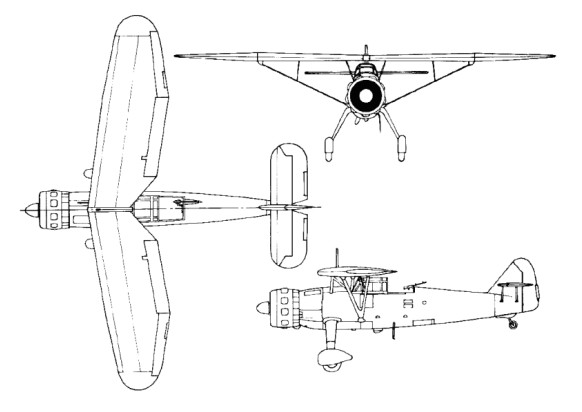
In 1935 Henschel developed the parasol-wing Henschel Hs122 short range reconnaissance aircraft as a replace¬ment for the Heinkel He 45 and He 46, but although a few of the 492-kW (660-hp) Siemens SAM 22B-engined aircraft were built, the Hs 122 was not adopted for Luftwaffe use. From it, however, Henschels chief designer Friedrich Nicolaus derived the Henschel Hs 126 which incorporated a new wing, can¬tilever main landing gear and a canopy over the pilot’s cockpit, the observers position being left open. Making its appearance in 1936 the Henschel Hs 126 V1 was a modified Hs 122A airframe powered by a Junkers Jumo 210.
The pilot was seated in a protected cockpit under the parasol wing and the gunner in an open rear cockpit. The aircraft was of all-metal construction, the wing was a high lift parasol wing was designed by Friedrich Nicolaus and this allowed the Hs 126 to use short and rough landing strips. The wheels had long struts which gave it a nose high appearance on the ground. To reduce drag, spats were sometimes fitted. It had a strut-braced tail unit and tailwheel-type landing gear. Cockpit access was via a ladder on the side and the rear of the cockpit was open to the elements. The gunner/observer had a handheld camera and also operated a Zeiss Rb topographic camera that was located in a bay behind him. The canopy had deflector panels to shield the gunner’s gun from the slipstream.
The first prototype was not entirely up to Luftwaffe standards; it was followed by two more development planes equipped with different engines. Following the third prototype, during 1937 Henschel built 10 pre-production Hs 126A-O aircraft based on the third prototype, and some were used for operational evaluation by the Luftwaffe’s Lehrgruppe reconnaissance unit in the spring of 1938.
Initial production version was the Hs 126A-1, generally similar to the pre-production aircraft but powered by the 656-kW (880-hp) BMW 132dc radial engine. Armament comprised one forward-firing 7.92-mm (0.31-in) MG 17 machine-gun, plus one similar weapon on a trainable mounting in the rear cockpit, and five 10-kg (22-lb) bombs or a single 50-kg (110-lb) bomb could be carried on an underfuselage rack. A hand-held Rb 12.5/9x 7 camera in the rear cockpit was supplemented by a Zeiss instrument in a rear-fuselage bay.
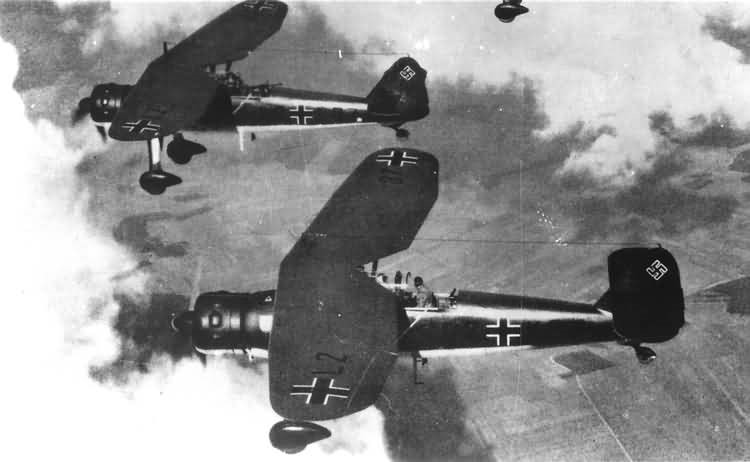
The Hs 126 entered service in 1938 after operational evaluation with the Legion Kondor contingent to the Spanish Civil War (in 1938 six were delivered to the Condor Legion and served in Aufklarungsgruppe 88. Five of these survived to be turned over to Spain at the end of the Civil War), and 16 were delivered to the Greek air force.
An improved but similar He 126B-1 was introduced during the summer of 1939, this incorporating FuG 17 radio equipment and either the Bramo 323A-1 or 671-kW (900-hp) 323A-2. The final Hs 129B- 2/R-4 version was armed with a 75 mm cannon.
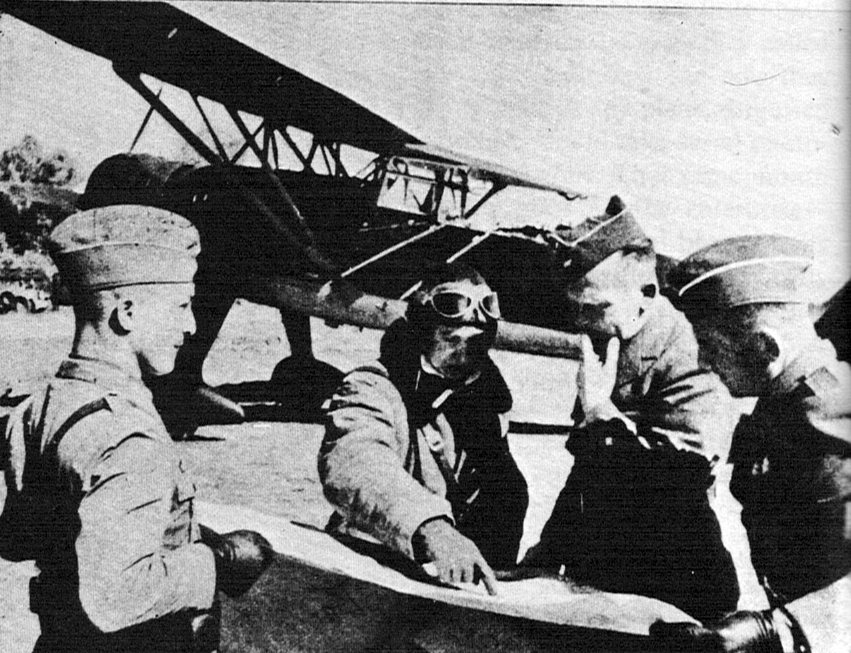
By the time the Hs 126A-1 joined the Luftwaffe, the re-equipping of reconnaissance formations was already well advanced, and by the start of World War II in September 1939, Germany already had several good short range observation and long range recon aircraft. Some 13 squadrons were equipped with the He 126 in the invasion of Poland, where it was able to operate as a bomber and ground attack aircraft, as well as in its normal army co-operation, reconnaissance and artillery spotter roles. Luftwaffe Henschels were active during the Polish campaign, the absence of any effective fighter or antiaircratt opposition enabling them to mix in a bit of bombing and strafing with their everyday reconnaissance and Army cooperation duties. RAF and Armee De l’air aircraft weren’t so obliging, being present in large numbers and motivated by hostile intent, and losses among the poorly armed Henschels began to rise alarmingly- twenty were lost between 10-21 May. By spring, when the “Sitzkrieg” ended in the invasion of the Netherlands, Belgium, and France production of the Hs 26 was being wound down following the RLM’s decision to order Focke Wulf’s Fw 189 “Fliegende Alige” into production as a replacement. One Staffel operated Hs 126s in Atrica in support of Rommel’s Afrika Korps, but the rest were transferred to the Eastern Front when Operation Barbarossa began, gradually being phased out as Fw 189s arrived from mid 1942 on. Relegated to rear area utility jobs Hs 126s re-entered combat later that same year following the establishment of Storkampfstaffeln for night time harassment, and continued flying these missions against partisans in the Balkans during 1943.
By June 1941, there were 48 squadrons of the aircraft in service – in the aftermath of the campaign in France one squadron, 2.(H)/14 took the Hs 126 to North Africa, where it remained in service until August 1942. This left forty-seven squadrons equipped with the Hs 126 for the invasion of the Soviet Unit. The aircraft was still vulnerable, and began to suffer heavy losses. In the spring of 1942 the Fw 189 began to replace it, and by the end of the year it had gone from use in the front line. From 1942 on, most of the surviving Hs 126s were used as training aircraft but some were used as a glider tug and for night-fighting units (Nachtschlachtgruppen) in specialized close-support and ground attack roles. The Hs 126 was used by NSGr 7 in the Balkans, 3./NSGr 11 in Estonia and 2./NSGr 12 in Latvia. It remained in use in the Balkans until April 1945 and the German collapse. Production of the Hs 126 ended in 1941 and the type was retired from the front line in 1942. Some 800 in total were produced.
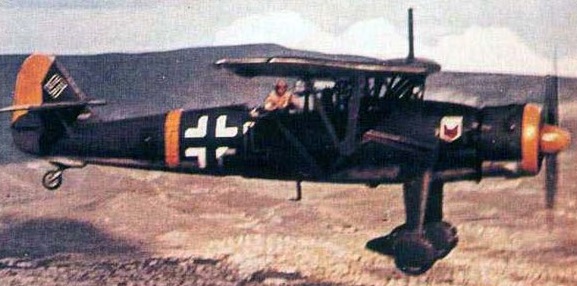
Production aircraft were built in Berlin, at Schänefeld and Johannisthal, from 1938 and entered operational service first with AufklGr. 35. By the outbreak of World War II the re-equipment of He 45- and He 46-equipped reconnaissance units with the Hs 126 was well under way. The type was withdrawn progressively from front-line service during 1942 on replacement by the Focke-Wulf Fw 189.
Hs 126A4
Max Speed: 221mph.
Ceiling: 9840ft.
Wingspan: 47ft 6in.
Length: 35ft 7in.
Armament: MG17 and MG15 machine guns.
Hs 126B-1
Engine: 1 x Bramo 323A-1, 634kW / 850-hp
Max take-off weight: 3090 kg / 6812 lb
Empty weight: 2030 kg / 4475 lb
Wingspan: 14.5 m / 47 ft 7 in
Length: 10.85 m / 35 ft 7 in
Height: 3.75 m / 12 ft 4 in
Wing area: 31.6 sq.m / 340.14 sq ft
Service ceiling: 8300 m / 27250 ft
Range: 720 km / 447 miles
Maximum speed: 310 km/h (193 mph) at sea level
Armament: two 7.92-mm (0.31-in) MJ 17 machine-guns, plus one 50-kg (110lb) or five 10-kg (22-lb) bombs
Crew: 2

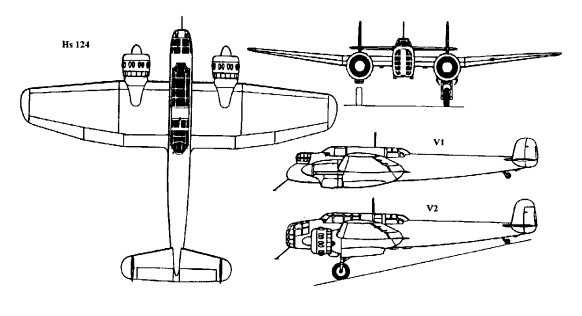
The Henschel HS 124 V1 was a prototype “Kampfzerstorer” or heavy fighter-bomber concept from the early Luftwaffe at a time when the development and rearmament of the Luftwaffe was largely a clandestine affair, hence the lack of Luftwaffe makings and swastikas.
Only three prototypes were constructed, each with different engines. The —V1 variant was powered by two liquid-cooled Jumo V-12 engines.
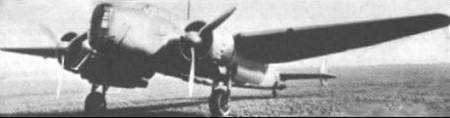
The 1936 twin-engined strategic fighter, competing for orders with the Fw 57 and Bf 110, was heavier than the Bf 110 and Fw 57, the glazed nose seating a gunner. For its size the Hs 124 was an agile and fast aircraft, but Luftwaffe requirements were better fulfilled by the Bf 110. Three HS 124 were built.