The British Government formulated plans for the construction of two new airships, the R100 to be built by private enterprise and the R101 to be constructed by the Government Airship Works at Cardington.
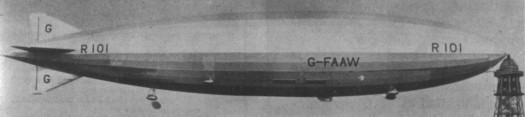
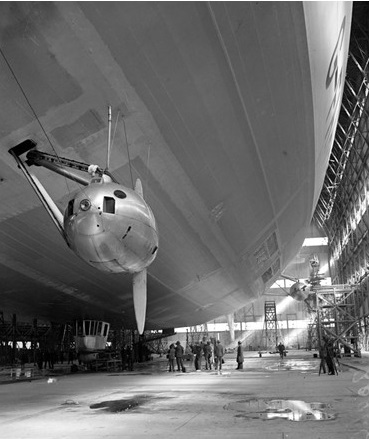
R101 G-FAAW, powered by 650 hp Beardmore Diesel engines, was launched and moored to its mast for the first time on 12 October 1929.
Both airships had their maiden flights in 1929 with R100 being the more successful of the two to the extent that R101 was returned to the Cardington hangar for extensive modification including the insertion of another section into the ship to accommodate an additional gas cell in order to increase her lifting capacity. This added another 55 feet to the length of the ship and further delayed her flight trials.
In the meantime R100 completed a successful trial flight to Canada and back before the modified R101 had begun its trials following the modifications.
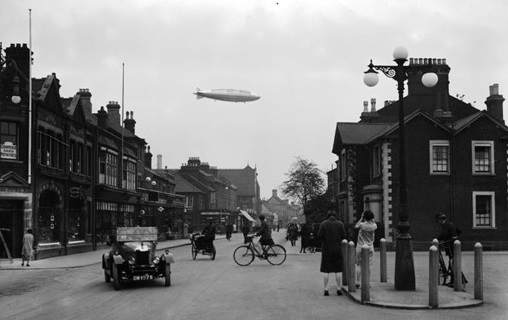
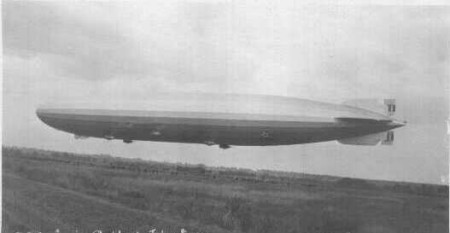
Over Bedford on its first flight
In spite of reservations, held by many technical personnel, as to the airworthiness of the modified ship, pressure brought to bear by Air Ministry Officials and the Secretary of State for Air saw the untried R101 hastily prepared for the inaugural flight to India where a mooring mast and facilities had already been prepared at Karachi.
Upon the successful completion of this flight to India and back hinged the approval of the British Government for an airship service linking the outposts of Empire including a future service to Australia and New Zealand. Sadly, political jealousies between the Government backed faction supporting the R101 and the private enterprise airship, plus the insistence of Lord Thomson, Secretary of State for Air that the India Flight begin without delay saw the R101 lift off from Cardington on 4 October 1930 without having completed its speed trials and with a Certificate of Airworthiness issued without an inspector’s report. R101’s departure was into overcast, wet and stormy weather. Over France worsening conditions were encountered which highlighted the airship’s deficiencies in performance and construction to the extent it became almost impossible to control. Shortly after 2 am on 5 October, almost uncontrollable, the ship made contact with the ground, burst into flames, killing all but six of the 54 persons on board. Among those killed was the Secretary of State for Air on whose insistence the airship began its ill-fated flight long before its airworthiness had been proven. The loss of the R101 heralded the end of the British dream for an airship service linking the outposts of Empire.
Substantially larger than the preceding R31 class, the R33 class was in the design stage in 1916 when the German Zeppelin L 33 was brought down on English soil. Despite the efforts of the crew to set it on fire, it was captured nearly intact, with engines in working order. For five months, the LZ 76 was carefully examined in order to discover the Germans’ secrets.
The existing design was adapted to produce a new airship based on the German craft and two examples were ordered, one (R33) to be constructed by Armstrong-Whitworth at Barlow, North Yorkshire and the other (R34) by William Beardmore and Company in Inchinnan, Renfrewshire, Scotland.
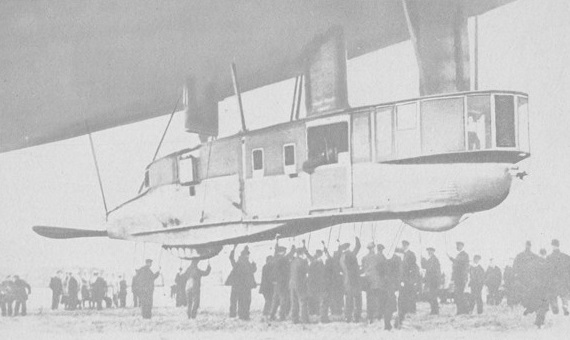
The manufacture of the components for the R33 and her sister ship R34 had begun in the summer of 1917, but the actual construction of the ship in the shed did not commence until the summer of 1918. The ship design was semi-streamlined fore and aft, with a parallel mid-ships section. The main control car was positioned well forward on the ship, and on closer inspection was separated from the engine in the rear of the car by a small gap. The small gap was faired over, so the gondola seemed to be a single structure. This was designed to stop vibrations from the engine car being transmitted down to the forward control car, with its radio detection finding and wireless instruments. Hence, the forward control car and engine car looks as if it is one combined piece, but serviced by two ladders into the hull above.
R34
Two more power cars were suspended in the wing positions further aft along the hull and a single engine aft car was positioned amidships at the rear of the craft. All five engines were 275 hp (205 kW), Sunbeam Maori water-cooled petrol units, with one in the aft section of the control car, two more in a pair of power cars amidships each driving a pusher propeller via a reversing gearbox for manoeuvering, and the remaining two in a centrally mounted aft car, geared together to drive a single pusher propeller. The power cars included two gearboxes for each engine, enabling the engines to be started up and running without the propellers rotating. The ship carried enough fuel for 48 hours engine running, but to increase range it was possible to fly the ship on only 3 engines, giving the ship a speed of some 40 knots with petrol consumption of one mile a gallon. The petrol was held inside the hull and fuel flowed from them by gravity to header tanks in the engine gondolas. The reasoning behind this change of arrangement was to feed a smoother and more precise fuel supply than the older arrangements in earlier ships of direct gravity feed.
The radiators in the forward engine gondolas had the flow of air regulated by the use of movable shutters, however the rear gondolas had the old type of traditional “elevated” radiator. Twenty main frames and thirteen longitudinals made the main structure of the ship. There were 19 gasbags within the hull giving a capacity of 1,950,000 cubic feet of hydrogen giving a disposable lift of almost 26 tons. The total construction of the R33 came to £350,000.
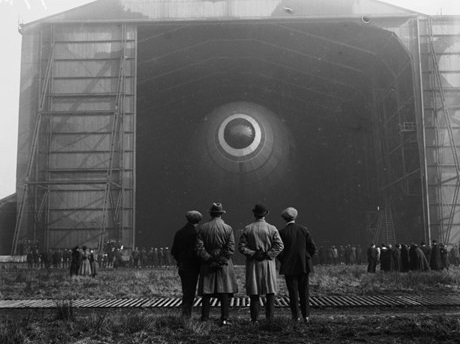
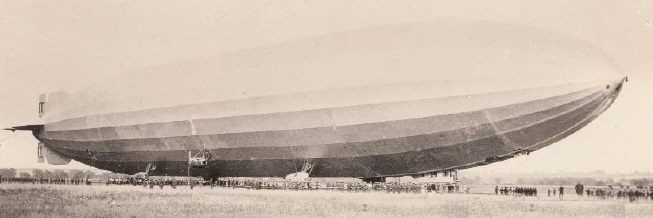
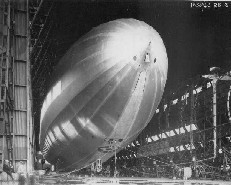
R33 in its hangar before its first flight in Barlow, Yorkshire, March 1919
R33 first flew on 6 March 1919, and was sent to RAF Pulham in Norfolk. Between then and October 14, R33 made 23 flights totalling 337 hours flying time. One of these, a flight promoting “Victory Bonds” even included a brass band playing in the top machine gun post.
In 1920 she was “demilitarised” and given over to civilian work with the civil registration G-FAAG. This work consisted of trials of new mast mooring techniques using the mast erected at Pulham. On one occasion winds of 80 mph (130 km/h) were successfully withstood while moored. Another experiment was an ascent carrying a pilotless Sopwith Camel which was successfully launched over the Yorkshire Moors. After an overhaul, R33 was based at Croydon Airport, moored to a portable mast. In June 1921 it was used by the Metropolitan Police to observe traffic at the Epsom Derby, and in July she appeared in the Hendon Air Pageant before flying to Cardington, Bedfordshire, where she was laid up for three years.
On 31 May 1921 the British government cancelled all airship development for financial reasons. Military airships were scrapped, but as a civilian airship R33 was mothballed instead. In 1925, after being inactive for nearly four years, the reconditioned R33 emerged from her shed at Cardington.
At 09:50 on 16 April 1925 the R33 was torn from the mast at Pulham during a gale, and was carried away with only a partial crew of 20 men on board. Her nose partially collapsed and the first gas cell deflated leaving her low in the bow. The crew on board started the engines, gaining some height, and rigged a cover for the bow section, but the R33 was blown out over the North Sea. A Royal Navy vessel was readied and left the nearby port of Lowestoft in case the R33 came down in the sea. The local lifeboat was launched, but was driven back by the weather conditions.
Some five hours after the initial break from the mast, R33 was under control but still being blown towards the Continent. As she approached the Dutch coast R33 was given the option of landing at De Kooy, where a party of 300 men was standing by. Late in the evening R33 was able to hold her position over the Dutch coast, hovering there until 5 o’clock the next morning. She was then able to slowly make her way back home, arriving at the Suffolk coast eight hours later and reaching Pulham at 13:50 hrs, where she was put into the shed alongside the R36.
For their actions the airships first officer, who had been in command, Lieutenant Ralph Booth was awarded the Air Force Cross, the coxswain, Flight-Sergeant “Sky” Hunt, was awarded the Air Force Medal, four other crew members were awarded the Meritorious Service Medal and the other crew members were presented with inscribed watches.
In October 1925, following repairs, she was used for experiments to provide data for the construction of the R101 airship. Once these were finished, in mid-October, she was used for trials launching a parasite fighter, using a DH 53 Hummingbird light aircraft. After some near misses, a successful launch and recapture was achieved in December that year. The following year she launched a pair of Gloster Grebes weighing about a ton apiece, the first of which was flown by Flying Officer Campbell MacKenzie-Richards. She was then sent to the sheds at Pulham where she was finally broken up in 1928, after “severe” metal fatigue was found in her frame. The forward portion of R33’s control car is on display at the RAF Museum at Hendon.
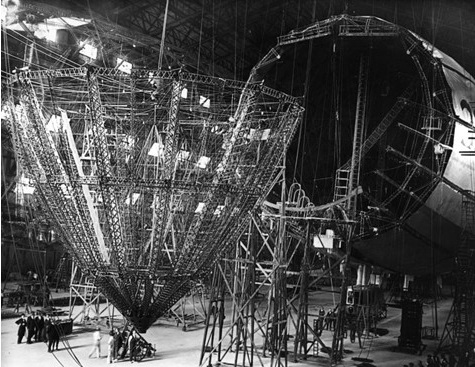
Construction of a new nose for the R33, 1925
The R33 class of British rigid airships were built for the Royal Naval Air Service during the First World War, but were not completed until after the end of hostilities, by which time the RNAS had become part of the Royal Air Force. The lead ship, R33, went on to serve successfully for ten years and survived one of the most alarming and heroic incidents in airship history when she was torn from her mooring mast in a gale. She was called a “Pulham Pig” by the locals, as the blimps based there had been, and is immortalised in the village sign for Pulham St Mary. The only other airship in the class, R34, became the first aircraft to make an east to west transatlantic flight in July 1919 and by the return flight, completed successfully the first two-way crossing, and was decommissioned two years later after being damaged during a storm. The crew nicknamed her “Tiny”.
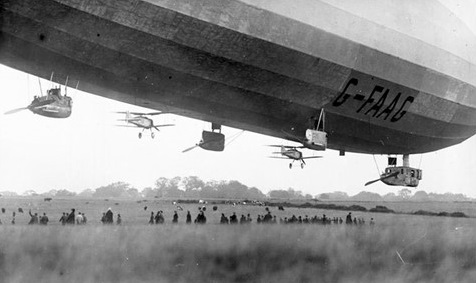
Gloster Grebe fighter planes, tethered to the underside of the British Royal Navy airship R33, October 1926
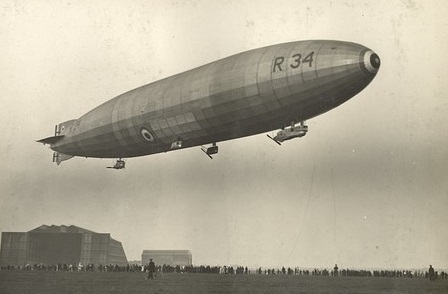
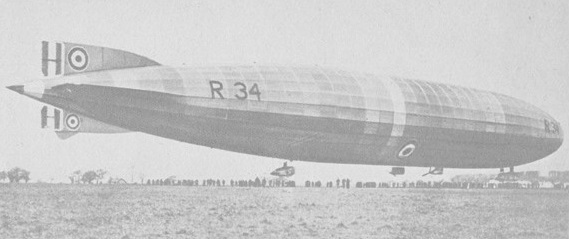
R34 made her first flight on 14 March 1919 and was delivered to her service base at East Fortune on 29 May after a 21-hour flight from Inchinnan: having set out the previous evening, thick fog made navigation difficult, and after spending the night over the North Sea the fog made mooring impossible in the morning, and after cruising as far south as Yorkshire she returned to East Fortune to dock at about 3 pm R34 made her first endurance trip of 56 hours over the Baltic from 17 to 20 June.
R34
It was then decided to attempt the first return Atlantic crossing, under the command of Major George Scott. R34 had never been intended as a passenger carrier and extra accommodation was arranged by slinging hammocks in the keel walkway. Hot food was prepared using a plate welded to an engine exhaust pipe.
The crew included Brigadier-General Edward Maitland and Zachary Lansdowne as the representative of the US Navy. William Ballantyne, one of the crew members scheduled to stay behind to save weight, stowed away with the crew’s mascot, a small tabby kitten called “Whoopsie”; they emerged at 2.00 p.m. on the first day, too late to be dropped off.
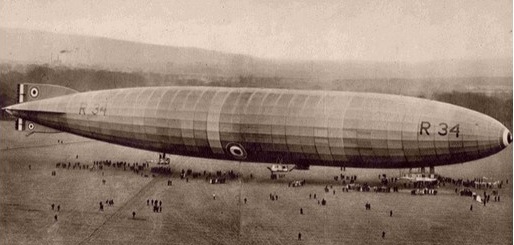
R34
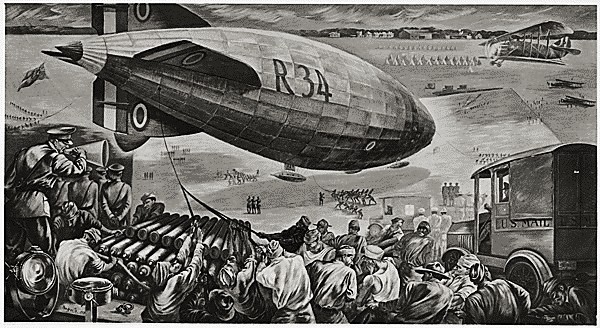
R34 left Britain on 2 July 1919 and arrived at Mineola, Long Island, United States on 6 July after a flight of 108 hours with virtually no fuel left. As the landing party had no experience of handling large rigid airships, Major E. M. Pritchard jumped by parachute and so became the first person to reach American soil by air from Europe. This was the first East-West crossing of the Atlantic and was achieved weeks after the first transatlantic aeroplane flight. The return journey to RNAS Pulham took place from 10 to 13 July and took 75 hours. Returned to East Fortune for a refit, R34 then flew to Howden, East Yorkshire, for crew training.
On 27 January 1921 R34 set off on what should have been a routine exercise. Over the North Sea the weather worsened and a recall signal sent by radio was not received. Following a navigational error the craft flew into a hillside on the North Yorkshire Moors during the night, and lost two propellers. She went back out to sea using the two remaining engines and in daylight followed the Humber estuary back to Howden. Strong winds made it impossible to get her back into the shed and she was tied down outside for the night. By the morning further damage had occurred and R34 was written off and scrapped.
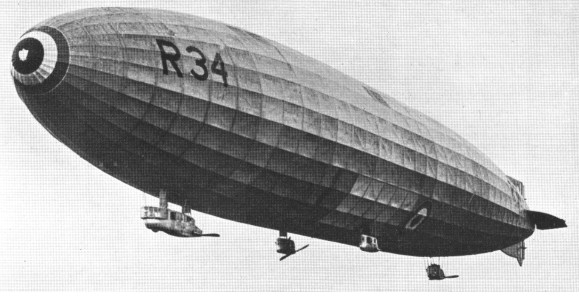
R34, the first airship to make a round-trip flight across the Atlantic.
R34 Engines: 5 × Sunbeam Maori, 275 hp (205 kW) Length: 643 ft 0 in (196 m) Diameter: 79 ft 0 in (24 m) Volume: 1,950,000 cu.ft (55,000 cu.m) Useful lift: 58,240 lb (26,470 kg) Maximum speed: 62 mph (99 km/h) Crew: 26
In June of 1918 the Admiralty made requirements for a ship to be build which would “be required to patrol the North Sea for 6 days without support, as far as 300 miles from a home base.” It was to have a combat ceiling of 22,000ft, and required to carry enough fuel for 65 hours at full speed of 70.6 mph. It was agreed that a further ship be ordered and the new ship, classed as the “Admiralty A Class” was designated the R38. The ship was also to be armed for defence of ships on escort duty and for attacking other aggressors :-
4x 520 lb of bombs 8x 230lb of bombs 1x 1pdr gun on gun platform on the top of the ship 12 pairs of machine guns spread along the top of the ship, the lower gun pit, and through the gondolas.
The order was given to Shorts Brothers at Cardington, and in February 1919 work started on the ship which would become the largest airship in the world.
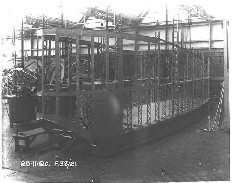
R 38 Control Car under construction
It was proposed that the R38 order was cancelled, as Cardington had been “Nationalised” under the Defence of the Realm Act. The Shorts Brothers were paid £40,000 in compensation for the cancellation, and the loss of the Cardington premises which became know as the Royal Airship Works.
However, following the Armistice the Americans still wanted a large rigid airship and so to gain experience in this field, the R38 contract was offered to them in October 1919. For the sum of $2,500,000 the British agreed to provide the Americans with a brand new and unique airship, and also offer training for her officers and crews. The contract was agreed, and it was also agreed that each country would equally borne the sharing of any possible loss. In this price was included the use of the R32 and R80 for training the crews. America also had to prepare for the delivery of the worlds largest airship, and advised that they could not expect to receive the ship for at least one year in order that they could make arrangements for it’s housing in the United States.
The whole process of building was restated. Designed as a match to the “Zeppelin Height-Climbers” the R38 was to be a high altitude, high speed airship. Slow progress was made on the ship, and when the contract was originally agreed with the United States, a delivery date of “late 1920” was agreed upon. However. The staff at Cardington were concerned when the work on the R37, which was being built in the bay beside the R38 was halted. The workmen on the R37 were then laid off when it was decided not to progress on the ship.
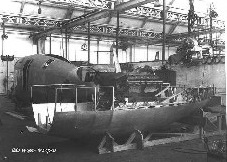
R 38 Engines under construction
Of course this worried the construction staff working on the R38 as there were no further workorders coming through the airship factory. The ship was finally completed on 7th June 1921. The pressure to get the ship “flying” was noted as there was not time to change the registration of the ship from R38 to the designated the ZRII by the American’s. It was agreed that the ship would fly with this US insignia markings on the outer cover but also with her “British” Registration R38, on her first flight, and have the conversion completed to the ZRII when she reached her Howden base.
First flown on June 23, 1921, R38 was the largest airship in the world to be built as yet, with a length of 694 ft and a diameter of 85 ft. On 23rd June 1921 she was launched from Cardington, and delivered to Howden in Yorkshire. Minor girder damage had been caused in flight by various stresses and the suggestion was made that strength had been sacrificed to achieve lightness. Later test flights were not conclusive about the strength of the ship.
23rd August 1921, the R38/ ZRII was now ready for her 4th trial flight. Now resplendent in her American livery, the ship was to fly from Howden to Pulham in Norfolk and carry our height and speed tests over the North Sea. The Following completion of the trials she flew over the coast to land at Pulham. The original plans were to have at least 150 hours of intensive flight trials for all crews on the new ship, however it was decided that once airworthiness was agreed then the ship be handed over to the Americans with their agreement. This meant that the planned 150 hours were not required and the ship fly down to Pulham, moor on the mast and be loaded up ready for her transatlantic delivery to Lakehurst New Jersey. When the ship flew in low over Norfolk, the airship station was obscured by fog and so it was agreed that the ship would fly our over the North Sea and spend the night over water. When she returned in the morning to the airship station, the airfield was still obscured by thick fog, it was then agreed that the ship return to Howden and carry out more trials en route that day. At approximately 17.00 on the 24th August Disaster struck on a test flight during a tight turn over the Humber near Hull.
Eyewitness reports confirmed that the ship seemed to crumple along mid section and then the front section broke away and detonated. The nose section detonating in two explosions killing 44 crew. Five members of the crew in the tail section were saved from the wreckage as it did not catch fire.
The tail section tilted and fell towards the Humber estuary, but was not alight. The official report attributes structural weakness as the cause of the crash, however the board of enquiry did not offer any technical opinions of the disaster. However the ship had been build far stronger than the comparable L-71, but the L-71 was not capable of being manoeuvred as sharply, and protected from higher stresses as exerted on the R38/ZRII.
44 of the 49 men on board perished in the tragedy. Among them was Air Commodore Maitland and sixteen men from the US Navy training with her.
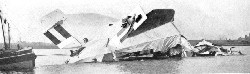
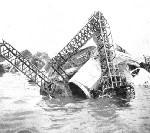
Wreckage of the R38 being salvaged from the Humber.
In March 1922 the Air Ministry, following Commander Scott’s investigations suggested that the R36 be given to the United States as part compensation. The United States would have to bear the $30,000 expense of repairs and inflation of the ship and upkeep of Pulham after 31st March and the risks of the transoceanic flight. The Air Ministry would not approve the R36 being flown across the Atlantic by an American Crew and so Scott was to be the Commander. The US department of Aeronautics declined the offer. The final interest the US had in the R38 was the settlement of the accounts.
Three quarters of the $2,000,000 of the contract price had been paid with the final $500,000 being due on acceptance of the ship. It was agreed by both Governments that the ship was lost before delivery and hence both were equally liable for the loss. The total loss of the R38/ZRII was calculated at $1,964,334.
Subsequent to the loss of the R101 in 1930 the British Airship Programme was abandoned.
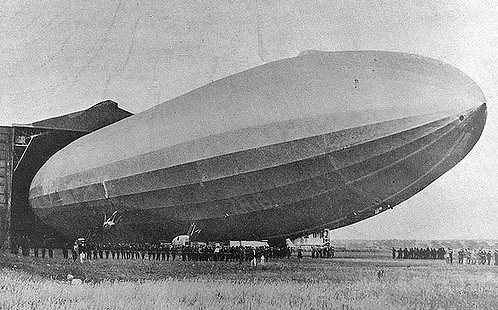
R 38 at Howden shed
Engines: 6 x 350hp Volume: 2,724,000cft Length: 695 ft Diameter: 85.5 ft Speed: 71 mph
Wolf Hirth GmbH, a prewar manufacturer of sailplanes, made wooden subassemblies for Messerschmitt projects during the Second World War, including a high-speed glider-trainer for Me 163 Komet pilots, and components for the Me 321 and Me 323 Gigants. The re-established company, owned largely by Messerschmitt-Bölkow-Blohm, built Arnold Wagner’s Acrostar competition aerobatic aircraft in small numbers, and supported the Bolkow Bo 107, 207, 208, and 209 lightplanes.
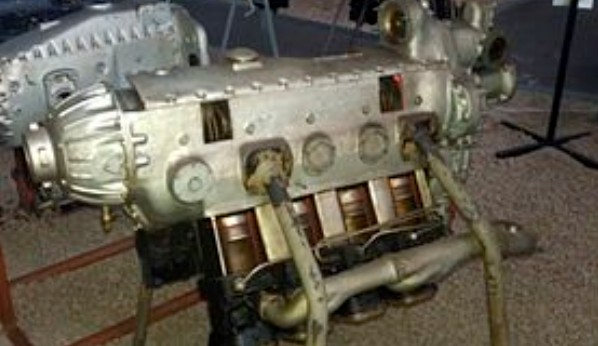
The Hirth HM 512 was a 12-cylinder development of the earlier, 6-cylinder HM 506, produced in the late 1930s. Both were supercharged, inverted V, air-cooled engines.
The HM 512 shared the same bore and stroke (105 mm × 115 mm) and 6:1 compression ratio with the rest of the HM500 series air-cooled engines. Other shared features were Hirth’s use of roller bearings in the crankshaft and at both ends of connecting rods. The crankshaft was of typical Hirth multipart design, the 12-cylinders requiring 7 roller bearings. Like the HM 508, the drive was geared down by 1:1.5.
Variants:
HM 512A Initial version; take off power 400 hp (300 kW), continuous 360 hp (270 kW)
HM 512B Take off power 450 hp (335 kW), continuous 360 hp (270 kW)
Applications: Dornier Do 212
Specifications:
HM 512A-0 Type: Inverted 60° V-12-cylinder air-cooled piston Bore: 105 mm (4.128 in) Stroke: 115 mm (4.52 in) Displacement: 11.94 L (728.6 cu in) Length: 1,507 mm (59.33 in) Width: 680 mm (26.87 in) Height: 853 mm (33.58 in) Dry weight: 270 kg (595 lbs) Supercharger: Light alloy centrifugal type, driven at 3.86 times crankshaft speed. Fuel system: Supercharger drew through twin Pallas 65VH2 carburetters with automatic mixture control and equipped for inverted flight. One Bosch double magneto with automatic advance. Oil system: Metered fresh oil to cylinder barrels and crankshaft bearings. Splash lubrication for supercharger and camshaft. Stökicht Sun and planet reduction gear lubricated by high pressure oil. Cooling system: Air Power output: maximum 270 kW (360 hp) at 3,000 rpm, rated 224 kw (300 hp) at 2,810 rpm, take off 300 kW (400 hp) Compression ratio: 6.0:1
The Hirth HM 508 was an air-cooled, eight-cylinder, 60º cylinder bank angle inverted-V aircraft engine built in Germany in the 1930s. It had a bore and stroke of 105 mm × 115 mm (4.1 in × 4.5 in) and developed 210 kW (280 hp) at 3,000 rpm.
HM 508D Type: Eight-cylinder 60-degree inverted V inline engine Bore: 105 mm Stroke: 115 mm Displacement: 7.97 L Length: 1,289 mm Width: 683 mm Height: 815 mm Dry weight: 208 kg Power output: 280 hp at 3,000 rpm Compression ratio: 6:1
The Hirth HM 506 was a six-cylinder air-cooled inverted inline engine that was developed from the earlier four-cylinder HM 504. The HM 506 was a popular engine for light aircraft of the 1930-40’s and powered the Bücker Bü 133A model trainer. The engine featured a cast magnesium alloy crankcase.
Applications: Bücker Bü 133 A Fieseler Fi 98 (prototype) Fieseler Fi 99 Fieseler Fi 157 (UAV prototype) Fieseler Fi 158 (UAV prototype) Gotha Go 241 Klemm Kl 35 B (D-ERLQ)
Specifications HM 506 Type: 6-cylinder air-cooled inverted inline Bore: 105 mm (4.13 in) Stroke: 115 mm (4.53 in) Displacement: 5.976 L (364.7 cu in) Length: 1,276 mm (49.8 in) Width: 490 mm (19.1 in) Height: 735 mm (28.66 in) Dry weight: 149 kg (328 lbs) Valvetrain: 1 inlet and 1 exhaust valve per cylinder, operated by push-rods and rockers Fuel system: 2 Sum down draught carburetters, automatic mixture control and suitable for inverted flight. Twin Bosch magnetos. Oil system: Fresh oil, metered for each cylinder. Rockers in oil bath. Cooling system: air Power output: 160 hp Compression ratio: 6:1
The Hirth HM 504 is a four-cylinder air-cooled inverted inline engine. The 504 was a popular engine for light aircraft of the 1930-40s and it was used to power a number of Germany’s trainer aircraft of WWII. The engine featured a cast magnesium alloy crankcase. The Hitachi Hatsukaze Model 11 was a Japanese licensed version.
The Hitachi Hatsukaze also known as the Hitachi model GK4, was Hitachi’s fourth design in a series of aircraft engines built in Japan prior to and during World War II. The original Hatsukaze was a license-built Hirth HM 504. Hatsukazi engines were air-cooled, four-cylinder, inverted inline engines developing around 82 kW (110 hp).
Hatsukaze engines were produced in very large numbers, as the powerplant for the license-built Bücker Bü 131 Jungmann variants that were the standard primary trainers for the Imperial Japanese Navy and Imperial Japanese Army.
The naval version of the engine was designated GK4, the army version as Ha-47. 1,376 were built.
The Hatsukaze Model 12 was the power section linked to a compressor to create a primitive jet engine called a motorjet, the resulting Tsu-11 was intended to power Yokosuka MXY7 Ohka 22 flying bombs. The standard Hatsukaze 11 engine was modified at a Navy arsenal by replacing the propeller drive shaft and engine front crankcase cover with a step-up gearbox. The gearbox increased engine output shaft RPM at a 1:3 ratio. At engine speed of 3,000 RPM, the compressor section was operating at 9,000 RPM. The compressed air was then ducted into a combustion chamber where a liquid fuel was sprayed. The heated compressed air then exits through the tailpipe providing static thrust of 180 kg (396 lb). It is likely that about 1/3 of the total thrust was contributed by adding the combustion chamber aft of the compressor.
The Tsu-11 was also selected to power the Yokosuka MXY-9 Shuka (“Autumn Fire”), a trainer intended to prepare pilots for the Mitsubishi J8M rocket-powered interceptor. Neither of these aircraft entered service, however, as their development took place too late in the war.