Huff Daland and Co Inc of Ogdensburg, New York.
Huff-Daland became Keystone March 1927, still centered at Bristol, Pennsylvania.
Keystone Aircraft single-engined biplanes in the early 1920s had their origins in the single-¬engined XLB 1 prototype and nine pre series LB 1 biplanes produced in 1925 by Huff Daland and Co Inc of Ogdensburg, New York.
Inter-Wars
Hübner Mücke
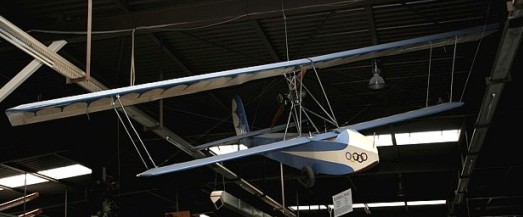
At the end of of 1935 Hübner flew the Mücke for the first time. Flight areas were the Neckarwiesen and Obrigheim, Germany. The biplane is detachable and can fit a trailer. The 2 cyliner, pusher, 1.8Ps engine was fastened between two struts.
Howitt Monoplane
Designed in 1937, the Howitt Monoplane was a parasol single-seat. It was built by the designer. R.C.Howitt, at Cowley with a 600cc Douglas conversion. It was registered G-AEXS c/n H.23D and first flew in 1937, at Abingdon.
It was re-engined in 1939 with a four cylinder but was not flown as such. It was put into store at Abingdon but lost during World War 2.
Span: 31.03 ft
Length: 21.00 ft
Howard DGA-6 Mister Mulligan
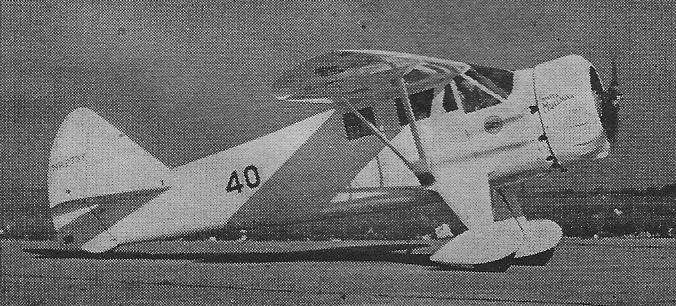
In 1933, Benjamin Odell Howard, a pilot for United Air Lines, decided that he wanted to get into the corporate airplane business. To do it, he chose to design and build a fast four place machine to win the Bendix Trophy cross country race. This would both bring the plane instant notoriety and give him prize money to help defray the cost of development. He enlisted the help of a promising young engineer named Gordon Israel in designing Mister Mulligan, a high wing, strut braced cabin monoplane. Benny Howard had discovered the magic of supercharging and high altitude flight. In 1935, he and Israel flew Mister Mulligan at 20,000 feet and above from Los Angeles to Cleveland and won the Bendix race at an average speed of 238.7 mph.
With DGA-6 Mister Mulligan Howard won all three major American racing titles in 1935, and this design was developed through several models into the Howard DGA-15.
Howard DGA-5 Mike
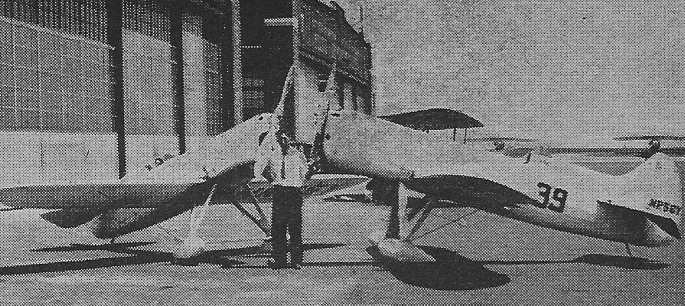
1938
Howard DGA-4 Ike

1938
Howard DGA-3 Pete
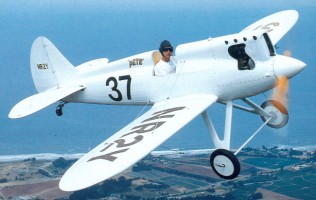
An original 1930 race aircraft, built for the U.S. National Air Races.
Pete, a closed course racer with a compar¬atively small 318 cubic inch 90 horsepower Wright Gypsy. Gordon Israel handled the structural design of the airframe and assembled it as well. Its success can be measured by its win¬ning five firsts and two thirds at its first out¬ing, in 1930. And the two third place finishes came in the 1,000 inch and unlimited dis¬placement classes.
The DGA-3 Pete racer, was succeeded by DGA-4 Ike and DGA-5 Mike.
Engine: Curtiss Wright Gipsy, 90 hp.
Max speed: 168 mph.
Howard DGA-1
Benjamin Howard built his first airplane, the DGA-1 (“Damn Good Airplane”), in 1923, while working for the Curtiss company.
Howard Aircraft Corp
Benjamin Howard built his first airplane, the DGA-1 (“Damn Good Airplane”), in 1923, while working for the Curtiss company. His DGA-3 Pete racer, built for the 1930 U.S. National Air Races, was succeeded by DGA-4 Ike and DGS- 5 Mike.
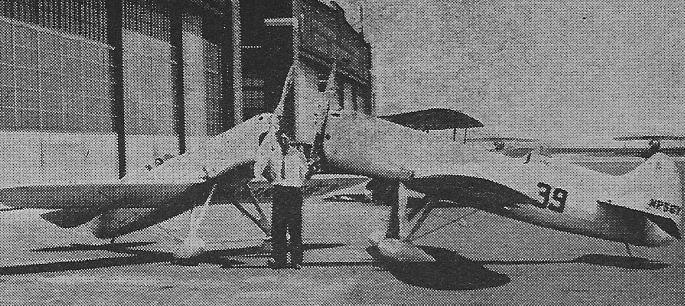
With DGA-6 Mister Mulligan Howard won all three major American racing titles in 1935, and this design was developed through several models into the Howard DGA- 15 five-seat cabin monoplane which served with the U.S. Navy in transport, instrument trainer and ambulance roles during the Second World War. The Howard DGA-18K two-seat primary trainer was produced in quantity during 1940- 1942 for the U.S. Government’s Civilian Pilot Training Program.
Horton Ho XIV
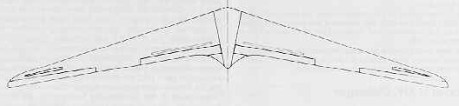
This was a sports sailplane designed to conform to the 1939 Olympic Games specification. It was designed for simplicity and ease of production. The first aircraft was built from sketches and proper drawings for the production type were made later with slight modifications. Construction was carried out at Hersfeld.
Span was 15 m and aspect ratio 16.2. The wing had 23 degree leading edge sweep and 8.6 degree total twist. Sections were 4% camber and 17% thickness at the root with 10% thick symmetrical tips. Empty weight was 120 kg giving a flying weight of 225 kg.
Controls consisted of one Frise nose elevon per side with rudders and dive brakes of H IV design. The glider trimmed at CL=1.0 with elevons neutral.
The pilot was put in a prone position as on the H IV and the undercarriage arrangement was also similar but for the replacement of the rear skid by a wheel.
Wing span: 16m
Wing area: 15.76sq.m
Empty Weight: 150kg
Payload: 80kg
Gross Weight: 230kg
Wing Load: 14.6kg/sq.m
Aspect ratio: 16.2
L/DMax: 30 70 kph
MinSink: 0.62 m/s 55 kph
Seats: 1

