Naugatuck
Conn
USA
Circa 1920s built the Beetle K engine
Naugatuck
Conn
USA
Circa 1920s built the Beetle K engine
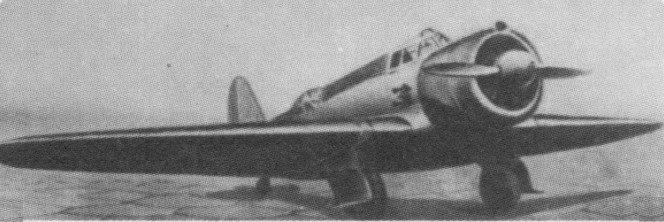
KhAI-5 was a prototype of the fast photoreconnaissance aircraft. It featured numerous innovations developed for KhAI-1 aircraft, including retractable gear, wing and control surfaces with stressed skin, internal bomb/camera bay, new type of gunner’s turret, and remotely controlled camera capable to make shots at 80° relatively to flight direction. Neman’s slogan was “No parts in the air flow”, so the whole design was very clean.
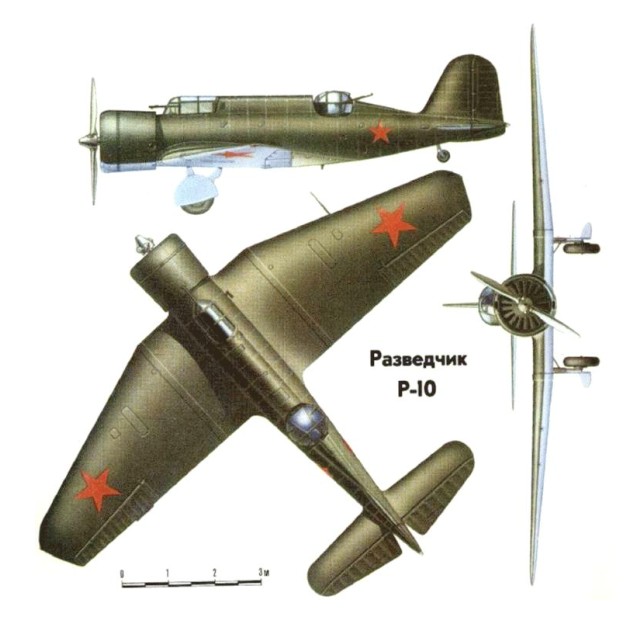
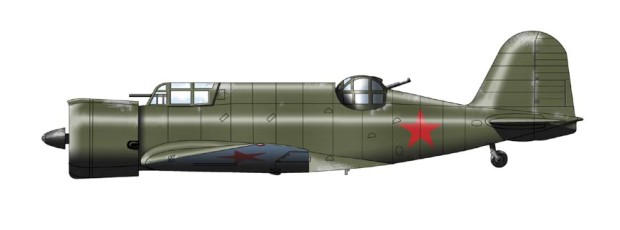
The KhAI-5 had low, plywood-covered wooden wings. The fuselage was of semi-monocoque construction. The undercarriage retracted into the wings. The crew consisted of two: a pilot and an observer-rear gunner in separate compartments; the observer sat in a turret with one machine gun. In the observer compartment’s floor there was an AFA-13 camera for reconnaissance duties. Between the crew compartments there were fuel tanks and a vertical bomb bay. The maximum bomb load was 300 kg/661 lb (6 × 50 kg/110 lb or 10 × 25 kg/55 lb). The plane was powered initially by the M-25A, later M-25V radial engine power: 540 kW (730 hp). The two-blade propeller was made of metal. Armament consisted of 2 x fixed forward firing 7.62 mm (0.300 in) ShKAS machine-guns in the forward top decking and 1 x manually aimed ShKAS machine-gun in the rear turret.
The first prototype of the plane, with a factory designation KhAI-5 (ХАИ-5), flew in June 1936. Despite a lower performance, the aircraft won a contest against another reconnaissance plane design, the Kotcherigin R-9, and was accepted for a production with the military designation R-10 (‘R’ for razvyedchik – reconnaissance). 493 R-10s had been manufactured in Kharkiv and Saratov aviation plants by early 1940. The first series showed some teething problems, and because of these I. Neman was arrested by the NKVD on December 11, 1938 under false accusation of sabotage and espionage.
In 1938, a variant KhAI-5bis was tested – fitted with an M-25E engine, it developed a speed of 425 km/h (264 mph). In 1938, the KhAI-52 ground attack aircraft, based on the R-10, was also developed. It was fitted with an M-63 670 kW (900 hp) engine and armed with seven machine guns and 400 kg (882 lb) bombs. A production run of an experimental series of 10 aircraft was prepared, but it was cancelled after one was produced and I. Neman had been arrested.
In total over 490 were built.
Some production R-10s were fitted with more powerful Tumansky M-88, Shvetsov M-62 and M-63 engines. Over 60 aircraft, withdrawn from the Air Force, were used from 1940 as mail carriers by Aeroflot, under the designation PS-5 (Russian: ПС-5), with 3 passenger seats.
The aircraft entered service in the Soviet Air Force in 1937, replacing some Polikarpov R-5s. R-10s were first used in combat in the Soviet-Japanese Battle of Khalkhin Gol in 1939. Then, they were used in the initial stage of the World War II, starting with use against Poland in the Invasion of Poland (without combat encounters) and against Finland in the Winter War (1939–1940). R-10s were next used in the first period of the German-Soviet war, following the German attack on June 22, 1941. By this time, they were outdated and suffered heavy losses. They were used as close reconnaissance aircraft, and, in need, also as light attack bombers. Later many were used as night bombers, to avoid losses in encounters with fighters. The remaining R-10s were withdrawn from combat service in 1943 (two Finnish pilots claimed shooting R-10 in 1944).
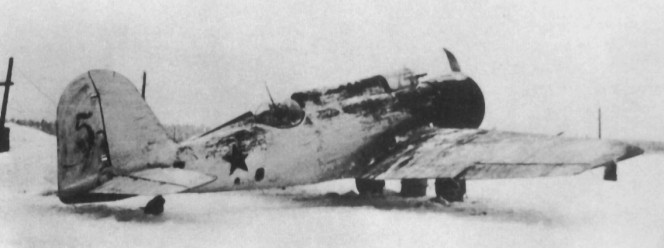
Variants
R-10 – Production version of KhAI-5
KhAI-5bis / KhAI-51 – Improved R-10/KhAI-5, one example flown early 1939.
KhAI-52 – Production version of KhAI-51. Ten ordered but production halted with the arrest of I.Nyeman.
Specifications
Engine: 1 × Shvetsov M-25V, 531 kW (712 hp)
Propellers: 2-bladed Hamilton Standard two-pitch propeller
Length: 9.3 m (30 ft 6 in)
Wingspan: 12.2 m (40 ft 0 in)
Wing area: 26.8 sq.m (288 sq ft)
Empty weight: 1,823 kg (4,019 lb)
Gross weight: 2,515 kg (5,545 lb)
Fuel capacity: 260 kg (573 lb) fuel + 30 kg (66 lb) oil
Maximum speed: 350 km/h (217 mph; 189 kn) at sea level, 388 km/h (241 mph) at 2,500 m (8,202 ft)
Landing speed: 125 km/h (78 mph)
Range: 1,450 km (901 mi; 783 nmi)
Service ceiling: 7,700 m (25,262 ft)
Time to altitude: 1,000 m (3,281 ft) in 2 min 24 sec, 5,000 m (16,404 ft) in 12 min
Take-off distance: 250 m (820 ft)
Landing distance: 230 m (755 ft)
Crew: 2
Armament:
2 x fixed forward firing 7.62 mm (0.300 in) ShKAS machine-guns in the forward top decking
1 x manually aimed ShKAS machine-gun in the rear turret
Bombload: 6 x 50 kg (110 lb) FAB 50 bombs in internal bays
In 1927 Keystone designed and built an open cockpit Pup.

The Keystone K-55 Pronto was a mail plane developed in the United States in the late 1920s. It was a conventional single-bay, unequal-span biplane design with slightly staggered wings. The pilot sat in an open cockpit, in tandem with a forward cockpit that could carry two passengers side-by-side. The fixed, tailskid undercarriage had divided main units.
Pronto was the first aircraft Keystone made for the civil market. However, like many aircraft manufacturers of the late 1920s – early 1930s, this attempt was not successful. A number of these aircraft were purchased by the government of Peru. Operated by the aviation arm of the Peruvian Navy, these aircraft initiated the first airmail service into the Peruvian Amazon. The first flight of this service was made by two Prontos, piloted by Leonardo Alvariño Herr and Harold B. Grow from Lima to San Ramón on 26 October 1927.
At least one Peruvian Pronto was fitted with pontoons and used to survey the Amazon River for locations suitable for seaplane operations.
In the Colombia-Peru War one Peruvian K-55 flow by Lieutenant Suero was captured by the Colombian Army.
Engine: 1 × Wright J-5, 220 hp (160 kW)
Wingspan: 39 ft 11 in (12.17 m)
Length: 26 ft 9 in (8.15 m)
Empty weight: 594 kg
Maximum take-off weight: 1100 kg
Maximum speed: 112 mph (180 km/h)
Cruising speed: 160 km / h
Range: 500 miles (800 km)
Crew: One pilot
Capacity: 2 passengers

Patrician was three-engined 20-passenger monoplane.
A biplane trainer for a 1928 competition (19 built)
A three-engined civil transport
The last two LB designations covered seven LB 13s with 525 hp Hornets (redesignated in 1930 as five Y1B 4s and two Y1B 6s) and three LB 14s with 575 hp Hornets (redesignated as Y1B 5s).

Developed from the Keystone B-3, the Keystone B-4 was a biplane bomber produced for the United States Army Air Corps in 1930. Originally seven were ordered by the United States Army Air Corps as the LB-13 light bomber. They were to be equipped with single vertical tails and were to be powered by a pair of 525 hp Pratt & Whitney GR-1690 radials. Serials were 30-344/353. When the LB- designation was dropped in 1930, the first five planes were redesignated Y1B-4. (The Y1B- designation indicates that funds for the design did not come from the normal annual funds.) Of seven LB-13s ordered, five were completed as Y1B-4s with 575 hp R-1860-7 engines (30-344/348). The Y1B-4 had a slightly better performance than the B-3A because of the more powerful engines, but was otherwise almost exactly the same.
The first B-3A (S/N 30-281) was converted to Y1B-4 configuration with the addition of R-1860-7 radial engines and low pressure tires. Because of more powerful engines, the performance of the Y1B-4 was a slight improvement on the B-3, but the only difference between the two planes was their engines.
On April 28, 1931, the army ordered 25 improved Y1B-4s as the Keystone B-4A. Serials were 32-117/141. This production version was part of the last biplane bomber order made by the Army Air Corps (along with 39 B-6As, identical in all respects except their make of engine), and the B-4As, delivered between January and April 1932, were the last biplane bombers delivered to the Air Corps.
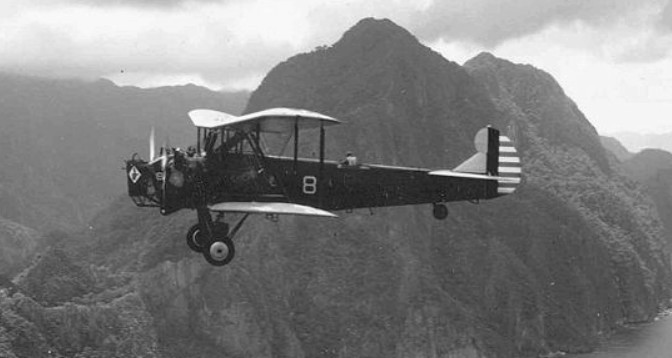
Like the B-3A, the B-4A carried five crew members; two pilots, a bombardier, and a front and rear gunner. The B-4A was externally almost identical to the B-3A which preceded it (as well as to the B-5 and B-6 which followed it).
B-4 was the last of the Keystone biplane bombers ordered by the U.S. Army in late 1931. These aircraft were used primarily as observation and reconnaissance aircraft as early as 1934 when the Martin B-10B went into operational service. Some remained in service into the early 1940s.
In 1932, Keystone produced 25 B 4As (575 hp R 1860 7 Hornets) and 39 B 6As (575 hp R 1820 1 Cyclones). Like the B 3A, these also had single tails; their armament was reduced to three 0.30 in (7.62 mm) guns, and bombload increased to 1130 kg (2500 lb).
Variants:
LB-13
Seven aircraft ordered but delivered as the Y1B-4 and Y1B-6 with different engine installations.
Y1B-4
Five pre-production aircraft, as the LB-10 but with two 575 hp (429 kW) Pratt & Whitney R-1860-7 engines.
B-4A
Production version of the Y1B-4, 25 built.
Serials:
Keystone Y1B-4
30-344/348
Keystone B-4A
32-117/141
Specifications:
B-4A
Engines: 2 × Pratt & Whitney R-1860-7, 575 hp (429 kW)
Wingspan: 74 ft 8 in (22.8 m)
Wing area: 1,145 sq.ft (106.4 sq.m)
Length: 48 ft 10 in (14.9 m)
Height: 15 ft 9 in (4.8 m)
Empty weight: 7,951 lb (3,607 kg)
Loaded weight: 12,952 lb (5,875 kg)
Wing loading: 11.31 lb/sq.ft (55.22 kg/sq.m)
Power/mass: 0.0888 hp/lb (146 W/kg)
Maximum speed: 130 mph (110 kn, 210 km/h)
Cruise speed: 103 mph (90 kn, 167 km/h)
Range: 850 mi (760 nmi, 1,400 km)
Service ceiling: 14,000 ft (4,300 m)
Rate of climb: 580 ft/min (30 m/s)
Crew: 5
Armament: 3 × .30 in (7.62 mm) Browning machine guns
Bombload: 2,500 lb (1,100 kg); 4,000 lb (1,800 kg) on short runs
B 6A
Span: 22.78 m (74 ft 9 in)
Length: 14.88 m (48 ft 10 in)
Gross weight: 6048 kg (13334 1b)
Maximum speed: 195 km/h (121 mph).
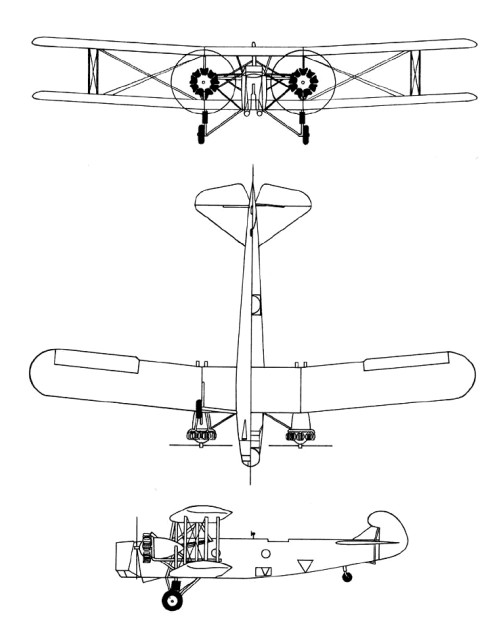
A number of the Keystone aircraft became one off flying testbeds for various newly developed geared or direct drive versions of the Hornet and Cyclone engines. This programme gave rise to the new designations LB 8, LB 9, LB 10, LB 11, LB 11A and LB-12. Most of these were conversions from existing LB 6 or LB 7 bombers.

