Rocket plane project 1936.
Inter-Wars
Korolyev S.K.9
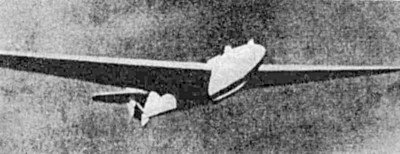
The two-seat SK-9 was designed by S.P.Korolev in 1934 – 1935 and was built at Osoaviakhim’s Planernyi Zavod (“Glider factory”, Tushino, near Moscow) in the Fall of 1935. The glider was built as a two-seater and had an unusual for sailplanes airframe: SK-9 had very high wing load and was capable to withstand loads up to 7g.
Chosen parameters were based on earlier experiments with BICh-11 glider, which was never flown with rocket engine just because light wooden airframe “expired” prior to arrival of the powerplant.
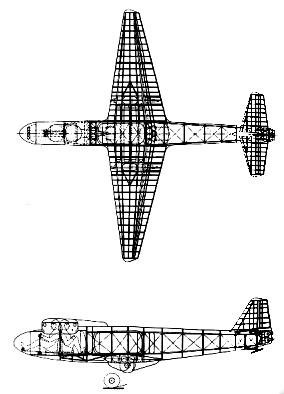
The SK-9 was an all-wooden aircraft. Box-type spars, ribs and 1mm plywood skin formed rigid box with strong resistance against bending and twisting. Fuselage of the oval crossection had 1mm to 1.5mm external skin and internal 1mm plywood skin for extra rigidity. Wing carried 2-section slotted ailerons covered with fabric.
Landing gear included a ski and fixed tailskid. The wooden ski was covered with steel and linked to the fuselage by set of rubber rings protected with fabric cover.
Pilot’s and passenger cockpits – of the open type. Pilot is protected by small plastic windshield. Rear cockpit had a removable set of controls.
During the Fall of 1935 the SK-9 passed factory trials at Tushino airfield, performing number of flights both towed by the airplane and in free flight.
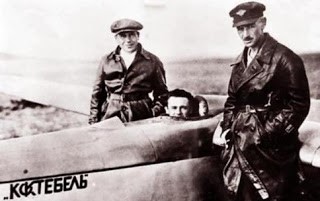
It was flown (towed by an R-5) from Moscow to Koktebel for participation in the XIth All-Union Glider Convention (September 6 – October 6, 1935) in Koktebel (it flew there from Moscow on tow, as part of an “aerotrain”, with Korolev onboard as a passenger). During overflight and at the Convention SK-9 proved its high performance and good handling at speeds up to 180km/h even in “rough air” conditions. During flight from Moscow to Koktebel and back the SK-9 was piloted by glider-pilot Romanov and S.P.Korolev himself (he was a licensed pilot too).
The SK-9 was designed to be converted into a Rocketoplane – aircraft propelled by a rocket engine, and was later converted into the RP-318-1 rocket-plane.
The SK-9 fuselage and leading edges of the wing were painted bright-red. Wing, tailplane, rudder and nose section of the fuselage – ivory. Landing ski – black.
SK-9
Wingspan: 17.0 m
Wing area: 22 m2
Wing aspect ratio: 13.1
Length: 7.33 m
Height: 2.64 m
Empty weight: 300 kg
Loaded weight: 4605 kg
Wing loading: 23 kg/sq.m
Takeoff speed: 71-76 kph
Tow speed: 130-140 kph
Min glide: 85 kph
Normal glide: 100 kph
Max glide: 200 kph
Glide ratio: 19:1 (23:1 by another source)
Landing speed: 70 kph
Minimal descent: 0.94 m/sec
Normal descent: 1.4 m/sec
Crew: 2
Korolyev KL-5 / SKL-5 / SK-5 / Koktebel
The Korolev SK-5 Koktebel single-seat, high-perform sport glider. Designed together with Sergei Lyushin; sometimes mentioned as KL-5. Built in 1929 in Moscow, took part in 6th (October 6-23, 1929) and 7th (1930) All-Union gliding contests. The glider was named after a town in Crimea where all gliding contests until 1935 were held (in 1944 this gliding center was even renamed into Planerskoye – “Glider Town”; it regained name “Koktebel” in 1991).
Among contemporary gliders, SK-5 was unusual with its long fuselage and robust design; but it had excellent aerodynamics (for that time of course) and flew as well as the better of its much lighter counterparts.
Wing span: 17.0 m
Length: 7.75 m
Wing area: 16.4 sq.m
Wing aspect ratio: 17.6
Empty weight: 230 kg
Flight weight: 300 kg
Glide ratio (L/D): 25:1
Korolyev S.K.4

After attending the Kiev Polytechnic Institute, Korolev went on to the Moscow Higher Technical University (MVTU). There he was involved in design and construction of an increasingly ambitious series of gliders, culminating in the powered SK-4, designed for record duration flights in the stratosphere.
The student of the graduate course of the Bauman Moscow Technical University Korolev passed the production practice at the Central Aerohydrodynamic Institute (TsAGI), at the Tupolev Design Bureau. At this time, he was already working at the aircraft factory in Fili. At the same time, in 1929, he was preparing a thesis project, deciding to design a light-engine twin aircraft SK-4 (his advisor was Andrei Tupolev).
The design of the SK-4 aircraft, designed for a record range of flight, turned out to be original, detailed and well designed. The project manager was Tupolev himself, signing it with the first presentation. This is not the case in the practice of students. The Tupolev approved single-engine two-seater SK-4 project was then built and tested.
The aircraft was designed for a 100-hp Shvetsov M-11, but it had just came to production and Korolev couldn’t obtain one. As an alternative one Walter NZ-60 engine, 5-cylinder radial, of 60 hp was used.
The SK-4 could be used as liaison and trainer aircraft, but Korolev planned to use it also for long-range air raids. He wanted to surpass the achievement of the Yakovlev AIR-3 in which pilot Filin, with journalist Koval’kov onboard, performed a non-stop flight from Minvody to Moscow on September 6, 1929 (during 10 hours 23 minutes they covered 1750 km – a world record for this category of aircraft, unregistered officially because USSR wasn’t FAI member that time).
The SK-4 was tested in late 1930 – early 1931 by Korolev’s good friend Dmitry Koshitz, and Korolev himself also participated in the tests. During one of test flights, the engine failed and the SK-4 crashed (Koshitz wasn’t seriously injured, and Korolev wasn’t onboard that time). The record flight was never attempted.
Engine: one Walter NZ-60, 60 hp
Wingspan: 12,2m
Wing area: 15.36 sq.m
Length: 7,15m
Height: 1,88m
Empty weight: 500 kg
Takeoff weight: 690 kg
Maximum speed: 160 km/h
Landing speed: 68 km/h
Service ceiling: 4000 m
Ceiling: 4000m
Seats: 2
Flight endurance: 2 hours
Korolyev SK-3 Red Star / Krasnaya Zvezda

The S.K.3 Red Star (Krasnaya Zvezda, SK-3) glider was designed by Soviet engineer Sergei Korolev (1907-1966). Korolev began his first full-time paid position at Factory 22 Design Bureau in 1929, and was assigned a glider project.
It had a wingspan of 12.2 metres and was designed for aerobatic manoeuvres (safety factor of 10). It was built in 1930 in Moscow during only 47 days.
Its pilots included Vasily Stepanchonok. Photographed in October 1930, in Koktebel, the Crimea region, Ukraine, taking part in the 7th All-Union (USSR) glider competition.
The SK-3 participated in 7th (October 1930) and 8th (October 10 – November 10, 1932) All-Union gliding contests in Koktebel. On October 28, 1930 Vasily Stepanchonok (later renowned test pilot) during one flight made three loops with it. This was world’s first successful attempt to perform such manoeuvres on a glider which climbed on thermals (shortly before an American pilot made four loops on a glider, but he used assistance of towing airplane for climbing).
Not only a successful glider design, it was accepted for production and demonstration, flown by S.V.Ilyushin.
Wing span: 12.2 m
Length: 6.79 m
Wing area: 12 sq.m
Wing aspect ratio: 12.4
Empty weight: 189 kg
Flight weight: 270 kg
Glide ratio: 20:1
Rate of sink: 0.9 m/s
Korolyev RP.218 / RP.318

The RP-318 or RP-318-1 was Russia’s first rocket-powered aircraft or Rocket Glider (Rocketny Planer or Raketoplan) which “RP” stands for in Russian language. Beginning in early 1936 it was firstly known as RP-218-1 or “Objekt 218” before it was changed to RP-318-1 in 1938 due to inner reforms of Rocket Science And Research Institute.
According to the proposal of Marshall Tukhachevsky the Revolutionary Military Board established on 21 September 1933 a brand new institution – RNII. The activities of the new institute began on October 31 by merging of GDL and GIRD. In the beginning the works on a rocket-glider were not a part of RNII activities and also the development of rocket engines using a liquid propellant was also not in the focus of activities – the main activities were focused on military rockets, using solid fuel.
He understood well, that the idea of creation of the rocket plane simply by putting a rocket engine into usual airframe was wrong. He stressed, that there are differences in flight characteristics, trajectories and weights. The development of necessary airframes could be possible on condition, that there was a reliable and powerful rocket engine. These conclusions he pointed at the conference about utilizing of rocket-powered aircraft for use in the atmosphere, which was held on 2-3 March 1935 in Moscow.
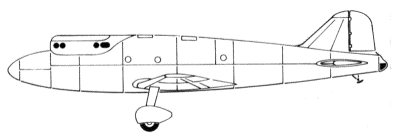
The chief designer was S.P.Korolev and his deputy was E.S.Schetinkov. The original design was a single-seater and a pressurised cabin was not in consideration, instead the pilot was provided with a space suit. The empty aircraft was to be very light: 240kg airframe, 200kg fuel system, 200kg compressed air system (used for life support and to displace fuel components toward the engine), 50kg for engine. The rocket engine should have thrust of 19.6kN and the take-off should be assisted by solid fuel boosters. After a steep climb (at angle of 60°) to an altitude 32km, and the aircraft would glide at the speed of up to 2500km/h, covering 220km in 18min.
Some changes were introduced in the design. Now it was a two seater, high-altitude experimental aircraft with pressurized cockpit, equipped by a rocket engine (developed by the 1st department of liquid rocket engines, managed by V.P.Glushko). It was obvious that such a complicated aircraft can not be successfully built without simpler manned technology demonstrator. S.P.Korolev was ready for this: he already built a strengthened glider SK-9, specially intended to fly with a rocket engine. On June 16 1936 the board of RNII decided to proceed with a “supplement” to the Object 218. It would be an experimental aircraft equipped by a low-output rocket engine, named RP-318, essentially a SK-9 fitted with ORM-65 engine and fuel system. The engine selected, Glushko’s ORM-65, a nitric acid/kerosene engine capable of generating between 50 and 175 kg of thrust, was already under development for the 212 winged missile.

Built in 1936 by Sergei Korolev as an adaptation of his SK-9 glider, it was originally designed as a flying laboratory to test rocket engines and ORM-65 (RDA-1-150) designed by Valentin Glushko was the one selected to be used. Arvid Pallo took the work on installation into the SK-9 rear fuselage, and the tanks for nitric acid and kerosene occupied the former rear cockpit. The whole powerplant weighed 136.8 kg, the fuel 75 kg. The engine could run for 112 seconds. Ground fire tests began at February 1939, until October more than 100 firings were done.
In late 1938, when both Korolev and Glushko were arrested in suspicion of Anti-Soviet activity, new RNII Director B.M.Slonimer transferred the “Rocket-Glider” project with remains of the team to the new department (head – L.S.Dushkin). A.V.Pallo was put in charge for the RP-318. Development of the RP-318-1 was continued by Alexei Scherbakov (Щербаков, Алексей Яковлевич) and Arvid Pallo (Палло, Арвид Владимирович), culminating in the first powered flight on Feb. 28, 1940 by test pilot Vladimir Fedorov. The rocketplane took off towed by a Polikarpov R-5; at 2800 m altitude it released, Fedorov set up 80 km/h speed and then fired the engine. After 5-6 seconds the speed increased to 140 km/h; Fedorov established climbing flight with 120 km/h speed and held it during all time the engine worked (110 seconds); he climbed 300 m during this time. The speed increase after engine start was smooth, vibrations didn’t appear. On March 10 and March 19, 1940 two more successful rocket flights were performed.
As it already occur several times in Soviet pre-WWII history, purges and re-organizations added new problems. RNII lost its Flight-Trials Grounds. There were no more experienced test-pilots (S.P.Korolev was in prison). It was necessary to find an organization within Aviation-Industrial complex capable to carry out flight trials of the aircraft. Help came from the OSK Factory N°1 NKAP. A.Ya.Scherbakov, head of the OSK was involved with “Project 218” as a designer of pressurized cabin. Glider-pilot V.P.Fedorov was invited as a test-pilot. The aircraft was carefully evaluated. Tail section (damaged by acid) was rebuilt. New landing ski was installed. Rigid tail skid got a shock absorber. New cowling for fuel tanks was developed.
Flight trials of RP-318-1 (designation of rebuilt RP-318) took place in November-December 1938 towed by R-5 biplane (pilot Fikson). The engine was replaced by its weight equivalent. First three flights were dedicated to the center of gravity studies: with empty tanks, 50% of fuel, 100% of fuel drained gradually to imitate its consumption by the engine.
After those flights RP-318-1 was installed in the L.S.Dushkin laboratory for engine installation and trials. Soon several problems with the ORM-65 engine were revealed. First of all, there were only three ORM-65s built, and two of them were allocated to the “Project 212” winged rocket (cruise missile). This brought some limitations on use of the engine for a RP-318: no provision for multiple start, overheating of the engine head, few unreliable sealings. Acceptable for a missile, ORM-65 needed to undergo serious modifications before it could be used on the manned aircraft.
Modified engine was designated RDA-1-150. It was 2kg lighter than the ORM-65, had improved cooling system. Number and design of injectors was changed. Intermediate ‘starter’ engine regime (fuel flow at 8…10% of normal) was introduced for the first time. Monitoring of the engine operation was improved. Though still very basic, it was a step forward from couple of ORM-65’s wires burned by flames and disrupting the electric current to lights on the pilot’s instrument panel.
Experiments with multiple ignition (additional air-hydrogen burner with electric start) were successful, but tight design limitations of the RP-318-1 created problems for its installation. Total number of engine firings was more than 100, including 16 after installation on the RP-318 (July 21, 1939). On October 3 A.Ya.Scherbakov sent to People’s Commissar of Aviation Industry a request for permit to fly RP-318-1 with the rocket engine fired.
KB-29 NKAP airfield at Podlipki (Moscow Region) was chosen for trials. In November 1939 the aircraft was installed on the edge of the field, partly covered by birch and fir trees. The team had to perform systems tune-up and to work with kerosene and concentrated acid under deep freeze conditions, with very basic fuelling equipment and rudimentary accommodations: wooden package box used to transport the aircraft served as a “field laboratory and workshop”.
More on-ground firings were performed and all were successful, but on January 3, 1940 supervising commission ordered more unpowered flights and demanded to perform more study of the airframe shape (the wooden SK-9 glider had been built in 1935). No damage or degradation of wooden parts were revealed, but speed was restricted by 150km/h.
Test pilot V. P. Fedorov (Владимир Павлович Фёдоров) was towed to 2,600 m and cast off at 80 km/h before firing the rocket engine and accelerating the aircraft to 140 km/h and an altitude of 2,900 m. In all, the RP-318 flew nine times before World War II ended development.
First flight with rocket engine fired at full power took place on February 28, 1940. It took since early morning until 5 p.m. to prepare the snow-covered airstrip, fuel the RP-318-1 (40kg of acid and 10kg kerosene), fill the nitrogen bottle to 130kg/m2, and check the fuel system for leakage absence. Flight crews were in cockpits: N.D.Fikson as a pilot of the R-5, A.V.Pallo as an observer and A.Ya.Scherbakov as a tag winch operator – in the rear cockpit of the R-5. V.P.Fedorov – pilot of the RP-318-1.
At 5:28 p.m. both aircraft took off, and 31 minutes later at altitude 2800m RP-318-1 was released. It took some time for N.D.Fikson to bring the R-5 into an optimal position for observation, and at altitude 2600m V.P.Fedorov fired the engine. First, grey smoke indicated ignition of the powder charge. Shortly its place was taken by blurred flame with brown smoke showing that the engine is running in the ‘start’ regime. And, finally – spear-shaped bright flame near 1.5m long with little smoke.
After gradual acceleration of the RP-318-1 left the observers far behind, and all efforts of the R-5 pilot to keep up with the experimental machine failed. Once it was out of sight, N.D.Fikson, A.V.Pallo and A.Ya.Scherbakov turned back to the airfield to meet the rocket-plane during its landing.
From V.P.Fedorov report:
Start of the ZhRD was normal, the glider speed was 80km/h. In 5…6sec speed was increased to 140km/h. During following climb speed was reduced to 120km/h. Engine was working during 110sec. During the climb altitude increased from 2600m to 2900m. Climb rate was 3m/sec. Handling and stability of the rocket-plane with fired engine are good. Start of the ZhRD does not deteriorate handling of the aircraft. Acceleration is smooth. Noise in the cockpit from the ZhRD is not irritating is is more muffled than during ground trials. The feel of acceleration and flight with the ZhRD fired is more appealing than on a prop-driven aircraft with the engine boosted to maximum power.
On March 10 and 19 two more flights were performed without an accident. During those flights the engine start was filmed from the R-5 observer’s cockpit.
Than the Spring came. Melting snow made the airfield unusable and delivery of the acid to the plane virtually impossible. No more flights were performed. In the Fall of 1940 the RP-318-1 was transported back to the RNII and disassembled.
It was planned to continue trials with modified RDA-1-300 engine. Plans included rocket-powered takeoff using jettisonable wheel cart. But this project was pushed aside by RAS and RDD rockets. In 1941 priority was given to RDA-1-1100 engine for Bolkhovitinov’s BI rocket fighter.
In August 1941 RP-318 was burned. The Rocket Institute was preparing for evacuation, and old wooden airframe was worthless.
RP.218
1935
Powerplant: 1 × RDA-1-150 rocket, 0.98 kN (220 lbf) thrust 100 kgf
Wingspan: 17.0 m (55 ft 9 in)
Wing area: 22.0 sq.m (237 sq ft)
Length: 7.44 m (24 ft 5 in)
Empty weight: 570 kg (1,257 lb)
Gross weight: 700 kg (1,543 lb)
Maximum speed: 140 km/h (87 mph; 76 kn)
Range: 220 km
Endurance: 18min
Ceiling: 32,000 m
Crew: 1
RP.218
1938
Engine: 4900 to 9800kN
Loaded weight: 1600 kg
Endurance: 15 to 20min
Ceiling: 50,000 m
Crew: 2
RP318-1
Powerplant: 1x Dushkin RDA-1-150 rocket engine, 1500 N maximum thrust Wing span – 17.0 m
Length: 7.44 m
Wing area: 22 sq.m
Normal takeoff weight: 637 kg
MTOW: 700 kg
Vne: 160 km/h (limited by strength reasons)
Korolyev, Sergei Pavlovich
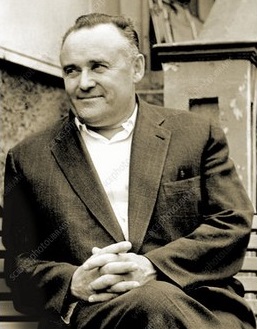
Sergi Pavlovich Korolev (Серге́й Па́влович Королёв) was born on December 30, 1906 to parents that were married by contract, and little chance of remaining together. Korolev’s birthplace was Zhitomit, a small city in the Ukraine near Kiev. Young Korolev witnessed the same events as other Russians during WW-I, and the violent revolutionary and the civil wars.
The endless strife during his childhood and the departure of his father when he was three were instrumental in molding his independent character. Unfortunately, his mother was even more independent and left to attend school in Kiev and was with him only during the weekends. Raised by his grandparents, his curiosity was roused by everything around him. Young Korolev became enthralled when a renowned pilot and his biplane put on a show for the village.
At the age of six, Korolev’s new stepfather, Grigory Balanin, provided the much-needed parental nurturing, as well as an inspiration for his future education Grigory’s influence generated even greater interest in physical science and engineering, although he also pursued both eclectic and classical works
The Balanin family moved to Odessa in the early 1920s when Korolev was a young teenager. Because of the rapidly changing educational structure in the new Soviet Union, Korolev entered a nearby vocational school to complete his preliminary education He was skilled at woodworking, but took greater interest in lectures from a number of prominent mathematicians and physicists. The unusually scholarly vocational school offered him studies far more enriching than the gymnasium he attended earlier.
A seaplane detachment in the port of Odessa became his extracurricular focus and his first opportunity to fly came in a biplane float plane while he was offering his time and effort in helping to repair several of the aircraft.
Sergei Korolev’s designation system was very irregular and complicated (if there was a system at all). His very first glider project, designed in 1924 at aviation enthusiasts circle in Odessa inhering to ChAG (ЧАГ – Black Sea Aviation Group) when Korolev was 17 years old, was designated “K-5” for some reasons.
Later Korolev designated his new creations with “SK” index. But the numeration was still irregular. His next design was SK-5, followed by SK-3 and SK-4. SK-1, SK-2 never existed. Also Korolev often used the same index for different projects, until one of them would reach construction stage. For example, there was a lot of very different projects (some were gliders, others powered aircraft) named SK-7 and SK-8.
Later Korolev designated his new creations with “SK” index. But the numeration was still irregular. His next design was SK-5, followed by SK-3 and SK-4. SK-1, SK-2 never existed. Also Korolev often used the same index for different projects, until one of them would reach construction stage. For example, there was a lot of very different projects (some were gliders, others powered aircraft) named SK-7 and SK-8.
While in Odessa, Korolev began his engineering career in glider design. This was the same year the he met a girl who would become his future wife. However, Korolev’s distractions of his passion for flight and the love of Xenia Vincentini brought pressure from his stepfather to spend more time with his formal education, which ultimately divided the two. With his new direction, Korolev became even more independent and looked to his own beliefs and maturity in establishing his goals. Strong principles derived from an allegiance with a new and growing socialist government led him to apply for admission to the Zhukovsky Academy, an institution involved with the design of military aircraft. He was rejected because he was not a military pilot, and decided to enter the Kiev Polytechnic Institute
As a student in Kiev, Korolev redesigned and built four gliders including a trainer that were used to set a number of gliding records, although he was not chosen as a pilot. He then switched to Moscow Tech in 1925 to pursue his aviation studies. One of his professors, Andrei Tupolev, would not only inspire him in the classroom and applied laboratories, but would become an important figure in helping Korolev survive imprisonment and possible execution during the Stalin purges
Korolev began his first full-time paid position at Factory 22 Design Bureau in 1929, and was assigned a glider project. His choice was to make it capable of aerobatic flight, and with the help of his stepfather who he was then living with, succeeded in completing a unique design Korolev’s SK-3 Red Star glider was not only a successful glider design, it was accepted for production and demonstration by S. V. Ilyushin, the designer of numerous Soviet military and civil aircraft.
Korolev’s interest in rocket-powered flight evolved over a period of time, beginning with his early aircraft design work It is likely that rocket propulsion was simply an attractive augmentation of aircraft propulsion for him. Now with his pilots license, Korolev was drawn to the idea of rocket powered gliders by the infectious enthusiasm of Friedrikh Tsander. As a member of one of four groups designing rockets and aircraft powered by rocket engines in Tsander’s Group for Studying Rocket Propulsion, Korolev began looking more closely at pure rocket design.
Korolev was also working on an autopilot for Tupolev’s TB-3 heavy bomber. Growing interest in rockets led him to immerse himself in the design of rocket engines. Together, and as part of GIRD, Korolev, Tsander, and Pobedonostsev, produced a 110 lb thrust gasoline and liquid oxygen propellant engine, the OR-2.
Korolev then adapted the OR-2 to a glider he earlier designed, both with somewhat limited success. The glider never flew successfully with rocket power, and in the following year Tsander died. However, GIRD members including Korolev completed Tsander’s plan for the first Russian liquid fuel rocket, with the launch of the GIRD rocket powered by the GIRD-09 engine, designed by Mikhail Tikhonravov.
Korolev became the chief engineer at the new RNII rocket design bureau in 1934 and immediately began winged rocket research. However, stability and guidance was a difficult problem for all ballistic rockets. The newly formed RNII encouraged collaboration on many projects as intended, which included Korolev’s glide design powered by Glushko’s ORM-65 rocket engine. In 1937 and 1938, RNII produced increasingly advanced rocket and aircraft designs made more capable by engine and guidance system breakthrough.
Following his conviction on suspicion of a lack of loyalty to the Soviet Union, Korolev would join other engineers at his last factory-prison in Karen. In 1942, an assignment that also included Glushko Turbojet and rocket propulsion aircraft design projects from this group would later be used in future rocket programs.
This period included the initial design of the ubiquitous four-chamber rocket cluster design that still flies today in a much-improved rocket. In 1944 Korolev and the entire design bureau was released from incarceration, but their records were not cleared of the charges. The two were assigned lead engineering positions at a new rocket design bureau; chief designer was Glushko and Korolev his deputy.
Korolev and several others continued to work at the Kazan site for another year. Then in 1945, he was commissioned in the Red Army as a colonel. At the close of WW-II, his assignment was to follow Glushko and Vassily Mishin to Germany and survey the captured V-2/A-4 hardware.
The teams were also instructed to interrogate any Germans involved with the project for possible use in Russia’s already existing ballistic weapons projects. A restricted compound was quickly fashioned near the V-2 factory at Nordhousen to retain anything and everything in the area related to the V-2. Because the U.S. had left with the best scientists and engineers led by Wernher von Braun, the V-2 blueprints, and as many of the salvageable V-2 as they could find, the Russian team’s goals were to coordinate efforts to collect hardware that could be used for reconstruction of the rockets.
British defence officials joined Russia and the U.S. in V-2 missile hardware, personnel and launch site searches in 1945. Launches of the captured V-2s were also made by the British in 1945. In spite of the efforts of the early Russian teams to convert captured V-2s for use as their own weapons, the 200 truckloads and 400 freight cars of materials collected produced only eight complete V-2s.
Preliminary efforts to reconstruct the V-2s for launch and experimentation by the Soviets were limited to the already existing facilities in Soviet controlled Germany to expedite the conversion program. Engine test facilities were organized by Glushko, guidance by Mishin, while Korolev spent time coordinating and organizing. His eternal interest in space flight rather than weaponry, in spite of being beaten and imprisoned for the same allegiance, was reported in a conversation with German engineers. Korolev queried the German engineers for some time, then began discussing launch performance improvements that could lead to orbital flight, and to lunar missions.
After the first year of the V-2 assembly project, as many as 1,000 of the German collaborators and their families were shipped by car, truck, bus and train to Russia without prior notice. Before the transfer, a rail transport car for shipping as well as testing the V-2 missiles was built under contract with a German factory, with the capability of erecting the V-2 for launch. Under the auspices of simplifying V-2 missile testing in Russia, the transport car was in essence a mobile launcher. This seemingly trivial transportation device became a standard transport technique for later Russian military and civilian launch operations and is still used today.
In 1946, a new and larger rocket/missile design bureau was created by Stalin’s directive to begin work on the Soviet’s newest missile program NII-88 replaced the RNII bureau located in Podlipki, near Moscow, and was staffed with a number of the RNII engineers. The German scientists and engineers that were brought form the Peenemunde and Nordhausen facilities were relocated to Podlipki. Ironically, the factory buildings used for the NII-88 facility were built by Germans in 1926.
A separate decree established the Soviet’s rocket and missile development program and assigned Dimitri Ustinov as director Director of the NII-88 facility was Yuri Pobedonostsev. Glushko became design chief of OKB-456, the rocket engine plant Korolev, originally head of a separate group, was assigned chief designer of OKB-1, the long-range missile facility.
A somewhat traditional separation of responsibilities to a number of design and production facilities by the Soviets was reflected in these assignments. This made simple operations complicated and complex operations nearly impossible. However, Korolev would play a major part in making the missile and rocket programs work by his organizational skills. He had no authority over the other branches, but he did have the respect of the design chiefs, at least until his success alienated a number of the directors including Glushko.
Russia’s interest in creating longer range vehicles capable of carrying heavier payloads kept some of the German engineers and technicians in Russia for as much as six years Intriguing design concepts for two-stage missiles, winged glider warheads, anti-ballistic missiles, and large engines capable of increasing the range and payload of the R-1 by a factor of 10, surfaced but were never accepted. An early design by one of the chief German engineers, Grottrup, was a dramatic improvement on the V-2 design – a model called the G-1.
During 1947 and 1948, Korolev and the NII-88 staff began the R-2 program which was similar in concept to the G-1, and doubling the range and payload of the R-1 Little more came from the German team that related to rocket design, but significant contributions related to vehicle and operations testing, instrumentation and refurbishment of the V-2 did benefit the Russian missile programs. The last of the Germans returned to their homeland in 1954.
From the R-2, the Soviet design bureaus began planning more versatile and long-range missiles which included the R-3, R-5, R-9, R-10 and R-11, with Korolev managing much of the work from the R-3 onward. During Korolev’s R-9 project development in 1960, a rival’s R-16 with storable propellants was being built to compete for military missile production. The first test of the R-16 on October 24, 1960 was a pad-launch disaster when the fuel and oxidizer tanks ruptured, spilling fuming nitric acid and UDMH.
One hundred and sixty five workers, technicians, and managers perished, including Marshal Mirrofan Nedelin, the head of the Soviet strategic forces who brought a chair to the launch for a close observation. Although the R-16 did have development problems, it was completed and deployed along with Korolev’s R-9 in the mid-1960s.
Directives to build a long-range ballistic missile to reach the U.S. from Russia came in 1947 from Stalin directly to Korolev in a meeting in Moscow. Specific performance was not defined, just approximations for range and payload Korolev’s R-3 assignment in 1948 was followed by an assignment as chief designer of a new RII-88 department, OKB-1.
Success and failures of the R-3 were not unlike the other programs, but more demanding requirements and obligations would cancel the R-3 project in 1952, although it represented the prototype that would be their first ICBM. Guidance and stability systems soon became much more accurate and reliable than the R-1 and R-2, and Glushko was improving his quad-cluster RD engines. The RD-110 was expected to produce 100 metric tons sometime in 1952.
Korolev’s R-5 missile was the first original Soviet missile design that required an increase in the level of performance, the level of complexity, and resulted in the number and magnitude of failures. Pressure to complete the R-5 and pursue Korolev’s R-7 increased as Russia tested its first atomic bomb in 1952. Stalin and the Soviet military leadership demanded that the R-7 carry the nuclear warhead over the same 8,000 km distance established earlier. The 170 ton liftoff weight became 300 tons in order to accommodate the five ton nuclear warhead.
Other challenges faced Korolev during the R-2, R-3, R-5 and R-7 projects His divorce earlier from Lyalya. Near failures of the R-1 and R-2. Technical complications with combustion chamber burn instabilities in Glushko’s high-thrust engines. Demanding requirements for nuclear warhead capabilities for the R-7 that compounded production and organization problems, and very low budgets for his bureau.
Stalin’s death in March 1953 had little effect on the Soviet commitment to produce the world’s first ICBM. Nakita Kruschev who replaced Stalin was supportive of Korolev and his missile projects. But Korolev’s greatest interest was in space launch and exploration, and the development of the R-7 missile gave him the capability of launching satellites into Earth orbit, and with added booster stages, of reaching the Moon and Mars.
Korolev’s proposal to launch a satellite in orbit for the International Geophysical Year in 1957/1958 was accepted by Kruschev and the Politburo in 1956 and followed up by edict. After nearly a year of testing and preparation, the first launch attempt of the R-7 was made on 15 May, 1957 but failed 50 seconds after lift-off. Three subsequent launches were similar failures, placing pressure on Korolev and OKB-1 staff to show success in the R-7 ICBM and satellite launch projects because of the high cost of the programs.
The first successful launch of the R-7 was on August 3, 1957. The second launch on September 7th which was attended by Kruschev was also a success. These trials set the stage for the launch of the first orbiting satellite, but they would have far greater significance for the U.S. military.
Korolev’s R-7 became a foundation for a wide variety of space launch vehicles that included the first manned missions in the Vostok and Voshkod manned flight vehicles, and the first lunar, Mars and Venus probes. Today the R-7 variant fly as the Soyuz, Progress, and Molynia launch vehicles.
Approval for Korolev’s Sputnik launch on his R-7 was not unexpected. First, the Soviet Academy of Science specifically wanted an orbital satellite to pave the way for future research satellites, and an announcement of the intent to launch a satellite for the IGY in 1957/58 was planned for 1956. Second, Kruschev and the Politburo wanted the Sputnik satellite launch to prove Soviet technology superiority, plus it could provide a long list of propaganda pronouncements. Third, the expectation of future interplanetary exploration and manned flight required the development of this intermediate step in reaching space.
Plans for launching Sputnik in 1957 began long before the first successful flight of the R-7 Korolev had anticipated the dramatic launch of the world’s first orbital satellite and the completion of the technology for a sophisticated 1,300 kg satellite capable of measuring the Earth’s magnetic field and upper atmosphere, cosmic rays, and solar radiation. By the time of the first successful R-7 missile was launched, the required components and integration was months away form completion.
Korolev and a close ally, Mstislav Keldysh, appealed to the presidium of the Academy of Sciences to prod the other branches in their engineering and fabrication support. After a lukewarm response, Korolev himself reported to the presidium that America was on the verge of launching their own satellite and the commission quickly issued directives for completion of the project.
Korolev’s intentions to launch his advanced satellite first that was known as Object D, later called Sputnik 3, required an alternative because of the delays caused by lacking support outside of OKB-1. In August 1957 it became clear that the original Sputnik slated for launch would be delayed several months. Korolev had preliminary plans for a simple Sputnik satellite (Prostreishiy Sputnik, “simple Sputnik”, contracted to PS) completed for a launch targeted for Tsiolovsky’s birthday on September 17th.
After the Sputnik 1 launch and the overwhelming world-wide reaction, Korolev was asked to launch another package with even more international impact, within a month corresponding to the Russian Revolution celebration. Korolev began immediate preparations to launch an even more complex mission within a month. Already in progress were plans for a second satellite that would include a dog, and the original satellite planned for first launch, Sputnik 3.
Korolev’s next goal was to reach the Moon with the launch same R-7 vehicle used for Sputnik, and with the expertise of his and the other design bureaus. Korolev’s success came quickly with the first lunar mission launch Luna 1 just 14 months after Sputnik 1. Luna 2 was the first to impact the Moon, launched 6 months later in September 1959. Luna 3 launched just one month later was a sophisticated, guided photographic payload that was the first to send back pictures of the far side of the Moon.
Korolev’s ultimate objective was to place cosmonauts on the Moon. Manned missions to Earth orbit were followed up with hardware designs for heavy-lift boosters, and crew and cargo vehicles. With competition from other designers, and mounting pressure to beat the Americans to the Moon with a limited budget, Korolev began testing the N-1 booster and the Soyuz lunar crew vehicle, but behind the pace of NASA’s Apollo program.
Major setbacks to Korolev’s manned lunar program were driven by Gllushcko’s refusal to provide propulsion engines for the huge N-1. Korolev’s death in January 1966 from a semmingly simple intestinal surgery doomed the Soviet manned lunar program. No one else had Korolev’s skills in dealing with the enormous Soviet bureaucracy. No one else had the organization skills to bring together the technologies and designers to build the complex lunar hardware. Korolev’s competitors that included Glushko and CHelomei were designing competing projects to get cosmonauts to the Moon.
Korolev’s status as Chief Designer and architect of the Soviet’s space successful program was unknown outside the inner Soviet government. His death afforded him recognition as one of the great Russian leaders. Not only did he have one of the very few private homes in Moscow (private ownership of property was not allowed in the socialist state), but his prestige allowed him to be buried in the Kremlin Wall. This distinction is limited to Russia’s greatest heroes and leaders.
Koppen Skyfarer
Otto Koppen left Ford to join the faculty of MIT, and in 1938, he decided that the time was ripe for an easy to fly airplane, so while teaching at MIT, he designed and set up a company to produce the Skyfarer, a two seat, two control monoplane. Koppen felt the Skyfarer needed no rudder, since its large twin vertical stabilizers were widely spaced on the tail out of the slipstream. In the air, the ball stayed centered at all times. In fact, the Skyfarer was so easy to fly that a complete novice was once taught the basics during only 50 minutes in the airplane. Twenty five Skyfarers were built; then World War II began, the Government requisitioned aluminum and production stopped.
Koolhoven F.K.59
The type number F.K.59 has been used for three Koolhoven designs: a two-engined float plane, an open two-seat sports plane and a single engined military biplane developed from the F.K.52. Of these three aircraft it was the single engined biplane that made it to production as Koolhoven F.K.59, first flown in 1940. It was the last Koolhoven design in production.
Other sources mostly show a photo of the two-engined float plane as F.K.59, but this was just a mock-up, not an actual aircraft, neither a prototype.
Koolhoven FK.58
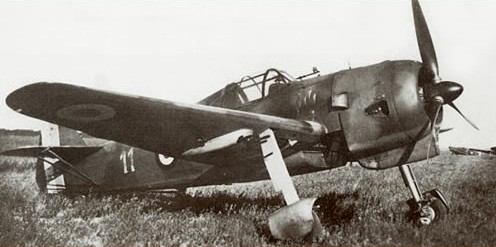
Dutch single seat fighter aircraft. The NV Koolhoven Vliegtuigen of Waalhaven, near Rotterdam, built the prototype F.K.58 within two months of completion of the design, and it flew for the first time on July 17, 1938, bearing the civil registration PH ATO. Designed by Dr Erich Schatzki, formerly of Fokker, to meet a French requirement, the F.K.58 had plywood covered wooden wings and fixed tail surfaces; a metal and fabric-covered steel tube fuselage; and metal framed fabric covered wing and tail control surfaces. A total of 450 litres (99 Imperial gallons) of fuel was carried internally, and the 1080 hp Hispano Suiza 14Aa 14 cylinder two row radial engine gave it a top speed of 483 km/h (300 mph).
This prototype was demonstrated to the French authorities at the Centre d’Essais du Materiel Aeden at Villacoublay on October 10, 1938, and an order for 50 aircraft followed in January 1939. Intended for use by the Armee de l’Air in French Indo China, they were to be powered by, 1030 hp GnomeRhone 14N39 14 cylinder radials and designated F.K.58A. Deliveries began in mid June 1939, and 17 were delivered within the next three months, of which the first four retained the Hispano Suiza powerplant, the other 13 being F.K.58As. However, due to inadequate production facilities, the small Koolhoven factory was not able to complete the French order. The construction of 10 French F.K.58As was sub contracted to SABCA in Belgium, but although the airframes had been completed when Germany invaded that country in 1940, their Gnome Rhone engines had not been delivered from France.
Following the first flight of a second Hispano powered prototype (PH AVA) on February 14, 1939, the Netherlands government in the following month ordered 36 F.K.58s, to be powered by 1080 hp Bristol Taurus III engines; but here again engine supply problems intervened, and Koolhoven was unable to complete any of the order for the Luchtvaartafdeling (Dutch air force). The production line and the second prototype were destroyed in a Luftwaffe air attack, the first prototype having already been lost in a crash in January 1940.
Thus the only operational F.K.58s were those supplied to the Armee de l’Air. Armed with four 7.5 mm (0.29 in) FN Browning machine guns, in two underwing fairings outboard of the main undercarriage legs, most of them were deployed by patrouilles de protection in May 1940, in defence of such towns as Aulnat, Caen, Clermont Ferrand, Cognac and La Rochelle. For a short time, they were among the Luftwaffe’s most cosmopolitan opponents, for these Dutch fighters with French engines and Belgian guns were often flown by Polish pilots.
F.K.58A
Span: 10.97 m (36 ft)
Length: 8.68 m (28 ft 51 in)
Gross weight: 2750 kg (6065 lb)
Maximum speed: 475 km/h (295 mph).

