La Porte IN.
USA
Circa 1938 built a monoplane
La Porte IN.
USA
Circa 1938 built a monoplane
In 1931 C R Lansing built a two place open cockpit monoplane powered by a 40hp Ford engine, registered N12830.
C R Lansing
Warren OH.
USA
Circa 1931 airplane builder
The 1932 LVF (XL-5) open-cockpit mid-wing monoplane NX12865 c/n XL-5 was stable enough not to slip or dive in a stall. In landing it had a tendency to favour a steep descent with control maintained at minimum forward speed.
Engine: 36hp Aeronca
Wingspan: 14’4″
Useful load: 225 mph
Max speed: 96 mph
Cruise speed: 80 mph
Stall: 30 mph
Range: 250 mi
Take-off run: 90′
Seats: 1-2
The 1931 XL-4 single-place cabin, high wing monoplane N11512 c/n X-141 was the XL-3 modified with stabilizing wingtip “winglets”. The wing was mounted as a parasol on top of a central pillar which also housed the pilot.
Engine: LeBlond
Max speed: 110 mph
Stall: 25 mph
The circa 1931 XL-3 single-place cabin, high wing monoplane could take-off in about 50′.
Wingspan: 13’10”
Max speed: 90 mph
Stall: 25 mph
The 1930 XL-2 NX816Y c/n XL-2 had the vacuum cell mounted as a separate box on top of the fuselage. The full-cantilever mid-wing had a span of at least 25′, reportedly a modified Durand 13 airfoil. The tail consiste of twin fins and rudders. The pilot was in an enclosed cabin under the wing.
Engine: 85hp LeBlond 5DF
The 1928 XL-1 N3505 c/n 1 was a single-place, open cockpit low-wing monoplane powered by an Anzani engine. The apprimately 8’10” span wings were spaced away from the fuselage to allow the air to flow against the vacuum cell.
Edward H Lanier and son (Edward M)
Miami and Jacksonville FL, Covington KY.
USA
1943
(E M) Lanier Aircraft Corp
Marlton NJ.
USA
The elder Lanier was also inventor of the ice cream cone, which he created while an exhibitor at the 1898 Columbian Exposition in Chicago. Although he had a profitable business selling patented cone-making machines, his real fascination was with flight.
Lanier conducted a series of experiments 1928-33 to explore ideas on low-speed flight. The idea was to adopt the vacuum principle for inherent stability, especially at stalling conditions. Low speed was achieved by placing an upwardly-open concave cell (“vacuum cell”) in the center section of the aircraft, most often blending into the fuselage. Slots were also involved. Hence reduced air pressure evolved in the cell which, of course, had a positive influence on the lift. Most Vacuplanes involved the University of Miami aeronautics department and its director, Prof F H Given, to some degree.
In the early 1930s Edward H. Lanier published six US patents concerned with increased aircraft lift and stability, minimising the stall, sideslip and spin. This was to be achieved through vacuum chamber (“Vacua-cells”), initially in the upper fuselage but later in the upper wing, where the reduced pressure established by airflow over a curved surface would act on the lower surface inside the cell, providing lift. The second patent suggests that the cell should contain angled spanwise slats to prevent air entering them at low speeds and that these should be adjustable so that the cells could be closed when required. The earlier patents stress stability improvements; claims of enhanced lift begin with the fourth patent. Five Lanier Vacuaplanes were built in the 1930s, followed by three Paraplanes from about 1948, before the Paraplane Commuter 110 which first flew in 1958.
Relative US patents from 1930-33: #1,750,529, #1,779,005, #1,803,805, #1,813,627, #1,866,214, and #1,913,809.
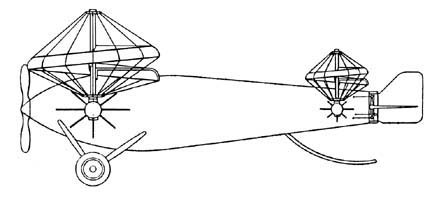
The 1929 single-place Helicopter used a helical vane arrangement with a myriad of wires replacing the wings and stabilizers on a heavily-modified Curtiss JN-4D fuselage. US patent #1,694,880 was granted in 1928. The rotor was driven by a disc drive, with friction providing speed control.
The plane was apparently built, but flight info, if any, was unrecorded.
Engine: 150hp Hisso A
Rotor: 26’0″

