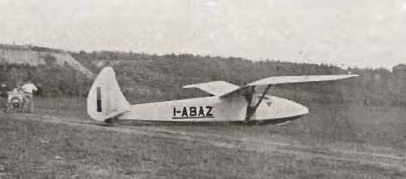
The Balestruccio was a single seat glider with a high aspect ratio gull wing built in four parts. The two inner panels, straight edged with constant chord and carrying dihedral, joined on top of the fuselage, their extremities braced from the lower fuselage with flat steel V-struts, encased in faired wood to reduce drag and assisted on each side by a pair of jury struts. The upper end of each strut was attached on one of the two wing spars. The outer wing panels were straight tapered, with rounded tips. There were differential ailerons on the outer trailing edges and flaps inboard.
The fuselage of the Balestruccio was hexagonal, with deep, near vertical sides. Its comfortable cockpit was immediately in front of the wing leading edge and was originally provided with a wooden canopy with small side openings, similar to that used on the German DFS Fafnir, but this was later replaced with a more conventional open arrangement which provided better all-round visibility. A single, sprung skid and a tail bumper provided an undercarriage. The fuselage tapered aft to a mid-mounted horizontal tail consisting almost entirely of the elevator; although this had straight leading edges, a combination of their slight sweep and the full, rounded trailing edges gave the planform an almost elliptical appearance. There were aerodynamic balances and a large cut-out for rudder movement. As first constructed, the vertical tail was rather similar, with a small fin and a full, deep, curved, balanced rudder which extended slightly below the keel. Later, with the fuselage shortened by one frame or about 700 mm (28 in), the Balestruccio was given a new, angular fin and rudder with straight taper and square tip. Like the old rudder, this was also balanced and deep, though extending only to the keel. The original horizontal tail was retained.
The Balesruccio proved to be versatile and efficient and was flown by Vittorio Bonomi and Enrico Rolandi from Mottarone and Campo dei Fiori di Varese. On 18 December 1932 Rolandi flew it for 25.8 minutes, setting a new Italian national endurance record, covering 15.7 km (9.8 mi) and winning the Castiglione Trophy. As late as 1937, it was demonstrating its performance in Asiago.
Wingspan: 18.00 m (59 ft 1 in) Wing area: 17.14 m2 (184.5 sq ft) Aspect ratio: 18 Wing section: Gottingen 549 Length: 8.33 m (27 ft 4 in), later 7.55 m (24 ft 9 in) Empty weight: 125 kg (276 lb) Gross weight: 205 kg (452 lb) Wing loading:11.50 kg/m2 (2.36 lb/sq ft) Maximum glide ratio: estimated 24:1 Rate of sink: 0.58 m/s (114 ft/min) Crew: One
Italy Most Aeronautica Vittorio Bonomi construction was carried out by Aeronautica Lombarda – hence the common use of Aeronautica Lombarda BS-28, etc
In 1937, Lombarda bought out Aeronautica Vittorio Bonomi, building light aeroplanes and gliders. After the Abyssinian War turned to military aircraft production. During Second World War built Heinkel He 111 and Loire 130.
The LN.40 was evolved from the Nieuport 140 in response to a French naval requirement for a ship-borne dive-bomber, and emerged as a compact single-seater with inverted gull wings and a crutch to lever the single large bomb clear of the propeller before release. The prototype flew in June 1938, trials revealing the need for tail modifications. It was also decided to use the extended main landing gear legs as dive brakes, allowing the removal of the tail-mounted dive brakes. Some 42 LN.401 production aircraft were ordered, although only 23 or so had been delivered by the fall of France. The French Air Force also ordered 40 LN.411s, these having no arrester hook, wing-folding mechanism or flotation bags; again only about 23 had been delivered by the fall of France. After the Armistice SNCASO assembled another 24 LN.401s and LN.411s from components.
LN.401 Span: 14m (45ft 11.25 in). Length: 9.75m (3l ft 11.75in). Powerplant: l x Hispano-Suiza l2Xcrs, 515kW (690 hp) Max TO weight: 2825 kg (6,228 lb). Max speed: 236 mph at 13,125 ft. Operational range: 746 miles. Armament: 1 x 20-mm Hispano¬-Suiza cannon and two 7.5-mm (0.295-in) Darne mg plus provision for 1 x 225-kg (496-lb) bomb carried under the fuselage.
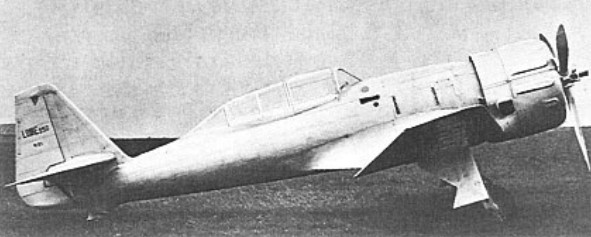
In 1934, the Service Technique issued an outline specification for a new single-seat fighter, all the contenders but one having all-metal stressed-skin monocoque structures with enclosed cockpits and retractable undercarriages. The structural exception was the MS 405.
The Loire 250 was powered by a 1000hp Hispano-Suiza 14Ha-79 two-row radial and was first flown on 27 September 1935 temporarily with a fixed-pitch two-bladed wooden propeller. Intended armament comprised two synchronised 20mm cannon and two 7.5mm machine guns, but trials with the Loire 250 proved disappointing from the outset, the prototype suffering serious drag problems. Various methods were applied to reduce drag, the vertical tail was redesigned to rectify a stability problem and a three-bladed variable-pitch propeller was fitted. Regardless the fighter proved incapable of attaining the max speed of “at least 485km/h” called for by the specification, and was eliminated from the contest at an early stage.
Engine: 1 x 1000hp Hispano-Suiza 14Ha-79 two-row radial Max take off weight: 2200 kg / 4850 lb Empty weight: 1500 kg Wingspan: 10.80 m / 35 ft 5 in Length: 7.81 m / 25 ft 7 in Height: 3.72 m / 12 ft 2 in Wing area: 16.30 sq.m / 175.45 sq ft Max. speed: 480 km/h / 298 mph Range: 875 km / 544 miles
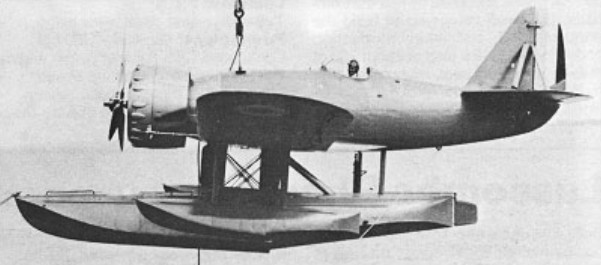
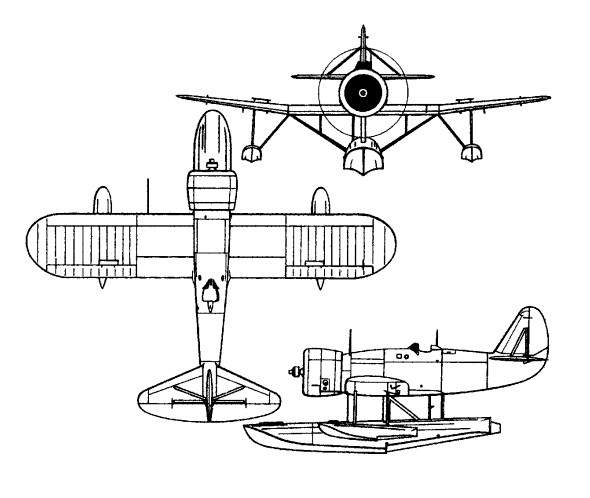
In 1933, the Marine Nationale formulated and issued a requirement for a modern float-equipped fighter that could be launched from the rotatable catapults of such cruisers as the Foch and the Richelieu.
Contenders were built by Loire, Bernard (H.52), Potez (452) and Romano (R-90).
The Loire 210, first flown on 21 March 1935, was of all-metal construction with metal skinning apart from the outboard sections of the wings which were fabric covered. Powered by a 720hp Hispano-Suiza 9Vbs nine-cylinder radial, the Loire 210 began official trials in June 1936.
A production order, which called for 20 aircraft, was not placed until 19 March 1937, the first series aircraft flying on 18 November 1938. The production model carried an armament of four wing-mounted 7.5mm Darne machine guns, two escadrilles forming with this fighter in August 1939. However, after several accidents resulting from wing structural failures, the remaining aircraft were withdrawn from service and their units disbanded.
Engine: 720hp Hispano-Suiza 9Vbs Max take off weight: 2180 kg / 4806 lb Empty weight: 1440 kg / 3175 lb Wingspan: 11.79 m / 38 ft 8 in Length: 9.51 m / 31 ft 2 in Height: 3.80 m / 12 ft 6 in Wing area: 20.30 sq.m / 218.51 sq ft Max. speed: 299 km/h / 186 mph Range: 750 km / 466 miles
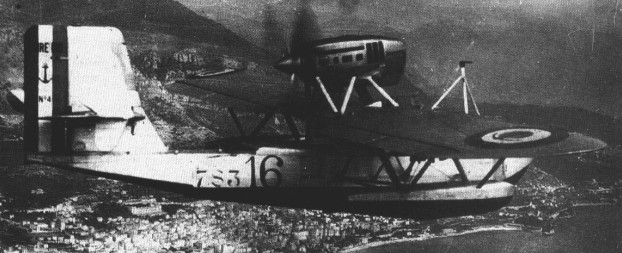
Designed in response to a 1933 French Navy requirement for an all-purpose seaplane capable of being catapult-launched, the three-seat Loire 130 prototype first flew in November 1934.
The trials programme was considerably slowed by the need to cure stability problems, and it was August 1936 before production orders were placed for the initial two versions, the Loire 130M (Metropole) and Loire 130C (Colonie) intended for metropolitan and colonial deployment respectively. The 130C being strengthened and equipped for use in tropical climates with a larger radiator. Power was a Hispano-Suiza engine mounted on struts over the hull.
The Loire 130 did not reach French navy escadrilles until 1938. By 1939 it equipped Escadrille 7S2 aboard the seaplane carrier Commandant Teste and 7S3 and 7S4 embarked on various capital ships and cruisers. Overseas the Loire 130 was with 8S2 at Fort-de-France, French Antilles, 8S3 in West Africa, and 8S4 in the Levant (now Lebanon).
In 1939-40 the type went on to equip several newly formed shore-based and shipborne units and also equipped Armee de I’Air units, including 1/CBS in French Indo-China (now Vietnam). About 95 of the Loire 130s on order had been completed by the time of the June 1940 armistice with the Germans, but permission was given for 30 more of the type to be built under the auspices of the Vichy regime. All being used in the coastal role after the removal of catapults from all French ships in November 1942.
The last Loire 130 in flying condition, with Escadrille 8.S in Indo-China, was withdrawn and scrapped in late 1949.
Engine: 1 x Hispano-Suiza 12Xbrs V-12, 537kW / 720 hp Max take off weight: 3396 kg / 7487 lb Loaded weight: 2090 kg / 4608 lb Wingspan: 16.00 m / 52 ft 6 in Length: 11.30 m / 37 ft 1 in Height: 3.85 m / 12 ft 8 in Wing area: 40.10 sq.m / 431.63 sq ft Max. speed: 226 km/h / 140 mph Ceiling: 6000 m / 19700 ft Operational range: 1100 km / 684 miles Armament: 2 x 7.5mm Darne machine-guns, 2 x 75kg / 165 lb bombs Seats: 3
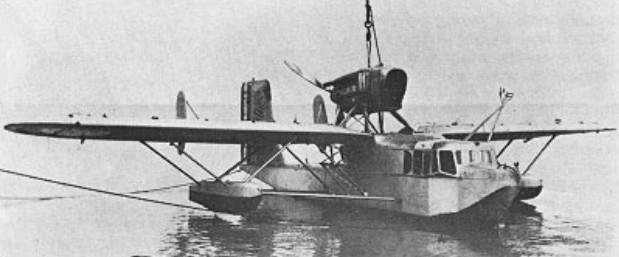
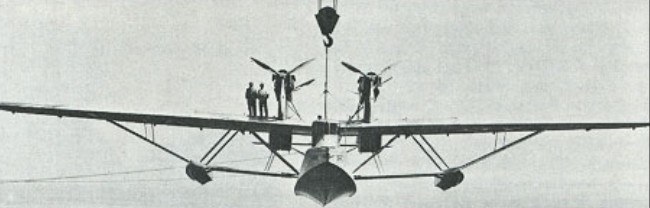
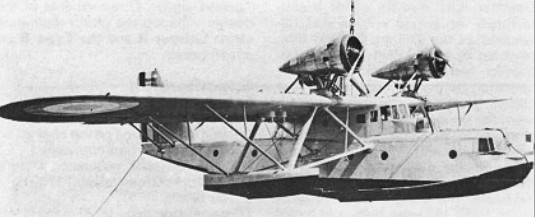
Designed for the South Atlantic mail route between West Africa and Brazil, the Loire 101 Bretagne (Brittany) flew for the first time on 12 May 1936. A large superstructure, on the lines of the naval vessels for which the firm was famous, was set-on top of the two-step hull and contained the control cabin and various crew compartments. Forward in the hull was a comfortable cabin for four passengers, to the rear of which were holds for mail, baggage and freight. Set on top of the high braced wing were four 537kW Hispano-Suiza 12Kbrs-1 liquid-cooled engines in tandem pairs. Vibration problems of the Loire 102 were never resolved and the flying-boat was finally scrapped in 1938.
Max take off weight: 19100 kg / 42109 lb Wingspan: 34.0 m / 111 ft 7 in
An eight-man long-range maritime reconnaissance and bombing flying-boat designed to a 1932 French navy requirement, the prototype Loire 70 made its first flight on 28 December 1933.
During tests the original three 373kW Gnome-Rhone 9Kbr radials were replaced by more powerful 9Kfr engines, and other changes included supplementing the large single fin and rudder with a pair of small auxiliary fins, elimination of the bow gun position, and relocation of the bomb-aimer/ navigator in the extreme nose.
Seven production aircraft were delivered to Escadrille E.7 at Karouba to join the prototype within a 12-month period from June 1937. From the beginning of hostilities, in September 1939, the Loire 70s patrolled the Mediterranean until three of four surviving machines were destroyed in an Italian air raid on their base on 12 June 1940. Nothing was heard subsequently of the surviving flying-boat.
Engine: 3 x Gnome-Rhone 9Kfr radial, 552kW Max take off weight: 11500 kg / 25353 lb Loaded weight: 6500 kg / 14330 lb Wingspan: 30.00 m / 98 ft 5 in Length: 19.50 m / 63 ft 12 in Height: 6.75 m / 22 ft 2 in Wing area: 136.00 sq.m / 1463.89 sq ft Max. speed: 235 km/h / 146 mph Ceiling: 4000 m / 13100 ft Range: 3000 km / 1864 miles Armament: 6 x 7.5mm machine-guns, 600kg of bombs
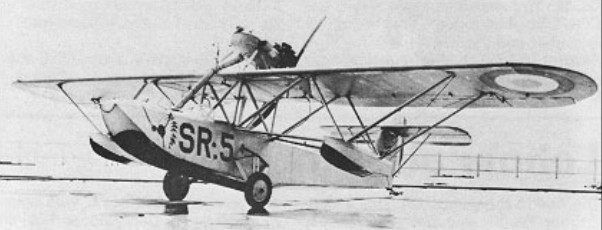
A three-seat parasol-wing flying-boat for liaison or training duties, the Loire 50.01 prototype first flew on 7 September 1931. After being sunk in an accident it was recovered and on 24 March 1932 was flown as an amphibian, the two main wheels retracting to a horizontal position clear of the water. In summer 1933 its 172kW Salmson 9Ab radial was replaced by a 261kW Hispano-Suiza 9Qd radial, and it was then redesignated Loire 50bis.
Six series Loire 501 amphibians, closely resembling the Loire 50bis and retaining its crew arrangement, were delivered in 1935 to various sections de servitude (general-duty flights) at French naval air stations, the last surviving Loire 501 reported at Karouba (Bizerta, Tunisia) in August 1941.
Engine: 1 x Hispano-Suiza 9Qd radial, 261kW Max take-off weight: 2150 kg / 4740 lb Empty weight: 1385 kg / 3053 lb Wingspan: 16.00 m / 52 ft 6 in Length: 11.10 m / 36 ft 5 in Height: 4.47 m / 14 ft 8 in Wing area: 39.40 sq.m / 424.10 sq ft Max. speed: 195 km/h / 121 mph Ceiling: 4850 m / 15900 ft Range: 1100 km / 684 miles
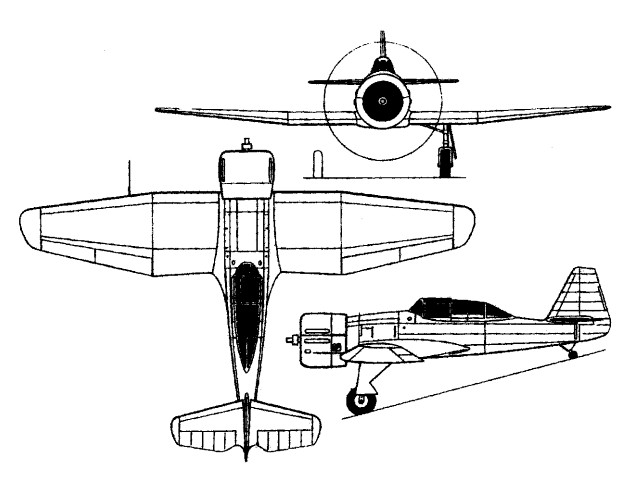
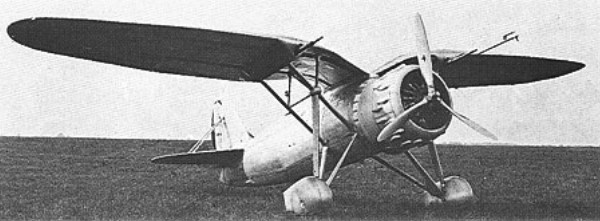
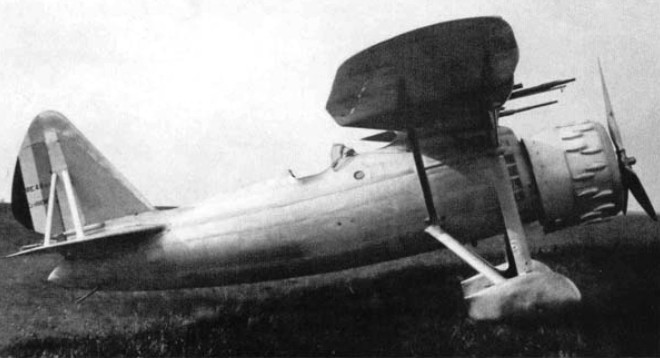
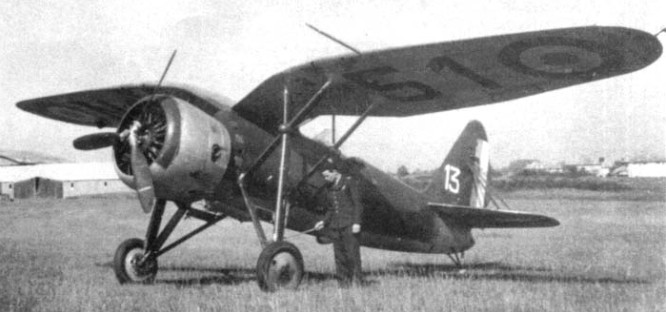
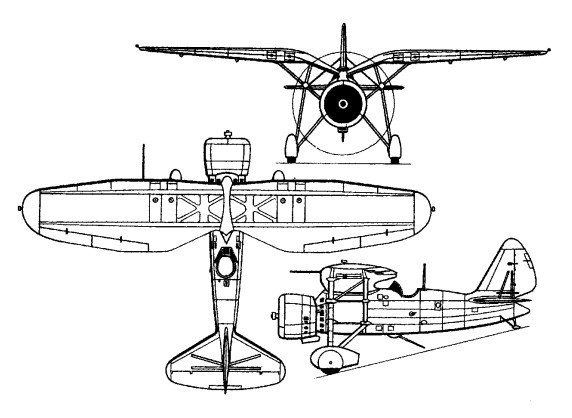
To address the inadequate visibility from the cockpit of the Loire 45, a prototype was built as the Loire 46. Compared to the 45, the wing centre section was more deeply gulled, and the wing had tapered outboard leading edges and semi-elliptical trailing edges. The engine thrust line was lowered, the cockpit was moved farther aft, the rear fuselage was deepened and all tail surfaces were enlarged. The landing gear was also revised and strengthened.
The Loire 46 was of metal construction with aluminum alloy fuselage panels, wing and tail, ribs, spars and stringers of the fuselage, wing and tail. In the left side were two portholes. One of them was intended to illuminate the dashboard, and the second (lower) provides the pilot a better view of the ground during takeoff and landing.
The wing spars were I-beam and the airfoil shaped ribs were set at an angle of 60 degrees to the front spar. The center of the wing never had ribs: it consisted of bent sheet duralumin skin. Almost all of the trailing edge of the wings were rectangular ailerons with compensation weights. They were duralumin, fabric covered. Ailerons were controlled by duralumin rods.
Guns were installed in the center section of the wing. Access to them, as well as a cartridge drive was via removable hatches at the bottom of the wing.
Rudder and elevator control was by cable, equipped with trimmers. The rudder trim was set on the ground. Elevator-section. Wheels are made of magnesium alloy, the mains were 750×150 mm
The fuel capacity was 360 liters, set in the central part of the fuselage, and oil tank capacity of 44 liters located in the central part of the fuselage to the right of the fuel.
On board was Thomson-Ducretet Th.53 a radio. The transmitting antenna was mounted on top of the fuselage behind the cockpit and the receiving antenna under the fuselage. During takeoff and landing the receiving antenna was retracted.
Loire 46 C1 n.01
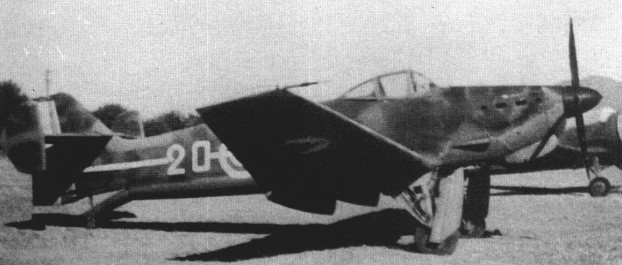
Powered by an 880hp Gnome-Rhone 14Kcs engine, the Loire 46 flew on 1 September 1934. In October the Loire 46 flew SEMA tests. After SEMA evaluation of the prototype was returned to the factory for minor changes, replacing the cowling and a Oerlikon FF wing gun. Re-engined with a 930hp Gnome-Rhone 14Kfs in February 1935, the Loire 46 demonstrated excellent handling characteristics, and a contract for five pre-series aircraft. In May 1936, the company received an order for 40 fighters Loire 46, launched their production factory Nieuport. At the end of 1936 the order was increased to 60.
The first production Loire 46 C1 was flown in February 1936, deliveries commencing in the following August to the 6e Escadre of the Armee de l’Air. Armament comprised four wing-mounted 7.5mm MAC 1934 guns with 300 rounds per barrel. All new arrivals were sent to the 6th Air Force squadron.
The five pre-production examples were relinquished by the French Service and supplied to the Spanish Republican government between 5 and 7 September 1936.
The last Loire 46 was delivered in July 1937, by which time its gull-winged configuration was obsolescent and most were relegated to Armée de l’Air training schools. Only three remained on the effective first line strength of the 6th Air Force squadron at the beginning of World War II. Another four Loire 46 were in one of the flight schools. The remaining had been withdrawn into reserve.
Loire 46
The outbreak of World War II all serviceable aircraft was given to the disposal of the Polish pilots who escaped to French territory before heading to the combat units.
Those in service with the Spanish the Republican Army arrived in Spain in silver color. It is known that one of these aircraft flew in the squadron Espana. The greatest number of flights on this fighter were performed by lieutenants and A.Gvide and V.Venil. At least another four aircraft joined the international Fighter Group, commanded by the Spaniard M.Luna.
The machine guns, and ground equipment for the Loire was sent to Spain in 46 trucks, and did not reach the destination. The Spaniards fitted Vickers guns with a lower rate of fire and heavier. The highest scoring Republican pilot, A.Las Salle, made emergency landings in two Loire 46. In both cases, it was preceded by the engine stopping.
In the first months of his stay in Spain, Kovalevsky, who arrived in Spain in the first group of Soviet pilots, shot down three enemy aircraft, including on September 25, 1936 at Madrid, a Ju-52 bomber.
On September 16, 1936, a Republican fighter shot down G.Morato, landing in neutral territory. All the wreckage was collected for examination by the Republicans. On October 21, 1936 during bombing raid the fighter was damaged in a parking lot. Under different circumstances at their aerodromes four Loire 46 were also lost.
Loire 46 Engine: 1 × Gnome-Rhône 14Kfs, 694 kW (930 hp) Prop: 3 blade metal fixed pitch Gnome-Rhone 85NZ type series 1440 Wingspan: 11.83 m (38 ft 9¾ in) Wing area: 19.50 sq.m (209.9 sq ft) Length: 7.88 m (25 ft 10¼ in) Height: 4.13 m (13 ft 6⅝ in) Empty weight: 1,450 kg (3,197 lb) Loaded weight: 2,100 kg (4,630 lb) Maximum speed: 370 km/h (200 knots, 230 mph) Range: 750 km (466 miles) Service ceiling: 11,750 m (38,550 ft) Rate of climb: 12.09 m/sec (2,411.76 fpm) Climb to 3,000 m (9,840 ft): 3.3 min Armament: 4× fixed forward-firing 7.5 mm (0.295 inch) MAC 1934 machine guns Crew: 1