Lorraine 12H Pétrel

The Lorraine 12H Pétrel was a French V-12 supercharged, geared piston aeroengine initially rated at 370 kW (500 hp), but later developed to give 640 kW (860 hp). First run in 1932, it powered a variety of mostly French aircraft in the mid-1930s, several on an experimental basis.

During the 1930s Société Lorraine, which in 1937 was nationalised into the Société Nationale de Construction de Moteurs (SNCM), continued its tradition of building large water-coooled aeroengines. These later engines were named after birds: Eider, Courlis (en:curlew), Pétrel and Sterna. The last two remained in production in 1938.

The Pétrel was an upright V-12 engine with two banks of six cylinders, arranged at 60° to each other, driving a common crankshaft. The cylinder blocks were bolted onto the crankcase, all light alloy parts. The crankcase came in two pieces, with seven crankshaft bearings in the upper section. Roller bearings were used at the crankshaft ends; the remaining five were plain. The upper crankcase section also had integrally cast water channels as part of the cooling system.

Steel cylinder liners were screwed into the heads, with their lower parts projecting into the crankcase. Steel seats for valves and sparking plugs were shrunk into the heads. The pistons were forged from alugir, with three compression and one scraper ring and floating bronze bushes for the gudgeon pins. The twelve pistons were connected to the six crankpins in pairs, each with a master and an auxiliary connecting rod. The master rods had forked big ends with white metal bearings; the auxiliary rod ends ran between the forks on bronze bushes.

The Pétrel had four overhead valves per cylinder, two exhaust and two inlet, in bronze valve guides. Each bank had its own overhead camshaft and each cam operated a pair of valves through T-shaped tappets, the stem of the T moving in a guide to avoid sideways force on the valve stems. There were two sparking plugs per cylinder and twin magnetos. A carburettor fed the mixture into the intake of the supercharger, at the rear of the engine. The Pétrel’s output could be left or right handed; a Lorraine patent planet gearset, with six satellite gears, provided an 11:17 reduction of propeller shaft speed.

Engine lubrication was by forcing pressurized oil through the crankshaft, with sump scavenging. The supercharger had its own lubrication system.

First run in 1932, the early Pétrels produced only 370 kW (500 hp) but by 1938 the engine had been developed into the 12Hars model which gave 640 kW (860 hp). This variant was used by the Koolhoven F.K.55 fighter, where it drove a pair of counter-rotating, twin-bladed propellers.

Like the Koolhoven F.K.55, many of the aircraft types to use the Pétrel were one-offs, testing the Lorraine against better known engines from Hispano-Suiza and Rolls-Royce but the Potez 542 version of the Potez 540 family were built in numbers, with 74 of these twin-engined, multi-role (bomber, reconnaissance and transport) aircraft supplied to the French and Spanish air forces.

Variants:

12H Pétrel
Initial power 370 kW (500 hp).

12Hars
640 kW (860 hp).

12Hdrs

12Hfrs Normale
536 kW (720 hp).

12Hfrs Chasse
Designed for fighter aircraft produced higher powers, 567 kW (760 hp) at 2,800 rpm and 4,000 m (13,120 ft).

Applications:
Breguet Br.19.10
Fokker D.XVII
Hawker Fury
Hawker Hart
Koolhoven F.K.55
Nieuport-Delage NiD 82
Potez 39
Potez 542
P.Z.L. P.8/II
Renard R-31
Société Aérienne Bordelaise AB-21

Specifications:

12Hfrs Normale
Type: Supercharged upright water-cooled 60° V-12 piston engine
Bore: 145 mm (5.71 in)
Stroke: 145 mm (5.71 in)
Displacement: 28.73 L (1,753 cu in)
Length: 1,858 mm (73.15 in)
Width: 707 mm (27.83 in)
Height: 795 mm (31.30 in)
Dry weight: with accessories 475 kg (1,047 lb)
Valvetrain: 4 spring-loaded valves per cylinder, driven in pairs via T-shaped tappets by cams on overhead camshafts, one per block
Supercharger: centrifugal, driven at 8.8 crankshaft speed via epicyclic gears; independent lubrication with dedicated pressure and scavenge pumps
Fuel system: single or double barrelled Lorraine carburettor at supercharger inlet, supplied by 2 A.M. fuel pumps
Ignition system: 2 plugs per cylinder; 2 magnetos
Fuel type: petrol
Oil system: 1 pressure pump supplies oil via crankshaft, removed from sump by 2 scavenge pumps. Operating pressure 0.49 Mpa (71 psi)
Cooling system: water
Reduction gear: 17:11
Power output: 536 kW (720 hp) rated at 2,650 rpm and 4,000 m (13,123 ft)
Compression ratio: 6:1
Specific fuel consumption: 315 g/(kW.h) (8.0 oz/(hp.h))
Oil consumption: cruise 12±1 g/(kW.h) (0.33± 0.05 oz/(hp.h))
Lorraine 9N Algol

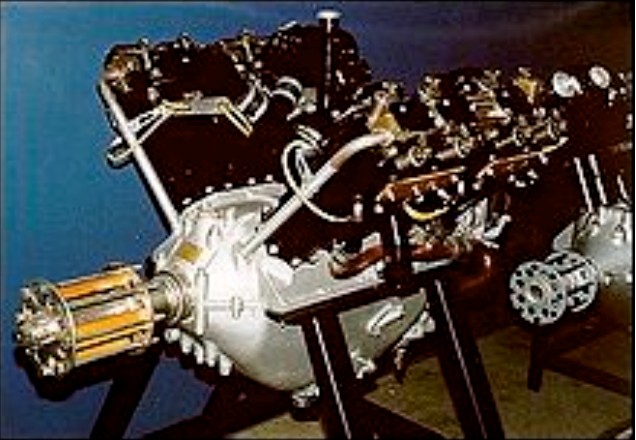
The Lorraine 9N Algol was a French 9-cylinder radial aeroengine built and used in the 1930s. It was rated at 500 hp (375 kW).

A conventionally laid out radial engine, with nine cylinders in a single row. The crankcase was a barrel-shaped aluminium alloy casting, with an internal integral diaphragm which held the front crankshaft bearing. Forward of the diaphragm there was an integrally cast cam-gear case for the double track cam-ring. The reduction gear was housed under a domed casing attached to the front of the crankcase.

Flange-mounted steel barrels were bolted to the crankcase and enclosed with cast aluminium alloy, screwed-on, cylinder head with integral cooling fins. The pistons were also made of aluminium alloy and had floating gudgeon pins. The nine pistons drove the single throw crankshaft via one channel-section master rod and eight circular section auxiliary rods. The master rod had an integral, split type big-end. The crankshaft was machined from a single forging, with bolt-on balance weights.

The Algol had a single pair of overhead inlet and exhaust valves per cylinder. The cam-ring drove roller tappets, mounted in the cam-case, which in turn operated rocker arms, fitted with ball bearings, via pushrods. The cam-ring was concentric with the crankshaft and driven via epicyclic gears.

Most Algols were conventionally aspirated via a single carburetter but at least one 1938 variant used a form of fuel injection, where fuel was blown into the induction system rather than the cylinder head.

Applications:
ANF Les Mureaux 120
Bernard 161
Bloch 120
Bloch 500
FBA 290
Potez 33
PWS-24
Romano R.16
SAB-SEMA 12
Weymann 66

Specifications:
Type: 9-cylinder single row supercharged radial
Bore: 140 mm (5.51 in)
Stroke: 150 mm (5.90 in)
Displacement: 20.78 L (1,268 cu in)
Length: 1.347 m (53.2 in)
Diameter: 1.275 m (50.2 in)
Dry weight: complete 390 kg (860 lb)
Valvetrain: one inlet and one exhaust overhead valve per cylinder, operated with rocker arms, pushrod driven via roller tappets bearing on a double track cam-ring
Fuel system: single Stromberg carburettor, heated by exhaust
Fuel type: petrol
Cooling system: air-cooled
Reduction gear: 11:17
Power output: rated 221 kW (296 hp)
Compression ratio: 6:1

Lorraine / Lorraine-Dietrich

Lorraine-Dietrich was a French automobile and aircraft engine manufacturer from 1896 until 1935, created when railway locomotive manufacturer Société Lorraine des Anciens Etablissments de Dietrich and Cie (known as De Dietrich et Cie, founded in 1684 by Jean de Dietrich) branched into the manufacture of automobiles. The Franco-Prussian War divided the company’s manufacturing capacity, one plant in Niederbronn-les-Bains, Alsace, the other in Lunéville, Lorraine.

In 1896, managing director of the Lunéville plant, Adrien, Baron de Turckheim, bought the rights to a design by Amédée Bollée. This used a front-mounted horizontal twin engine with sliding clutches and belt drive. It had a folding top, three acetylene headlights, and, very unusual for the period, plate glass windshield. While the company started out using engines from Bollée, de Dietrich eventually produced the entire vehicle themselves.

After World War I, with Lorraine restored to France, the company restarted manufacture of automobiles and aero-engines. Their 12-cylinder aero-engines were used by Breguet, IAR, and Aero, among others.

The de Dietrich family sold its share in the company, which became simply known as Lorraine from 1928 on.

Automobile production eventually became unprofitable and, after the failure of their 20 CV model, the concern ceased production of automobiles in 1935.

In 1930, de Dietrich was absorbed by Société Générale Aéronautique, and the Argenteuil plant was converted to making aircraft engines and six-wheel trucks licenced from Tatra. By 1935, Lorraine-Dietrich had disappeared from the automobile industry. Until World War II, Lorraine concentrated on the military market, manufacturing vehicles such as the Lorraine 37L armoured carrier.

The Lunéville plant returned to rail locomotives. In 2007, it still operated as De Dietrich Ferroviaire.

Loring R-III / C-1 / T-1

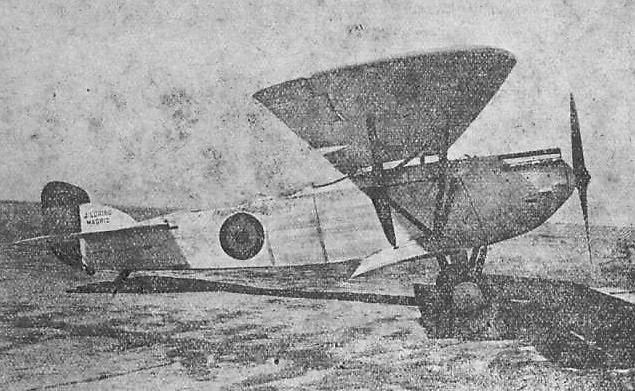
The Loring R-III or R-3 was a 1920s Spanish two-seat sesquiplane reconnaissance and light attack aircraft designed by engineer Eduardo Barrón and built by Dr. Jorge Loring’s company — Talleres Loring.

In the mid 1920s, during General Primo de Rivera’s dictatorship the R-III entered a contest along with the Potez 25 for the modernization of the Spanish Military Air Arm. Both planes had similar characteristics, but the Military Directory favoured the Loring R-III in order to promote local industries. First flying in 1926, the Aeronáutica Militar placed an order of 110 units, which put the Loring company at the head of the Spanish aeronautical industry of the time.

In October and November 1926 three variants of the R-3 were exhibited at the Loring section of the National Aeronautics Exhibition held in Madrid’s Palacio de Cristal: The R-3, the C-1 fighter (one built in 1926) and the T-1 light trainer (one built in 1926). Neither the fighter nor the trainer variants, however, went into production.

Some R-3s remained in service well after the proclamation of the Spanish Republic until the outbreak of the Spanish Civil War. It is not clear, however, whether they saw active service in the civil war.

Engine: 1 × Hispano Suiza 12Hb, 447 kW (600 hp)
Wingspan: 14.50 m (47 ft 7 in)
Length: 9.7 m (31 ft 10 in)
Height: 2.60 m (8 ft 6 in)
Empty weight: 1,400 kg (3,080 lb)
Gross weight: 2,380 kg (5,240 lb)
Maximum speed: 235 km/h (146 mph)
Crew: 2 (pilot, observer)
Armament:
2 × fixed, forward-firing 7.7 mm (0.303 in) machine guns in the engine cowling.
2 × trainable 7.7 mm (0.303 in) machine guns on a Scarff ring for the observer.
40 × 11 kg (24 lb) bombs on under-fuselage racks, or 8 × 50 kg (110 lb) bombs