A Schneider Trophy racing seaplane (1922)
Inter-Wars
Macchi M.16
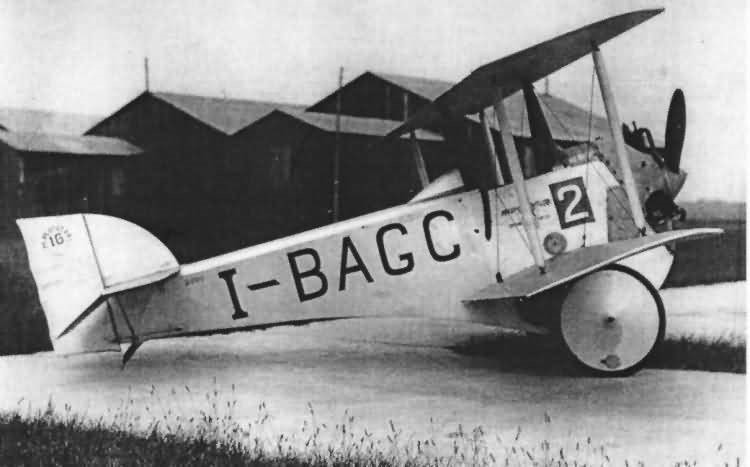
The Macchi M.16 was a light, single-seat aircraft designed by Alessandro Tonini and produced by Macchi in Italy in 1919.
It was a single-bay biplane with unstaggered wings and a largely conventional design except for an unusually deep fuselage that extended in a bulge below the lower wing. The landing gear axle being sprung directly on the bottom longerons with shock cord. The plane could also be fitted with pontoons.
The M.16 was developed in parallel with the Macchi M.20, a two-seat civil trainer aircraft which it resembled and with which it shared many common features.
The M.16 proved a successful sporting type, setting an altitude record of 3,770 m (12,370 ft) in 1920 while competing for the Coppa Mappelli (“Mapelli Cup”), and winning first prize in the competition in 1921.
The United States Navy purchased three float-equipped examples for evaluation as communication floatplanes.
Powerplant: 1 × Anzani, 22 kW (30 hp)
Wingspan: 6.00 m (19 ft 8 in)
Wing area: 11.3 m2 (122 sq ft)
Length: 4.43 m (14 ft 6 in)
Height: 2.12 m (7 ft 0 in)
Empty weight: 160 kg (350 lb)
Gross weight: 260 kg (570 lb)
Maximum speed: 165 km/h (103 mph, 90 kn)
Landing speed: 25 mph
Range: 420 km (260 mi, 230 nmi)
Crew: 1, pilot
Macchi M.15
A reconnaissance, bomber, and trainer aircraft (1922)
Lyulka RTD-1 / VDR-2
1938
Two stage centrifugal compressor turbojet
500 kg est thrust
Testbed only
Lycoming R-680
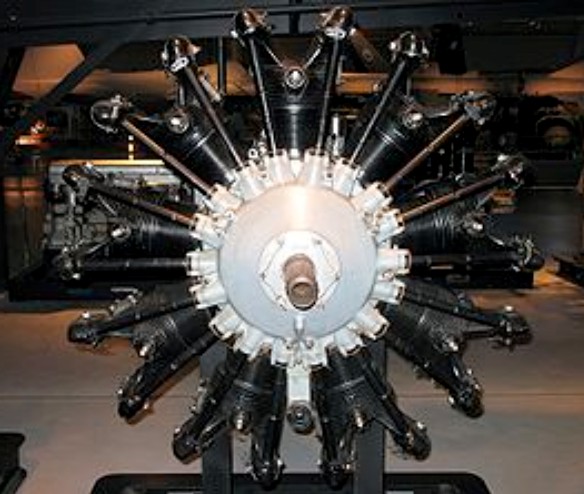
The Lycoming R-680 is a nine-cylinder air-cooled radial engine, the first aero engine produced by Lycoming.
Pressure lubrication is to the crankshaft, master rod, link pins, cam drive gears, and main accessories drive shaft and gears.
First run in 1929, the engine was produced in two types the E and B series both are essentially the same, the B4E was available in a trainer version with a front exhaust collector for use without cylinder air baffles.
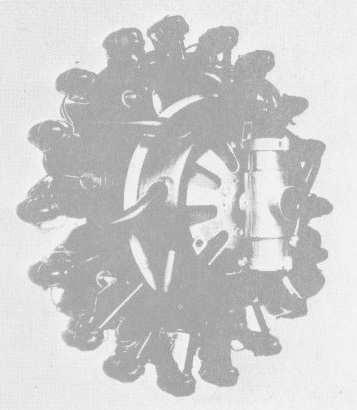
Equipment was a tachometer drive at ½ canshaft speed, exhaust ring, cowling and air cleaner.
Accessories available were a generator and starter,
Variants:
R-680-B4E
Rated at 225 hp at 2100 rpm.
R-680-E3A
Rated at 285 hp at 2200 rpm.
R-680-13
Rated at 300 hp at 2200 rpm.
Applications:
Beech AT-10 Wichita
Boeing-Stearman PT-13
Cessna AT-8/AT-17
Curtiss-Wright AT-9
Fleetwings BQ-2
Spartan NP-1
Stinson Airliner
Stinson Reliant
Stinson Vigilant
Waco S Series (very rare facory authorization)
Specifications:
Type: 9 cylinder air cooled radial
Rating: 210 hp at 2000 rpm
Displacement: 680 cu.in
Compression ratio: 5.2-1
Bore: 4 5/8 in
Stroke: 4 1/2 in
Length: 43 1/8 in
Diameter: 43 1/4 in
Weight: 465 lb dry
Fuel consumption: not more than .55 lb/hp/hr
Oil consumption: not more than .035 lb/hp/hr
Lubrication: 1 pressure pump, 2 scavenger pumps (in one unit)
Ignition: Scintilla dual magneto type SC-A
Carburation: 1 Stromberg NA-R7
Spark plugs: 2 per cylinder
R-680-E3A
Type: Nine cylinder air-cooled radial
Bore: 4 5⁄8 in (117 mm)
Stroke: 4 1⁄2 in (114 mm)
Displacement: 680 cu.in (11.15 litres)
Length: 37.5 in (953.1 mm)
Diameter: 43.5 in (1104 mm)
Dry weight: 515.46 lb (233.9 kg)
Valvetrain: One inlet and one exhaust valve per cylinder at 30 degrees.
Fuel system: single-barrel carburetor
Fuel type: 87 octane rating gasoline
Oil system: Full pressure type
Cooling system: Air-cooled
Power output: 330 hp (246 kW) at 2,300 rpm at sea level
Compression ratio: 7:1
Power-to-weight ratio: 0.64 hp/lb (1.05 kW/kg)
Lycoming O-1230
In 1932, the engineers at Lycoming Engines became aware that the United States Army Air Corps (USAAC) wanted a high performance engine that could produce at least one horsepower per cubic inch (46 kW/L) of engine displacement and that a contract had been made with Continental Motors, Inc., Lycoming’s main rival in the general aviation engine market. Lycoming’s management wanted to be considered for development of the next generation engine, but no USAAC development contract was signed. Still determined to become known as a high performance engine manufacturer, Lycoming began an experimental, high-performance engine of its own. After spending US $500,000, and after many attempts to develop a successful engine, it finally came close to the USAAC specifications with the 1,200 hp (895 kW) O-1230 engine.
Lycoming’s O-1230 engine design was a 12-cylinder liquid-cooled horizontally-opposed low-profile piston engine that could be mounted either horizontally, buried in the wing of a multi-engine aircraft; or vertically, in the fuselage of a single engine fighter. From 1935 the engine design proceeded at a faster pace after a number of former Continental engineers, who had become unhappy with the working conditions there, joined Lycoming.
The same year the USAAC became interested in the O-1230, and began supporting the engine development program. In 1936, the single-cylinder development tests exceeded expectations, passing its 50 hour test requirement. The full-size engine was ready for testing in 1937, and was rated at 1,000 hp.
The last Vultee A-19 that had been ordered by the USAAC was delivered as the XA-19A, fitted with an O-1230-1 offering 1200 hp. It first flew on May 22, 1940. This aircraft was subsequently re-engined with a Pratt & Whitney R-1830-51 and redesignated.
Continued development of the O-1230 reached its peak when the engine was rated at over 1200 hp. It was as powerful as the Allison V-1710, but with a narrower cowling than the Allison V12 engine. The O-1230 was not well received by aircraft manufacturers, because it was not very reliable at that power setting.
Specifications:
O-1230-1
Type: 12-cylinder, Geared, liquid-cooled, horizontally-opposed piston engine
Bore: 5.25 in (133.4 mm)
Stroke: 4.75 in (120.7 mm)
Displacement: 1233.9 cu.in (20.219 L)
Dry weight: 1342 lb
Valvetrain: Overhead camshaft
Cooling system: Liquid
Reduction gear: 0.40
separate cylinders
hemispheric cylinder head design
one-piece cylinder head for each bank
Power output: 1000 hp@3100 rpm, 1200 hp@3400 rpm, 1,275 hp (951 kW)
Specific power: 1.03 hp/cu.in
Power-to-weight ratio: .95 hp/lb
Lycoming O-145
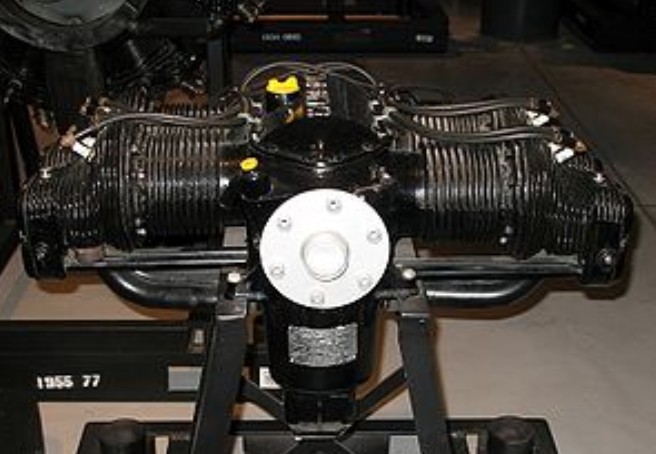
The Lycoming O-145 is a family of small, low-horsepower, four-cylinder, air-cooled horizontally opposed aircraft engine produced from 1938 until the late 1940s by Lycoming Engines. The family includes the reduction-geared GO-145.
The O-145 was produced in three major versions, the O-145-A rated at 55 hp (41 kW), the -B rated at 65 hp (48 kW), and -C rated at 75 hp (56 kW). The “B” model was the major production model, with the “A” and “C” produced in much smaller quantities.
All models of the series had the same bore, stroke and displacement, additional horsepower being generated by increasing compression ratio and maximum rpm. All use a Stromberg NA-S2 or NA-S2A or Marvel MA-2 or MA-2-A carburetor. The dual ignition versions use two Scintilla SF-4L, SN4LN-20 or -21, Superior SMA-4 or Edison-Splitdorf RMA-4 magnetos.
The original O-145-A produced 55 hp (41 kW) at 2300 rpm, weighed 165.5 lb (75 kg) and featured single ignition. In an attempt to compete with the Continental A-65 Lycoming boosted the rpm and power output to 65 hp (48 kW) at 2550 rpm and finally 75 hp (56 kW) at 3100 rpm. The O-145 had a hard time competing with the same horsepower Continentals due to its smaller displacement, which resulted in a steeper torque curve.
The GO-145 is a geared model, introduced in 1938, that uses a 27:17 reduction ratio (1.59:1) gearbox to produce 75 hp (56 kW) at 3200 crankshaft rpm, giving 2013 propeller rpm. The engine employs a gearbox bolted to the front of the engine and the resulting engine weighs 193 lb (88 kg) without starter or generator. The GO-145 suffered from a poor reputation for reliability, because pilots mis-handled the engine, running it at too low a cruising rpm and causing gearbox wear as a result.
The series’ type certificate expired on 2 November 1950 and no O-145-B1 or -C1 or GO-145-C1s engines produced after 1 August 1941 and O-145-B2, -B3 or -C2 or GO-145-C2 or -C3s produced after 24 August 1949 are eligible for certification. The single ignition O-145-A series, O-145-B1 and -C1 are not covered by the original type certificate.
Lycoming ended production of the O-145 and replaced it with the O-235 series.
Variants:
O-145-A
Four-cylinder, direct drive, 55 hp (41 kW), single ignition
0-145-A3
Four-cylinder, direct drive, 55 hp (41 kW), single ignition, with starter and generator installed
O-145-B1
Four-cylinder, direct drive, 65 hp (48 kW), single ignition
O-145-B2
Four-cylinder, direct drive, 65 hp (48 kW), dual ignition
O-145-B3
Four-cylinder, direct drive, 65 hp (48 kW), dual ignition
O-145-C1
Four-cylinder, direct drive, 75 hp (56 kW), single ignition
O-145-C2
Four-cylinder, direct drive, 75 hp (56 kW), dual ignition
GO-145-C1
Four-cylinder, reduction gearbox, 75 hp (56 kW), single ignition
GO-145-C2
Four-cylinder, reduction gearbox, 75 hp (56 kW), dual ignition
GO-145-C3
Four-cylinder, reduction gearbox, 75 hp (56 kW), dual ignition
Applications:
O-145
Airdrome Fokker D-VIII
Piper J-3L Cub, most often the 65 hp version
Carlson Skycycle
Piper PA-8 Skycycle
GO-145
Piper J-5 Cruiser
Funk B75L
General Skyfarer
Rich Twin 1-X-2
Shirlen Big Cootie
Specifications:
GO-145-C2
Type: Four-cylinder, reduction-geared engine
Bore: 3.625 in (92 mm)
Stroke: 3.500 in (89 mm)
Displacement: 144.5 cu.in (2.4 L)
Dry weight: 193 lb (87.5 kg)
Fuel system: Stromberg NA-S2 or NA-S2A or Marvel MA-2 or MA-2-A carburetor
Fuel type: minimum 73 octane
Cooling system: air-cooled
Power output: 75 hp at 3200 rpm (56 kW)
Specific power: 0.52 hp/cu.in (23.3 kW/L)
Compression ratio: 6.5:1
Power-to-weight ratio: 0.39 hp/lb (0.64 kW/kg)
Lycoming H-2470
In 1932, the engineers at Lycoming Engines became aware that the United States Army Air Corps (USAAC) wanted a high performance engine that could produce at least one horsepower per cubic inch (46 kW/L) of engine displacement. Determined to become known as a high performance engine manufacturer, Lycoming began an experimental, high-performance engine of its own. After spending US $500,000, and after many attempts to develop a successful engine, it finally came close to the USAAC specifications with the O-1230 engine, which was a 12-cylinder liquid-cooled horizontally-opposed low-profile piston engine. In 1936, the single-cylinder development tests exceeded expectations, passing its 50 hour test requirement. The full-size engine was ready for testing in 1937, and was rated at 1,000 hp. Continued development of the O-1230 reached its peak when the engine was rated at over 1,200 hp (895 kW). The O-1230 was not well received by aircraft manufacturers, because it was not very reliable at that power setting.
It was apparent that the O-1230 engine was uncompetitive with the high performance air-cooled engines that were then becoming available. The US Navy began funding the development of the Lycoming engine. The funding enabled Lycoming’s engineers to attempt rescuing the design by proposing a 24-cylinder H-configuration engine made by stacking two of the O-1230 engines, gearing them together to one common output shaft. The new engine was the H-2470. It weighed in at 2,430 pounds and produced 2,300 hp (1,700 kW) at 3,300 rpm.
The Navy specified the H-2470 for the Curtiss XF14C-1 experimental fighter. After some rigorous testing the engine’s poor performance led to the substitution, before the aircraft flew, of a Wright R-3350 radial engine, which was also having technical problems but was considered to be more reliable than the H-2470. The testing program was eventually terminated due to the poor performance of the aircraft.
The USAAC was also interested in the H-2470, and installed and flew it in the Vultee XP-54 prototype fighter. The XP-54 was the only aircraft to actually use it for flight, but like the Navy’s XF-14C, the XP-54 never went into production.
Applications:
Curtiss XF14C
Vultee XP-54
Specifications:
Type: 24 cylinder, ‘H’ piston engine
Bore: 5.25 in. (133.35mm)
Stroke: 4.75 in. (120.65mm)
Displacement: 2467.8 cuin (40.44 Li)
Dry weight: 2,430 lb
Cooling system: Liquid-cooled
Power output: 2,300 hp at 3,300 rpm
LWS RWD-14 Czapla / RWD RWD-14 Czapla
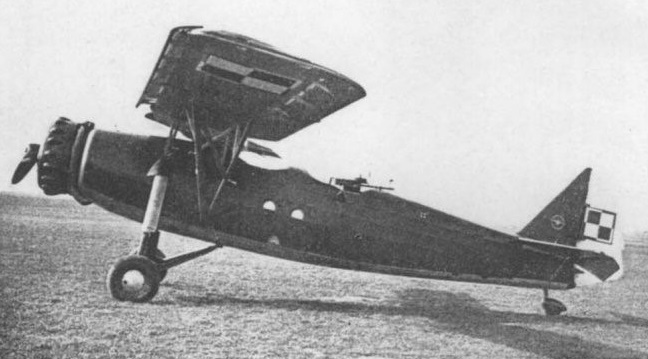
The RWD-14 Czapla was a Polish observation, close reconnaissance and liaison aircraft, designed in the mid-1930s by the RWD team, and produced in the LWS factory from 1938. The aircraft was designed in response to a Polish Air Force requirement of 1933 for a new army cooperation plane, a successor of the Lublin R-XIII. The RWD team of the DWL workshops (Doświadczalne Warsztaty Lotnicze) initially proposed the RWD-12 project, based on the RWD-8 trainer. It was however considered as not as good as the R-XIII, and another aircraft, the RWD-14 was designed by Stanislaw Rogalski and Jerzy Drzewiecki. Designer Tadeusz Chyliński prepared its technical documentation.
The aircraft was a mixed construction monoplane with a braced parasol high-wing. The fuselage was a metal and wooden frame, covered with canvas. Wooden two-spar wings were covered with canvas and plywood and fitted with slats and the stabilizers were also of wooden construction. The wings folded rearwards. The fixed landing gear was of conventional design with a rear tailwheel. The Crew of two sat in tandem open cockpits, with twin controls and individual windshields. The observer had a 7.7 mm Vickers K machine gun, the pilot had a fixed 7.92 mm wz.33 machine gun with interrupter gear. 9 cylinder air-cooled radial engine PZL G-1620B Mors-II with 430 hp (320 kW) nominal power and 470 hp (350 kW) take-off power and a two-blade wooden propeller. Two fuel tanks with total capacity of 315 litres (265 liter in the fuselage, 50 liter in the central wing). The aircraft could be fitted with a radio and camera.
The first prototype was flown in late 1935. It won the contest over the Lublin R-XXI project and the Podlaska Wytwórnia Samolotów factory project, but factory trials showed that its performance was still not satisfactory. Between 1936 and 1937 two modified prototypes were built, designated RWD-14a, but both crashed during trials due to steering mechanism faults (the pilots survived). Finally, in early 1938 the fourth prototype, designated RWD-14b, was built.
It was ordered by the Polish Air Force, receiving the name Czapla (Heron), but due to the long development process, it was regarded as only an interim model, to replace the R-XIII until the advent of the more modern LWS-3 Mewa. In return for refunding the development costs, DWL gave the rights to produce the RWD-14b to the state factory LWS (Lubelska Wytwórnia Samolotów – Lublin Aircraft Works, a successor of the Plage i Laśkiewicz).
The fourth prototype was tested by the Ilmavoimat evaluation team but the only feature that rated highly was the short take-off (140 m) and landing (120 m) distances which enabled it to operate from fields and meadows.
LWS built a series of 65 RWD-14b Czapla’s by February 28, 1939, out of 125 ordered by the Polish Army, 120, and Polish Navy. The Czaplas entered service in the Polish Air Force in the spring of 1939, equipping a number of observation squadrons (eskadra obserwacyjna). Due to its long development, it was not a modern aircraft, only a little better than the Lublin R-XIII. Its advantage was its short take-off (140 m) and landing (120 m), enabling it to operate from fields and meadows. Its modern successor, the LWS-3 Mewa, did not manage to enter operational units due to the war. In the invasion of Poland in 1939, the Polish Air Force had 35 Czaplas in five observation squadrons (out of 12): No.’s 13, 23, 33, 53 and 63. Each squadron had seven aircraft. Squadrons were distributed among the field Armies.
The remaining 30 Czaplas were in reserve (probably only four supplemented combat units during the campaign). Like the R-XIII, the Czapla was no match for any Luftwaffe fighter, bomber, or even reconnaissance aircraft encountered, being much slower, and armed with only two machine guns. In spite of this, they were actively used for close reconnaissance and liaison tasks. Most RWD-14b’s were destroyed during the campaign. About ten were withdrawn to Romania (there are quoted numbers from 10 to 16) and one probably to Hungary. They were taken over by the Romanian Air Force and used for auxiliary duties. No RWD-14b has survived.
Ten Polish Air Force Czaplas escaped from Poland to Sweden as the Polish resistance to the German and Soviet invasions collapsed. On arrival in Sweden after flying across German-held territory and then a wavetop flight across the Baltic, they were quickly refueled and flew on to Finland, eventually landing at Turku. These aircraft were incorporated into the Ilmavoimat.
RWD-14 Czapla
Crew: two (Pilot and Observer)
Engine: 1 x PZL G-1620B Mors-II air-cooled 9-cylinder radial, 470 hp
Maximum speed: 153 mph
Range: 421 miles
Service ceiling: 16,728 ft
Defensive armament: 1 × fixed, forward-firing 7.92 mm wz.33 machine gun / 1 × flexible, rearward-firing 7.7 mm Vickers K machine gun for observer.
L-W-F T-3
Built Model T-3 for Army, 1923-1924

