Makhonine, Ivan

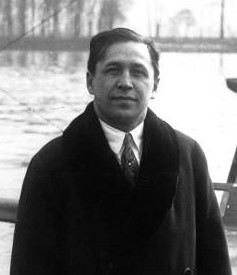
Ivan (Jean) Makhonine (Махонин Иван)

Born in Russia in 1895, Yvan Makhonine, finds himself in the war of 14/18 in a state research center to invent weapons and ammunition of all kinds, which brings him fortune.

Makhonine Article

Around 1917, he invented a way to produce synthetic fuel, able to run without noticeable changes, all types of combustion engines typically powered by gasoline or other fuels.

Unlike gasoline, his fuel can not be ignited in the cold, but only when hot as fuel. But though it can only be ignited with difficulty by auto ignition, unlike gasoline, it can help to significantly increase the efficiency of combustion engines by simply raising their compression rate.

This fuel, a little fatter than gasoline, with the appearance of diesel, is easily sprayable by carburetor engines, provided you bring the electric air preheating systems to facilitate cold starts and to increase the efficiency of the usual means of heating the body of the carburettor.

Some adjusting the weight floats and sizes of the nozzles are to be made because of the density of the product, markedly higher than gasoline, and close to 1.0.

Around 1918, Mr. Makhonine built an electric-powered locomotive with motors driving the wheel axles are powered by a power generator itself driven by an internal combustion engine with a high compression ratio. The cars of this train were also equipped with electric motors.

According to witnesses, it leaves a vapor with the appearance of a thick smoke, which feeds directly into the combustion engine electric generator.

If this “smoke” is sent to a conventional distillation apparatus, it condenses as fuel that can be stored for later use.

This electric powered locomotive, ultra modern for its time compared to intensive steam engines, was used in Russian cars until 1920 or 1921.

Beginning 1922, Mr. Makhonine with his wife (the singer Nathalie Ermolenko) and fortune, arrived in France, and decided to sell his invention to the French State.

For many years the fuel was used successfully in all vehicles equipped with an internal combustion engine, automobiles, trucks, boats, planes etc.

Finally everything stopped around 1927, when he found himself almost ruined after suffering the fate of many inventors.

Mr. Ivan Makhonine, engineer, Russian inventor, died in France in 1973 in a retirement home for Russian emigrants, without disclosing the precise secret of his invention, i.e., the exact technology that transformed the machine hydrocarbon vapors and other carbon products in a “smoke” condensable giving this famous fuel and this with tremendous efficiency, which we are unable to achieve with our current science.

Mr. Makhonine knew just make an ideal fuel that was neither petrol nor diesel, but an intermediate product.

He could manufacture this fuel from raw materials most unfit for this, i.e., coal tars, the worst coal, crude oil, vegetable oils and all hydrocarbon or carbonaceous waste.

What we know is that it was preparing the base product with means that differed product (see French Patent No. 622036 below), so as to extract a steam that was posing in a kind large insulated tube externally – not described in the patent system – whose other end is connected directly to an engine, or a conventional distillation apparatus where the fuel comes out.

We know that production of this exceptional fuel yields were approximately 95% crude oils and coal tars. These results are not comparable with that obtained in quantity and quality by conventional methods which are known to us.

We also know that the engines burning the fuel, in addition to their exceptional performance, did not pollute, produced no smoke or the usual unpleasant smell, but only a sort of hot gas with a slight pleasant odor.
Mahoney-Ryan X-1 Special / Sportster

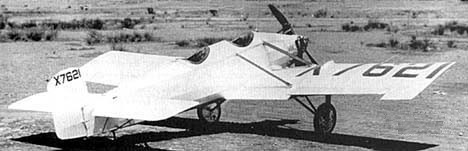
The 1928 X-1 Special aka Sportster experimental lightplane was designed by Don Hall and first flown in September 1928 (piloted by Red Harrigan, registered NX7621). Power was an 80hp Siemens-Halske.

Repowered with 90hp Warner Scarab as a 1929 Safety Plane entry with a variable-airfoil wing (“no two ribs are alike”) controlled by a lever in the cockpit. No fin or stabilizer, which were replaced by a large, moveable “stabilator” and a longitudinally adjustable 50 lb weight on a track to shift the c/g. All that resulted in enough stability problems to cancel the project.

Only the one was built, reportedly flown several times by Charles Lindbergh.

Wing span: 27’0″
Length: 22’0″
Max speed: 135 mph
Seats: 2

Mahoney-Ryan Aircraft Corporation

USA
Incorporated 1922 at St Louis, Missouri, known originally as Ryan Airlines. Developed Ryan M-1 mailplane from which, in 1927, was derived Spirit of St Louis, built for Charles Lindbergh’s New York-Paris flight; commercial development produced as Ryan Brougham.

Purchased Ryan Aircraft Co as B F (Ben Franklin) Mahoney Aircraft Co, later B F Mahoney-Ryan Aircraft Co, San Diego, in 1927.

1929: Ryan Aircraft Corp.

Company merged with Detroit Aircraft Corporation May 24, 1929.

Magni-Aviazione

Italy
Founded by Piero Magni in 1919, primarily research and development organization but manufactured aircraft for other designers, including Jona J-6 tilting-wing sesquiplane and the conventional-winged J-6S military trainer. Magni’s own aircraft included PM-3-4 Vale 1937 single-seat aerobatic aircraft and the derived PM-4-1 Supervale.

Magnan M-2 Marin

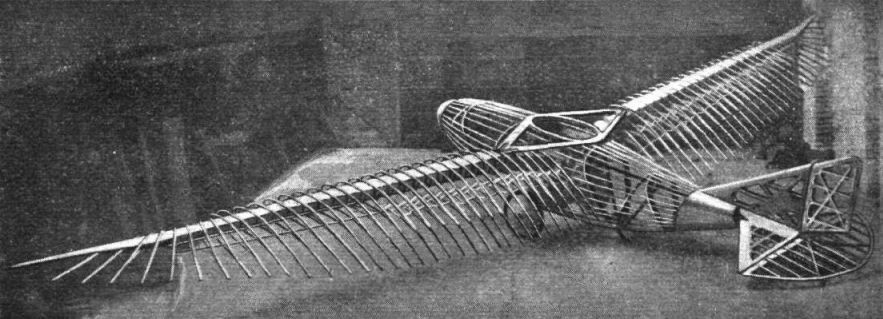
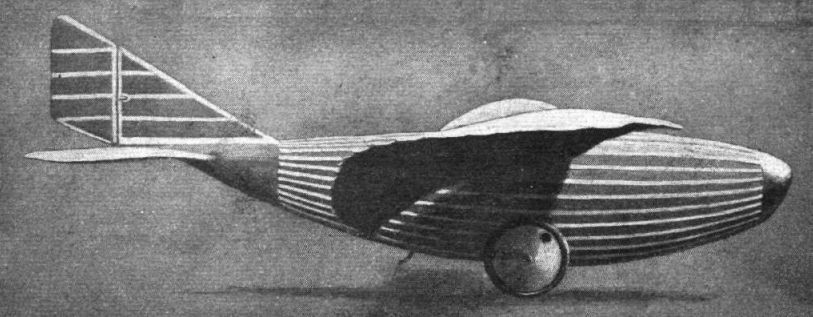
Apart from the studies made in Germany, several French experimenters have attacked the problem of “gust-soaring,” among them being Dr. Magnan, who has made a close study of bird flight, and who reached a stage when he could justify the building of a machine for the purpose of carrying out actual flying experiments. This machine is of unorthodox design, both aerodynamically and structurally.

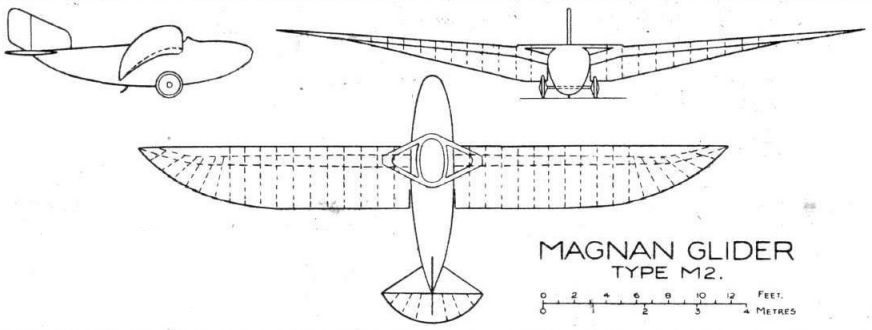
Basing his design to some extent upon birds, in 1921 Dr. Magnan produced a cantilever monoplane, the wing of which is of uniform chord over approximately one-half of its span, but tapering to a point at the tips. The leading edge is straight and the taper is provided solely by the trailing edge. Near the root the wing is swept down suddenly and sharply to form a pronounced dihedral angle. This angle extends over but a few feet of the span, and the rest of the wing is at a smaller dihedral. The wing tapers in thickness as well as in chord, and the angle of incidence is progressively altered, being around 20 degrees at the root. In addition to the change in section and angle, the wing ribs are so constructed that they are capable of being flexed to an extent under varying loads. No ailerons are fitted. Lateral control is by wing warping.

The fuselage is short in proportion to the span, and a large portion of it projects ahead of the wing. This results in the tail being very close to the wing, only about one chord-length separating the trailing edge from the forward end of the fixed tail plane. A large rudder is fitted. The “fin area” of the forward portion of the fuselage is very considerable, of rounded section.

The monoplane wing has but a single spar, of box section and built of wood. There are two fairly sharp bends in each spar, one a few feet out from the body, where the horizontal cabane meets the spar, and another a few feet from the tip, where the spar tip is swept forward to meet the straight leading edge. The ribs have top and bottom flanges of ash, the lower flange, which runs from leading to trailing edge, being screwed and glued to the lower face of the spar. The top flange stops short of the trailing edge, about one-third of the chord from it, and is so attached to the lower flange and to the spar that it can slide a short distance in a fore-and-aft direction, thus allowing the trailing edge to flex.

Near the wing tips the ribs slope outwards, and also they are so mounted on the spar as to give a pronounced “wash-out” to the wing. Lateral control is by warping, but instead of the warp causing a change of angle without sensible change in camber, in the Magnan monoplane both angle of incidence and camber are altered. The fabric covering is applied in a way which was claimed to prevent wrinkling when the wing is being warped.

The fuselage is of egg-shape section, and is built up of formers alternating sloping back and forward, thus forming a series of Vees as seen in side view. To these formers are attached four main longerons and a great number of stringers, and wire bracing is employed for stiffening the structure against torsion. The fuselage is fabric covered except at the extreme nose and stern. The tail is of more or less orthodox design, but is supported on a duralumin cone bolted to the rear bulkhead of the fuselage proper.

A simple undercarriage consisting of two wheels carried on a duralumin axle is fitted, the axle being sprung by rubber cords anchored inside the lower portion of the fuselage.

The pilot’s seat is mounted on longitudinal rails, somewhat like the sliding seat in a boat, and for fore-and-aft control he can alter the position of the centre of gravity by sliding the seat along. The ordinary controls are of the usual type.

The machine was to be launched from a cliff on the coast, and glide into the wind until fairly low over the sea. During a gust the pilot would pull back the stick, and if necessary shift his seat back so as to bring the tail down quickly. As a gust dies down he would push the stick forward and slide his seat forward at the same time so as to avoid stalling the machine. During a lull it was to be the pilot’s endeavor to glide forward with the minimum loss of height, i.e., at the best gliding angle for the particular conditions. Dr. Magnan considered that another method would be to glide down-wind during the lulls and up-wind during the gusts, but that it was doubtful if the machine could be manoeuvred quickly enough to make this form of gust-soaring feasible.

Some preliminary tests over land were made with the machine, piloted by Canivet, and these were stated to have indicated that the machine should, under suitable conditions, be capable of taking advantage of a gusty wind.

As alighting on the sea was to be one of the normal functions of the machine, the fuselage and wings have been made watertight, the opening for the wheel axle being bulkheaded off from the rest of the fuselage.

Type Marin M.2
Length o.a., 4-95 m. (16 ft. 3 ins.)
Wingspan, 11-5 m. (37 ft. 9 ins.)
Chord (root), 1-3 m. (4 ft. 3 ins.)
Wing area, 10 -25 sq. m. (110 sq. ft.)
Weight of wing, 60 kgs. (132 lbs.)
Weight of machine (empty) 130 kgs. (286 lbs.)
Weight in flying trim, 200 kgs. (440 lbs.)
Wing loading, 19 kgs./sq. m. (4 lb./sq. ft.).

Maer The Egg / The Fly

A machine built around 1924, consisting of an egg-shaped fuselage with an underslung gondola and extra-long landing gear that could be found at Stinson Field at the time. A mid-wing monoplane, the 90hp Curtiss OX-5 engine was mounted in a cowl that looked much like a NACA cowl, not then invented, and its radiator was mounted on the outside of the cowl.

The ship was said to be the brainchild of a German inventor, and one named Maer was known to be working at Stinson Field, but other sources credit it to a Prof Warner, who also designed an ornithopter.

An Air Service Newsletter lists the plane as “The Fly,” designed and constructed by a Lt D B Phillips, assisted by members of the 3rd Attack Group.

Reportedly was Charles Lindbergh who labeled it “The Egg” when he saw it.