First flown in 1931, one Mureaux 131 military reconnaissance aircraft was built.
Inter-Wars
Mureaux 120
First flown in 1931, two Mureaux 120 military reconnaissance aircraft were built.
Mureaux 110 / 111 / 113 / 115 / 117
The ANF Les Mureaux 110 originated with a French air ministry requirement for an aircraft to replace the Breguet 19 in Armeé de l’Air service in the “R2” reconnaissance role. The Mureaux 110 first flew in 1931. Two slightly different variants, the 110 and 111 were presented to the air force for evaluation, and were soon ordered into production.
The first mass-production version was the 113 in 1933, of which 49 examples were purchased.
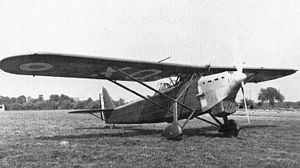
This was supplanted in production by the 115 in 1935 and the 117 later than year. The major difference between the 117 and the earlier 115 was that the 117 had improved aerodynamics. Both these series were given light bombing capability as well. By the outbreak of World War II, the ANF Les Mureaux 117 equipped nine Groupes Aériens d’Observation.
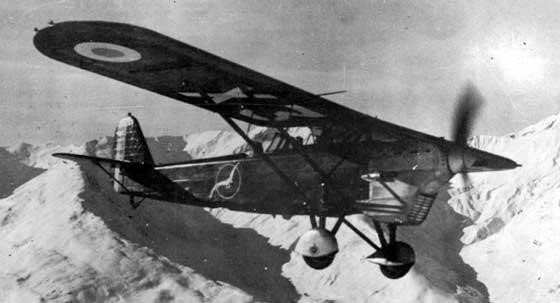
The Mureaux 115.R2 was a two-seat fighter. A Mureaux 115 model was the first French aircraft destroyed by the Luftwaffe.
In early 1938, the Ilmavoimat / Maavoimat test team evaluated the ANF Les Mureaux 117. It was assessed as a rugged but somewhat dated aircraft similar to the Fokker C.X the Ilmavoimat already had in service and without any real multi-role or STOL capability.
A total of 285 military reconnaissance aircraft were built.
ANF Les Mureaux 117
Engine: single 634-kW (850-hp) Hispano-Suiza 12Yers
Maximum speed: 210 mph
Range: 620 miles
Service ceiling: 32,800 ft
Armament: 1 × 20 mm Hispano-Suiza HS.9 cannon through propeller hub, 2 × fixed, forward firing 7.5 mm MAC 34 machine guns and 2 × flexible 7.5 mm MAC 34 machine guns for observer
Bombload: 200 kg (440 lb)
Crew: 2 (Pilot and Observer)
Mureaux 4
The ANF les Mureaux series of light observation aircraft first appeared in late 1920’s and developed further into the 1930’s. The Mureaux served as a forward reconnaissance aircraft to the start of World War 2. The aircraft was wholly outclassed in many ways though some 100 were still in operational service.
The design of the Mureaux 4 was with simple static landing gear, a high-monoplane wing on supportive struts and seating for two personnel. With limited armament options, the Mureaux served a more definitive role of reconnaissance and could operate up to 500 miles at altitudes upwards of 26,000 feet.
Only one Mureaux 4 fighter was built, first flying in 1928.
By the time the German Luftwaffe invasion over French airspace in 1940, the Mureaux series was already on its way out. The system was eventually replaced by the more capable Potez series 63.11 aircraft in the same role.
ANF Les Mureaux 4
Engine: 1 x Hispano-Suiza 12-cylinder liquid-cooled V-type, 860hp
Length: 33.40ft (10.18m)
Wingspan: 50.52ft (15.40m)
Height: 11.29ft (3.44m)
Maximum Speed: 197mph (317kmh; 171kts)
Maximum Range: 500miles (804km)
Service Ceiling: 26,247ft (8,000m)
Armament: 4 OR 5 x 7.7mm machine guns, Up to 882lbs of ordnance.
Accommodation: 2
Maximum Take-Off Weight: 7,606lbs (3,450kg)
Mureaux 3
A Military fighter aircraft (1 built) first flying in 1927.
Mureaux
Ateliers de Construction du Nord de la France et des Mureaux
ANF Les Mureaux (full name: Les Ateliers de Construction du Nord de la France et des Mureaux) was founded in Les Mureaux, France, in 1918 as Les Ateliers des Mureaux building aircraft under license.
Significant products included Vickers Vimys and Breguet 14s during the 1920s. Under head designer André Brunet, it also produced a few original parasol-winged monoplanes that eventually led to the firm’s greatest success, the 113 military reconnaissance aircraft of 1931 and its derivatives.
In 1928, it purchased French seaplane manufacturer Besson.
Developed a number of military prototypes including Mureaux 115.R2 two-seat fighter and Mureaux 200.A3 two/three-seat reconnaissance derivative, both with Hispano- Suiza 12Y engine; also Mureaux 190 single-seat fighter.
Les Ateliers de Construction du Nord de la France et des Mureaux, headquartered at Mureaux, Seine-et-Oise, amalgamated with Ateliers de Construction du Nord de la France in 1930, nationalized and absorbed into SNCAN March 1,1937, CAMS, and part of Breguet.
Mummert 1921 biplane
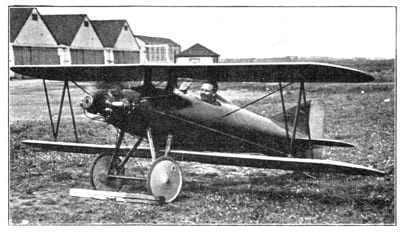
The Mummert biplane was designed and built in 1921 by Harvey Mummert, a Curtiss engineer from Long Island, New York. Powered by a 28-hp Lawrence engine, it featured a laminate-plywood monocoque fuselage, such as those used on the Curtiss Oriole. Only one was built.
Engine: 28-hp Lawrence
Wingspan: 18 ft
Length: 12 ft
Loaded weight: 591 lb
Speed: 90 mph
Muller GMG V
A two-seat cabin monoplane with Argus As.16 or BMW Xa engine.
Muller
Boots und Flugzeugbau Gebr Muller
Germany
Brothers Jacob and Philipp Muller formed Boots und Flugzeugbau Gebr Muller at Darmstadt in 1908, manufacturing parts for Voisin aircraft being built under license by August Euler. After First World War developed several light aircraft, including GMG V two-seat cabin monoplane with Argus As.16 or BMW Xa engine.
Mueyetemi Sportrepulo Egyesulet M.24 Nebulo
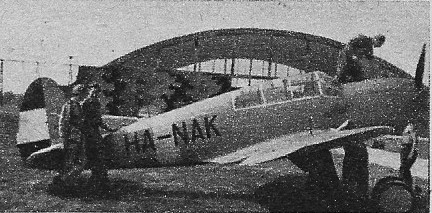
The M.24 Nebulo tandem two-seat cabin monoplane was built by the Muegyetimi Sportrepulo Egyesult (Sport Flying Association of the Technical University) of Budapest, Hungary, and first flown in 1938.
The M.24 was of mixed construction with a wooden wing and steel-tube fuselage with plywood and fabric covering, and power was provided by a 100 hp Hirth HM.504 engine.
 All Aero