SA Nieuport-Delage
Societe Anonyme des Etablissements Nieuport amalgamated with the Astra airship company in 1921, but all construction of airships was abandoned and the company name changed again to SA Nieuport-Delage.
This new company’s next project was the design and construction of two racing seaplanes for the 1929 Schneider Trophy races, but these were not finished in time to compete. The Nieuport-Delage 62-C1 was a single-seat sesquiplane fighter of partial wood construction, with monocoque fuselage, powered by a Lorraine or Hispano-Suiza engine. The 82-C1 was an all-metal version. Other projects included the N-D 481 single-seat, high-wing aerobatic or sporting monoplane; the N-D 641 mailplane; and the N-D 540 all-metal long-range passenger aircraft, which had jettisonable long-range fuel tanks.
Inter-Wars
Nieuport 81 / Mitsubishi Ko-1
Mitsubishi built 57 Nieuport 81 trainers for the Imperial Japanese Army as the Mitsubishi Ko-1.
Nieuport 31
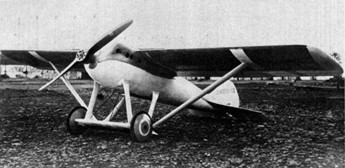
In Sept of 1921, the French Nieuport 31 held the World’s Speed Record of 205 mph.
Nieuport 29
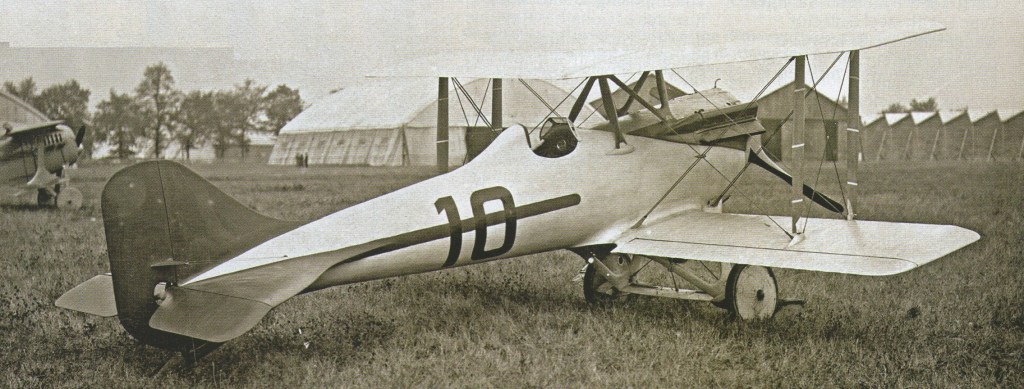
The 1924 Beaumont Cup race was won by Sadi Lecointe on the Nieuport 29, equipped with Hispano’s 450-horsepower V-engine. The Sadi-Lekuanta aircraft covered a distance of 300 kilometers in 57 minutes 50 seconds with an average speed of 312.39 km / h. Thus, a prize of 75,000 francs was awarded by Société Nieuport-Astra.
The Nieuport 29V set two world records in 1929.
Nieuport
Societe Anonyme des Establissements Nieuport
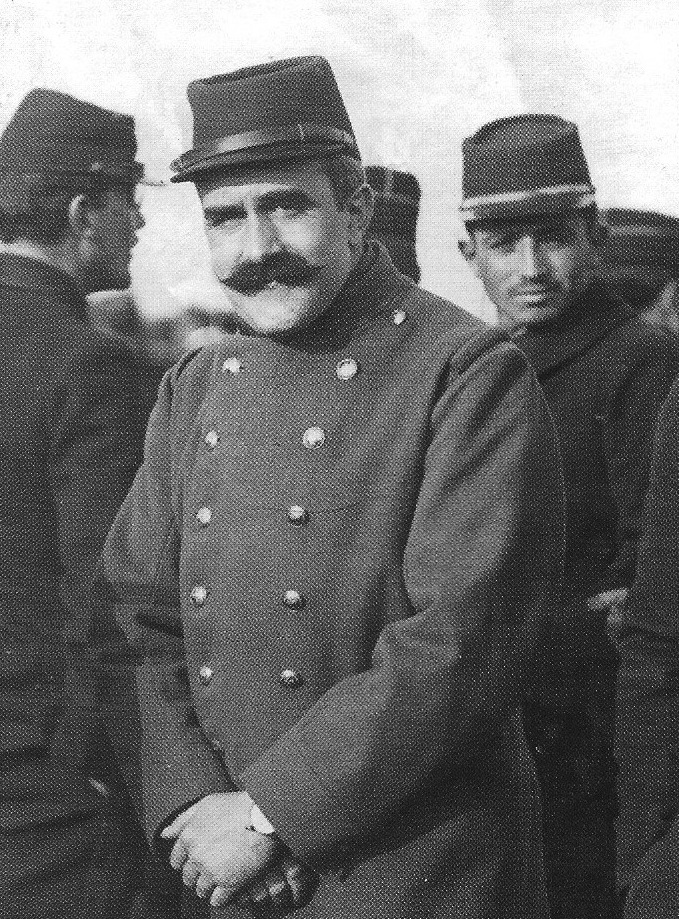
Edouard de Nieport was born in Algeria in 1875. With his brother Charles, he emigrated to France, altering their name to Nieuport. In 1905 Edouard began designing aircraft and appliances like spark plugs and magnetos.
In 1910 Edouard de Nieport decided to build a monoplane with a covered fuselage and on 21 June 1911 he flew his Nie-2N monoplane at 87.2mph. In September 1911 Edouard de Nieport was killed in an emergency landing in the -2N. Immediately the company was taken over by Henri de la Meurthe.
On 24 Jan 1913 Charles Nieuport and his mechanic, Gouyot, were killed.
By 1914 the firm had at least two factories in Issy-Les-Moulinaux and one flight school at Villacoublay.
Designer Gustave Delage made the Nieuport company famous with his series of fighters. The sesquiplane Nieuport XI and XVII served with British, French, Belgian, Russian, Italian, Dutch, Finnish, and American services during the First World War. The improved Nieuport 28 biplane which appeared in 1917 was less successful, but best known for its exploits with the American 94th Aero Squadron (“Hat-in-Ring”) in the hands of Eddie Rickenbacker and Raoul Lufbery. Nieuport aircraft were manufactured under license in Britain and Italy.
Societe Anonyme des Etablissements Nieuport amalgamated with the Astra airship company in 1921, but all construction of airships was abandoned and the company name changed again to SA Nieuport-Delage.
Gourdou-Leseurre joined Nieuport in 1925 to become Loire-Nieuport.
In France, the Socialist Government of the so called Popular Front brought all the companies building military aircraft, aero engines and armament under its control in 1936. The immediate result was the socialized oblivion of such established companies as Marcel Bloch, Bleriot, Nieuport, Potez, Dewoitine, Hanriot and Farman within half a dozen nationalized groups or Societies Nationales, named according to their geographical location (Nord, Ouest, Centre, Midi and so on).
After World War II, although four of the nationalized groups continued operating under state control, private companies were allowed to resume the design and manufacture of both civil and military aircraft. Some of the pioneering names of French aviation, such as Breguet and Morane Saulnier, returned to prominence, and by 1950 a new one had been added Avions Marcel Dassault.
Loire-Nieuport joined SNCASO in 1942.
Nieman JAI-52
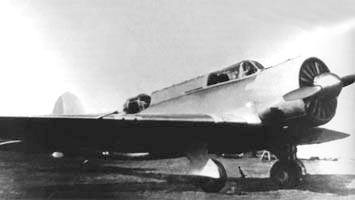
The idea of converting the Nieman R-10 into an attack aircraft led to the development by the Nieman collective of a new model airplane with the M-62 powerplant. The attack aircraft development process was divided into two stages. First, an experimental specimen called JAI-51 was developed in which the new systems and construction elements would be developed and tested. This copy was also to be used to polish all flight problems. The second stage would be called the Nieman JAI-52 (Russian: Неман ХАИ-52) and would be the final product, intended to serve as the basis for series production as a follow-up to the Nieman R-10.
Nieman assigned his best specialists to the attack aircraft project. The project was led by main builder LD Arson until his departure to prepare for production of the Nieman R-10 at the Saratov factory in January 1938, and he was succeeded by IP Zhiganov. At the beginning of 1937, of the 60 specialists in construction and calculations of the OKO-137, 37 were working on the new project and by November of that year practically all of them had joined.
Still without finishing the project, in August 1937, the construction of three copies began in the TsOM workshops, one JAI-51 and two JAI-52. The last plans for the JAI-51 were delivered to the factory in December 1937. The second example of the JAI-52 (known as JAI-521) was built with a new pine plywood, instead of birch.
The delivery of the JAI-52 to the tests could have allowed Nieman victory, but in December 1938 he was arrested.
The new general builder of the OKO-135, AA Dubrovin, did his best to continue modernization work on the Nieman R-10, with an emphasis on the JAI-52. Not having time to prepare the plans for the JAI-52, it was decided to build it using the plans for the JAI-51 with the direct introduction of the modifications.
At this time, on March 20, 1938, the VVS released new technical specifications for the JAI-52 in which a new top speed of 450 – 470 km/h was set instead of the original 390 – 400 km/h. This required significant modifications to the project, which resulted in new delays in the delivery of the model to the tests.
The JAI-52 attack aircraft were designed to use the 930 hp M-63 engine with a BISh-28 propeller. Maintaining the structure of the JAI-51, a duplicate flight control system was installed in the gunner’s cabin and the armament was reinforced. In addition to the four ShKAS machine guns on the wings, two new synchronized ShKAS were installed. Under the wings were installed mounts Der-31.
In this configuration and without having passed the tests yet, in January 1939 by decision of the NKAP, series production of the model was launched at Factory No.135. The Kharkov factory “Hammer and Sickle” also participated in the production of the first series of 10 copies, where wooden parts and components were prepared. The delivery of the first series copies was planned between August and September 1939. Preparation of the JAI-52 prototype was completed on March 15, 1939 (the commitment date had been December 1938). The M-63 engine was still not ready, so an M-62 with a BISh-26 propeller was installed.

On April 6, 1939 at 8:30 am, the factory test pilot, Colonel Darski, raised the JAI-52 on its first flight, which lasted 30 minutes. The behavior of the aircraft in the air was excellent, which allowed it to carry out a second, longer flight in the second part of the day. Engineer Semionov, the NKAP representative at the tests wrote:
“Despite a large number of construction defects, this M-63-powered aircraft is truly modern and if a turbocharger is installed, the VVS will be able to have in service by 1940 a machine superior to that of our potential enemies.”
In spite of this, the direction of the Commissariat received an unexpected letter at the end of April where it was established to take the plane of the Nieman saboteur out of production and to begin production of the Sukhoi BB-1 model, which on April 6, 1939 had successfully completed the state tests. The M-87 engine fitted to the Sukhoi BB-1 did not fail the builders and the aircraft performed better than the JAI-52.
AA Dubrovin refused to continue the development of the JAI-52 and went to Moscow. The continuation of work on the JHA-52 was carried out by IP Zhiganov. The OKO-135 collective still had hopes of saving the JAI-52 and proving that it was superior to Sukhoi’s aircraft.
In May 1939, the JAI-52, during factory tests and with a weight of 3,220 kg, showed a maximum speed at sea level of 374 km/h and at 4,500 meters of 410 km/h. Ascent time to 5,000 meters was 16 minutes. These results allowed the model to be accepted for state tests, so the plane was prepared for its trip to Moscow.
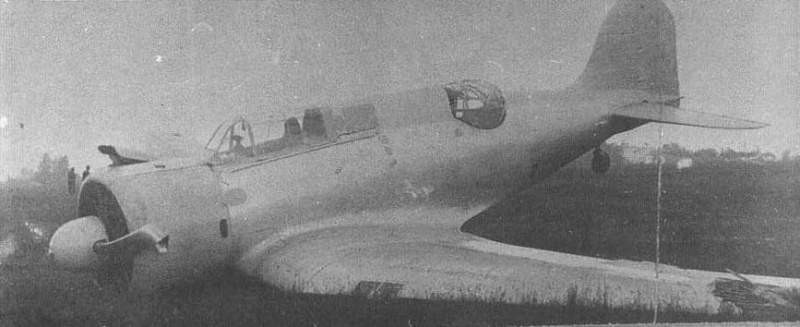
On May 18, the JAI-52, flown by Major Indyushkin, during a familiarization flight with the plane, lost speed at a very low altitude, dived over the wing and fell to the ground. The damaged plane was returned to the TsOM where, together with the repairs, they introduced new modifications. First of all, a freshly received M-63 engine from the Perm factory and a BISh-28 propeller were installed, which resulted in the redesign of a new cowl and propeller hub. To improve stability, the wingspan and wing area were increased.
In these modifications, two months of precious time were gone. Only on August 5, 1939, joint factory and state tests of the JAI-52 attack aircraft began. These tests were executed by the NII VVS test pilot AK Dolgov.
As a result, it was found that the new model was superior to the Nieman R-10 in terms of stability and had better visibility from the cockpit. As a negative point, the displacement of the center of weight forwards was highlighted. Airborne tests showed that not all of the problems had been fixed. With a takeoff weight of 3,376 kg, a speed at ground level of 356 km/h and at 4,500 meters of 410 km/h was reached.
The M-63 engine presented problems so that only 5 test flights could be carried out. The tests were interrupted and with this the history of the developments of the Nieman R-10 ended.
JHA-52
Powerplant: 1 x 930 hp M-63
Propeller: BISh-28
Wingspan: 9.60 m
Wing area: 25.60 m²
Length: 12,208 m
Height: 3.80m
Takeoff weight: 3376 kg
Maximum speed sea level: 356 km/h
Maximum speed 4500m: 470 km/h
Armament: six 7.62 mm ShKAS machine guns with 500 shots each (4 in the wings and another two synchronous in the fuselage). A 600 round ShKAS 7.62mm machine gun in an MV-5 turret. 400 kg of bombs.
Nieman KhAI-1
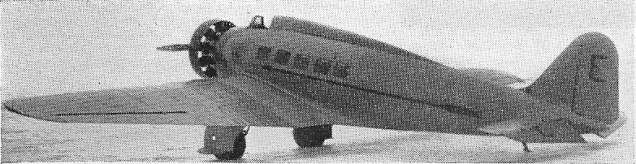
The KhAI-1 six passenger, one crew, airliner of 1933 was of all wood construction and designed by Newman at the Khar’kov Aviation Institute. It is credited with being the first Soviet aeroplane to have a fully retractable undercarriage.
Registrations included L-1351 and L-1367.
Engine: 480 hp M-22
Max speed: 190 mph
AUW: 5732 lb
Span: 40 ft approx.
Nieman JAI-6 / SFR
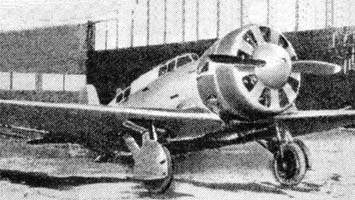
In parallel with the request for the development of a single-engine, scout aircraft, the collective led by Yosif Nieman received a request to develop a prototype aircraft: a high speed unarmed photographic reconnaissance aircraft and, named Nieman SFR (JAI-6) (Russian: Неман СФР (ХАИ-6) ) under the NIS JAI Projects Group. The main defense of this new type of aircraft would be its high speed. Officially the VVS designated the SFR model which corresponds to the acronym of Fast Photographic Reconnaissance Aircraft (in Russian: С коростной Ф отоР азведчик – СФР).
Delivery of the JAI-6 for testing was scheduled for September 1, 1934.
The concept project of the JAI-6 high-speed two-seat reconnaissance aircraft, with an air-cooled engine -58 (M-22U), was developed by the builder brigade S. Ya. Zholkovsky at the end of 1933. The general structure was similar to that of the JAI-1.
In January 1934 the project was handed over to the NII VVS for analysis, but it was quickly returned as the calculation data was considered extremely low and the M-58 engine was not available for production. On recommendations from SV Ilyushin, the project was modified to accommodate a 712 hp Wright Cyclone SGR-1820 F3 engine.
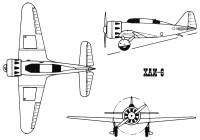
The JAI-6 was designed as an all-wood cantilever low-wing monoplane with an aerodynamically clean fuselage. The retractable type landing gear, manually retractable.
All rudders featured duralumin structure. The wings and stabilizer were made of plywood-clad wood, the aerodynamic brakes of aluminium.
Many elements in the plane were used by the builders for the first time. In order to obtain the highest possible speed, wing mechanization was increased, adding flaps, in addition to the ailerons. The wing was planned as an integral unit (consoles and centerplane in one whole). A curious feature was the use of wooden fuel tanks. During the Great Patriotic War this experience would be applied to the Yakovlev and Lavochkin fighter models with the aim of saving metal.
In the course of the development process of the JAI-6, the retractable landing gear had major problems. The retraction of the gear was done manually and the process was generally similar to that of the JAI-1, but in this case the construction of the gear was very complex. The development of this landing gear was the diploma work of 5th year JHA students PG Shishov and ID Kravchenko.
A methodology for calculating this type of complex landing gear had not yet been developed. All the calculations that were made did not show the necessary resistance and during the static tests in the JHA laboratory the undercarriage was destroyed because it could not support the fixing point. Nieman, after reviewing what happened, proposed a distribution of fixation points that should lead to a decrease in elastic deformation. Finally the wheels passed the physical resistance test, but no way was found to demonstrate the design mathematically. In the project submitted to the state commission these calculations were not included.
In the JAI-6 a photographic turret was located in the central region of the fuselage, behind the observer’s cabin. Hatches for the AFA-13 camera were located on the floor and on the sides. Through these hatches, photographs were taken at an angle of up to 80º and distances of up to 40 – 50 km to the sides. For the first time, a remote control system was also developed to rotate the camera and open the gates.
The military received the project with the new power plant in February 1934 and by May they approved a life-size wooden model, presented by the JAI. The calculations gave a speed of 450 km/h at 4,000 meters and 435 km/h at 2,000 m. The climb time to 5,000 meters was calculated at 8 minutes, the ceiling at 10,000 meters, and the range at 1,000 km. Those data were impressive for the time. The use of TsAP type aerodynamic brakes was foreseen in the wing.
Complications in development delayed the delivery date. The date was first moved from September 1 to November 1, 1934 and then to March 1, 1935, but for this date they were not yet ready.
In January 1935, the aircraft was delivered to production at the newly created TsOM JAI building (JAI Central Experimental Workshops, directed by Galietko. With the hope of being able to develop the static and resistance tests, the production of three copies was ordered in parallel. At the beginning of June 1935 the first prototype was ready and it was sent to the airfield of the Kharkiv Aviation Factory in Sokolniki for testing.
Everything was ready for the first flight when the aircraft mechanic SV Kieglievich received the information that the Wright Cyclone engine needed high octane gasoline. The JAI did not have it so they had to look for it in a military aviation unit. On June 15, test pilot BN Kudrin and designated test engineer Ye. I. Baru made the first flight.
The JAI-6 successfully passed the factory tests, reaching a speed of 429 km/h at an altitude of 2,500 meters, which can be considered a world record for this type of aircraft, although it was never registered.
Everything seemed to be going smoothly, but soon the problems began. The idea of an unarmed fast aircraft had its detractors within the VVS. During Nieman ‘s trip to the United States as part of a state commission, the VVS instruction was received to set up a defensive point in the observer’s cabin. From the NII VVS was sent, to the JAI, “Top Secret” blueprint of a new basket-shaped machine gun installation protruding from the fuselage. Builders were allowed to review plans only in a special department and under the supervision of security personnel. The calculations showed that the central fuselage of the JAI-6 was so narrow that it did not admit a normal machine gun installation, much less that enormous basket.
Soon the builders were informed of the early visit to the institute of the chief of armaments of the Red Army, Marshal MM Tukhachevki, with the aim of defining the fate of the JAI-6. On the morning of the day after the notification, Tukhachevsky arrived at the TsOM accompanied by the aircraft manufacturer AI Putilov, requesting to be shown the plane, the plans, the weapon installation model and the problems for its construction.
Next to the plane the marshal found the director of the JHA PP Krasilnikov, the chief builder LD Arson, the chief test engineer Ye. I. Baru and the head of the weapons brigade I. Dyachenko. About the installation of weapons on the JAI-6 personally stated the head of the project S. Ya. Zholkovsky. Putting a plywood sheet on the ground, Tukhachevsky took off his greatcoat and lay down under the aircraft. There he evaluated the different models and installation variants, reaching the conclusion that it was impossible to carry out any installation without affecting the speed advantages of the aircraft. Tukhachevsky got up, confirmed the builders’ proposals, congratulated them on his work, and left.
The change in military requirements crucified the future of the JAI-6. A few months after Tukhachevsky ‘s visit, the institute was visited by the head of the GUAP aviation department, SV Ilyushin, and reported that the VVS leadership refused to obtain an unarmed scout plane and that the purpose of his visit was to be able to confirm this decision.
At the beginning of November 1935, the JAI-6 prototype was delivered to the NII VVS, where tests were carried out, including the use of a ski undercariage. The test program was led by PM Stefanovski. With this, the issue of the JAI-6 was closed and its builders began to dedicate themselves entirely to the development of the JAI-5.
JHA-6
Engine: 1 x 712 hp Wright Cyclone SGR-1820 F3
Wingspan: 9.20
Wing area: 14.00 m²
Length: 7.3m
Empty weight: 1020 kg
Maximum takeoff weight: 1730 kg
Maximum speed: km/h 429
Practical range: km 980
Service ceiling: 9800 m
Accommodation: 2
Nieman, Yosif Grigorievich
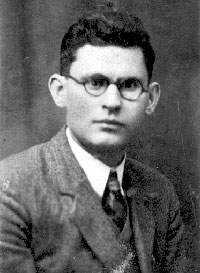
Yosif Grigorievich Nieman (Russian: Иосиф Григорьевич Неман) was born in 1903 in Bielostok, a Polish city in the Grodnienski Governorate into a Jewish family.
In August 1920, during the Civil War, he volunteered for the Red Army. He served as a politician in the department of the 4th Army and then in the political leadership of the Kharkiv Military Region and the Ukrainian Military Region. In 1922 he was demobilized and sent to study at the Kharkiv Technical Institute, which he finished in 1929.
He began his aeronautical career in the construction bureau of KA Kalinin in 1926, participating in the development of the Kalinin К-3, К-4 and К-5 models.
In 1930, he became head of the aeronautical construction chair at the Kharkov Aviation Institute, where he was able to develop his conception of creating airplanes with high aerodynamic characteristics. With the support of the director PP Krasilnikov he organized the aeronautical projection within the research scientific sector (NIS) of the center. The actual projection, proposed by Nieman as a method of preparing future specialists, was based on the work of brigades of NIS students and professors.
In 1930 YG Nieman was selected as JHA’s head of the aircraft construction chair despite not having the necessary scientific degree. He held this post until his arrest in December 1938. From 1944 he returned to occupy the position, this time until his death.
The first JAI project using the Nieman method was called JAI-1 and originated as a diploma paper from the institute.
In March 1933, after the serial production of the JAI-1 was approved, Nieman’s construction brigade received official status. Thereafter it was named the NIS JHA Project Group and received as its base two small rooms on the fourth floor of the aerodynamics corps of the old Technological Institute, near the wind tunnel. Nieman was named lead builder and engineer S. Ya as replacement. Zholkovsky.
As a productive base for the development of the experimental models, the Central Experimental Workshops of the JHA – TsOM JHA (in Russian: Ц ентральные о пытные м астерские (ЦОМ) ХАИ) directed by the engineer Galietko, were organized. Several specialists from KA Kalinin ‘s KB with extensive experience in aeronautical development entered the projection group.
In September 1934, the specialized magazine Samoliot described the JHA aeronautical construction group as a leader in the USSR “in the openness of aeronautical thinking, courage in solving problems and culture in the production of airplanes.”
In the course of the years 1932 – 1938 and under his direction, a whole family of high-speed aircraft (for the time) was developed at the JAI, which included civil transport, reconnaissance and bomber aircraft, designed to be developed as part of the practical activity by students and teachers of the institute, among which the models JAI-1, JAI-3, JAI-5, JAI-6, JAI-51 and JAI-52 (Ivanov) stood out.
On August 17, 1933, he was awarded the Order of the Red Star for the creation of the JAI-1 airliner.
Once the JHA-5 project was approved in January 1935, Nieman was appointed lead builder of an OKO-135 design bureau based at the Kharkov Aviation Factory.
The title of Professor was received in 1938 by virtue of his achievements in organizing the educational process.
Four years later, on December 11, 1938, Nieman was arrested and sentenced to 15 years of labor in a camp, charged with “organizing subversion in the factory and being an agent of foreign espionage.” The OKO-135 design bureau continued without leadership, working on improvements to the stock R-10 aircraft.
In May 1939 Nieman was posted to the Tupolev “Sharaga” in the NKVD TsKB -29, where he worked under Myasichev on the development of the Pe-2. A year later he was appointed head of the Tupolev Tu-2 construction brigade.
On July 19, 1941, by resolution of the Presidium of the Supreme Soviet of the USSR, Nieman was released and all charges against him were dropped.
After his release Nieman worked in the OKB at the Omsk Aviation Factory. From 1942 he became Myasichev ‘s replacement at Factory No.22 in Kazan.
He died of leukemia on November 18, 1952, his body being buried in Kharkiv City Cemetery 2.
In November 1952 he was preparing for the defense of his doctoral thesis, which did not take place due to his sudden death.
The Supreme Court of the USSR fully rehabilitated him on November 5, 1955, postmortem.
Nicolas-Claude NC-2 Aquilon
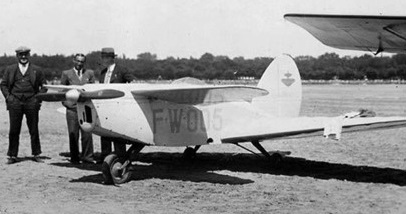
The Nicolas-Claude NC-2 Aquilon was a single-seat touring aircraft featuring a low-wing monoplane with canard foreplanes.
In 1936, French engineer Leon Claude (Leon Claude) began designing the aircraft, using the Henri Mignet formula, where the fuselage with a low center of gravity and two tandem wings were to provide the aircraft with sufficient longitudinal stability.
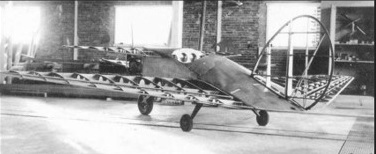
Claude did not have his own funds for the construction of the aircraft, but he managed to captivate the idea of industrialist Jean Nicolas.
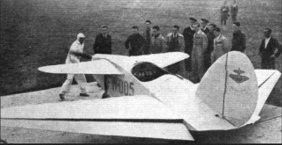
The NC-2 was first flown on 5 April 1937 at Auxerre. France, and only the one was built. In the same year, NC-2 took part in the so-called Prototype Tour, held in many cities in France.
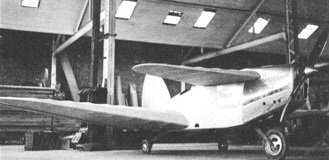
NC-2 Aquilon
Engine: 1 × Train 4T, 37 kW (50 hp)
Propeller: 2-bladed fixed-pitch
Wingspan: 7 m (23 ft 0 in)
Wing area: 14 sq.m (150 sq ft)
Length: 4.3 m (14 ft 1 in)
Empty weight: 183 kg (403 lb)
Gross weight: 410 kg (904 lb)
Maximum speed: 175 km/h (109 mph, 94 kn)
Cruise speed: 130 km/h (81 mph, 70 kn)
Stall speed: 50 km/h (31 mph, 27 kn)
Range: 850 km (530 mi, 460 nmi)
Service ceiling: 4,000 m (13,000 ft)
Wing loading: 29.2 kg/sq.m (6.0 lb/sq ft)
Seats: 1
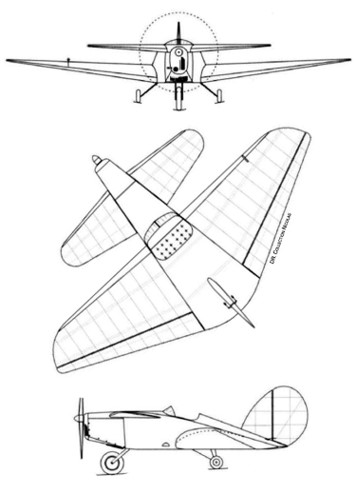
 All Aero