Pietsuj, Alexei Ivanovich

Alexei Ivanovich Pietsuj (Russian: Алексей Иванович Пьецух) was born in 1918 in Vínnitsa, Ukraine. At age 16, he built a small glider, called PAI-1, in which he learned to fly and demonstrated at Aviation Day parties in Kiev. For this device he would receive the award for the youngest constructor in the national competition for light aircraft.

Later, working in the Osoaviajim Glider Factory and under the direction of Oleg Konstantínovich Antonov and BN Sheremetiev he would build his second model, called PAI-2 “Pavel Golovin” in 1937, followed by PAI-3in 1937 itself. Pietsuj worked as a teacher at the glider school, developing the PAI-4 tailless glider in that period.

From 1939 on he was called up to serve in the ranks of the Red Army.

During the Great Patriotic War he served as a tug pilot in the glider section of the air landing troops. He was tasked with piloting an Ilyushin Il-4 to tow gliders towards the front line, but Pietsuj requested a fight. After his request was denied three times, in reply he made a dead link between Nesterov and the Il-4. His performance was branded as “dangerous vandalism”, for which he was handed over to a court, demoted to the ranks and sent to a punishment battalion. On his first night he made seven combat sorties in a Polikarpov Po-2 bomber. After two months the accusation was withdrawn in court.

As a pilot of the 44th Guards Bombardment Aviation Regiment and the Don Red Flag belonging to the 9th Guards Bombardment Division, he carried out 91 combat sorties. He participated in the fighting for Warsaw.

In the spring of 1945 in Germany and with the help of several soldiers, he managed to assemble a flight-capable Messerschmitt Me-410 using components from three aircraft. At the controls of the Me-410 he airlifted it to Moscow. In June this aircraft was tested on the NII VVS.

After the victory he began working as a test pilot in the GK NII VVS, serving in the V. Ye squad. Golofastov. At this stage he built the PAI-5 (1947) and PAI-6 (1949) gliders with aerobatic capacity, which participated in several aerial demonstrations for the Air Fleet Day in Túshino. He was the test pilot PAI-5 (02- 1948) towed gliders Antonov A-7 from Ilyushin Il-4. As a test pilot he flew in more than 60 types of aircraft and gliders.

In the early 1950s Pietsuj organized a student construction bureau among the students of the Moscow Aviation Institute. In this institution he developed the glider models PAI-6M (1952), MAI-56 (1956), MAI-63 (1964), MAI-68 “Pushinka” (1970) and the MAI-58 (1958) and MAI- 62 (1962), as well as the MAI-63M motor glider. He personally tested the MAI-53 models in 1954, MAI-56 in 1958, MAI-62 in 1965, MAI-63 in 1964 and MAI-63M in 1965.

He lived in the village “Liotchik Ispitatiel” (Test Pilot) of the city Iksha, in the Moscow suburbs. He built a house made of bottles there. He died in 1994.

Military grade
Captain

Awards and distinctions
Order of the Great Patriotic War Second Class (5-02- 1988)
Twice Order of the Red Banner (04- 1945, 1948)
Medals

Pietsuj was the author of several articles published in the pre-war period in the magazine “Samoliot”.

He wrote the book “Krylya Molodiozhi” (Youth Wings), published by the Moscow publishing house “Oborongiz” in 1954.
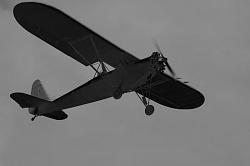
Pietenpol Sky Scout

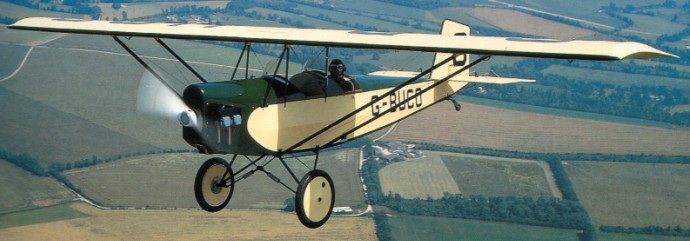
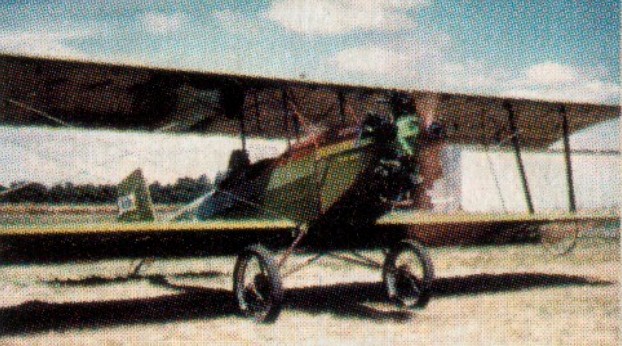
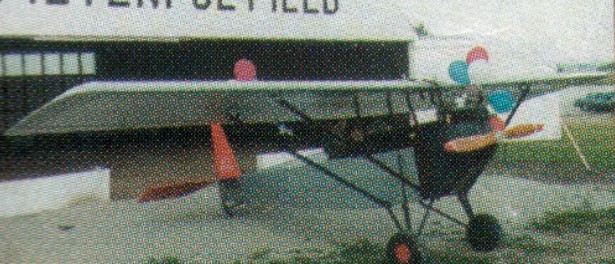
The 1931 Sky Scout was a slightly smaller version than Air Camper. The prototype was N10718.

In the late 1990s the two seat Air Camper and single seat Sky Scout designs are very much alive, with numerous examples still flying.

Mogg Sky Scout

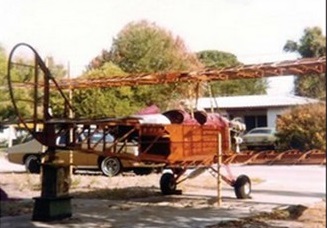
This Sky Scout was started by a 17 year old Alan Mogg, of Sydney, in 1936, but was not completed and flown until December 1940, mainly due to having to comply with the then Civil Aviation Board’s requirements. It was fitted with a Salmson AD9 engine which required the extended mount to bring the Cof G into limits and no doubt, brought about the larger fin and rudder.

Engine: Ford Model T, 20 hp
HP range: 20-40
Height: 6.5 ft
Length: 16.2 ft
Wing span: 27.25 ft
Wing area: 135 sq.ft
Fuel cap: 6 USG
Speed max: 62 mph
Cruise: 55 mph
Stall: 35 mph
ROC: 200 fpm
Take-off dist: 150 ft
Landing dist: 250 ft
Weight empty: 520 lb
Seats: 1
Landing gear: tail wheel

Pietenpol Air Camper

This popular design took to the air for the first time on May 29, 1929, from the rural Minnesota town of Cherry Grove. The brainchild of Bernard Harold Pietenpol, a self ¬taught mechanic and experimenter. It is a high wing two seat tandem open cockpit monoplane. The first, N12937, first flew on 20 April 1933.

Pietenpol Air Camper Article

Air Camper N10GR

The do-it-yourself craze was just getting started as a Depression-born phenomenon when the Air Camper replaced the earlier primary glider as aviation’s favorite backyard building project. It was in 1930 that Modern Mechanics magazine featured the Ford Model A engine as the perfect powerplant for the little homebuilt. The two-seater open-cockpit monoplane is said to land like a Luscombe and handle like a J-3 Cub. In the late 1990s the two seat Air Camper and single seat Sky Scout designs are very much alive, with numerous examples still flying. Modern Air Campers are powered by Corvair, Lycom¬ing or Continental engines.

Air Camper N10GR

Ultralight Replica:
RagWing RW1 Ultra-Piet

Gallery

Engine: Ford Model A, 40 hp
HP range: 40-125
Height: 6.5 ft
Length: 17.8 ft
Wing span: 29.5 ft
Wing area: 147.5 sq.ft
Weight empty: 620 lb
Gross: 1020 lb
Fuel cap: 18 USG
VNE: 90 kt / 104 mph / 167 kmh
Speed max: 90 mph
Cruise: 75 mph
Stall: 40 mph
ROC: 500 fpm
Take-off dist: 400 ft
Landing dist: 300 ft
Seats: 2
Landing gear: tail wheel

Pietenpol Aerial

A biplane adaptation of the stock Air Camper. Designed by Chad Wille.

Engine: Continental O-300, 145 hp
HP range: 85-200
Height: 7 ft
Length: 19.5 ft
Wing span: 29.5 ft
Wing area: 250 sq.ft
Weight empty: 900 lb
Gross: 1400 lb
Fuel cap: 15 USG
Speed max: 105 mph
Cruise: 85 mph
Range: 150 sm
Stall: 36 mph
ROC: 1000 fpm
Take-off dist: 250 ft
Landing dist: 200 ft
Seats: 2
Landing gear: tail wheel

Pickering-Pearson K.P.2

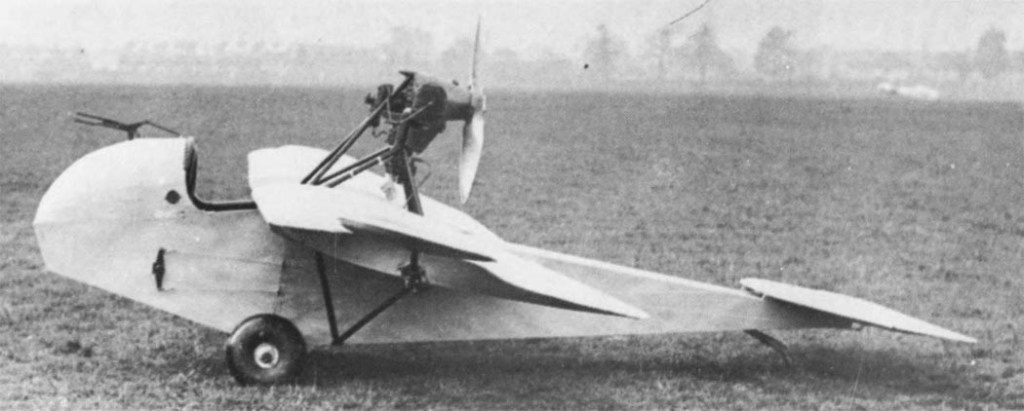
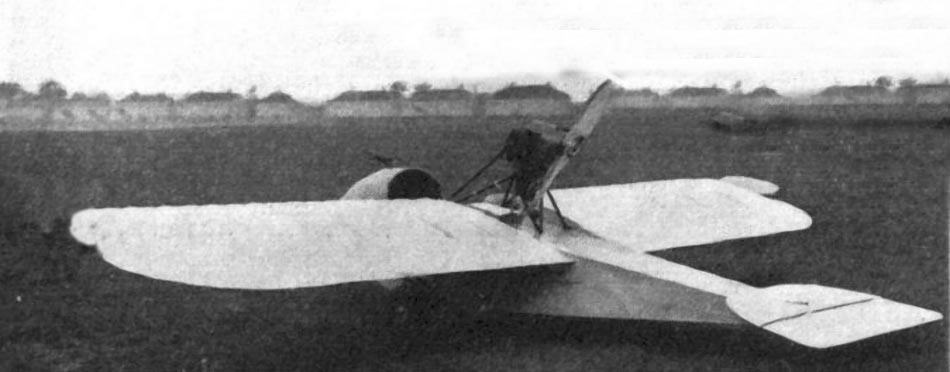
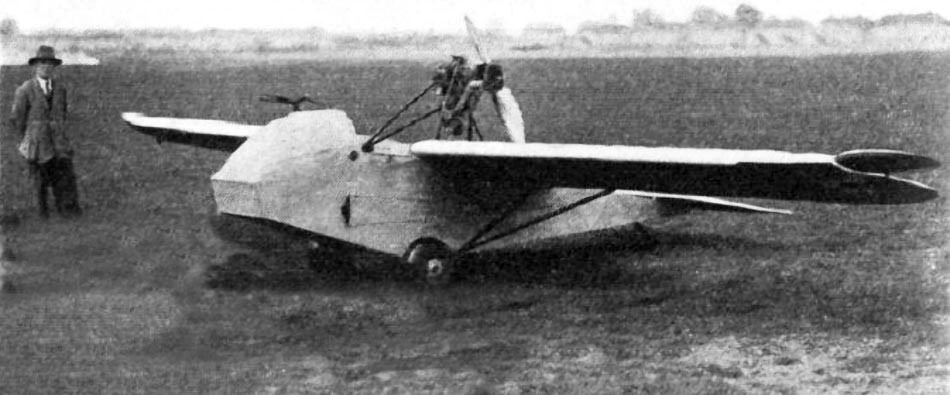
The Pickering-Pearson K.P.2 was designed by K.N.Pearson as a single-seat, mid wing monoplane. It was powered by a 40-horsepower Aeronca E.117 pusher engine. The KP.2 was a wooden monoplane with fixed landing gear.

It used no rudder, being equipped with Pearson rotary ailerons, one on each wingtip.

Built by G.L. Pickering at Hamworth in 1933.

It first flew in 1933 as G-ACMR c/n 2.

It was broken up in 1935.

Piaggio P.XII / P.XV / P.XXII

Piaggio P.XII

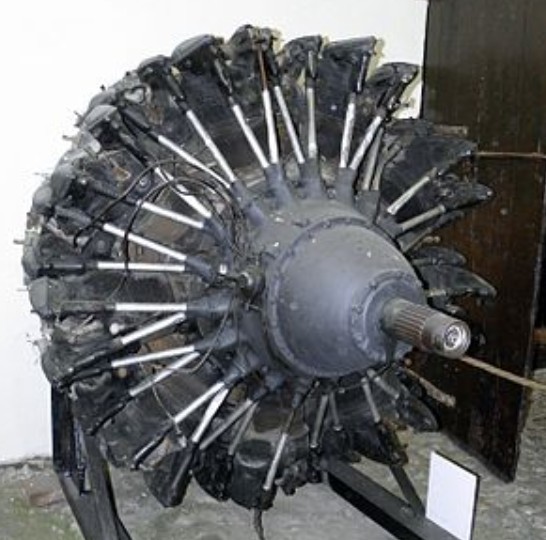
The Piaggio P.XII was an Italian 18-cylinder radial aircraft engine developed in the 1930s by the aeronautical manufacturing company Rinaldo Piaggio S.p.A. The engine was used in many Italian aircraft from 1940 until the end of World War II. An up rated version was produced as the Piaggio P.XXII.

Variants:
Variants of the Piaggio P.XII include: (R – Riduttori – reduction gearing and C – Compressore – supercharged)
P.XII R.C.35
(geared, rated altitude 3,500 m (11,500 ft))
P.XII R.C.40
(geared, rated altitude 4,000 m (13,000 ft))
P.XII R.C.l00/2v
(geared, rated altitude 10,000 m (33,000 ft))
P.XV R.C. 60/2v
(geared, rated altitude 6,000 m (20,000 ft))
P.XXII R.C.35D
Higher rating with slightly higher displacement than the P.XII series engines. (geared, rated altitude 3,500 m (11,500 ft))
P.XXII R.C.35R
Same as P.XXII R.C.35D, but propeller rotates in opposite direction
P.XXII R.C.60
(geared, rated altitude 6,000 m (20,000 ft))

Applications:
CANT Z.1015
CANT Z.1018
CANT Z.511
Caproni Ca.169
Piaggio P.108
Savoia-Marchetti SM.84ter
Savoia-Marchetti SM.89

Specifications:
P.XII R.C.35
Type: 18-cylinder air-cooled radial engine
Bore: 146 mm (5.75 in)
Stroke: 176 mm (6.93 in)
Displacement: 53 l (3,200 cu in)
Length: 1,700 mm (66.93 in)
Diameter: 1,410 mm (55.51 in)
Dry weight: 850 kg (1,874 lb)
Frontal Area: 1.56 sq.m (16.8 sq ft)
Valvetrain: 2 x overhead valves per cylinder operated by rockers and pushrods
Supercharger: Centrifugal compressor, geared to 7.81:1
Fuel system: Single Piaggio downdraught carburettor with automatic boost and mixture control
Fuel type: 87 octane
Oil system: Pressure fed at 482.6 kPa (70 psi), dry sump
Cooling system: Air
Reduction gear: Epicyclic reduction gear, gear ratio: 0.62:1
Starter: Garelli compressed air starter
Ignition: 2x Marelli AQ18 magnetos, 2 x spark plugs per cylinder fed by a shielded ignition harness.
Power output:
Take-off: 1,500 hp (1,100 kW) at 2,100rpm
Military: 1,350 hp (1,010 kW) at 2,100rpm at 3,500 m (11,500 ft)
Cruising: 1,000 hp (750 kW) at 1,700rpm at 3,500 m (11,500 ft)
Specific power: 22.29 kW/l (0.49 hp/cu in)
Compression ratio: 6.5:1
Specific fuel consumption: 0.2795 kg/kW/hr (0.46 lb/hp/hr)
Oil consumption: 0.0134 kg/k/w/hr (0.022 lb/hp/hr)
Power-to-weight ratio: 1.324 kW/kg (0.8 hp/lb)

Piaggio P.108

In 1938 the RA issued a request for proposal for a BGR (Bombardiere a Grande Raggio, long-range bomber); proposals came from Caproni with their Ca.204 and Ca.211 projects, CRDA with Cant. Z.1014 (built only in mock-up form), Piaggio with the P.108B (a private venture project, offered as an additional entry) and the P.112. Also considered was the purchasing of a production license for the Boeing B-17C ‘Fortress’, but this idea was later discarded for reasons of autarchia (national self-sufficiency). The competition was won by the Cant. Z.1014, but since the development of the P.108B was already at an advanced stage, this aircraft was chosen to be produced in quantity. Designed by Casiraghi, who had worked in the USA and was familiar with B-17 technology, it was a sophisticated machine, although slower and heavier than the Fortress.

Piaggio P-108B
Engines: 4
Span 108 ft 3 in
Length: 81 ft 6 in
Max speed: 290 mph at 11,480 ft
Range: 2500 miles
Armament: 8 x 12.7 mm mg
Bombload: 7716 lb
Crew: 6-7

Piaggio P.50

The Piaggio P.50 four-engine heavy bomber was the first aircraft to be designed for the company by Giovanni Casiraghi, following project outline by Giovanni Pegna. The P.50-1 (MM 369) prototype, test flown in 1937, was a shoulder-wing monoplane with a large single fin and rudder and four 544kW Isotta Fraschini XI RC V-12 engines wing-mounted in tandem pairs and driving two tractor and two pusher propellers. Three defensive gun positions included a nose turret, and offensive load was a maximum of 2500kg. A second prototype (MM 370) was damaged in a landing accident at Malpensa airfield in 1938. During that year the P.50-II (MM 371) appeared with a conventional four-engine layout, the 746kW Piaggio P.XI RC.40 radials driving four three-bladed tractor propellers. Defensive armament was increased to five 12.7mm machine-guns. Although no production ensued, the P.50 was the progenitor of the P.108 of World War II.

P.50-I
Engine: 4 x Isotta-Fraschini XI RC, 544kW
Wingspan: 25.76 m / 85 ft 6 in
Length: 19.8 m / 65 ft 12 in
Max. speed: 435 km/h / 270 mph

Piaggio P.32

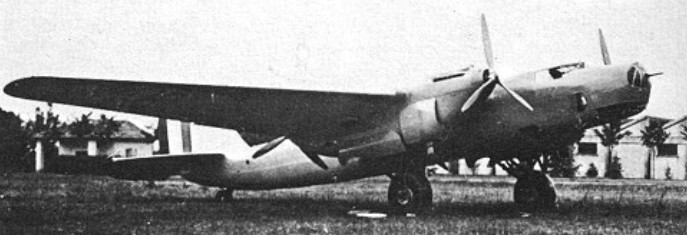
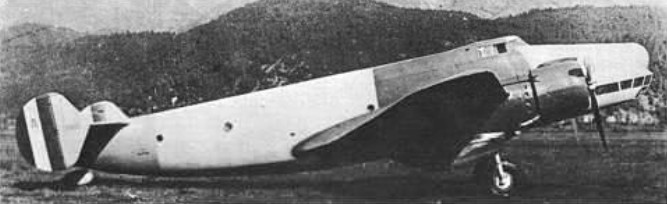
The prototype of the Piaggio P.32 twin-engine bomber flew in early 1936 powered by two Isotta Fraschini Asso XI V-12 engines. Of mixed construction, the P.32 had a stubby fuselage with a low/ mid-set wing incorporating Handley-Page leading-edge slats and double trailing-edge flaps, and a tail unit with twin fins and rudders. The V-12 engines were later replaced by 746kW Piaggio P.XI RC.40 radials. Armament comprised a single 7.7mm Breda machine-gun in a nose turret, and twin guns of the same type and calibre in retractable dorsal and ventral turrets.

A production series of 16 P.32s with Isotta Fraschini engines went into service with the 47a and 48a Squadriglie B.T. of the Regia Aeronautica during 1937, only to be withdrawn and scrapped the following year after a crash which indicated irremediable control problems. Twelve radial-engined aircraft under construction were never completed.

Used in the disasterous attempt by the Italians to bomb London on 11 November 1940.