In 1923, in the wake of the Castar, Paul PONCELET designed a second aircraft, this time two-seater, sponsored by Jean-Baptiste Richard, for participation in the Daily Mail competition, which was to take place in Lympne, Kent, England, on October 12 and 13, 1923.
Jean-Baptiste Richard was the representative of the Handley-Page Company in Belgium and also of the ADC Ltd (Aircraft Disposal Company) which liquidated the English planes and engines surplus from the war of 14-18. He was the first assignee of the right to install and operate an aerodrome at Saint-Hubert (Belgium) in May 1925, a right that he will cede in the following months to José ORTA (who was the owner of the aerodrome and constructor – aircraft finance).
Paul Poncelet was the head of the wood construction workshop of SABCA (Société Anonyme Belge de Constructions Aéronautiques) and the machine was built in the workshops of this company which did not hesitate to encourage its executives in technical innovation projects. in the field of aviation.
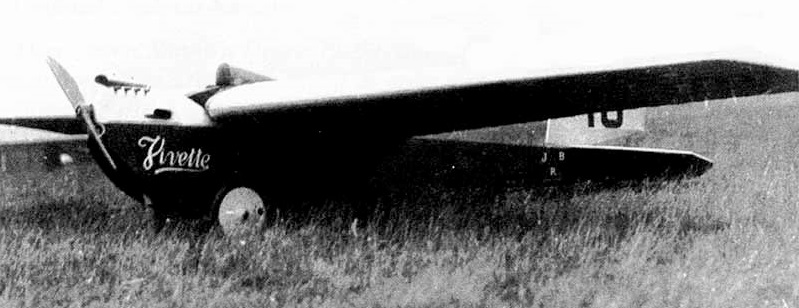
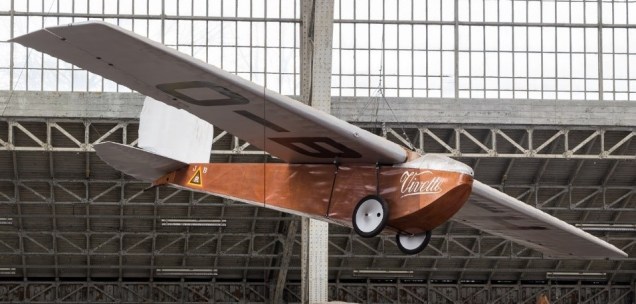
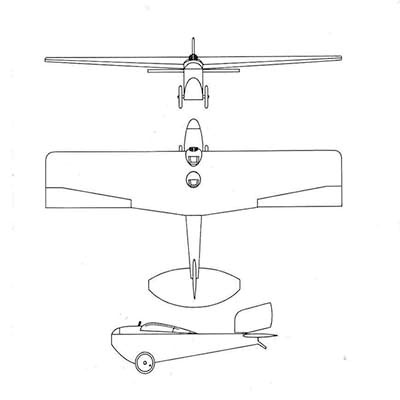
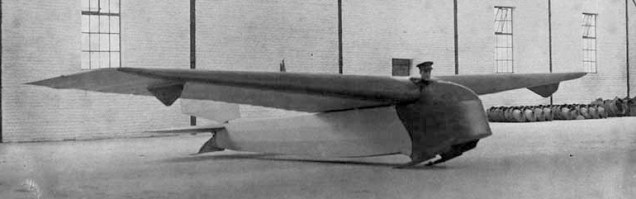
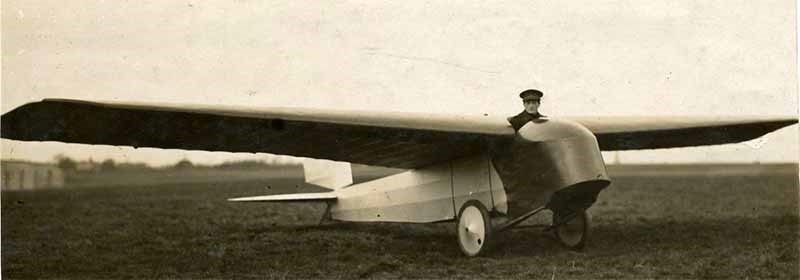
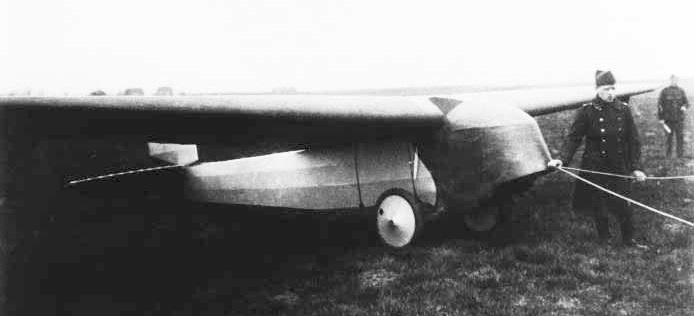
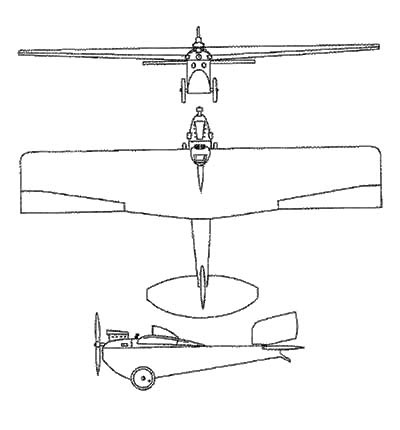
The aircraft was called Vivette, in homage to Jean-Baptiste Richard’s daughter, Geneviève, who was nicknamed Vivette by her family. The Vivette is an airplane derived directly from the Castar, to which Paul Poncelet has made some significant modifications. The fuselage, thinner than that of the Castar, was shortened by about twenty centimeters, and a second station could be installed in tandem by a circular cutout in the thick wing. The fuselage is completely clad in thin plywood.
The wingspan of the cantilever wing was 1.80 meters, bringing the wing area to 24 m² so as not to increase the wing loading compared to that of the Castar single-seater. The Poncelet Vivette made its first flights in the hands of Victor Simonet at the end of the summer of 1923. and, although not quite ready, was entered by its owner JB Richard (“That very good friend of England “as said in the magazine” The Airplane “of October 17, 1923) at the Lympne competition (England) at the end of September 1923 with Lieutenant Baron Kervyn de Lettenhove as pilot. The fuselage is thinner than that of the Castar, and the lander
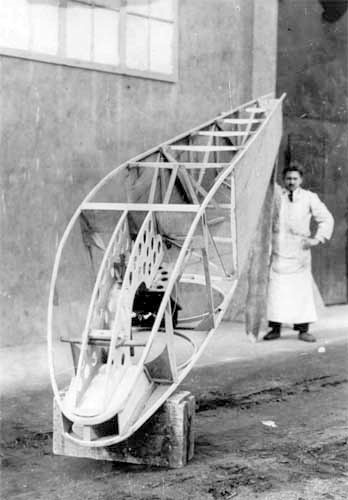
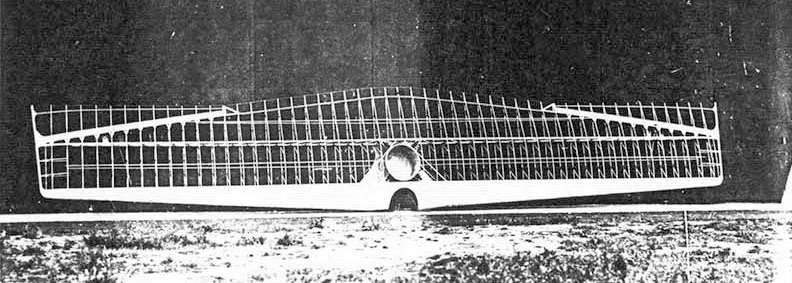
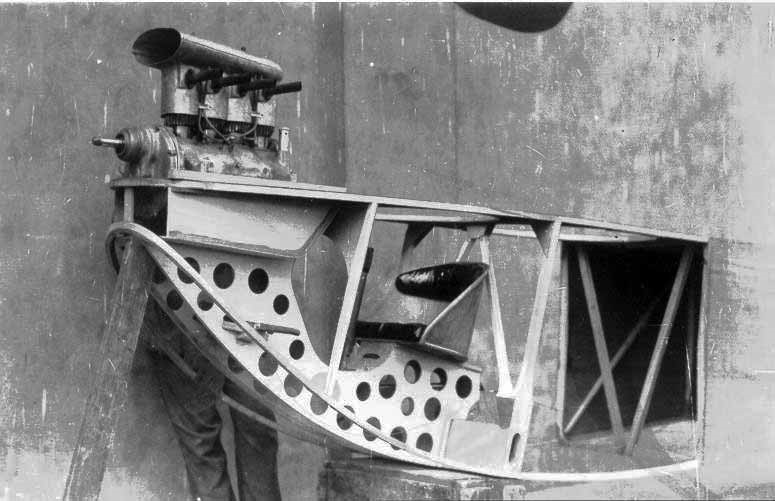
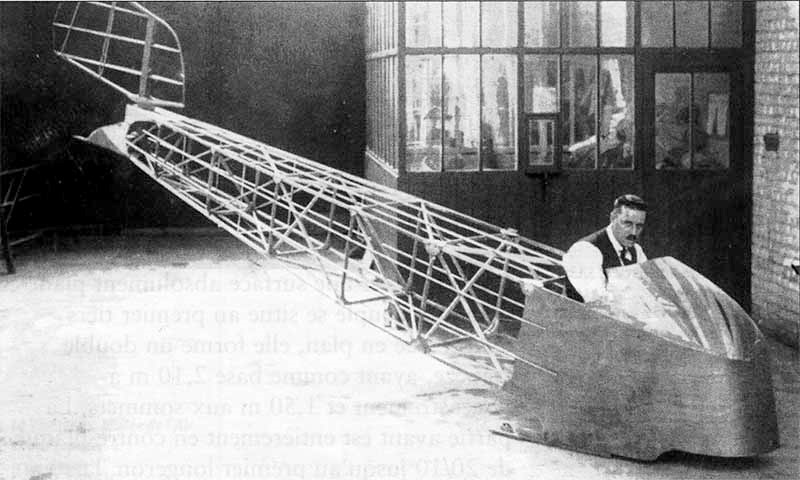
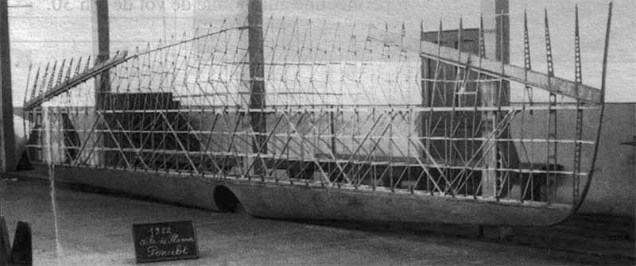
Structure of the Vivette’s wing – Note the hole in the rear seat of the two-seater
It can be configured as a glider, single-seater or two-seater, by adding a second seat directly behind the pilot’s seat, in place of the fuel tank.
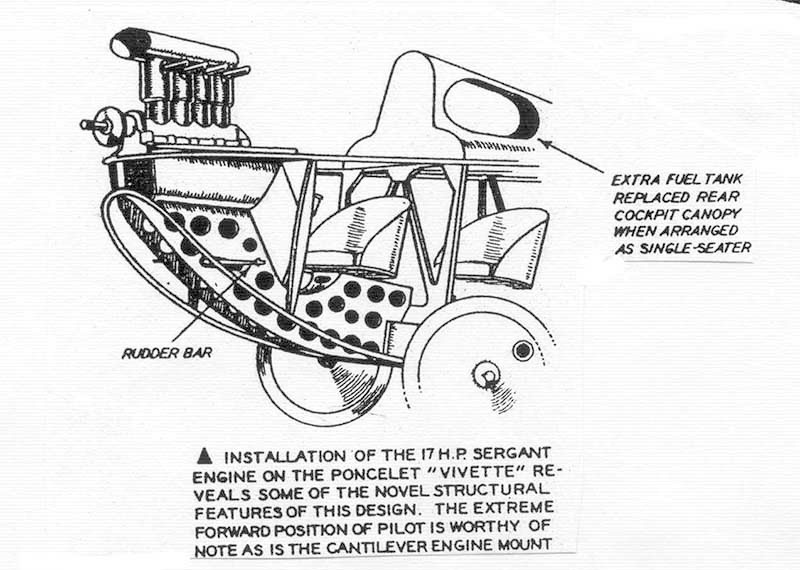
But it was easily converted into a aircraft with the installation of a Sergant engine, 4 cylinders in line, 780 cc, developing a power of 17.5 hp at 3500 revolutions / minute.
In the motor version, the rear seat was removed and a fuel tank could be installed on the wing.
Structure of the front of the fuselage -The Sergant engine is in place
The British Royal Aero-Club organized in October 1923, in Lympne, Kent (England), a richly endowed competition, reserved for moto-aviettes (light planes equipped with low-power engines). Three prizes were contested: a distance competition with given consumption, a speed competition and an altitude competition.
La Vivette made its first flights in the hands of Victor Simonet at the end of the summer of 1923. The aircraft was registered O-BAFH with certificate n ° 88 dated October 1, 1923, very shortly before its departure for Lympne.
The motorized gliders of Paul Poncelet, Castar and Vivette were registered for the Lympne 1923 meeting by Jean-Baptiste Richard and J.A. de Ro, respectively, but only for the altitude competition. The Vivette went to England on its own, flying over the English Channel piloted by baron Kervyn de Lettenhove, together with the Castar piloted by Victor Simonet. Competition number 16.
But during the competition, piloted by lieutenant baron Kervyn de Lettenhove, she had no luck: she was damaged during a take-off: When he started to rise, the pilot turned slightly to the left, but at the same moment a gust of wind lifted the right wing. This caused a sudden slip and a violent shock of the left wheel. Another gust lifted the tail of the craft which ended up on its back. Fortunately, the pilot got off without injury. A special feature of these airplanes is the position of the fuel tank, which is located just behind the pilot’s head, serving as protection for the latter in the event of an impact. In fact, during the accident, the tank played its protective role.
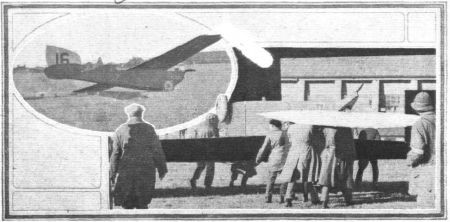
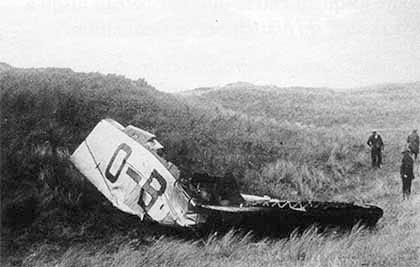
The Vivette accident on takeoff: the left wing touched the ground under the effect of a gust of wind, and the aircraft turns over, without damage to the pilot. He is brought back to the hangars still in its back position.
On the return from Lympne, two-seater flights were successfully carried out, with Victor Simonet as pilot, and Mr. Demonty, technical director of SABCA as passenger.
An article in Flight of December 27, 1923, indicates that: “On November 26 (1923) the Belgian light monoplane Poncelet” Vivette “carried out several flights with pilot and passenger, although its engine had a displacement of less than 800 cc” The Vivette began a series of records on November 23, 1923 by making a eleven-minute flight at an altitude of twenty meters with Victor Simonet as pilot and Mr. Demonty (technical director of SABCA) as passenger: The total weight of the machine exceeds 380 kg. With a bearing area of 24 sq,m, the weight per square meter is 15 kg and the weight per HP exceeds 25 kg, which is a world record.
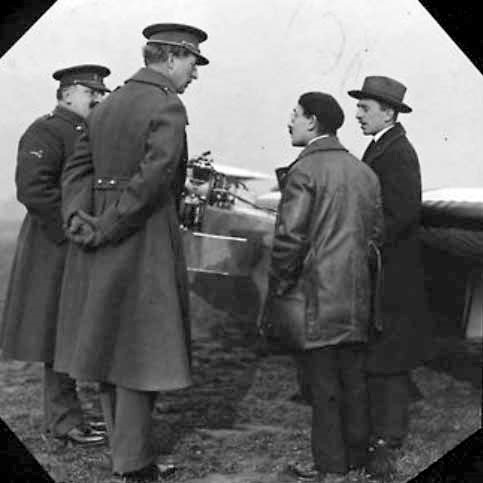
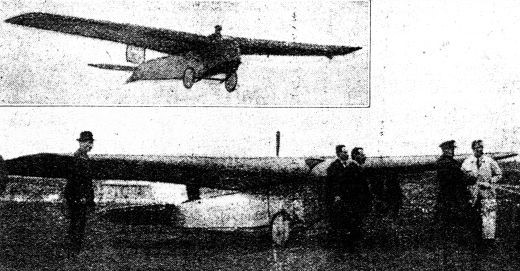
Visit of King Albert I of Belgium – Évère Aerodrome, November 20, 1923 From left to right: Major Smeyers, King Albert Iier, Paul Poncelet, Lieutenant Simonet and Kervyn de Lettenhove. The hood was removed, showing the Sergant engine. A plywood panel seems to have been replaced and “Vivette” has not been repainted yet?
“From a correspondent we have received the accompanying illustrations of Belgian light planes and of a visit paid by King Albert to the aerodrome to inspect these machines. This special royal visit took place on November 20, when the following four Belgian light ‘planes were present : The Poncelet “Castar” type, familiar from Lympne; the Poncelet “Vivette,” equally well known; the EMA biplane, designed and built by the Military Aviation School; and the Jullien SABCA monoplane, built by the Societe Anonyme Belge de Construction Aeronautique . His MAJESTY showed great interest in the construction of the machines explained to him by the various constructors, and was much impressed by the flying qualities of the different types, especially admiring the sharply-banked turns and the good speed range. “
From left to right: Major Sweyers (?), King Albert 1st, van Opstal (pilot) and Mathieu Demonty
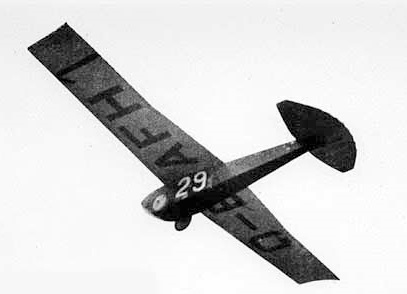
It was in 1925, in Vauville, that the Vivette won its laurels by participating in the Experimental Congress as a glider [competition number 29]. Commander MASSAUX established a world record for the duration of flight without an engine with 10 hours 19 minutes and 43 seconds, and won the “Petit Parisien” cup for a 52-kilometer engineless flight, with 52 turns.
Duration bonus of 800 francs for each flight: July 26, 1925: Poncelet Vivette (Cdt Massaux), 10:19:43 a.m. (world record) July 28, 1925: Poncelet Vivette (Cdt Massaux), 2 h 3 m 15 s August 1, 1925: Poncelet Vivette (Cdt Massaux), 4:29:21 a.m.
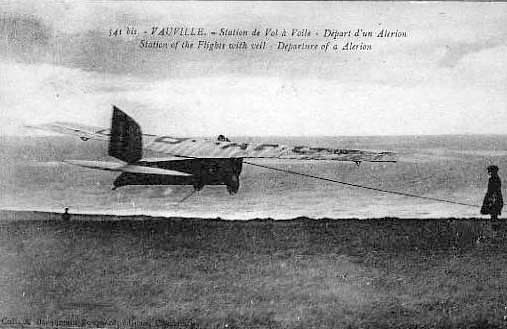
The Vivette in flight, glider version – Vauville 1925
The glider was donated by J.-B. Richard to the Air Museum (Brussels) in July 1926. The aircraft was cancelled by the Aeronautical Administration on January 31, 1931.
It was restored in 1995, in the workshops of Roger Poncelet (grandson of Paul), under the patronage of SABCA, on the occasion of the company’s 75th anniversary. It has since been exhibited in the aviation hall of the Royal Museum of the Armed Forces and of Military History in Brussels, in glider configuration.
Engine: Sergant Type A, 17.5 hp Wingspan: 13,0 m Wing area: 24 sq.m Length: 6,30 m Height: 1,50 m Empty weight: 140 kg Wing loading: 9-10 kg/sq.m Max speed: 95 km/h
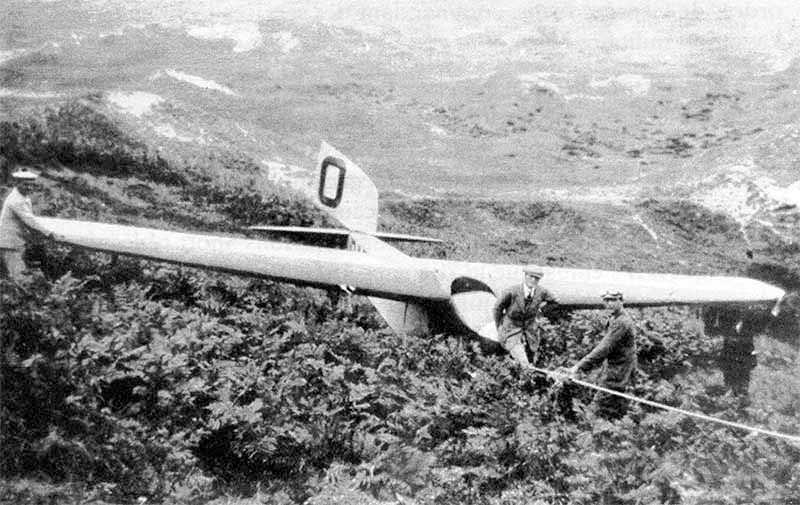
The Castar in its very first glider configuration.
Paul Poncelet, Belgian craftsman expert in woodworking, had already made a first plane, inspired by the Antoinette, in 1908. He was hired at the SABCA (Société Anonyme Belge de Constructions Aéronautiques, which had been created in 1920) as foreman, quickly becoming head of the timber section of the company. Passionate about gliding, which began across the Rhine, it was not long before he designed a glider. It began construction in June 1922, in a cellar on rue Saint-Vincent, in Brussels, with rudimentary means. He devoted all his free time and evenings to it for eight months.
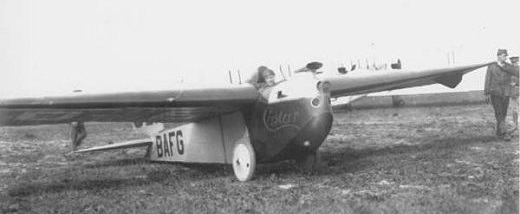
The Castar is made entirely of wood (except wheels, axle and stick). The fuselage of rectangular section, with slightly rounded sides, is profiled at the front with a plywood covering 1.5 mm by 1.5 meters long and canvas on the rear. The canvas is placed on longitudinal rails. The cockpit is embedded in the leading edge of the indented wing which serves as the back of the pilot’s seat.
The aircraft is a monoplane with a 20 sq.m thick cantilever wing. The depth is 380 mm at the root, gradually decreasing towards the tips. The wing seen in plan forms a double trapezoid of 2.10 m chord at the root and 1.50 m at the ends.
The front part is formed in 2 mm plywood up to the first spar, the rest is canvas. The trailing edge is a 2mm string.
The final assembly of the machine is done in the SABCA workshops in Haren-Evère. On February 10, 1923, on Evère aerodrome, Lieutenant Victor Simonet, pilot at SABCA, made it take off over a distance of 115 meters, launched with the bungee cord, despite the total absence of wind.
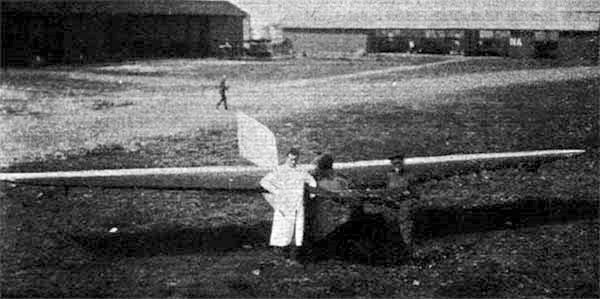
Poncelet glider – probably in February 1923, on the Evère aerodrome
“Finally, on February 10, 1923, in front of many enthusiasts and photographers who suspected that we would proceed to tests, that day at 2 pm, everything is ready. We try the controls, the control surfaces work well and the aircraft is driven on the plain of Haren. Mr. Simonet, who must pilot it, designates the place and the direction in which he wishes to carry out the tests. He stops the details of the launch mode, the placement and the tension of the bungee cords, restraint of the device and the various commands it will give. promptly executed, the glider frees itself and performs its first flight, gliding in a straight line, a few meters above the ground, for a few seconds. Despite the falling night and the weak wind, Victor Simonet carried out three new very successful flights, one of which was 115 meters at heights of about 5 meters. “ La Conquète de l’Air, March 1, 1923
Note: Note that this was the first flight of a glider ever designed and built in Belgium.
February 10, 1923: preparations for the first launch at the bungee cord – Evère aerodrome
On February 11, 1923, despite a total lack of wind, towed by a car, Simonet made a dozen flights, the most noticeable of which was 225 meters at a height of 20 meters.
In its edition of February 22, 1923, the Flight review reports on the first flights of the Poncelet glider: “FEBRUARY 10 will go down in history as the first occasion on which a motorless flight was made in Belgium. The monoplane glider used in the flight was built by M. Poncelet, who is, we understand, a foreman in the works of the S.A. .Belge de Constructions Aeronautiques. The wind was only very light, and as the flight was made over the Brussels aerodrome, or, in other words, over flat country, no extended flight was expected nor attempted. With the rubbers pulled out to half their length only the machine got off well, and made a hop of about 120 yards, piloted by Lieut. Simonet, who is a test pilot in the Belgian Army Air Service. During the short flight the machine was found to be well balanced, and seemed to answer its controls readily.
ON February 11 there was a flat calm, and it was not though advisable to launch the glider in the ordinary way. Tests were, however, made with towing the glider behind a motor-car, and hops of 300 yards or so were made, the machine reaching a height of 40 to 50 ft. The pilot took the opportunity to test the rudder and ailerons, doing left and right-hand banked turns. We understand that Lieut. Simonet is now going to the Ardennes to look for a suitable place where he can do some real gliding and soaring. “
After these few tests, Poncelet and Simonet are eager to test the glider on longer flights. After prospecting, the glider is tested on a site located near the Remouchamps station, on a drop of 65 meters, where the most promising flight was 3 minutes.
Then transported to Lixhe (near Visé), on the banks of the Meuse, It made four flights of one to two minutes, and altitude gains of around 50 meters.
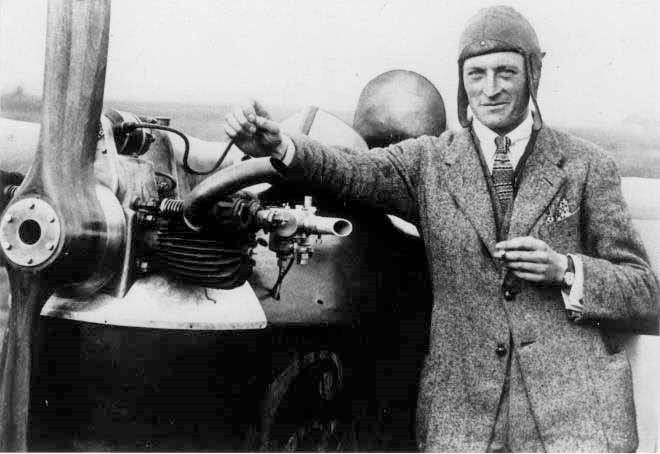
At the start of the fifth flight, the glider crashes. The fuselage is destroyed, but Simonet comes out unscathed. Not at all discouraged, Poncelet immediately undertook the construction of a new fuselage, this time providing a place for mounting an engine. An Anzani engine, flat twin, developing 7 hp was chosen.
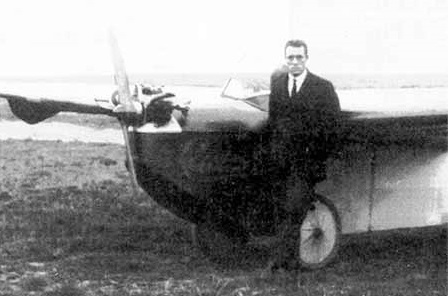
Paul Poncelet with the Castar and Anzani
Simonet flies with the new motorized Castar from Saturday July 7, 1923. The following Tuesday he performs a 45-minute flight, ascending to an altitude of 1100 meters in 20 minutes and flying over Brussels.
On July 12, 1923, the Flight magazine announced: “Some Climb! ACCORDING to reports in the daily Press the ” Motor Glider” looks like putting real aeroplanes completely in the shade. It is stated that Lieut. Simonet ascended from Evere aerodrome on Tuesday and climbed to 2,600 ft. in less than one minute (sic) —in a tiny monoplane fitted with a 7 h.p. engine.”
Simonet corrects the error and gives details: [Flight 2 August 1923] “I have just read in your interesting paper your article ‘Some Climb ‘ regarding my performances on the Belgian glider ‘ Poncelet,’ fitted with a 7-10 h.p. Anzani engine. ” I have not climbed at 2,600 ft. in one minute ! It is, of course, a mistake on the part of the daily press. The truth is this : — ” Saturday, July 7, I tried for the first time the Poncelet light ‘plane (tried before successfully as a glider). I flew 17 minutes at 100 to 200 metres ; next day I flew 15 minutes ; the Monday I flew 28 minutes and reached 800 metres. Tuesday I flew 45 minutes and reached easily (in about 20 minutes) a height of 1,100 metres. The machine is very well balanced, possesses a wide speed range (40 to 85 kms.), lands at 35 kms per hour, and climbs at a rate of 60 to 75 m. per minute. The machine can be readily transformed to a pure glider by only removing engine and gasoline tank, which is placed behind pilot’s head. The balance is exactly the same ; this seems extraordinary as the pilot’s seat is in front of the wing and the engine weighs 32 kgs. I propose, as you know already, to pilot this machine at the French gliding competition at Cherbourg. The ‘ Poncelet ‘ light ‘plane characteristics are as follows : span, 11 m. 20; length, 6 m. 70; weight: with engine, 100 kgs. ; without engine, tank, etc., 155 kgs. ; surface, 20 m2 ; engine, 7-10 h.p. Anzani 1,100 c.c, developing 10 h.p. at max. revs. (1,550) ; petrol tank, 18 litres, oil tank, 3 litres, giving about 3 hours’ flight duration. Wing: Gottingen section—deepest section, 38 mm. “
Paul Poncelet (on the left) and Victor Simonet present the rebuilt and motorized Castar [Flight 2 August 1923]
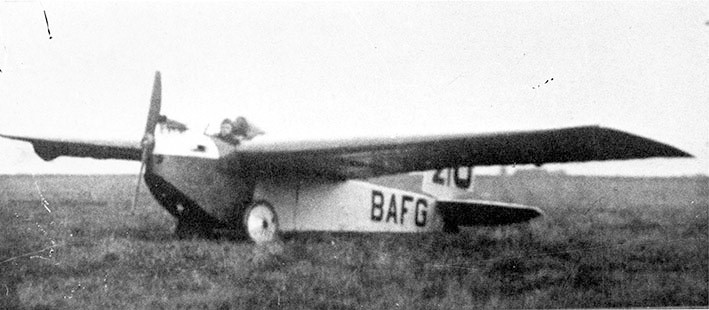
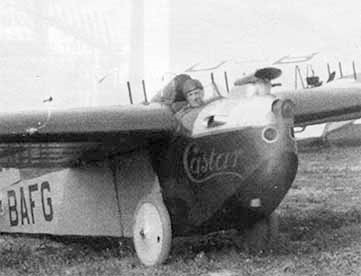
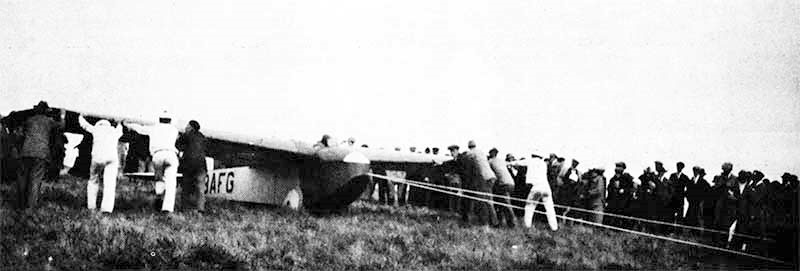
The Castar was registered O-BAFG on July 28, 1923.
The SABCA decided to have Paul Poncelet’s glider participate in the Second Experimental Motorless Flight Congress, which was to take place in Vauville (near Cherbourg-France) from August 5 to 26, 1923, and it was registered with the n° 7. The machine, which took the name of Poncelet-Castar (“castar” being a typical Brussels Belgian euphemism for “beefy” in a somewhat pejorative sense). after its motorization, leaves Brussels by air to go to Vauville. The conveyance, as we will see, will not be easy.
On August 9, 1923 Victor Simonet and the Poncelet plane left Brussels in excellent conditions and landed in Valenciennes where he was prevented from going further, the Belgian pilot not having the necessary papers for customs. It took three days to settle the matter. Simonet set off again, headed for the coast, stopping at Douai, then Calais and Boulogne, and which he followed to Crotoy. Since then, we have been waiting for him every day in Vauville.
Victor Simonet was ill in Montreuil-sur-Mer where he landed with the glider. On August 12 1923 Simonet, recovered, had resumed his flight when he was the victim of an engine accident: the bursting of a cylinder. From Saint-Valéry-en-Caux where the damage we have reported occurred, the glider was transported by road to Le Havre by the care of Mr. Mathieu Demonty, technical director of SABCA.
The Castar whose engine broke down in Saint-Valéry-en-Caux is transported to Le Havre by Mr. and Mrs. Demonty
August 17, 1923, at Vauville, Victor Simonet took his place in the aircraft and at 3.52am took off, in a few meters, almost on the spot. The wind was finally blowing from the west at an average speed of about 10 m / s. The upwelling of the wind was remarkable and in two or three minutes Simonet was over 150 meters high. After staying a while there, he began to sail along the ridge. When he made up his mind to land, Simonet performed one of the most beautiful maneuvers we have seen, tacking, veering above the camp before “taking his ground”. He finally arrived in the line of hangars, crossed the camp at 1 meter above the ground, grazed the ground and, caught up by the updraft, set off again 100 meters high. It really felt like a powered plane with the pilot “pouring the sauce” at the right time. Simonet landed on the beach, in front of the camp, after having glided 47 min 35 sec.
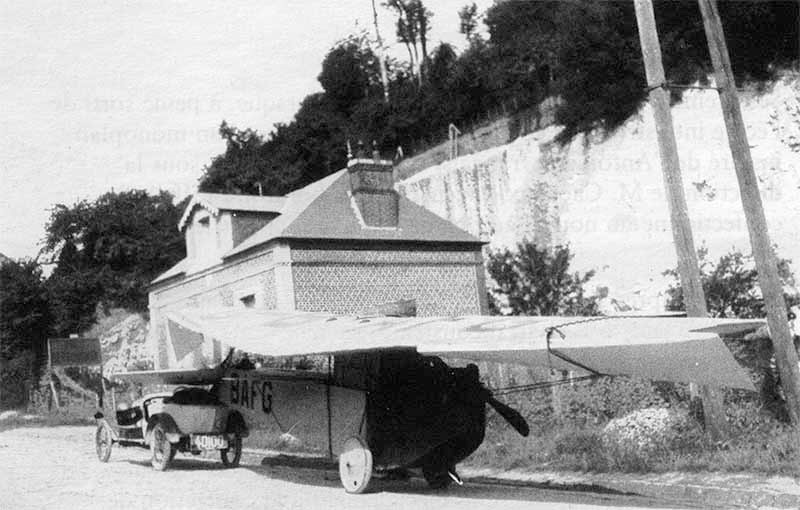
Castar O-BAFG at Vauville
On August 18 the Poncelet glider had been brought up from the beach in the morning; by early afternoon he was ready for another flight. And indeed, Simonet flew away like the day before, with the same ease, in a style of great beauty. He thus flew 1 hour 2 minutes 3 seconds, during which he reached the altitude of 182 meters above his starting point, becoming by this performance holder of the Louis Bréguet Prize.
At 8:30 am on August 19, Simonet takes off for a flight that will last 50 minutes 17 seconds. The good Belgian pilot has advanced too far above Vauville and the sea. He left the favorable zone and after ten minutes of admirable efforts, unable to climb the coast, he decides to land on the beach. Belgium came back to the top of the total with 2 h 48 m 55 s.
At 2:17 p.m., the Poncelet glider having been brought up to the camp, Simonet took off again. His mastery visibly increases with experience. His knowledge of the terrain now allows him to make much more daring evolutions forward as well as behind the ridge.
Simonet who turned towards Vauville, comes back at full speed, initiates a new turn, dives, straightens up, and lands gently on the ground. Simonet flew 2 hours 58 minutes 43 seconds, bringing his total number to 5 hours 47 minutes and 8 seconds.
Castar on the dunes of Vauville
On 20 August 1923, Simonet left at 9:11 am. It flew 54 minutes, stopped at the end of this time by the mist and the famous drizzle. Forced to land on the beach, he tried to prolong his flight as much as possible and succeeded quite well since he was going to land at 3 km 200 from its starting point. Simonet therefore took first place in long distance flights. In the afternoon, the weather improved. The Belgian pilot took off again at 3.30 pm but the mist returned with more intensity than ever, interrupting a well-started flight. Simonet was going to be forced to land. He decided to do this by trying to improve the distance performance he had achieved in the morning. Heading towards Siouville, he approached the beach where the high cliff gives way to small dunes 3 to 6 meters high. And above these dunes, Simonet still found a current sufficient to carry it, between 4 and 5 meters of altitude, two kilometers further, where it landed definitively. The experience was remarkable: dunes less than 6 m high, sometimes less than 3 m, allow a glider to sustain itself without the aid of an engine. Simonet, whose flight had lasted 40 minutes, had landed 5 km 10 from his point of departure.
21st of August, a little after 8 p.m., Simonet, chilled and tired, returns to land: he has flown 4 hours 6 minutes 20 seconds. Simonet’s digits are 4 hours 6 minutes 20 seconds and 11 hours 27 minutes 28 seconds. Simonet also reached the height of 221 meters.
August 22, Simonet, for his part, left at 9.26 am and made a flight of 50 m. 50 s. on his Poncelet glider. He thus regained first place in the total with 12 h 27 m 18 s. The barograph indicated a height of 180 meters.
23 August, the wind has turned to the south, now sliding on the cliffs of Vauville instead of attacking them head-on. But the Poncelet glider nevertheless took to the air for a flight that Simonet managed to extend for 1 h 33 m 10 s. With its nice flight of the morning, the glider Poncelet now totals the respectable figure of 17 h 39 m 58 s.
On 24 August Simonet took-off but following a sudden return of the bungee cord, it remained attached to the apparatus and went away with it. Simonet who “felt that something was wrong” did not notice his unexpected overload … He held the air for 10 minutes, but not managing to gain height, he landed in the meadow of … The bungee cord which weighed more than 15 kg and was 40 to 50 meters long offered enormous resistance to the advancement of the machine and it is even remarkable that it was able to fly for so long in such conditions. The Belgian team, who had come with a few sailors, helped Simonet to bring the glider back to the camp, from where it set off again without incident this time, for a fine flight of 1 h 44 m 50 s.
Simonet increased his total by flying 2 h 39 m 20 s on August 25.
Around 1 p.m., on August 26 the weather improved slightly. Simonet took-off on his Poncelet glider. Simonet for his last flight, will hold the air for 2 hours 11 minutes. It will thus have totalled during the last ten days of the Congress, 24 hours 25 minutes 8 seconds. The valiant Belgian driver broke the totalization record set at Biskra by Descamp
Finally the results of Victor Simonet on the Poncelet Castar were as follows: Flight duration: 3rd with 4 h 6 m 20 s (Prize of the City of Cherbourg) Totalization: first with 24 h 25 m 8 s (4000 francs, Prix du Conseil Général de la Manche) Height: 1st with 295 meters (5,000 francs, Louis Bréguet Prize, vermeil plaque from the Aéro-club de France) Distance: 2nd with 5 km 100 (4000 francs, Charles Renard Prize)
In September, the Castar returned from Vauville, but its engine was not repaired even though we were eight days away from the Meeting de moto-aviettes that the Aéro-Club de Bruxelles organized. In an emergency, Poncelet mounted a Coventry Victor engine on the Castar, kindly donated by the Belgian motorcycle manufacturer “Jeecy Vea”. But the aircraft has all the trouble in the world to take off and only manages to complete a runway three meters above the ground.
Victor Simonet, in front of the Castar with Coventry Victor engine, 1923
Characteristics of the Coventry Victor engine: two opposed cylinders, 680 cc developing 16 HP at 3500 rpm and 10 HP at 2000 rpm
“On September 16, in Brussels, the Competition was held between Maneyrol on Peyret, Van Opstal and Van Cottem on SABCA-Jullien, Simonet on Poncelet and Captain Lambert; but in fact Maneyrol alone had fulfilled the conditions: qualified by an ascent to 1600 m and a descent, carried out in 28 ’25 “, he had covered the 5o km of the circuit for the test of consumption by burning 1.212 L of gasoline, in 36′; then in a test of 30 ‘of flight, it had consumed 1.983 L, thus winning the various prizes of the Competition. “[L’Aéronautique n ° 54, November 1923]
Poncelet Castar O-BAFG
The British Royal Aero-Club organized in October 1923, in Lympne, Kent, a richly endowed competition reserved for moto-aviettes (light planes equipped with low-power engines. These were often motorized gliders).
Three prizes were contested: a distance competition with given consumption, a speed competition and an altitude competition.
The motorized gliders of Paul Poncelet, Castar and Vivette were entered in this Lympne meeting by J.B. Richard and J.A. de Ro respectively, but only for the altitude competition.
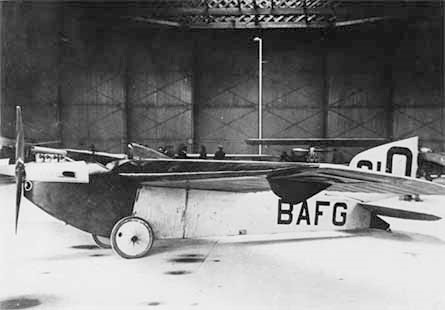
The performance of the Coventry-Victor engine having been disappointing, the Castar was fitted with a Sergant engine, (4 vertical cylinders, air-cooled, 750 cc is used. A reduction gear is integrated into this engine).
The Castar, went to England on its own, crossing the Channel, in the company of the Vivette (equipped with the same engine).
Victor Simonet at the controls of the Castar equipped with the Sergant engine – October 1923 at Evère aerodrome
The Castar, piloted by Victor Simonet, made an excellent start to the competition, but did not break a record in this event. It should be noted, however, that he flew at a speed of 58 mph (over 100 km / h) which would have placed him fifth in the speed contest.
The motorized gliders of Paul Poncelet, Castar and Vivette were registered for the A.F.A. (French Air Association) meeting from July 26 to August 9, 1925, by Jean-Baptiste Richard and J.A. de Ro, respectively, but only for the altitude competition. The Vivette went to England on its own, flying over the English Channel, together with the Castar piloted by Victor Simonet.
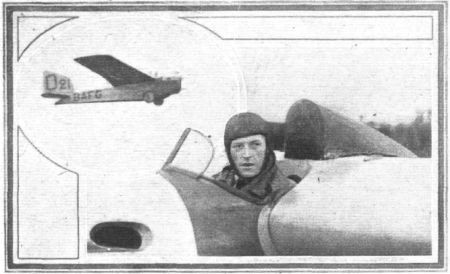
Victor Simonet, in the cockpit of his Castar during the Lympne meeting [Flight].
The Poncelet Castar, piloted by Victor Simonet, made an excellent start to the competition, but did not break a record in this event. However, it should be noted that he flew at a speed of 58 mph (over 100 km / h) which would have placed him fifth in the speed contest.
The Castar equipped with the Sergant engine, bearing the n° 21 of the Lympne competition Photos taken in Lympne’s hangar. Note the removable fuel tank serving as the pilot’s headrest.
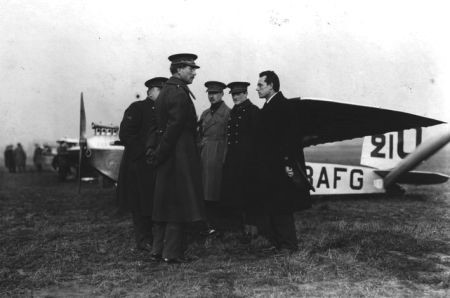
King Albert of Belgium visiting Evère aerodrome, November 10, 1923, in front of the Castar equipped with the Sergant engine. The plate still bears the n° 21 of Lympne’s competition. From left to right: Major Smeyers, Commander of the Belgian Air Force (hidden by the king), King Albert I of Belgium, Lieutenant baron Kervin de Lettenhove, Lieutenant Victot Simonet and Paul Poncelet
Simonet is about to take off – Vauville 1925 Helpers (many are sailors) hold out the bungee cords
In July 1925 the Castar was in competition between Vauville and Siouville with the Ferber glider, the Poncelet-Vivette glider, the Glymes glider, the Nessler glider, then a little later the Sablier glider.
On Saturday July 25, 1925 Simonet failed to return. Simonet was found killed next to his broken glider. The accident due to a break in the elevator control.
Paul Poncelet started at SABCA as a foreman. Passionate about gliding which was starting across the Rhine, it was not long before he designed a glider, which he built with primitive means after his daily work, and devoted his evenings to it for eight months. On February 10, 1923, his glider – the first airplane without an engine to fly in Belgium -, called “Castar”, was brought to Haren at SABCA, where the pilot Victor Simonet made the take-off, launched pulled taut by helpers.
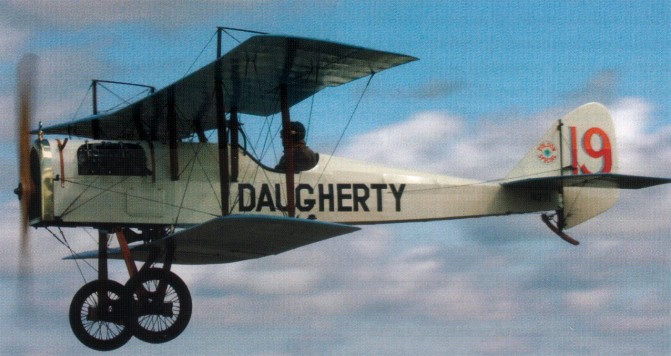
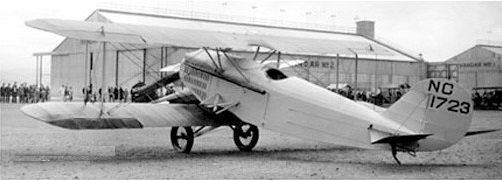
The Polson Special C/NC1723 was built between 1917 and 1925 by Thor Polson of Long Beach, California, for Earl Daugherty who was a regular participant in air shows, stunt displays and air racing post WW 1.
1922
The aircraft was restored by George Jenkins of St. Davids, PA, and flew again from Brodhead, after 83 years.
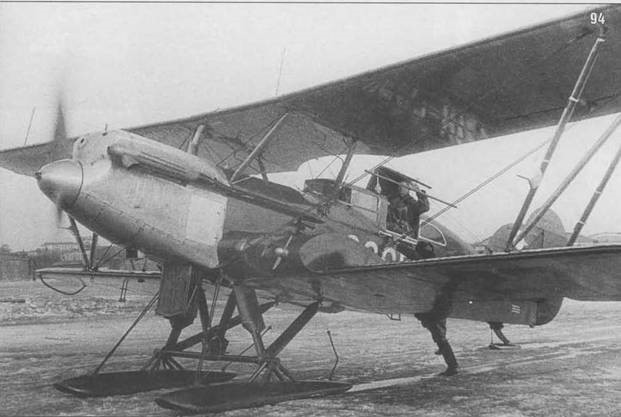
Mikhail Vodopyanov during the salvation of the crew of the steamship Chelyuskin used an R-5 specially prepared for Arctic operations. On these flights Molokov used the containers for people designed by Grojovski, which allowed him to save 39.
In correspondence with the polar exploration plans of the 30s the management of the Glavsievmorputi prepared for 1936 a flight from Moscow to Franz Josef Land. This flight was not intended to break any records, it was only to study the access routes for the conquest of the North Pole, the recognition of flight paths and the conditions of the ice in the Kara and Barents Seas. Pilots were also required to collect information on climate and weather changes.
For this task two examples with closed cabins were modified. The changes in this case were very careful. This modification would be named Polikarpov ARK-5 (Russian: Поликарпов АРК-5) to highlight its Arctic use.
The crew of the ARK-5 was increased to three people. The cabin was modified and equipped with a heating system from hot air from the engine. The overboard containers, previously used on the LP-5s, were enlarged so that spare propellers, skis, tents and an inflatable boat could be stored.
All the equipment was calculated so that in case of a breakdown the crew would be able to return to the mainland by their own means, counting on food reserves for the three crew members for 45 days.
Built at Glavsievmorputi Workshops, both aircraft received registrations of the Glavsievmorputi СССР Н-127 and СССР Н-128 and were painted in intense green and red colors.
March 28, 1936
The main aircraft, with number Н-127 was equipped with radio beacon and radio compass, radio station MRK-0.04 with a rigid antenna on the upper plane. The Н-128 received lighter equipment, being equipped with a shortwave radio station for ground contacts and with the Н-127.
As commander of the expedition was appointed M. V. Vodopyanov. Its crew consisted of mechanic F. I. Bassein and radista S. A. Ivanov. The second aircraft was flown by V. M. Majotkin, with V. L. Ivashin as mechanic and V. I. Akkuratov as radio operator.
ARK-5 of M. V. Vodopyanov at Moscow airfield in March 1936.
The planes took off on March 28, 1936 and in general the route did not present problems, which demonstrated the feasibility of flights at high latitudes. This expedition allowed to gain experiences in the preparation of future expeditions and to develop the idea of landing groups at the North Pole, which would be carried out in 1937.
On May 21, only one plane, the Н-127, arrived in Moscow. The second plane was damaged on the way back, near Tijaya Bay.
At the time of the breakdown the crew was in good physical condition. The plane was abandoned and the crew picked up by an icebreaker.
In 1935, two new ARK-35s were prepared at the Repair Factory No.5 in Smolensk.
These aircraft were characterized by the structure of the cabin deck made of steel. Part of the fuselage structure was replaced by duralumin parts.
In the front cockpit was the pilot and in the rear the mechanic, the radista and two passengers. The side containers were enlarged. On the left a compressor was installed with its engine, which allowed the engine to be started from compressed air even after a long stay on land.
At the front of the containers electric current generators were installed using fans. The one on the left for the radio station and the one on the right for lighting. One of these aircraft received a radio compass.
In March 1919 Polikarpov was selected as head of the technical department of the former Duks factory, soon to be renamed State Aviation Factory No.1 or GAZ No.1. In 1920, the first Soviet aircraft would be projected and built in GAZ No.1 and just three years later, it would already plan the construction of a multi-engine military aircraft known as 2B-L1 and powered by two 400 hp Liberty engines.
Nikolai Polikarpov’s construction activity was generally linked to fighters, but Polikarpov’s beginnings in aviation were directly linked to the Ilya Múromets bombers designed by Igor Sikorsky.
The development of this bomber began at GAZ No.1 in 1924 and the project was led by engineer L. D. Kolpakov-Miroshnichenko. Polikarpov had no relationship with the development of this project, since with the arrival of D. P. Grigorovich he would be excluded from the factory and transferred to the Glavnoavia aeronautical construction department. However, by the fall of that same year, after Grigorovich’s departure, Polikarpov would return to GAZ No.1 as head of the construction bureau. Once in this position he refused to take part in the construction of the 2B-L1 and acting as a consultant, he basically became a critic of the bomber.
The plane, however, began to be built. The VVS, foreseeing the possibility of practical use of the model, decided to replace the designation 2B-L1 with B-1, but it would soon become clear that the new bomber did not satisfy many of the requirements imposed by the military. This was the main reason why, even without finishing the B-1, it was decided to start working on a new bomber, which was called the B-2.
According to the requirements issued by the VVS management, the new bomber had to incorporate 3 to 4 Liberty engines. The B-2 should lift a weight of 1000 kg with an average speed of 170 km/h and transport it over a distance of 1000 km.
To meet this new requirement, the GAZ No.1 construction bureau developed six possible bomber variants:
4B-L3 – biplane with 4 Liberty engines and takeoff weight of 9 tons;
4B-L3 – biplane with 4 Liberty engines and takeoff weight of 10 tons;
4B-L3 – sesquiplane with 4 Liberty engines and takeoff weight of 11 tons;
3B-L3 – sesquiplane with 3 Liberty engines and takeoff weight of 9 tons;
3B-L3 – monoplane with 3 Liberty engines and takeoff weight of 8-9 tons;
4B-L3 – monoplane with 4 Liberty engines and takeoff weight of 10 tons.
Within this list were included projects by Polikarpov, Kolpakov-Miroshnichenko and Krylov.
Interest in these works remained between July and October 1925, but by this date it had already been decided to abandon the option of the Liberty engine, considering it lacking in perspective and to redesign the bombers with two 600-hp Wright Tornado North American engines.
As a basis for this new design, it was decided to use the French Farman Goliath bomber. Several of these aircraft had been acquired and arrived in Leningrad at the beginning of October.
To evaluate this foreign bomber and become familiar with its assembly, it was decided to send a group of specialists from GAZ No.1 to Leningrad. Polikarpov managed to ensure that neither Kolpakov-Miroshnichenko nor Krylov were included in this group, leaving the competition aside.
Already in the autumn of 1924 Polikarpov, head of the construction bureau and later head of the experimental department, had managed to establish a new, more effective system of work organization. The main objective of this new system was destined to gradually relegate the work of the old engineer-builders, accustomed to developing, approving and building their models based on their customs and points of view. The new structure of the OKB planned to use a system similar to the one adopted by A. N. Tupolev at the TsAGI, where a group of engineers defined the general concepts and then the different departments worked on the development of the components and systems.
The new B-2 bomber with two Wright Tornado engines, in its development stage began to be called GAZ No.1 2B-R2. The project began development in the spring of 1926.
Because the Wright Tornado engine had to be used in other types of devices, the possibility of buying a certain amount and then copying the model was valued, in the same way that this had been achieved with the Liberty.
The 2B-R2 was designed as a twin-engine biplane of mixed construction and was characterized by its bi-derived tail with double horizontal planes. The landing gear was of the conventional and fixed type.
Despite the great projection work carried out and the progress in the work, in April 1926 it was decided to cancel the VVS request for the 2B-R2 bomber. The main reason was the appearance of the all-metal Tupolev ANT-4 bomber, developed at TsAGI at the request of the Ostiexbyuró. The VVS management, pleased with the results of this new model, otherwise quite superior to the 2B-2R, decided to introduce it into service with the designation TB-1.
After a year and the appearance of some problems in the development of the TB-1 due to the lack of practice in the use of metal construction, it was decided to develop an alternative version of mixed construction. This job was assigned to Polikarpov’s collective and would be the basis for the TB-2 bomber.
2B-R2 Engines: Two 600 hp Wright Tornado Empty weight: 5200 kg Maximum takeoff weight: 9150 kg Payload: 3950 kg Maximum speed: 180 km/h Practical ceiling: 4000 m Bombload: 1500 kg Accommodation: 5
Acceptance that the concept of the I-180 was outmoded coupled with the prospect of the availability of powerful 18-cylinder radial engines led the Polikarpov OKB to design the I-185 within an extraordinarily short period of time (25 January to 10 March 1940). Intended for the 1,750hp Shvetsov M-90 engine, the I-185 was of mixed construction, having a wooden monocoque fuselage mated with metal wings featuring automatic leadingedge slats a la Bf 109. Armament consisted of twin 12.7mm and twin 7.62mm guns, all fuselage-mounted. Development delays with the M-90 – which, by December 1940, was cleared only for restricted flight testing – resulted in dismantling of the first prototype unflown, this having been known as Samolet (Aircraft) R.
A second prototype. Samolet RM, was completed with a Shvetsov M-81 18-cylinder two-row radial and a ducted propeller spinner. This was flown on 11 January 1941, but the M-81 was found to develop insufficient power and was replaced by the Shvetsov M-71 of 1,900hp in May 1941. A third prototype, Samolet I, was completed with a 14-cylinder Shvetsov M-82 engine rated at 1,330hp (later 1,400hp), the fuselage being lengthened for CG reasons from 7.68m to 8.10m, and fuselage-mounted armament being changed to three 20mm cannon. State Acceptance Tests were conducted successfully between 13 April and 5 July 1942. A fourth prototype reverted to the M-71 engine and this underwent operational evaluation on the Kalinin Front alongside Samolet I. A redesigned wing (of single- in place of two-spar construction) was featured by this aircraft, which was tested with both the four-machine gun and three-cannon armament arrangements. A pre-production prototype, the so-called I-185 Etalon (Standard), was flown on 10 June 1942. Regarded as the forerunner of the intended production derivative, the I-186, this standardised on the M-71 engine and three-cannon armament, and had a similarly lengthened fuselage to that of Samolet I. State Acceptance Testing was conducted between November 1942 and January 1943, the NIl VVS evaluation reports describing the I-185 Etalon as “superior to all contemporary fighters.” In the event, it was found impracticable to manufacture the M-71 in large numbers and airframe production capacity was unavailable.
Max take-off weight: 3735 kg / 8234 lb Empty weight: 3130 kg / 6901 lb Wingspan: 9.80 m / 32 ft 2 in Length: 8.05 m / 26 ft 5 in Wing area: 15.53 sq.m / 167.16 sq ft Max. speed: 680 km/h / 423 mph
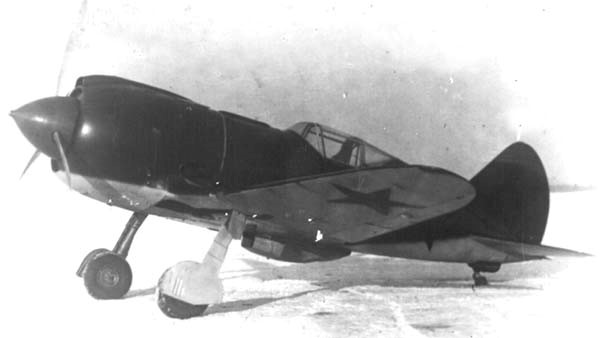
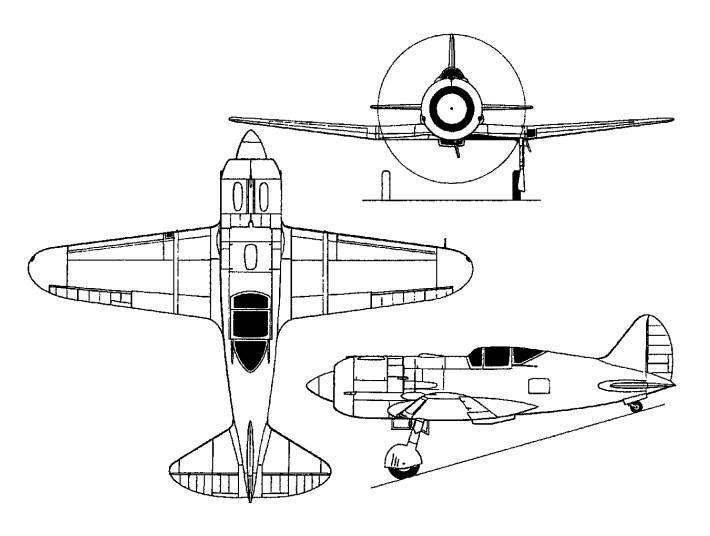
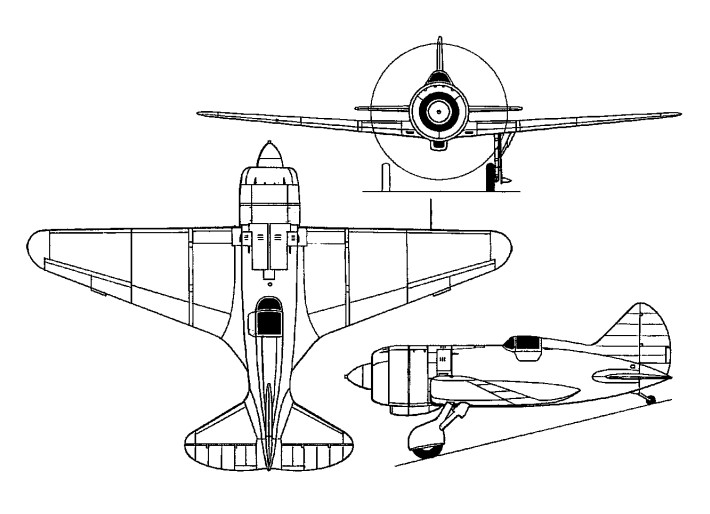
The preliminary design for the I-165 fighter was created in late 1937 and became the basis for the I-180 project design in March 1938. It was supposed to become a further evolution of the I-16 fighter with a slightly increased size and the M-88 engine. Developed by Dmitrii L Tomashevich (one of Polikarpov’s deputies), the I-180 was originally conceived with an all-metal structure. Limited all-metal construction experience, however, led the Polikarpov OKB to adopt an essentially similar structure to that of the earlier I-16, with a wooden monocoque fuselage and a fabric-skinned metal wing.
The machine took final form in its third prototype, and the first prototype was constructed in summer 1938. The first prototype, the I-180.1, was powered by a 1,100hp Tumansky M-88 14-cylinder two-row radial, intended armament being four 7.62mm guns. This aircraft was lost as a result of engine failure during its first flight on 15 December 1938 piloted by Valeriy Chkalov. Chkalov did not survive the accident. The second prototype, the I-180.2, differed primarily in having a 1,000hp Tumansky M-87A (later M-87B) 14-cylinder two-row radial and lengthened wing outer panels. These increased wing span from 9.00m to 10.05m and area from 14.68sq.m to 16.11sq.m. First flown on 19 April 1939, the I-180.2 was lost on its 53rd flight and the demise of another test pilot, Tomas Suzy.
Construction of the third prototype was started in mid-1939, the I-180.3 flown on 10 February 1940 with E. Ulyakhin as a test pilot, and featured a redesigned and more advanced wing structure, a 1,100hp M-88R engine, a cockpit canopy and an armament of two 12.7mm and two 7.62mm guns concentrated in the fuselage.
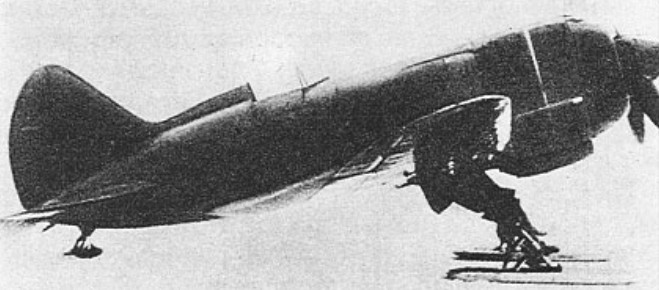
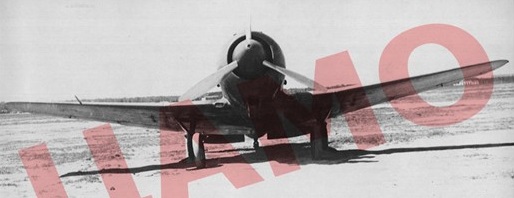
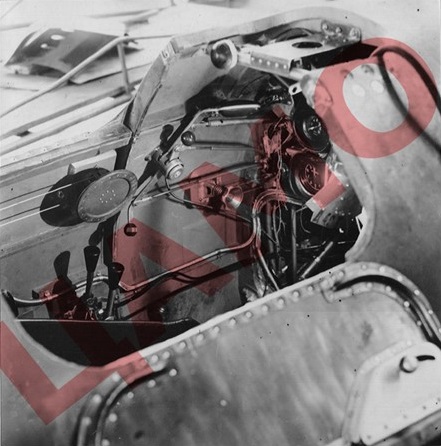
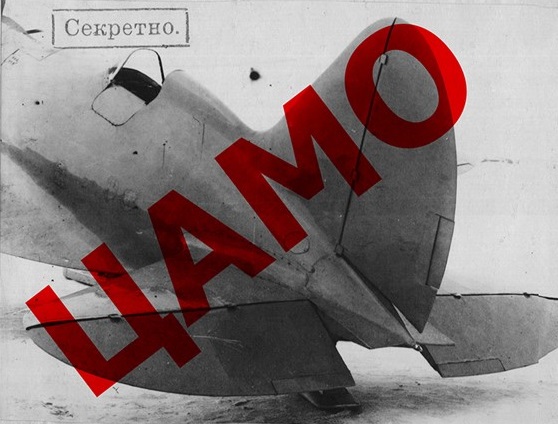
The I-180-3 was powered by an air-cooled M-88 engine that was not yet finished and proved to be quite problematic at the time of the aircraft’s testing. The motor passed the government testing only in December 1940, after the destiny of the I-180 project had already been decided. The aircraft strongly resembled the I-16 in its behaviour in the air, but had advantages over its predecessor in higher speed and faster climb times. It was also easier to control and more stable in manoeuvres, as well as during landing and take-off. Among the main drawbacks of the project were the lack of a canopy, various mechanical defects and poor plane surface finishing. Flown with both wheel and ski undercarriages, a lot of problems were fixed eventually but, on 6 July 1940 the third prototype was lost due to a pilot error accident during State Acceptance Trials.
In the meantime, a pre-series of 10 aircraft based on the I-180.2 had been under construction as the I-180S (Seriyny or Series), the first three of these having been completed in December 1939. Several I-180S machines took part in a May Day parade in Moscow. The I-180S was powered by the M-88R and carried an armament of two 12.7mm and two 7.62mm fuselage-mounted guns, and, like the I-180.3, featured an enclosed cockpit. The I-180S was cleared for service trials, but the results of these were academic as this fighter had been overtaken by the more advanced I-185.
As a part of the I-185 development programme, one pre-series I-180S fighter had the dated triangulated pattern mainwheel legs replaced with legs of cantilever type, this aircraft being referred to as the I-180Sh, the suffix indicating Shassi (chassis). In the event, it was not completed and flown.
A plethora of issues with the aircraft caused the work on its preparation for production to be stopped in late 1940 and the entire I-180 programme abandoned.
Max take-off weight: 2456 kg / 5415 lb Empty weight: 2046 kg / 4511 lb Wingspan: 10.09 m / 33 ft 1 in Length: 6.88 m / 23 ft 7 in Wing area: 16.11 sq.m / 173.41 sq ft Max. speed: 585 km/h / 364 mph


 All Aero