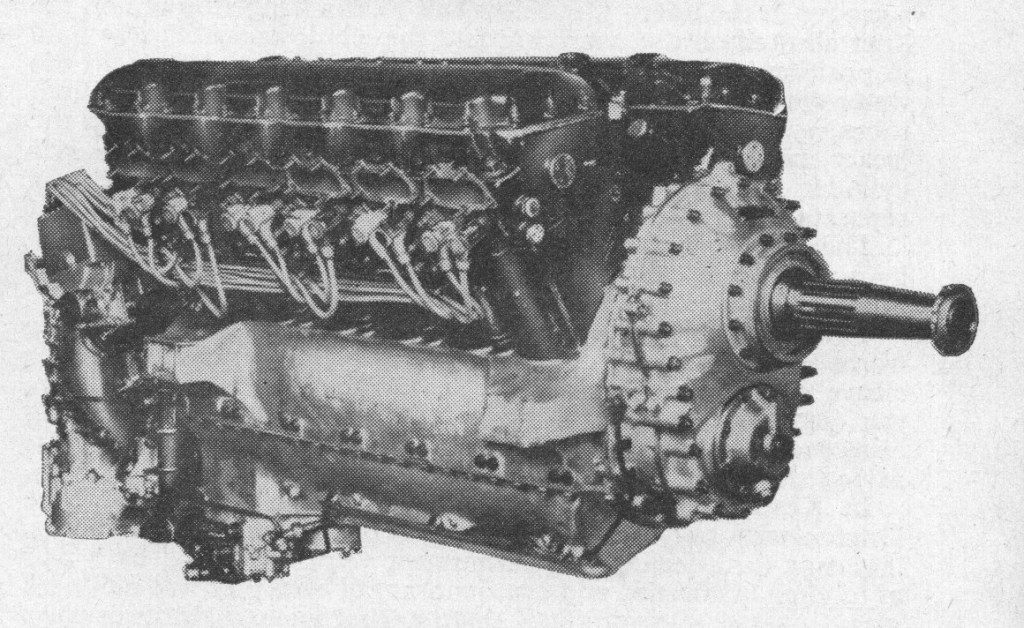
The engine first ran in 1933 and was first announced in 1934, and originally known as the P.V.G., this modified Kestrel paved the way for the development of the Merlin and was designed to be evaporatively cooled. The Goshawk was developed from the Kestrel IV prototype engine, to use evaporative (also known as “steam”) cooling. Rather than keep the cooling liquid below its boiling point in the cooling system, the coolant was allowed to boil; boiling taking more heat from the engine and less coolant was needed. Instead of a radiator to take the heat from the coolant, a condensor was required to turn the vapour back to liquid. These had to be much larger than radiators and added drag to the aircraft design.
Bore and stroke were the same as for the Kestrel, i.e., 127 mm x 140 mm.
Twenty engines were built and they flew only in prototypes as a few manufacturer’s private ventures and “one offs”.
Goshawks I, II and III were fully supercharged and gave 600 h.p. at 2,600 r.p.m. at 12,000 ft, and 650 h.p. at 15,000 ft. The weight was 975 lb, and the three marks had reduction-gear ratios, respectively, of 0.632,0.533 and 0.477. Goshawks VI, VII and VIII were medium-supercharged units rated at 660 h.p. (490 kW) at 2,600 r.p.rn. at 6,000 ft, and geared-successively as the I, II and III.
Problems with coolant leaks, coolant pumping and the realisation that large wing mounted radiators would be vulnerable to combat damage caused the project to be cancelled although lessons had been learned and were put into development of the later Merlin.
Only 20 Goshawks were built, but they were fitted in the Blackburn R7/30, Bristol R7/30, Gloster S.15/33, Hawker P.V.3, and Short R.24/31. The Goshawk was the power unit specified for the twin engined Short Knuckleduster flying boat (K3574) to Specification R24/31 and “preferred” for submissions to Air Ministry specification F7/30 for a fighter aircraft. Goshawks were used by all three officially sponsored prototypes, the Supermarine Type 224 (K2890), the Westland F.7/30 (K2891) and the Blackburn F3 (K2892), which only taxied with the Goshawk fitted and did not fly), in addition to two private venture entrants, the Bristol Type 123 and the Hawker P.V.3.
The Goshawk also powered Hawker’s privately developed “High Speed Fury Mk 2” (K3586) and “Intermediate Fury” 2″ (the latter Hawker’s own development aircraft and “hack” serial G-ABSE) and the Westland Pterodactyl V (K2770) and was installed for trials in the Gloster TSR.38 (S1705), and the first Gloster Gnatsnapper prototype (N227).
Variants: Goshawk I (1932) Developed from the prototype Kestrel IV.
Goshawk II (1935) 600 hp. Lowered propeller reduction gear ratio.
Goshawk III (1935) 600hp. Further reduction of gear ratio.
Goshawk VI 660 hp. High ratio reduction gear.
Goshawk VII 660 hp. Raised reduction gear ratio.
Goshawk VIII 660 hp. Special experimental engine. Maximum power output: 837 hp.
Application: Blackburn F3 Bristol Type 123 Gloster Gnatsnapper Hawker Fury Hawker P.V.3 Short Knuckleduster Supermarine Type 224 Westland Pterodactyl V Westland F.7/30 / P.V.4
Goshawk I Type: 12-cylinder liquid-cooled 60 degree Vee aircraft piston engine Bore: 5.0 in (127 mm) Stroke: 5.5 in (140 mm) Displacement: 1,295.88 in³ (21.25 L) Length: 74.61 in (1,895 mm) Width: 24.41 in (620 mm) Height: 35.63 in (905 mm) Dry weight: 975 lb (442 kg) Valvetrain: OHC – Overhead Camshaft Supercharger: Single-stage supercharger Fuel type: 77 Octane petrol Cooling system: Liquid-cooled Power output: 600 bhp (447 kW) at 2,600 rpm Specific power: 0.46 hp/in³ (21 kW/L) Compression ratio: 6:1 Power-to-weight ratio: 0.61 hp/lb (1 kW/kg)
The appearance of the Curtiss D-12, and its importation under license to Britain by Fairey prompted the Air Ministry to ask Rolls-Royce to develop a new aero engine for fighter aircraft, the ministry felt that there were too many engine manufacturers and did not support or encourage the Fairey company to continue. Rolls-Royce developed two distinct types of engine to meet the requirement, the F engine, which became the Kestrel, and the Eagle XVI.
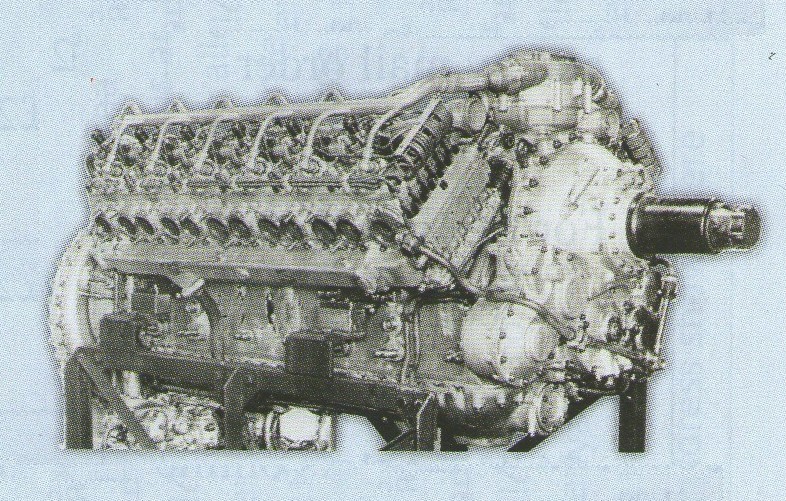
Designed by Henry Royce, the Eagle XVI was a completely new design and unrelated to the earlier Eagle. The engine featured four banks of fore and aft staggered cylinder blocks with the banks arranged at 90 degrees to each other to form a perfect ‘X’. The valve gear was operated by a single overhead camshaft and used four valves per cylinder. The crankcases and cylinder blocks were cast from aluminium alloy. Normal engine bearers could not be used so the unit was held in the test stand by two conical mounts that attached to the crankcase.
Initial test running was carried out in 1925 without a supercharger fitted and an improvised carburettor and induction system. The engine did not run well with this arrangement due to poor fuel distribution, however when a supercharger and matched carburettor were fitted (borrowed from the Kestrel development unit) the engine ran and performed well, producing 500 hp (373 kW) on the dynamometer. Despite this the engine was not received well by the aircraft industry where it was felt that the unusual layout would block the pilot’s forward view in a typical fighter aircraft installation. The project was dropped and development efforts then concentrated on the Kestrel.
Only one was built and the Eagle XVI was one of the few Rolls-Royce projects that did not fly, it is of note that the ‘X’ engine layout was reused in the later Vulture and Exe designs.
Eagle XVI Type: 16-cylinder liquid-cooled 90° X aircraft piston engine Bore: 4.5 in (114 mm) Stroke: 4.75 in (121 mm) Displacement: 1,208 in³ (19.8 L) Valvetrain: Overhead camshaft, four valves per cylinder Supercharger: Single speed, single sided impeller Fuel system: Single carburettor Cooling system: Liquid-cooled Power output: 500 hp (373 kW) Specific power: 0.41 hp/in³ (18.8 kW/L)
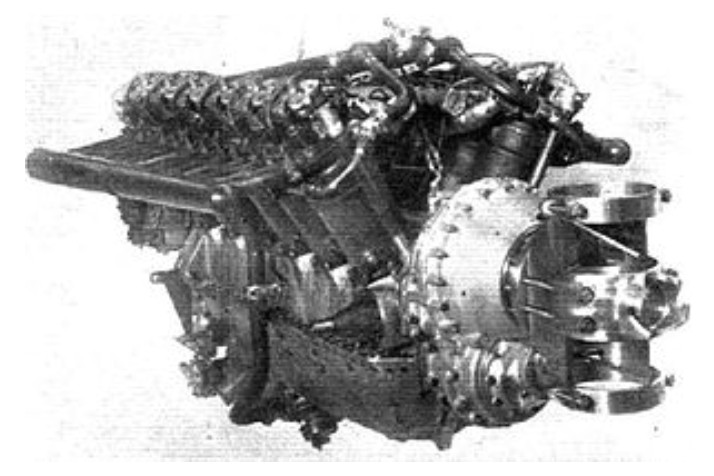
The first Rolls-Royce engine to be named after a river, as are the modern turbojets, was this experimental unit, which was notable in having sleeve valves and pressure-air cooling. Its 24 cylinders were arranged in X form, in four banks of six, and the capacity was 22 litres. Rated output was 1,200 h.p. at 4,000 ft. The Exe was test flown in a Fairey Battle during 1938, but the project was shelved when it became clear that the company’s main productive capacity must be devoted to the Merlin. Another experimental unit related to the Exe was the Pennine, and it may be noted here that in the years preceding the war Rolls-Royce were experimenting with two-stroke as well as four-stroke engines, and continued the compression-ignition experiments started with the Condor. The H layout was also examined.
The Eagle was designed by Henry Royce in collaboration with his chief assistant, A. G. Elliott. It set the pattern for the smaller Falcon and the larger Condor, and in improved forms continued in service from 1917 until the 1930s.
Though designed for only 200 h.p., the first example was run in October 1915 (less than six months after work on the drawings had been started at Derby) at a brake horsepower of 225.
By March 1916 the new engine was delivering 266 b.h.p.; by July 284 h.p.; and by December 322 h.p. By September 1917 the figure had risen to 350 h.p.; in Feburary 1918 it had reached 360 h.p. An official Rolls-Royce instruction book dated December 1917 ascribes the following outputs (at normal r.p.m.) to the various series: Eagle 1, 225 b.h.p.; Eagle If, 266; Eagle Ill, 284; Eagle IV, 284; Eagle V, 322; Eagle VI, 322; Eagle VII, 322; and Eagle VIII, 350. These variants differed in the type and number of carburettors, in jet size, in the pattern of inlet pipes and pistons, and other details. By far the most famous among them was the Eagle VIII, which powered such fine aircraft as the Phomix Cork, Felixstowe F.3 and F.5, the D.H.4, 9A, 9B, 10B and IOC, the Fairey IIIC and IIII), the Handley Page 0/400 and V/1500, the Short Shirl, and the Vickers Vimy and Vernon. Other military installations were made in the Wight seaplane, F.E.2D, REA, R.E.7, Porte Baby, F.2, Felixstowe Fury (F.4), D.H.10, Fairey F.16 and F.17 Campania, Handley Page 0/100 and Vickers Vim. Civil applications included the D.H.16 and Handley Page W.8b.
Irrespective of series number, the Eagle was a twelve-cylinder, water-cooled, 60-deg vee of 20.32 litres capacity. Each cylinder, with its water-jacket, formed a separate unit; the barrel, machined from a steel forging, was retained by a base flange and studs. Inlet and exhaust ports were machined from solid forgings, welded-in at opposite sides of the head, and the water-jacket was fabricated from steel pressings, welded in place. There was one inlet and one exhaust valve for each cylinder, and a single camshaft, carried in a casing along each bank of cylinders, operated both. There were two sparking plugs per cylinder, served, on the earlier engines, by four six-cylinder magnetos and on the later series by two twelve-cylinder magnetos.
A contemporary Rolls-Royce description continues: “The oil consumption should be taken as 1 gallon per hour. . . . The lubrication system is of the type in which one oil pump supplies pressure oil to the main bearings and other parts, while one scavenger pump evacuates the accumulation of oil in the crankcase to the oil tank. . . . The quantity of water carried in the cylinder water-jackets, water pipes, and pump is 3.1 gallons…. The Rolls-Royce carburettors are fitted with a control so that the delivery of petrol may be adjusted from the pilot’s seat. This not only serves as a means of correcting the effects of decreasing atmospheric pressure with increasing altitude, but can also be used to obtain extremely economical running, and also to obtain a rich mixture for starting…. All controls, e.g., throttle, altitude, and magneto, are brought to one common location on the engine, to facilitate connection to the plane…. The carburettor throttles are fitted with springs, which, in the event of a breakage of the control, are intended to open the throttles to the full extent.”
A special feature of the Eagle was the epicyclic reduction gear, for which the advantage was claimed that it imposed far less strain on the crankcase than would spur gearing. The gear was of fixed sunwheel type, in which an annulus, or internally toothed gearwheel, on the crankshaft meshed with three small spur gearwheels on the extremities of three arms formed integrally with the airscrew shaft. The three small gears were connected to three pinions which meshed with the fixed sunwheel, and the airscrew shaft was bolted to the three-armed spider which carried the planet pinion cage. An Oldharn coupling provided the anchorage of the sunwheel to the gear casing and allowed the gears to be perfectly aligned.
Late in 1922 Flight reported: “A recent model introduced by Rolls-Royce, Ltd., is the Eagle IX, which is generally similar to the famous Eagle VIII but differs from that type in certain details. The new model has been designed to be equally suitable for peace and war purposes, and to that end the following improvements have been effected: Two carburettors are fitted instead of four, so that tuning is considerably facilitated. The placing of the carburettors low down allows of using directgravity feed; the float feeds have been redesigned. The engine will now function satisfactorily with a ‘head’ of only 8in above the centre-line of the crankshaft. In view of the tendency m modern commercial aircraft of employing direct-gravity petrol feed from the main tanks in order to avoid pumps, piping, etc., this should be a great advantage, and should help to ensure for the Eagle IX as great popularity as that enjoyed by the previous model.”
In the Eagle XV the epicyclic gear was further modified by the insertion of an additional friction clutch and gearwheel in the train, making the existing friction anchorage into a manually controllable clutch and converting the gear from a single-speed to a two-speed type. In the absence of a variable-pitch airscrew this arrangement gave a considerable advantage.
The following data for the Eagle VIII are taken from Rolls-Royce Aero Engine Instruction Book, Eagle Series I – VIII and Falcon Series I, II and III. Air Board Technical Department Book No. 244, December 1917: Dry weight, 847 lb; normal r.p.m., 1,800; max. permissible r.p.m. (5 min only), 2,000; gear ratio, 0.60; b.h.p. at normal r.p.m., 350; petrol consumption in gal/hr, at sea level, normal r.p.m. and normal b.h.p., 23; carburettors, four R.R. C.H. (Rolls-Royce, Claudel Hobson), 42 mm; magnetos, four Watford; pistons, high compression, four rings (one at bottom).
In 1925 a little-known Eagle development-the 16-cylinder, 500 h.p. Mk XVI-made its appearance. It had a stroke of 441n instead of 61in. The Mk XX was a projected scaled-up version, but was never built.
Sir Henry Tizard, Chairman of the Aeronautical Research Committee (ARC), was a proponent of a high-powered “sprint” engine for fighter aircraft and had foreseen the need for such a powerplant as early as 1935 with the threat of German air power looming. It has been suggested that Tizard influenced his personal friend Harry Ricardo to develop what eventually became known as the Rolls-Royce Crecy. The idea was officially discussed for the first time at an engine sub-committee meeting in December 1935.
“The Chairman remarked that if it was the desire of the Air Ministry to develop a type of sprint engine for home defence….there was the question as to how far fuel consumption could be disregarded. Mr Ricardo had raised this point in a recent conversation by enquiring whether a high fuel consumption might not be permissible under certain circumstances, for if so, an investigation of the possibilities of the two-stroke petrol engine appeared to be attractive.” —Henry Tizard, The Rolls-Royce Crecy
Previous experience gained between 1927 and 1930 using two converted Rolls-Royce Kestrel engines through an Air Ministry contract had proven the worth of further research into a two-stroke sleeve-valved design. Both these engines had initially been converted to diesel sleeve-valved operation with a lower power output than the original design being noted along with increased mechanical failures, although one converted Kestrel was subsequently used successfully by Captain George Eyston in a land-speed record car named Speed of the Wind. The second engine was further converted to petrol injection which then gave a marked power increase over the standard Kestrel.
Single-cylinder development began in 1937 under project engineer Harry Wood using a test unit designed by Ricardo. Although originally conceived as a compression ignition engine, by the time Rolls-Royce started serious development, in conjunction with the Ricardo company, the decision had been taken by the Air Ministry to revert to a more conventional spark-ignition layout, although still retaining fuel injection.
The first complete V12 engine was built in 1941, designed by a team led by Harry Wood with Eddie Gass as the Chief Designer. Bore was 5.1 in (129.5 mm), stroke 6.5 in (165.1 mm), compression ratio 7:1 and weight 1,900 lb (862 kg). The firing angle was 30 degrees BTDC, and 15 lbf/sq.in (100 kPa) supercharger boost was typical. First run on 11 April 1941, in bench-testing it produced 1,400 horsepower (1,000 kW); however, there were problems with vibration and the cooling of the pistons and sleeves. The thrust produced by the exceptionally loud two-stroke exhaust was estimated as being equivalent to a 30% increase in power at the propeller on top of the rated output of the engine. The power of the engine was interesting in its own right, but the additional exhaust thrust at high- speed and altitude could have made it a useful stop gap between engines such as the Rolls-Royce Merlin and anticipated jet engines. Serial numbers were even, Rolls-Royce practice being to have even numbers for clockwise rotating engines when viewed from the front.
The reciprocating sleeve valves were open-ended rather than sealing in a junk head – the open end uncovered the exhaust ports high in the cylinder wall at the bottom of the sleeves’ stroke, leaving the ports cut into the sleeve to handle the incoming charge only. They had a stroke of 30% of the piston travel at 1.950 in (49.5 mm) and operated 15 degrees in advance of the crankshaft. The Crecy sleeve valves were of similar construction but differed in their operation compared to the rotary sleeve valve design that was pioneered by Roy Fedden, and used successfully for the first time in an aircraft engine, the Bristol Perseus, in 1932.
Unlike most two-stroke engines, supercharging was used rather than crankcase compression to force the charge into the cylinder – this also allowed for a conventional oil lubrication system instead of the total-loss type found in many two-stroke engines. Stratified charge was used where the fuel was injected into a bulb-like extension of the combustion chamber where the twin spark plugs ignited the rich mixture. Operable air-fuel ratios of from 15 to 23:1 were available to govern the power produced between maximum and 60%. The rich mixture maintained near the spark plugs reduced detonation allowing higher compression ratios or supercharger boost. Supercharger throttling was used as well to achieve idling. The supercharger throttles were novel vortex types, varying the effective angle of attack of the impeller blades from 60 to 30 degrees. This reduced the power required to drive the supercharger when throttled, and hence fuel consumption at cruising power.
Later testing involved the use of an exhaust turbine which was a half-scale version of that used in the Whittle W.1 turbojet, the first British jet engine to fly. Unlike a conventional turbocharger the turbine was coupled to the engine’s accessory driveshaft and acted as a power recovery device. It was thought that using the turbine would lower fuel consumption allowing the engine to be used in larger transport aircraft. This was confirmed during testing however failures due to severe overheating and drive shaft fractures were experienced.
Test summary The following summarises the test running programme, hours run, and highlights some of the failures experienced.
Crecy 2
11 April 1941 First run. One-piece cylinder block/head. Testing stopped due to piston failure. Hours run: 69
October 1942 – December 1942 Three rebuilds during this period, testing stopped after 35 hours due to piston seizure. Hours run: 67
February 1943 – July 1943 Converted to Mk II configuration (separate cylinder heads), three rebuilds during this period. Air Ministry acceptance test passed. Hours run: 38
March 1944 – July 1944 Five rebuilds during this period. Equal length injector pipes fitted, modified supercharger drive. Two failures, sleeve valve seizure and supercharger drive failure. Hours run: 82
August 1944 – November 1944 Successful type test passed (112 hours). Post run inspection revealed cracked big-end bearings, pistons, reduction gear housing and sleeve valve eccentric drive bearing. Hours run: 150
March 1945 – April 1945 Attempted endurance test, piston failure after 27 hours. Two rebuilds during this period. Hours run: 49
(Total hours: 461)
Crecy 4
November 1941 No report available. Hours run: 55
July 1942 – August 1942 Three rebuilds, successful 50-hour test, second 50-hour test abandoned after cylinder block failure due to cracking. Hours run: 80
September 1942 – October 1942 Two rebuilds. Completed 25-hour test successfully, second test halted after four hours running due to sleeve valve failure. Hours run: 55
(Total hours: 293)
Crecy 6
July 1943 – February 1944 First engine built as Mk II. Eight rebuilds during this period, failures included supercharger drive failure and sleeve valve eccentric drive bolt fracture. Hours run: 126
May 1944 – September 1944 Four rebuilds. Supercharger flexible drive failure and sleeve valve seizure. Hours run: 93
November 1944 – February 1945 Three rebuilds, main bearing failure, piston failure. Hours run: 128
June 1945 – August 1945 One rebuild, endurance test halted after 95 hours due to sleeve valve drive failure, 40 hours run with a propeller fitted. Hours run: 132
(Total hours: 481)
Crecy 8
September 1943 – March 1944 Eight rebuilds, endurance test successfully completed. Hours run: 207
April 1944 Supercharger drive failure. Hours run: 73
June 1944 – September 1944 Five rebuilds, no failures reported. Hours run: 32
October 1944 – December 1945 Two rebuilds, piston failure, engine fitted with exhaust turbine. Hours run: 22
(Total hours: 336)
Crecy 10
August 1944 – February 1945 Six rebuilds, melted inlet manifold after seven hours, sleeve valve seizure after a further four hours. Two injector pump failures. Hours run: 53
March 1945 – June 1945 One rebuild, piston failure. Hours run: 30
July 1945 – September 1945 Two rebuilds, exhaust turbine fitted, some running without supercharger. Sleeve valve and supercharger drive failure. Hours run: 82
(Total hours: 166)
Crecy 12
January 1945 – October 1945 Four rebuilds, exhaust turbine fitted. Turbine failure, piston failure and sleeve valve drive failure. (Total hours: 67)
The progress of jet engine development overtook that of the Crecy and replaced the need for this engine. As a result work on the project ceased in December 1945 at which point only six complete examples had been built, however an additional eight V-twins were built during the project. Crecy s/n 10 achieved 1,798 horsepower (1,341 kW) on 21 December 1944 which after adjustment for the inclusion of an exhaust turbine would have equated to 2,500 horsepower (1,900 kW). Subsequent single-cylinder tests achieved the equivalent of 5,000 brake horsepower (3,700 kW) for the complete engine. By June 1945 a total of 1,060 hours had been run on the V12 engines with a further 8,600 hours of testing on the V-twins. The fate of the six Crecy engines remains unknown.
If the Crecy had flown it would have done so using a Hawker Henley, L3385 which was delivered to Hucknall for conversion on 28 March 1943. This aircraft remained at Hucknall until 11 September 1945 when it was scrapped without ever having the engine fitted.
Two years prior to the Hawker Henley’s arrival (Summer 1941) a Supermarine Spitfire Mk II, P7674 had been delivered to Hucknall and was fitted with a Crecy mock-up to enable cowling drawings and system details to be designed. It had also been agreed that the first production Spitfire Mk III would be delivered to Hucknall in early 1942 minus its Merlin engine for fitment of an airworthy Crecy; this delivery did not occur however. A Royal Aircraft Establishment report (No. E.3932) of March 1942 estimated the performance of the Spitfire fitted with a Crecy engine and also compared this to a Griffon 61-powered variant of the type. The report stated that the Crecy’s maximum power output would be too much for the Spitfire airframe but that a derated version would have considerable performance gains over the Griffon-powered fighter.
Crecy Type: 12-cylinder supercharged liquid-cooled 2-stroke aircraft piston engine Bore: 5.1 in (129.5 mm) Stroke: 6.5 in (165.1 mm) Displacement: 1,536 cu.in (26 lt) Dry weight: 1,900 lb (862 kg) Valvetrain: Crankshaft-driven reciprocating sleeve valves Supercharger: Gear-driven centrifugal type supercharger with variable angle of attack of the impeller blades providing up to 24 psi (165 kPa) of boost. Turbocharger: Three engines fitted with exhaust turbine (50% scale version of Whittle W.1 turbine) Fuel system: Direct fuel injection, 2 x CAV 6-cylinder pumps Fuel type: 100 Octane petrol Oil system: Gear pump Cooling system: Liquid-cooled Reduction gear: 0.451:1 (Left-hand tractor) Power output: 2,729 hp (2,035 kW) Specific power: 1.77 hp/cu.in (78.2 kW/L) Compression ratio: 7:1 Fuel consumption: 85.4 gal/hr (388.2 L/hr) at 2,500 rpm Specific fuel consumption: 0.55 pints/hp/hr at 1,800 rpm (with exhaust turbine) Power-to-weight ratio: 1.43 hp/lb (2.36 kW/kg)
When it first appeared, in August 1918, the Condor followed very closely the pattern of the Falcon and Eagle, though it was of larger (35 litres) capacity. The Condor Series I was designed for 550/600 h.p., and the larger cylinders necessitated four valves per cylinder instead of two. The valves on each bank were operated by a single camshaft. There were only two carburettors and these were mounted low down on each side of the crankcase in line with the centre bearing. The water pump was transferred to the centre of the engine and an electric starter could be provided.
In succession to the Series I came the IA, wherein the normal output was raised to 650 h.p. at 1,900 r.p.m. There is no record of the Condor II but the Series III, which differed considerably from its predecessors, developed 650 h.p. at 1,900 r.p.m., though it weighed nearly 300 lb less. The Series III was fitted with a single-spur reduction gear, carried in a housing bolted to the front end of the crankcase. This changed the outline of the engine and made for improved cowling lines. The makers nevertheless recognized that higher stresses were set up in the crankcase than with the old epicyclic type. In the new gear a flange was formed on the front end of the camshaft and to this was bolted an internally toothed ring, the teeth of which engaged with similar teeth on the end of a short hollow shaft. The opposite end of the shaft was formed with splines to transmit the torque to a hollow pinion mounted in roller bearings. Thus, any transverse loads were prevented from being transmitted to the crankshaft from the gearing. The pinion engaged with a toothed wheel mounted on, and keyed to, the airscrew shaft, which was supported on roller bearings and was fitted with a ball-and-thrust bearing to take the thrust of the airscrew. The engine was cleared to use a metal airscrew and an efficient diameter was about 16ft.
Another point of difference between the Condor and the earlier Rolls-Royce engines was in the design of the connecting rod assembly: in the former engines articulated rods had been used, the Condor had forked rods.
Condor III
Engines of the Condor III series varied from one another in certain respects, but an Air Ministry description in a publication of 1926 remarks that the various pumps serving the engine had been built into a single unit bolted beneath the crankcase lower half. This unit comprised three oil pumps, a water pump and a petrol pump, the last-named being a unit not previously fitted to any Rolls-Royce engine as a standard component. The description went on: “the carburettor has been redesigned and the altitude control valve is of an entirely new design. Owing to the desire to reduce weight, no hand starting device has been provided, but provision has been made for starting by means of the Bristol gas starter. To this end a gas distributor is provided and is driven from the mechanism contained in the wheelcase.”
The Condor IV was a direct-drive engine intended for fighters, and was extensively flown in the Hawker Hornbill, the fastest fighter of its day. The absence of the reduction gearing saved about 80 lb in weight. Normal output was 650 h.p. at 1,900 r.p.m., and dry weight 1,250 lb.
An experimental Condor was fitted with a turbo supercharger running at 26,000 r.p.m., and giving an induction pipe pressure of 13.5 lb/sq in at a height of 2,000 ft. It was never flight tested. The Series VIII, specially designed for internal installation in a projected Supermarine flying-boat, was another development which was not air-tested.
During 1932 it was announced that a compression-ignition version of the Condor had passed the Air Ministry’s civil-engine type test of 50 hr and that flight trials were then under way at Farnborough in a Hawker Horsley. The C.I. Condor gave 500 h.p. and weighed, with spares and accessories, 1,504 lb. Conversion was initiated by the Air Ministry and the engine was developed at the Royal Aircraft Establishment with the co-operation of Rolls-Royce, Ltd.
British aircraft powered with the Condor included the Beardmore Inflexible, Avro Aldershot, Ava and Andover, Blackburn Iris I. II and III, D.H. Derby, Fairey Atalanta, Titania and Fremantle, Handley Page Handcross, Hawker Horsley, SaundersRoe Valkyrie, Short Cromarty and Singapore, Vickers Vixen and Vanguard, and Westland Yeovil.
A total of 327 engines were recorded as being built.
In 1932 the Air Ministry initiated a conversion of the Condor petrol engine to the compression ignition system. The conversion was developed at the Royal Aircraft Establishment, Farnborough, with the co-operation of Rolls-Royce Ltd. Engine layout, bore, and stroke remained the same as for the petrol version; the compression ratio increased to 12.5:1. The more robust construction required to withstand the increased stresses increased the engine weight to 1,504 lbs (682 kg). At its maximum 2,000 rpm the engine developed 500 hp (373 Kw), giving a power/weight ratio of 0.33 hp/lb. The engine passed the 50-hour civil type test for compression ignition engines, being only the second British engine to do so. The only previous engine to pass this test was the much larger Beardmore Tornado fitted to the R101 airship. The diesel Condor was experimentally flown in a Hawker Horsley to explore the practical operation of a diesel engine in flight.
Variants: Condor I (1920-1921) 600 hp, 72 built at Derby.
Condor IA Alternative designation for Condor II.
Condor II (1921) 650 hp, revised propeller reduction gear ratio, increased compression ratio (5.17:1). 34 built at Derby.
Condor III (1923-1927) 650/670 hp, compression ratio 6.5:1, Re-designed connecting rods. 196 built at Derby.
Condor IIIA (1925) 650/665 hp. Improved main bearing design and material.
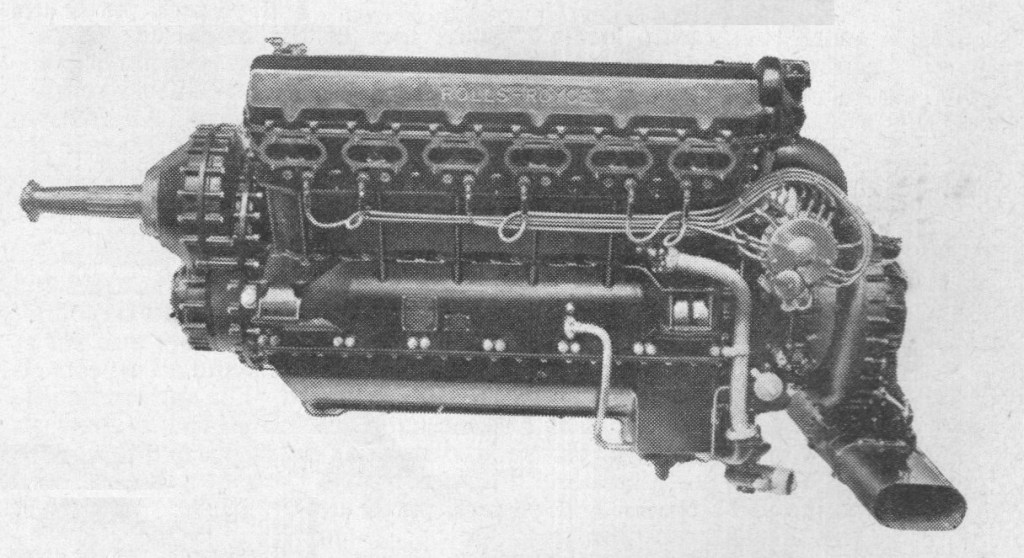
The Rolls-Royce Buzzard (also referred to as the H engine) was a British piston aero engine of 36.7 litres (2,240 cubic inch) capacity that produced about 800 horsepower (600 kW). The Buzzard was developed by scaling-up the Kestrel engine in the ratio of 5:6. Designed and built by Rolls-Royce Limited it featured 12 cylinders in a ‘V’ configuration of 6 inch bore and 6.6 inch stroke, and the engine was supplied as standard with a medium supercharger capable of being used to its fullest extent on the ground, so as to give the maximum possible take-off power, first run in June 1928.
The Series I, II and III engines had reduction gear ratios of 0.632, 0.553 and 0.477 respectively, and the normal power was 825 h.p. at 2,000 r.p.m. at sea level. At 2,300 r.p.m., 955 h.p. was available at sea level. The dry weight was 1,540 lb.
Buzzards were installed in the Blackburn Iris V and VI (Perth), MA/30 and MA/30A, Handley Page H.P.46 (MA/30), Hawker Horsley, Short Singapore I, K.F.I and Sarafand, and Vickers M.1/30.
The total production of Buzzard engines 100.
It was manufactured in the late 1920s, but only 100 were sold. A further development was the Rolls-Royce R Schneider Trophy engine.
Variants: Buzzard IMS, (H.XIMS) (1927), Maximum power 955 hp (712 kW), nine engines produced at Derby.
Buzzard IIMS, (H.XIIMS) (1932-33), Maximum power 955 hp (712 kW), reduced propeller drive ratio (0.553:1), 69 engines produced at Derby.
Buzzard IIIMS, (H.XIVMS) (1931-33), Maximum power 937 hp (699 kW), further reduced propeller drive ratio (0.477:1), 22 engines produced at Derby.
Applications: Blackburn Iris Blackburn M.1/30 Blackburn Perth Handley Page H.P.46 Hawker Horsley Kawanishi H3K Short Sarafand Vickers Type 207
Specifications: Buzzard IMS Type: 12-cylinder liquid-cooled Vee aircraft piston engine Bore: 6 in (152.4 mm) Stroke: 6.6 in (167.6 mm) Displacement: 2,239.3 in³ (36.7 L) Length: 75.7 in (1,923 mm) Width: 30.6 in (777 mm) Height: 44.4 in (1,128 mm) Dry weight: 1,140 lb (517 kg) Valvetrain: Overhead camshaft Supercharger: Single-stage supercharger Fuel type: 73-77 octane petrol Cooling system: Liquid-cooled Power output: 800 hp (600 kW) Specific power: 0.36 hp/in³ (16.3 kW/L) Compression ratio: 5.5:1 Power-to-weight ratio: 0.7 hp/lb
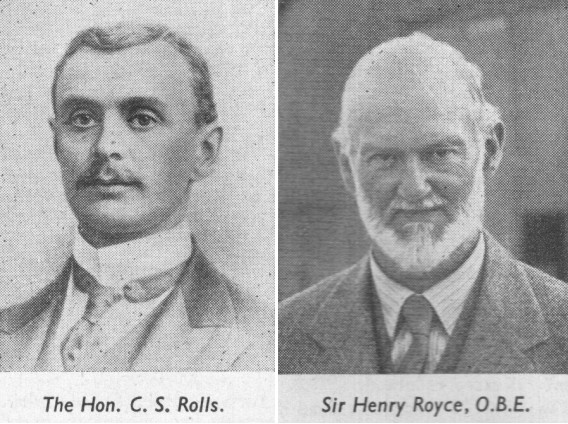
Rolls and Royce, met in Manchester in 1904. Rolls-the Hon. Charles Stewart Rolls-possessed wealth, an Eton-and-Cambridge education, a degree in mathematics and applied science, and a fine record as a motorist. He was a sportsman he had consistently displayed a daring at the wheel and a determined approach to the technical problems of motoring.
In the business of C. S. Rolls and Co., which he established with Claude Johnson in 1902. In 1903 he set a world speed record of 93 m.p.h.; but the car was a 70 h.p. Mors, and by the following year, when his books showed orders for a hundred Continental cars, he could still not find a British product which measured up to his standards.
At ten years of age Henry Royce started work as a telegraph boy, later attending a technical college, and serving a few years in the Great Northern locomotive shops at Peterborough. After a spell in an engineering works at Leeds, he set up a business in Manchester, making arc lamps and dynamos. The slump after the Boer War caused him to turn his ambition to cars. Disappointed with a foreign model which he acquired, he decided to put his own ideas into practice, and in 1903 he completed a two-cylinder car of 10 h.p., having handled much of the precision work himself.
One of his first three cars went to Henry Edmunds, who arranged the meeting in Manchester. The two men took to each other immediately, and having tried out Royce’s car, young Rolls undertook to sell its maker’s entire output. But he began to ply his partner with suggestions and demands.
The “two Rs” were first officially linked in business association at Christmas 1904, by a working agreement between the two firms; and thenceforth the Rolls-Royce car began.
By 1906 Royce’s production was large enough to allow Rolls to stop his sales of other makes of car, and Rolls-Royce, Ltd., was founded. Royce’s old partner, A. E. Claremont, became chairman; Rolls was technical managing director; and Royce was nominated chief engineer and works director.
Charles Stewart Rolls
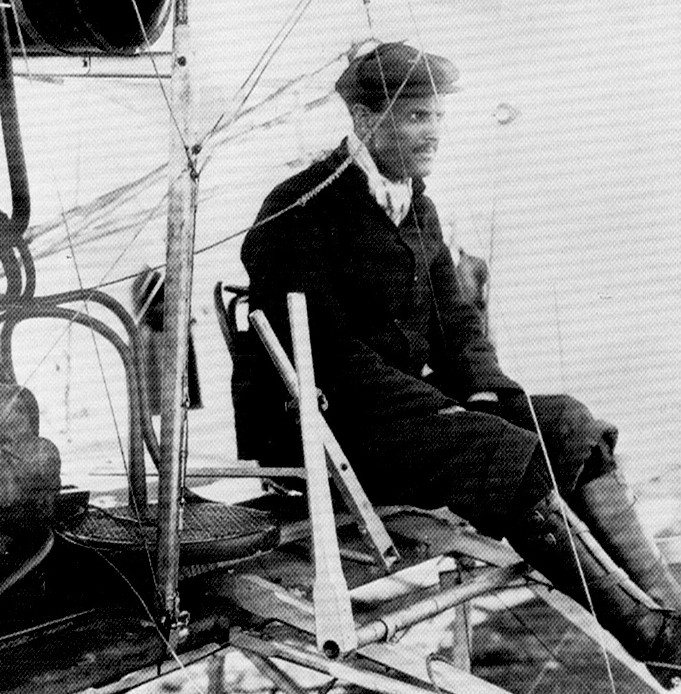
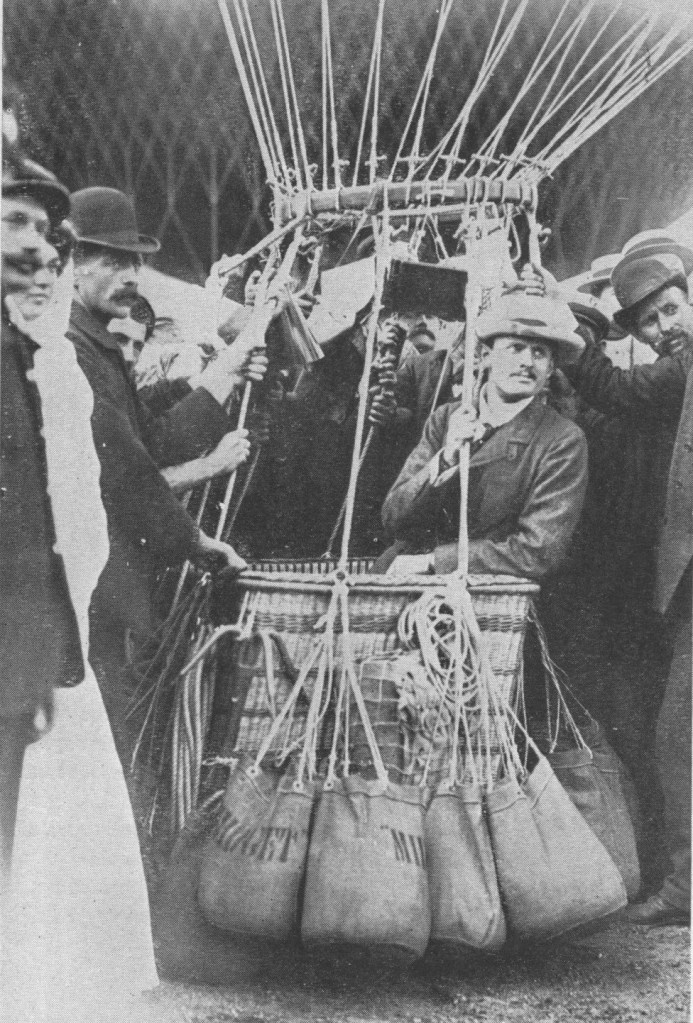
Rolls, who had become a member of the Aeronautical Society in 1901, was already a keen balloonist; then, having met the Wright brothers, he turned to heavier-than–aircraft. He was awarded his pilot’s certificate (No. 2) on March 8th, 1910-the very same day that Lord Brabazon received his No. 1. On the Wright biplane he made the first heavier-than-air crossing of the Channel by an Englishman, and the first double crossing by any aeroplane in history; but soon afterwards-on July 12th, 1910, he crashed to his death at the Bournemouth flying meeting, only 33 years of age. He was the first Englishman to die in an accident to a powered, heavier-than-air machine. His Wright Flyer broke up at 20 ft agl and he cracked his skull.
C.S. Rolls
In 1910 Royce became seriously ill and thereafter was absent for long periods from his new factory at Derby. He worked on in the south of France and on the south coast of England.
Following the British Schneider victory of 1929-made possible by the “R” engine-a baronetcy was conferred upon him, and he heard from his bed how an improved engine of this type sent a Supermarine S.6B to final victory in the Schneider Race of 1931. He died on April 22nd, 1933.
1914 Design of first Rolls-Royce aero engine-later named Eagle started. Company making engines of official pattern at Derby.
1915 Eagle on test six months after design initiated. Hawk designed and developed. Falcon designed
1918 Condor on test at 525 h.p.
1919 Alcock and Brown, in a Vickers Vimy (two Rolls-Royce Eagle Vills), mode first direct crossing of North Atlantic; flying time, 16 hir 12 min. Ross Smith and Keith Smith, in an Eagle-Vimy, made first flight from England to Australia11,130 miles in 124 hr flying time.
1920 Van Ryneveld and Quintin Brand, also in an Eagle-Vimy, made first flight from England to South Africa-6,281 miles in 92 hr 58 min flying time.
Between 1915 and 1924 Rolls-Royce Aero-engine production was: Eagle, 4,674; Hawk, 200; Falcon, 2,185; Condor, 327.
1925 Design of Rolls-Royce “F” series of engines (later called Kestrel) started.
1926 First “F” engine tested and delivered.
1927 The ” H ” engine-later the Buzzard-under development.
1929 Air Ministry decided in February to compete in Schneider Trophy Contest; Rolls-Royce asked to develop a racing engine. Within six months “R” engine was delivering 1,900 h.p. for a weight of 1,350 ]b. Installed in Supermarine S.6, which won Schneider Contest at 328.63 m.p.h.
1931 Rolls-Royce again asked to develop a Schneider Trophy engine to help secure a third victory, which would gain Trophy outright for Gt. Britain. Outcome was improved “R” engine of 2,360 h.p., weighing 1,630 lb. Schneider Trophy won outright. Later “R” engine gave 2,530 h.p. and enabled world speed record to be raised to 407.5 m.p.h.
By 1931, during the Great Depression, Bentley was having financial difficulties. When funds ran out in 1931, the receivers were negotiating with D.Napier & Sons Ltd for the sale of the remains of Bentley. However, Rolls-Royce put in a secret bid through a Liechtenstein company, and secured Bentley Motors for £125,256. For this, Rolls-Royce got the factory equipment, a number of incomplete car chassis, and the services of Walter Bentley for three years.
1932 Design of the P.V.12 engine (later called Merlin) started. (P.V. denoted private venture.)
1934 Merlin completed its first 100 hr run at 790 h.p.
1936 Merlin completed Service Type Test at 975 h.p.
1938 Building of Crewe factory started.
1939 First Merlin built at Crewe. Design and development work started on 37.V.12 engine, later named Griffon. Building of Glasgow factory begun in August. 1
1940 First Merlin built at Glasgow. First test run of Griffon.
1942 Quantity production of Griffon started.
1943 First Rolls-Royce turbojet-the Welland-passed its 100 hr type test; thrust, 1,700 lb, weight, 850 lb. Design of Derwent 1 started.
1944 Deliveries of Welland begun, for installation in Gloster Meteor. Design and development of Nene started.
1945 Meteor powered with Derwent Vs broke world air speed record at 606 m.p.h. In September a Meteor was flown with two Rolls-Royce Trent turboprops, being the first turboprop aircraft to fly. By this year power of Merlin had increased to over 2,000 h.p.
1946 World airspeed record again broken by a Derwent-Meteor; speed 616 m.p.h.
1947 Pratt and Whitney signed licence agreement for manufacture of Rolls-Royce Nene and Toy. Nenes in production at Derby. Trans-Canada Airlines started operations with Merlin powered Canadair North Stars.
1948 First public appearance ofAvon turbojet at S.B.A.C. Display. Belgium signed licence agreement for manufacture of Derwents.
1949 Dart turboprop type-tested at 1,000 h.p. B.O.A.C. intro- duced Merlin-powered Argonauts (similar to North Stars).
1950 Australia signed licence agreement to build Nene and Avon. Hispano signed agreement to make Nene and Toy.
1951 English Electric Canberra, with two Rolls-Royce Avons, made first non-stop transatlantic crossing by a jet aircraft the first of numerous record flights by Avon-Canberras.
1952 Sweden signed licence agreement to build Avon.
1953 Avon-Canberra flew from London Airport to Darwin, Northern Australia, in 22 hr 21 sec. Avon-powered Hawker Hunter established world air speed record of 726.6 m.p.h.; Avon-powered Supermarine Swift later raised record to 735.7 m.p.h. Ministry of Supply opened new factory at East Kilbride, Lanarkshire, to augment production of Avons for the R.A.F. (in addition, Avons were being made by the Bristol Aeroplane Co., Ltd., D. Napier and Son, Ltd., and the Standard Motor Company.)
1954 By May 1954 British-built Rolls-Royce gas turbines had completed 23 million flying hours; Merlins had cornpleted over 5.1 million flying hours in commercial service. By the end of the year over 185,000 Rolls-Royce piston and gas-turbine engines will have been built.
LHTEC (Light Helicopter Turbine Engine Company) is a joint venture between Rolls-Royce and Honeywell founded in 1985. The company was originally a partnership between the Allison Engine Company and AlliedSignal Aerospace . In 1995 Rolls-Royce acquired Allison, and AlliedSignal merged with Honeywell in 1999, and adopted its name.
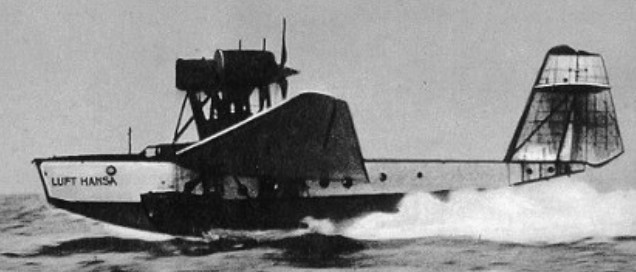
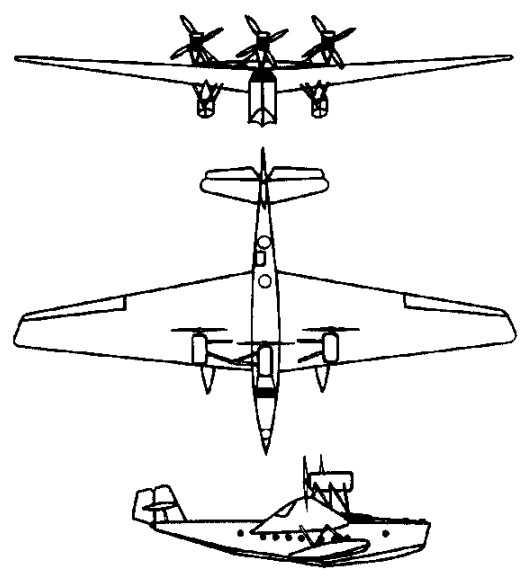
A long-range passenger flying boat, the first prototype flew on August 7, 1928.
Two models were produced. The Romar I (Werk Nrs 29,30 and 31), registrations D-1693, D-1734, and D-1747 respectively.
The single Romar II built, Werk Nr 62, went to France on the 1st April 1931 as F-AKEM.
The difference in the models was that the Romar II had BMW VIaU engines driving through a Farman gearbox. At some point the fin was changed on all models.
The three German aircraft, named “Hamburg”, “Bremen” and “Lubeck”, were all scrapped in 1933.
Ro X Romar Engines: 3 x BMW VIUZ, 485kW Wingspan: 36.9 m / 121 ft 1 in Length: 22.0 m / 72 ft 2 in Height: 8.5 m / 28 ft 11 in Max take-off weight: 19000 kg / 41888 lb Empty weight: 9900 kg / 21826 lb Max. speed: 210 km/h / 130 mph Ceiling: 2800 m / 9200 ft Range w/max.fuel: 4000 km / 2486 miles Crew: 4-5 Passengers: 12
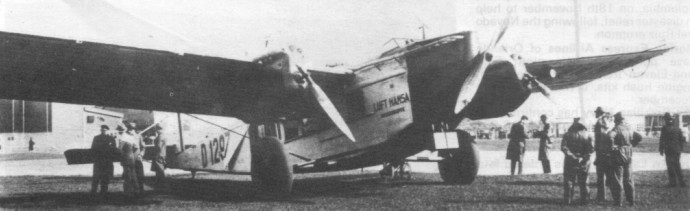
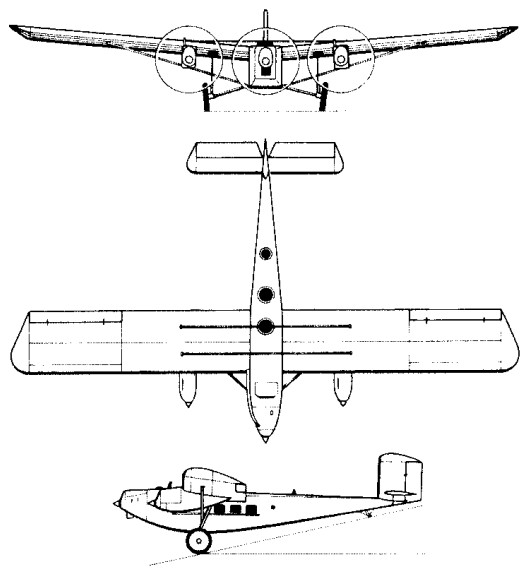
A the three engined version of the Farman Jabiru, the first flight was by D-991 (Werk Nr 18) on the 5th September 1926. It went to Iberia, as M-CAAC, later that year along with the second aircraft D-999 (Werk Nr 19) identified as M-CBBB. Both these aircraft were Mark I and were used on the Madrid – Barcelona route until August 1928 when they were returned to DHL. Six examples were operated by Deutsche Luft Hansa
There were effectively three marks: I, Ia, and II.
The Ia and II used the BMW Va engine, the Roland II of 1929 having an increased wing span of 26.3m and a maximum take off weight of 6615kg (14553lb). The maximum speed was increased to 225km/h (140 mph), the service ceiling was increased from 4,300m to 4,600m (15,100 ft). Both types were high-wing tri-motor monoplanes
A total of 18 of all models was produced with some flying well into the late 1930’s.
The last to be produced (Roland II Werk Nr50) was later registered D-ANAX. It was used by DLH until 1934 and then went to DVS.
Ro VIII Roland Engine: 3 x BMW IV, 239kW Max take-off weight: 5265 kg / 11607 lb Wingspan: 26.0 m / 85 ft 4 in Length: 16.3 m / 54 ft 6 in Height: 4.5 m / 15 ft 9 in Wing area: 88.0 sq.m / 947.22 sq ft Max. speed: 195 km/h / 121 mph Ceiling: 4600m Range w/max.payload: 925 km / 575 miles Crew: 2 Passengers: 10




 All Aero