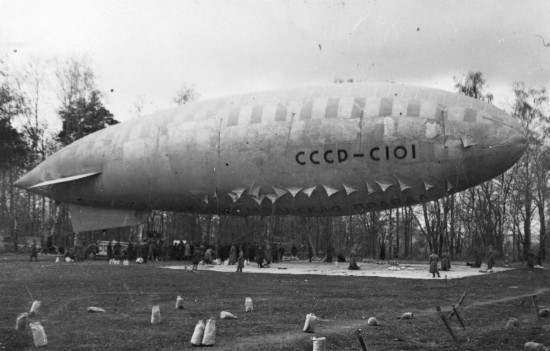
Russian Empire airship Komsomolskaya Pravda

For the decade of the 1920s the Soviet state refrained from building airships. Neither the Red Army neither the Soviet Navy wished to order an airship for military purpose, nor was there interest by any civilian agency. With the decommissioning of the airship MHR the newspaper “Komsomolskaya Pravda” began raising money to build a new airship. Some 12,000 Soviet rubles were raised from Soviet and foreign donors to fund the construction. “Komsomol’skaya Pravda” — literally “Komsomol Truth” — was an official countrywide newspaper of Komsomol, the All-Union Leninist Young Communist League. The airship was named after the newspaper as its editorial board was a fundraiser for her construction and the majority of donations were received from the Komsomol members.

Work on its production were conducted by the students of the aeromechanical High School, under N. Fomin. The new airship was named the “Komsomolskaya Pravda”.

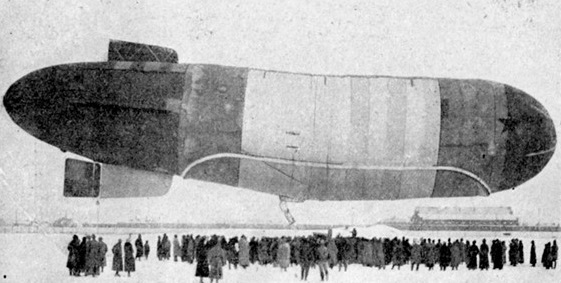
Komsomol’skaya Pravda was a simple non-rigid airship with a volume of 2500 cubic meters of hydrogen and a length of 46 meters. The ship carried one 185 hp BMW aircraft engine. The envelope was made of the fabric remaining from old Russian WWI observation balloons of the Parseval type, and a metal open car was rope-hanged beneath the envelope.

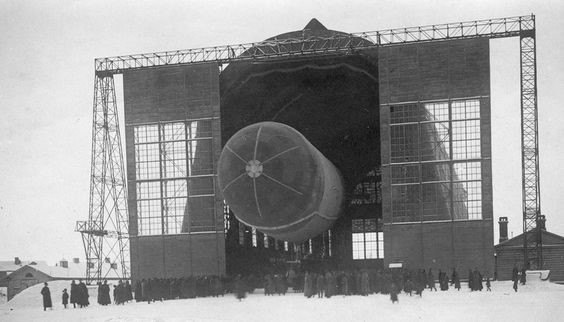
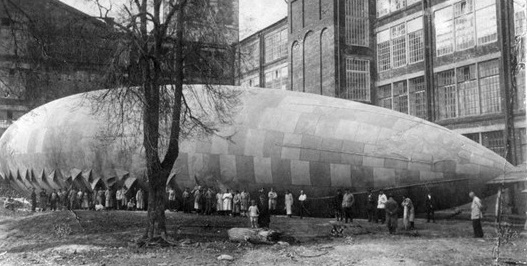
As there were no airship hangars around Moscow at the time, the Komsomolskaya Pravda’s units were fabricated in a former church building. The entire airship was finally assembled and filled with gas outdoor in a natural trough. The same place was used as a mooring in 1930 and 1931.
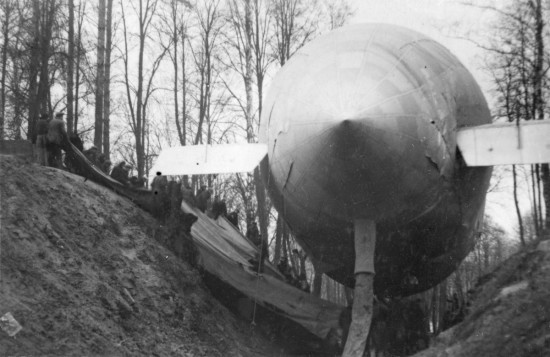
On July 25, 1930 the airship was filled with gas and on 29 August 1930, near Moscow, the Soviet airship “Komsomolskaya Pravda” (Комсомольская Правда) took off for her maiden flight. After a one-hour flight over Moscow she successfully landed.
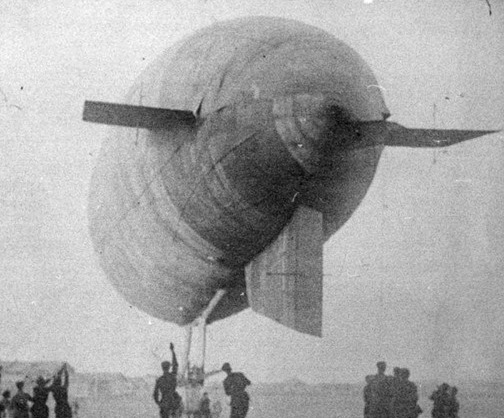
Komsomolskaya Pravda’s first test flight.

The commander of the ship became E.M. Oppman and on 31 August 1930 “Komsomolskaya Pravda” flew over Moscow. In 1930 they made 30 flights, and the next year another 25.

Komsomolskaya Pravda was used as a training airship by aeronautics students as well as for propaganda flights. During 1930 and 1931, Komsomolskaya Pravda made 55 flights and covered 3555 km. She was sent for total reconstruction because of deterioration in 1932.
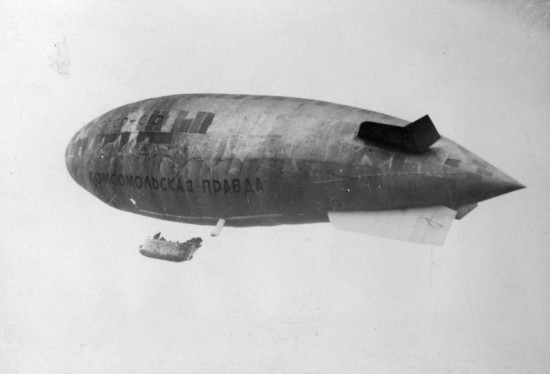
Komsomolskaya Pravda, 1930

In 1934, Komsomolskaya Pravda burnt after being struck with a lightning in the boathouse where it was kept together with its modernized versions.
Russian Empire airship Moscow chemist rezinschik / MHR

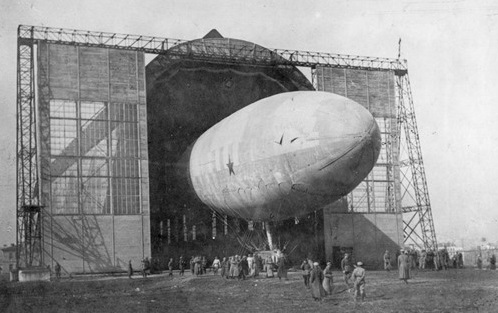
In the autumn of 1924 Vozduhsektsiyu Osoaviahima USSR completed the construction of another Myagenko airship named “Moscow chemist rezinschik” (MHR) under N. Fomin. It was made by voluntary contributions of chemical industry workers in and around Moscow.

The first flight of the airship was made On June 16, 1925, under the control of VL Nizhevskogo, in the air for 2 hours 5 minutes.

Flying from Leningrad to Moscow, it was mistakingly shot down by guards of a military factory in Tver.

Moskovsky Khimik-rezinschik airship, Gatchina, the Leningrad Region, 1928.

After its reconstruction, it had another crash and was disassembled.

This airship was operated until 1928, upgraded a couple of times and rebuilt. In total “Moscow chemist rezinschik” made 21 flights totaling 43 hours and 29 minutes.

Engine: 77 kW
Envelope volume: 2,458 cu.m
Length: 45.4 m
Width: 10.3 m
Maximum speed: 62 km / h
Payload: 900 kg

Russian Empire airship VI Oktyabr

Designed by General Nobile, the second Russian airship was “VI October”, which was built of makeshift materials in 1923 by students of higher forces aeronautical school located in St. Petersburg. The envelope of 1,700 cubic meters was sewn from old tethered balloons. The total length of the airship was 39.2 m and width 8,2 m. The engine was 77 kW.

The first flight of the airship was on November 27, 1923, lasting for about 30 minutes. A second flight, on 29 November lasted 1 hour and 20 minutes and reached a height of 900 meters. After that flying was stopped because of the very high gas permeability of the membrane.

Russian Empire airship / Vozduhtsentr / Dirizhablestroy

In 1906 the Chief Engineer’s Office Russian Empire was specially seconded to France, with a delegation of engineers and professionals for the development of on-site experience of the most advanced airship.

In 1923, the Society for the Friends of the Air Fleet of the USSR was created special Vozduhtsentr with tasks which included the promotion of Russian airship in Russia. After a while Vozduhtsentr was renamed vozduhsektsiyu Osoaviahima USSR and in the autumn of 1924 completed the construction of another Myagenko airship under the title “Moscow chemist rezinschik” (MHR). This title pointed to the fact that it was made by means of chemical industry workers in and around Moscow. The designer of this project was N. Fomin.

At the end of 1931 at CAB CAF was created under the title “Dirizhablestroy.” This organization was to unite the efforts of various groups of professionals working in the field, as do the planned deployment of the work in designing and building the next Russian airships. Also, the organization should take the time to research on the topic of aeronautic and improve methods of exploitation airships.

Nobile worked in the USSR from 1931 until 1935. He is believed to have been responsible for the design of nine semi-rigid airships.

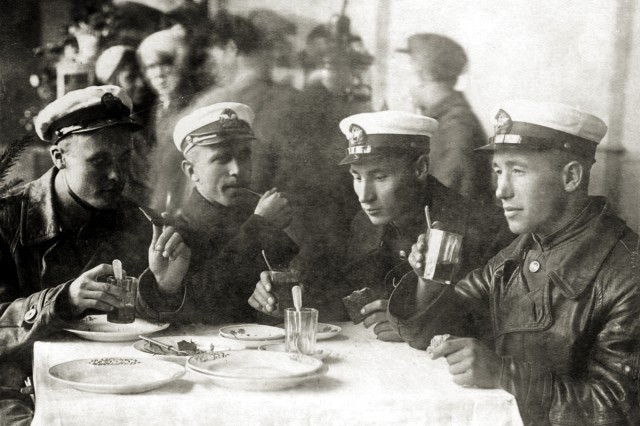
Russian airship crewmen (left to right) – Nikolai Gudovantsev, Ivan Obodzinsky, Ivan Pan’kov and Vladimir Ustinovich. 1933

The rationale for the Soviet program was to provide transport to distant rugged regions, notably Siberia, as well as such utility functions as surveying.

There were works at Leningrad, and Zagi near Moscow, the latter also the center of Tsiolkovski’s metalclad efforts. The plan was to make 92 ships but it is unknown how many were actually made.

There were also some non-rigids built in 1937 at Zagi.

Russell Comet

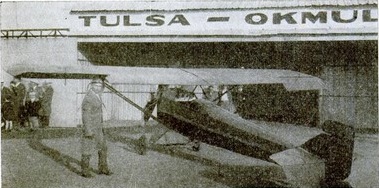
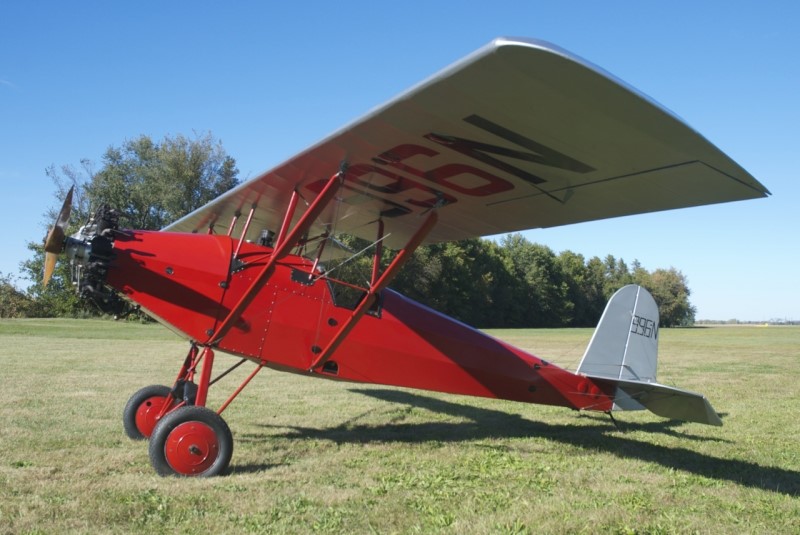
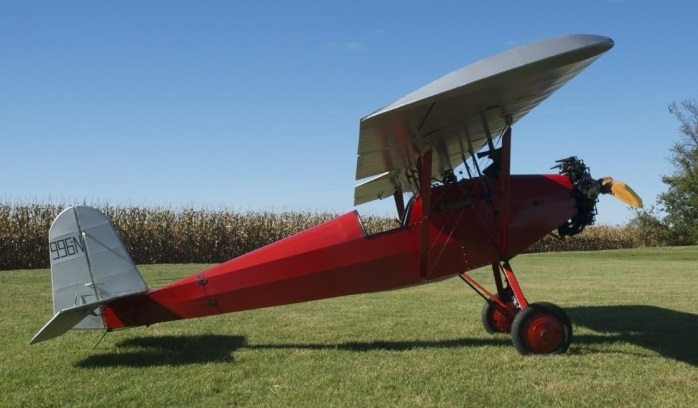
In 1930 Jack Russell of Oklahoma built a high-wing monoplane, designed for beginners, named Comet.

All fuselage members are welded steel tubing, including the tail group. The wing is of spruce.

A speed test over 78 miles took 38 minutes, using 1 USG and 3 qts of fuel and less than a pint of oil.

The 1930 price of the Comet was $1750 with 35 hp engine, and $1000 without motor.

Engine: 35 hp
Wing span: 24 ft
Wing chord: 5 ft
Length: 21 ft
Empty weight: 407 lb
Fuel capacity: 12 USG
Oil capacity: 2 USG
ROC: 700 fpm
Top speed: 100 mph
Landing speed: 24-26 mph
Landing distance: 100 ft
Endurance: 4 hr 30 min

Russell Light Monoplane

Salmson powered Russell

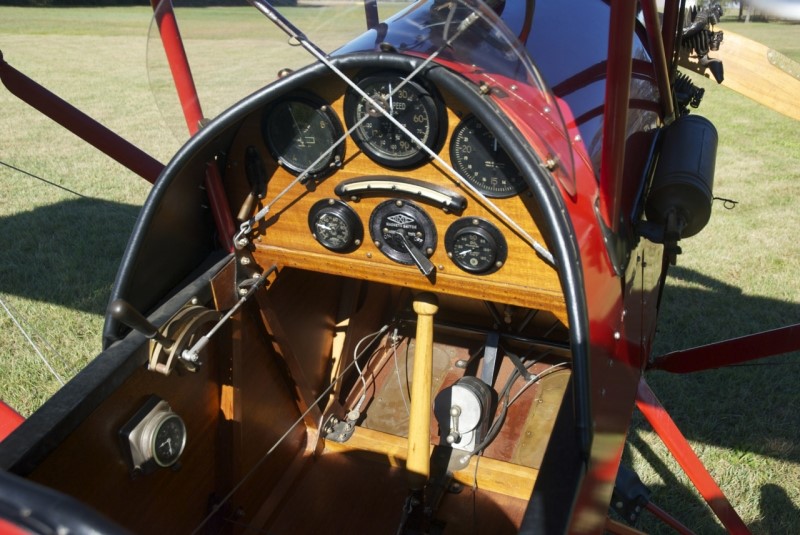
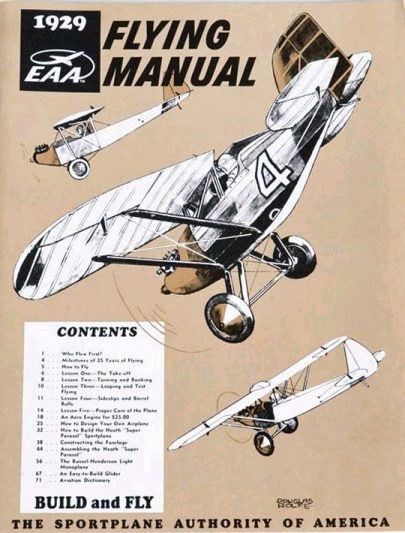
The Russell Light Monoplane is a plans-built design dating to 1929, when the plans could be obtained through Flying & Glider Manual, The Sportplane Authority of America and other publications.

Salmson powered Russell

It was intended to use a converted 4-cylinder Henderson motorcycle engine for power and built of wood with wire bracing. Covered with fabric, the Russell was relatively easy and inexpensive to build though it was never intended for tall people to fly it as it is really small.

1929 Flying & Glider Manual. The Russell-Henderson Light Monoplane is shown lower right on the cover.
Salmson powered Russell

Rubik R-08 Pilis (Tonsure)

A reduced-scale single-seat version of Szittya, 1938, 210 built

Variants:
R-08a – gull-wing, curvaceous semi-monocoque plywood fuselage, 1 built 1939
R-08b – simplified fuselage structure, 5 built 1938/39
R-08c – Gull replaced with pylon-mounted wing, 1939, 70 built
R-08d – An improved version with airbrakes & removeable canopy, 1943, 193 built postwar

Rubik R-07d / Ever KFT R-07 Tücsöl / Vöcsök

The Ever KFT R-07a Tücsöl (Cricket), open-frame single seat basic instruction glider appeared in 1938.
The R-07a Tücsök was a reduced-scale Vöcsök to replace the Zögling.

The Ever KFT R-07b Vöcsök (Grebe) appeared in 1940, a productionized version of the R-05/R-06 Vöcsök.

The Rubik R-07d was a postwar Vöcsök with modified ailerons, 30 built 1955/56.

As a production series of the R-06, 361 were built.

Rubik Aero Ever KFT R-07b Vöcsök
Length : 20.669 ft / 6.3 m
Wingspan : 38.058 ft / 11.6 m
Wing area : 161.46 sq.ft / 15.0 sq.m
Max take off weight : 430.0 lb / 195.0 kg
Weight empty : 242.6 lb / 110.0 kg
Max. weight carried : 187.4 lb / 85.0 kg
Glide ratio : 15.0
Minimum sink rate : 177.17 ft/min / 0.9 m/s