Santa Ana CA.
USA
1925:
J O York
Glendale CA.
USA
1928
Santa Ana Aircraft Co
Santa Ana CA
USA
1928 – Production rights sold to Grays Harbour Airways, Aberdeen WA.
Airplane builder
Santa Ana CA.
USA
1925:
J O York
Glendale CA.
USA
1928
Santa Ana Aircraft Co
Santa Ana CA
USA
1928 – Production rights sold to Grays Harbour Airways, Aberdeen WA.
Airplane builder
In 1930 members of the San Jose Flying Club Ltd rebuilt a wrecked Travel Air 3000 with a Hisso and reregistered it N837Y c/n 29.
1232 Martin Ave
San Jose CA.
USA
Circa 1930 airplane builder
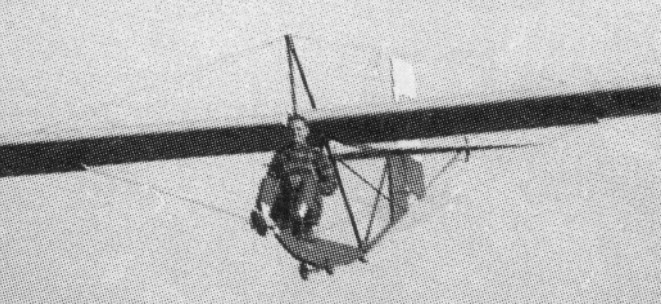
A replica 1929 Primary Glider
Features:
All Wood/Fabric Construction with minimum welding for fittings and control system
Easily disassembled for moving on trailer or auto roof rack
Downhill flyer or tow by auto
Much safer than hang gliders or ultralights
Excellent project for school or clubs
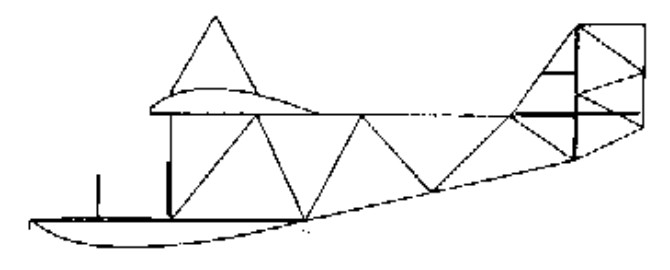
Plans Set consists of 2 highly-detailed 24″ by 36″ sheets, Materials Sheet and Safety Tips
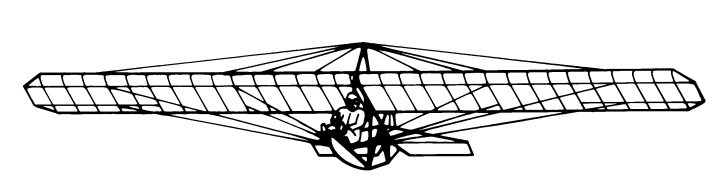
Fuselage Steel Tube Conversion available.
Wing Span: 32 ft
Chord: 60 in
Height: 7 ft
Wing Area: 157 sq.ft
Length (inc. rudder): 17 ft. 8 in
Take off Speed: 15 to 20 mph
Top Speed: 30 mph
Weight (empty) (wood construction): Approx. 150 lb
Seats: 1
Landing gear: fuselage skid
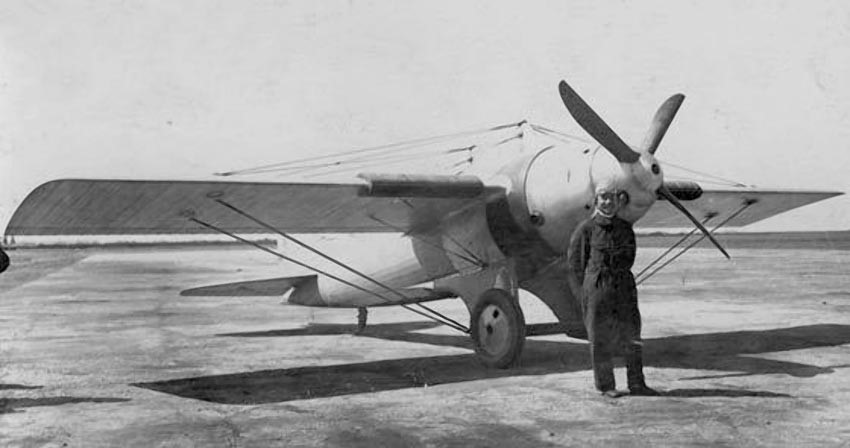
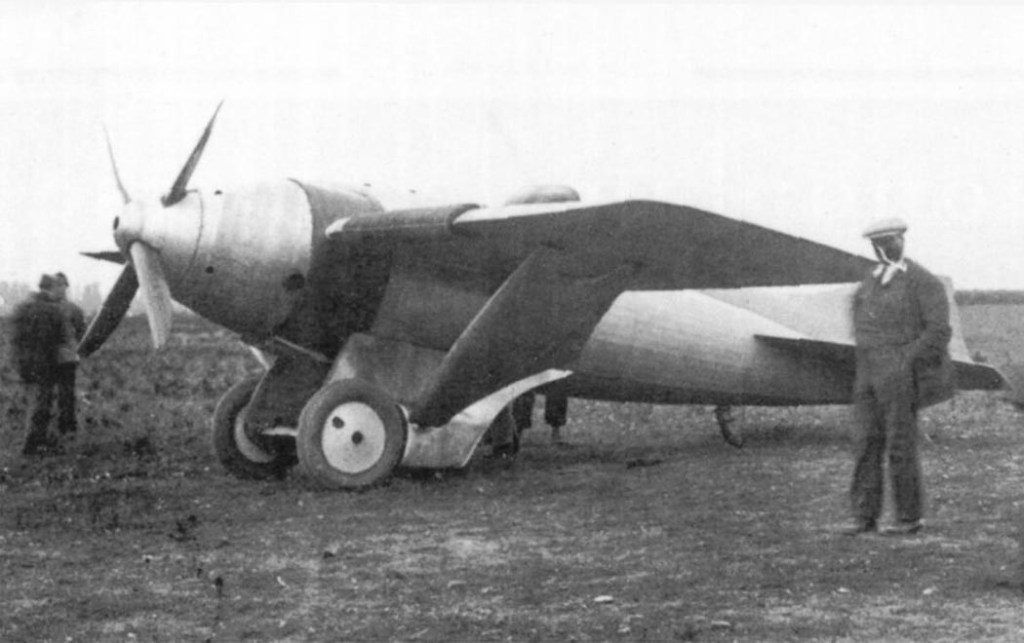
The Beaumont Cup races were to be held in Istra, but by decision of the French club (l’Aéro-Club de France) they did not take place for several reasons, one of which was the lack of participants: only 5 aircraft were registered, all of which were French. Salmson created the SB 3 aircraft (numbered “5”), which was tested by Potez test pilot Gustave Douchy.
Salmson-Béchereau SB 3 originated from SB 2 and was distinguished by a rather stocky shape and a huge nose. Its wing was supported by Y-shaped struts, which relied on the oil-pneumatic shock absorbers of the chassis design Louis Bechereau, the patent for which he received July 6, 1922 (No.553710). The mechanism was also equipped with cushioning cords hidden in these struts. The 520-horsepower Salmson 18 CMb engine installed on the aircraft was supposed to be cooled with Lamblin sheet radiators located in the front edge of the wing next to the fuselage. The skin of the aircraft consisted of varnished unbleached canvas. During the tests, terribly inadequate engine cooling was detected and speed tests were restricted. It was sent to Istres in October 1923 where Loizeau, an engineer, installed several straight lines on the radiators increasing their area.
According to the Beaumont Cup race Rules, the races were supposed to be international, the cup was played in France during two competitions, each of which consisted of a flight at a maximum speed of 300 kilometers. The winner received a prize of 200,000 francs, which was to be divided into two parts of 25,000 francs each (the first intended for the pilot, and the second to the manufacturer of the aircraft, which showed the best speed in both flights) and two annual awards of 75,000 francs. The races in Istra took place on June 23, 1924 along a circular route 50 kilometers long, the starting point of which was the center of military aviation (Center d’Aviation militaire). At least fifteen days before the race, the aircraft had to complete a five-minute test flight. Observation with a pen went from 08-00 to 20-00, and during this period rivals had to start. Each participant had the right to start, but in case of incomplete passage of the route or the wrong route, the plane had the right to re-flight. The cup cannot be won at a speed less than 290 km / h.
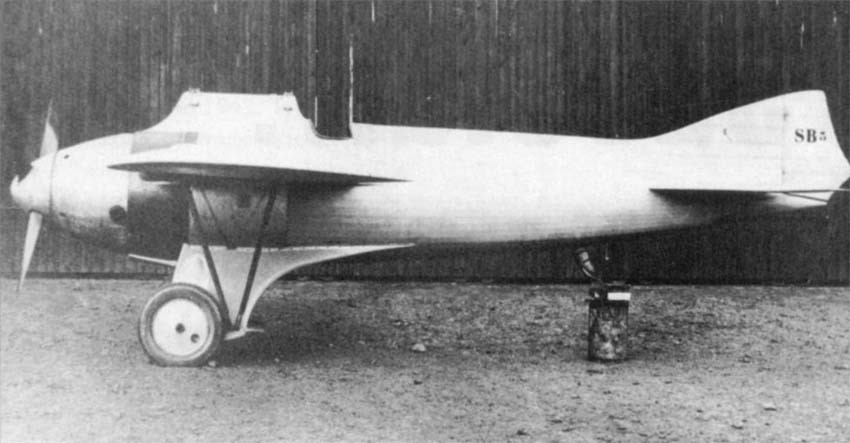
In order to race this new Cup, Salmson upgraded its SB 3 (sometimes referred to unofficially as SB 3bis). In order to increase aerodynamic characteristics, the wing gained increased wingspan (10 m) and surface area (19 m²). The center of gravity of the aircraft was located at 35% of the length of the wing chord. However, the resistance caused by the thick struts of the first configuration led Beshero to install on the SB 3 bis braces above and below the wing. The engine drove a four-blade propeller formed by two two-bladed propellers mounted relative to each other at an angle of 90° with 60 cm in length. This displacement relative to the axis caused vibrations; to fix this, a flat cylindrical screen was placed in the gap between the screw and the engine. The sides of this deformable thin sheet absorbed spontaneous movement of the screws.
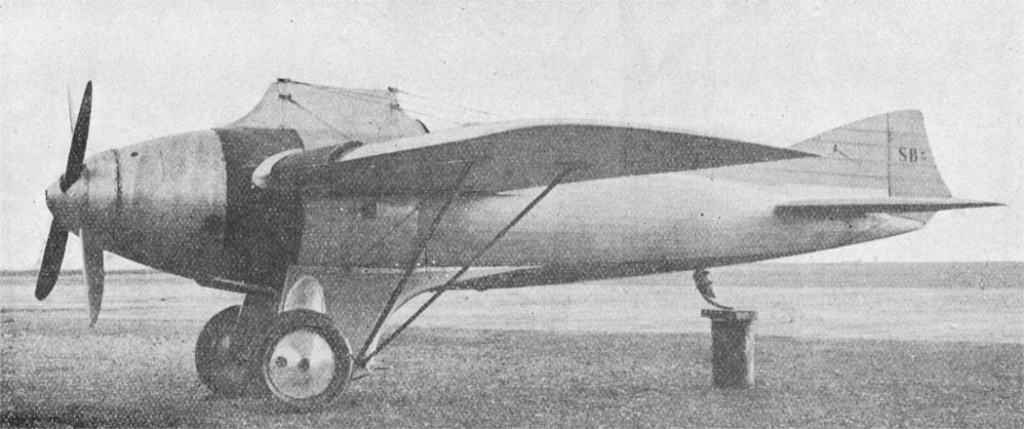
In late May 1924, Beshero had not yet found a pilot for the SB 3 bis. Thanks to the assistance of the Assistant Secretary of State for Aeronautics (sous-secrétaire d’Etat à l’Aéronautique), a volunteer was found – Lieutenant Georges Férigoule in Istra. After the test flight, Ferigul found a rather limited lateral control, but acknowledged that the aircraft has some interesting features. The only drawback was the completely insufficient cooling of the “forced” engine, which developed 800 hp on take-off. To solve this problem, Salmson installed a new pump to accelerate the passage of water in the radiators. But during the flight, the thin radiator bands were crushed by an overly powerful pump. The tank with engine cooling water, placed in an L-shaped fairing in front of the pilot, was depressurized and burned Ferigul’s face. Fortunately, his eyes were protected by flying goggles … Forced to land. the pilot refused to continue the competition that was won by Sadi Lecointe on the Nieuport 29.
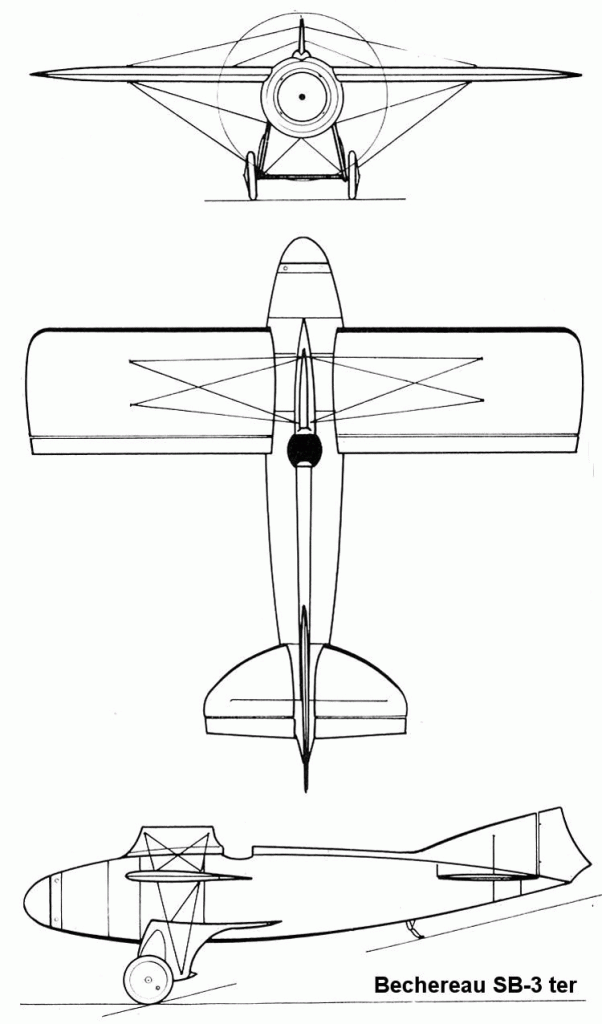
1925 was the last race for the cup with this name. the new rules were almost identical to the rules of 1924, except that victory in the race required speeds of at least 300 km / h and that flights were conducted from 07-00 to 17-00. Only two aircraft fought for their victory: Nieuport-Delage with a 500-horsepower Hispano engine and the Salmson Béchereau SB-3, which again underwent changes. Since the designation SB 3ter (designation not found in the company’s documentation). To participate in races in 1925, Beshero installed a wing with a span of 8 meters and an area of 15 m² on SB 3 bis; The water circulation system on the machine was also revised.
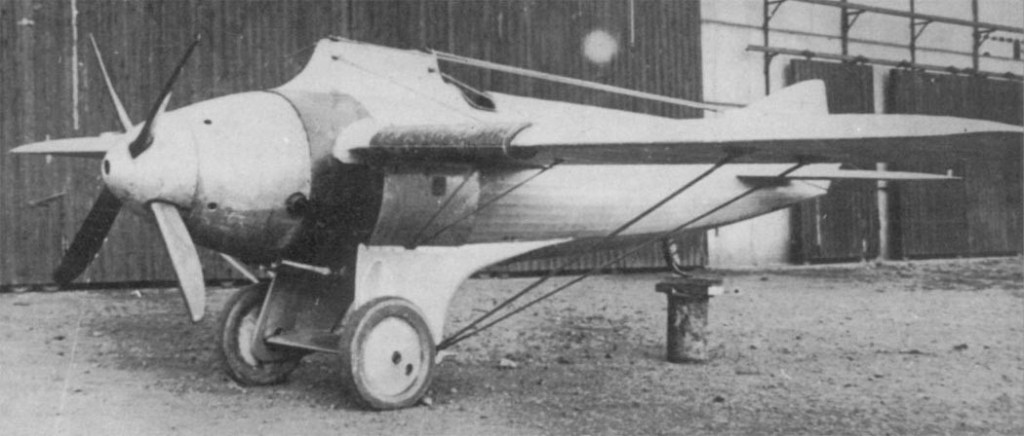
On October 18, two competitors attended the launch: Sadi-Lekuant at Nieuport-Delage and Ferigul at Salmson-Béchereau. Ferigul took off first at 07-30, but after passing ½ turn he had to land. However, at 10-15 he performed a second take-off. However, after two laps, he landed because the engine was very hot. Despite numerous attempts to improve the cooling system, satisfactory results were not obtained. It can be added that the empty weight of SB 3 ter was 1350 kg, and the total weight reached 1580 kg. The maximum speed of SB 3 was estimated at 360 km / h, making it the fastest modification of SB 3.
SB 3 ter ended its days as a flying laboratory for the final tests of the 18 CMb engine, which was a supercharged version of the 18 CMa. It was then suspended from the ceiling of the Salmson workshop in Billancourt, where during the occupation was destroyed by fire during the Allied bombing.
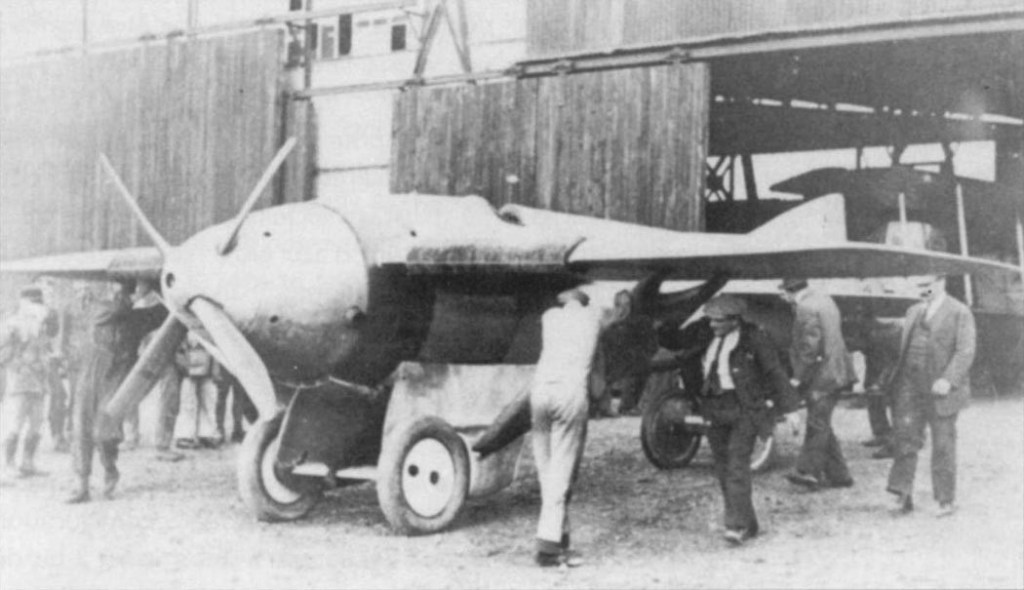
SB-3
1923
Engine: 1 x 520 hp Salmson 18CMb
Wingspan: 8.16 m
Wing area: 17 m²
Length: 8.10 m
Empty weight: 1350 kg
Total weight: 1700 kg
Wing load: 100 kg / m²
Power load: 3.1 kg / hp
Max speed: 350 km / h
Range: 350 km
SB-3 / SB-3a
faired lower struts
SB 3bis / SB-3b
1924 ‘open’ struts, kingpost pylon
Engine: 520 hp Salmson 18CMb
Wingspan: 10 m
Wing area: 19 m²
Length: 8.10 m
Height: 2.50 m
Empty weight: 1400 kg
Normal takeoff weight: 1620 kg
Maximum speed: 320 km / h
Practical range: 350 km
Crew: 1
SB-3 ter / SB-3c
1925
Wingspan: 8.00 m
Wing area: 15 m²
Empty weight: 1350 kg
Total weight: 1580 kg
Max speed est: 360 km / h

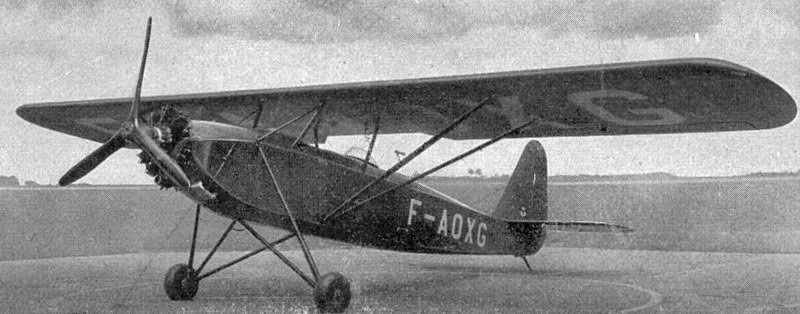
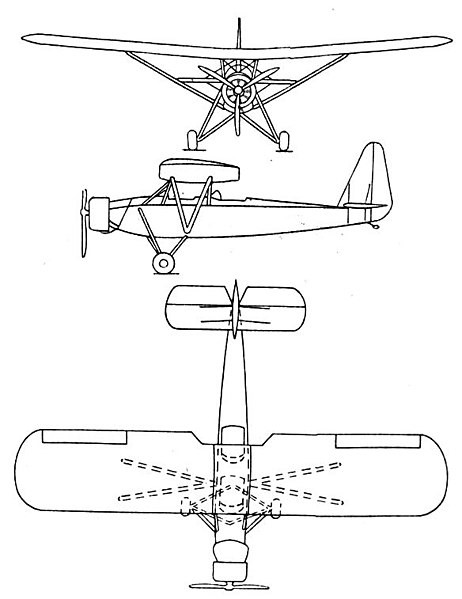
The Salmson Cricri (“Cricket”) was a French light aircraft designed by Paul Deville. Salmson launched work on this new aircraft in 1935, intended primarily for the military for intermediate and advanced training missions.
It was a conventional, parasol-wing monoplane with fixed tailskid undercarriage and seating in tandem open cockpits for the pilot and passenger. The negative dihedral wing had the distinction of having a very small forward sweep. A very large tail had been installed. Built mainly in canvas wood but also with metal inserts, it was powered by a Salmson 9Adr engine of 60hp driving a three-blade metal and wood propeller. A relatively high, relatively wide gauge fixed landing gear had been installed on the aircraft. The pilot and his passenger took place in two tandem open cockpits, separated from each other.
Officially designated D.6 by the manufacturer, it received the name of Cricri. Its first flight took place on April 14, 1936. Immediately thirty planes were acquired by the Air Force.
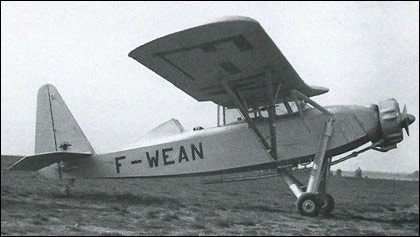
Shortly after receipt of the first of these aircraft, the Navy ordered two fairly similar aircraft for the intermediate training of combat aircraft pilots. These two aircraft received the official designation of D.6-3.
In September 1936, the Air Ministry placed an order for a hundred aircraft under the so-called Popular Aviation program which aimed to promote tourist aviation for the greatest number. These planes were therefore sent to schools and flying clubs across the country.
When World War II broke out in September 1939, production of the Cricri was still underway and several copies were urgently ordered for Air Force schools. But several dozen of them were camouflaged and received tactical codes from combat aircraft. Although generally disarmed, some machines carried in the rear position a mobile Darne 7.5mm machine gun for its own defense. They were widely used for the observation of the battlefield, border surveillance in particular along the Maginot line, or even the direction of ground artillery fire. At least half of the French military D.6s were used for missions other than training.
The majority of Cricri were used during all the French part of the war, and when in 1940 the Franco-German armistice was signed several planes joined the ranks of the German aviation for various secondary missions like the towing of gliders or transport and light postal flights.
345 were built.
Following the war, CFA attempted to revive the design as the Cricri Major. This differed from its predecessor mainly in having a more powerful engine and an enclosed cabin.
Variants:
D6 Cricri
Engine: 1 × Salmson 9 ADr, 45 kW (60 hp)
Wingspan: 9.66 m (31 ft 8 in)
Wing area: 16.0 m2 (172 ft2)
Length: 6.89 m (22 ft 7 in)
Height: 2.18 m (7 ft 2 in)
Empty weight: 287 kg (633 lb)
Gross weight: 575 kg (1,268 lb)
Maximum speed: 150 km/h (94 mph)
Range: 500 km (310 miles)
Service ceiling: 2,450 m (8,040 ft)
Crew: One pilot
Capacity: 1 passenger
329 built
D63 Cricri
dedicated flight trainer version
2 built
After their successful water-cooled radial engines, developed from 1908 to 1918, Salmson changed their focus to air-cooling to reduce weight and increase specific power (power per unit weight). The majority of the engines produced by Salmson were of radial type with a few other arrangements such as the Salmson T6.E. In common with other engines produced by this manufacturer, the air-cooled radial engines featured the unorthodox Canton-Unné internal arrangement that dispensed with a master rod in favour of a cage of epicyclic gears driving the crankpin. Built from 1920, production ended in 1951 with the liquidation of the manufacturing company.
In common with several other French aero-engine manufacturers Salmson named their engines with the number of cylinders then a series letter in capitals followed by variant letters in lower-case.
18 AB
Type: 18-cyl 2-row radial
Bore: 125 mm (4.921 in)
Stroke: 180 mm (7.087 in)
Capacity: 39.76 l (2,426.30 cu in)
Power: 410.1 kW (550 hp) at 1,700rpm
18 ABs
Type: 18-cyl 2-row radial
Bore: 125 mm (4.921 in)
Stroke: 180 mm (7.087 in)
Capacity: 39.76 l (2,426.30 cu in)
Power: 484.7 kW (650 hp) at 1,700rpm
18 Cm
18 Z
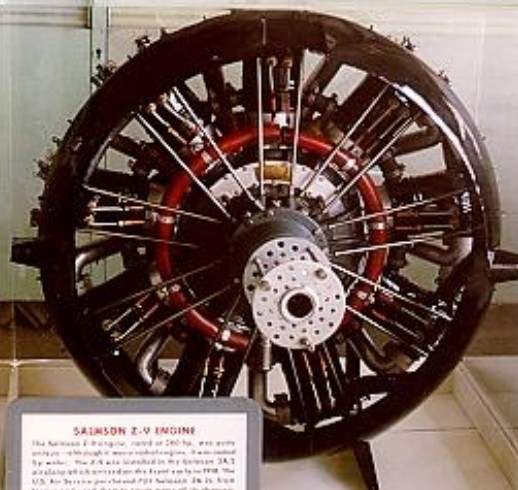
Henri Salmson, a manufacturer of water pumps, was engaged by Georges Marius Henri-Georges Canton and Pierre Unné, a pair of Swiss engineers, to produce engines to their design. First run in 1908, their initial efforts were on barrel engines, but these failed to meet expectations due to low reliability and high fuel consumption caused by internal friction.
A new design, a 7-cylinder water-cooled radial design, was then developed by Canton and Unné. This was expanded to produce 9-cylinder models, and also two-row 14-cylinder and 18-cylinder engines. By 1912 the Salmson A9 was producing around 120 brake horsepower; while competitive with rival designs from French companies, Salmson, Canton and Unné decided to develop more powerful engines as their rivals were concentrating on engines of lower power.
The engines were produced at Société des Moteurs Salmson’s factory at Billancourt, which was expanded during the First World War, and a second factory was opened at Villeurbanne. The Salmson-(Canton-Unne) series of water-cooled engines were also built by licensees in Russia and in Great Britain at the Dudbridge Iron Works Limited at Stroud in Gloucestershire between 1914 and 1918.
Salmson produced the series from 1908 until 1920.
Applications:
Aircraft powered by Salmson water cooled engines included:
Anatra DS
Besson H-5
Blackburn type L
Bréguet U2
Breguet 14 prototype
Caudron C.23
Farman HF.27
Farman 60
Hanriot HD.3
Hanriot H.26
Kennedy Giant
Lebed 12
Salmson-Moineau S.M.1
Salmson-Moineau S.M.2
Salmson-Moineau 2A2
Salmson 2 Berline
Salmson 2A2
Short S.74
Short type 135
Short type 166
Short type 830
Voisin Triplane
Voisin LA 3
Voisin LA 5
Sopwith Bat Boat II
Sopwith type C
Sopwith type 860
Vickers Vimy prototype
Wight Navyplane
Specifications:
Salmson A
Configuration: 2 x 7-cyl barrel
Year: 1908
Bore: 75 mm (2.953 in)
Stroke: 125 mm (4.921 in)
Capacity: 7.7 l (469.88 cu in)
Power: 37.285 kW (50 hp) at 800rpm
Barrel engine 1 built bench tests only
Salmson B
Configuration: 2 x 7-cyl barrel
Year: 1910
Bore: 75 mm (2.953 in)
Stroke: 125 mm (4.921 in)
Capacity: 7.7 l (469.88 cu in)
Power: 37.285 kW (50 hp) at 800rpm
1 built bench tests only -water cooled.
Salmson C
Configuration: 2 x 7-cyl barrel
Year: 1910
Bore: 85 mm (3.346 in)
Stroke: 95 mm (3.740 in)
Capacity: 8 l (488.19 cu in)
Power: 44.74 kW (60 hp) at 1100rpm
1 built with rotary inlet valves – water-cooled.
Salmson D
Configuration: 2 x 7-cyl barrel
Year: 1910
Bore: 85 mm (3.346 in)
Stroke: 95 mm (3.740 in)
Capacity: 8 l (488.19 cu in)
Power: 44.74 kW (60 hp) at 1100rpm
1 built with rotary inlet valves – water-cooled.
Salmson E
Configuration: 2 x 9-cyl barrel
Year: 1911
Bore: 110 mm (4.331 in)
Stroke: 130 mm (5.118 in)
Capacity: 22 l (1,342.52 cu in)
Power: 55.93 kW (75 hp)
1 built – timed valves – water cooled.
Salmson F
Configuration: 2 x 9-cyl barrel
Year: 1911
Bore: 110 mm (4.331 in)
Stroke: 130 mm (5.118 in)
Capacity: 22 l (1,342.52 cu in)
Power: 55.93 kW (75 hp) at 1200 rpm
1 built – timed valves – water cooled.
Salmson K
Configuration: 2 x 7-cyl barrel
Year: 1912
Bore: 85 mm (3.346 in)
Stroke: 105 mm (4.134 in)
Capacity: 11 l (671.26 cu in)
Power: 63.4 kW (85 hp) at 1200 rpm
1 built – automatic inlet valves – water cooled
Salmson A7
Configuration: 7-cyl radial
Year: 1911
Bore: 120 mm (4.724 in)
Stroke: 140 mm (5.512 in)
Capacity: 11 l (671.26 cu in)
Power: 59.65 kW (80 hp) – 74.57 kW (100 hp)
5 built for bench testing – water cooled
Salmson A9
Configuration: 9-cyl radial
Year: 1912
Bore: 122 mm (4.803 in)
Stroke: 140 mm (5.512 in)
Capacity: 14.73 l (898.88 cu in)
Power: 82 kW (110 hp) – 96 kW (130 hp)
30 built – certified to 47 hours running by 1914
Salmson C9
Configuration: 9-cyl radial
Year: 1912
Bore: 150 mm (5.906 in)
Stroke: 180 mm (7.087 in)
Capacity: 28.63 l (1,747.11 cu in)
Power: 223.7 kW (300 hp)
1 built for testing
Salmson M7
Configuration: 7-cyl radial
Year: 1913
Bore: 122 mm (4.803 in)
Stroke: 140 mm (5.512 in)
Capacity: 11.5 l (701.77 cu in)
Power: 74 kW (100 hp) – 85.75 kW (115 hp)
50 built for bench testing – water cooled
Salmson 2M7
Configuration: 14-cyl 2-row radial
Year: 1913
Bore: 122 mm (4.803 in)
Stroke: 140 mm (5.512 in)
Capacity: 23 l (1,403.55 cu in)
Power: 149.1 kW (200 hp) at 1300rpm
Water-cooled – 15 built in France 300 built in Great Britain.
Powered the Kennedy Giant, Short Type 166, Sopwith Bat Boat II, Sopwith Type C, Sopwith Type 860 and Wight Navyplane.
Salmson 2A9
Configuration: 18 cyl 2-row radial
Year: 1913
Bore: 122 mm (4.803 in)
Stroke: 140 mm (5.512 in)
Capacity: 29.46 l (1,797.76 cu in)
Power: 233.7 kW (313 hp) at 1500rpm
1 built for bench testing – water cooled
Salmson B9
Configuration: 9-cyl radial
Year: 1913
Bore: 122 mm (4.803 in)
Stroke: 140 mm (5.512 in)
Capacity: 14.73 l (898.88 cu in)
Power: 104.4 kW (140 hp)
Water cooled – 106 built in Great Britain, 300 built in France.
Powered the Short Type 135, Short S.74, Short Type 830 and Voisin LA 5
Salmson M9
Configuration: 9-cyl radial
Year: 1914
Bore: 122 mm (4.803 in)
Stroke: 140 mm (5.512 in)
Capacity: 14.73 l (898.88 cu in)
Power: 89.48 kW (120 hp) – 96.94 kW (130 hp)
Water cooled – 500 built in France.
Powered the Voisin LA 3, Bréguet U2, Blackburn Type L, Breguet 14 prototype.
Salmson P9
Configuration: 9-cyl radial
Year: 1915
Bore: 122 mm (4.803 in)
Stroke: 140 mm (5.512 in)
Capacity: 14.73 l (898.88 cu in)
Power: 111.85 kW (150 hp)
Water cooled – 300 built in France, 300 built in Russia.
Powered the Voisin type LA 5 and Farman HF.27
Salmson R9
Configuration: 9-cyl radial
Year: 1915
Bore: 125 mm (4.921 in)
Stroke: 140 mm (5.512 in)
Capacity: 15.46 l (943.43 cu in)
Power: 111.85 kW (150 hp) – 119.3 kW (160 hp) at 1300rpm
Water cooled – 50 built in France, 300 built in Russia.
Powered the Lebed 12, Anatra DS, and Salmson-Moineau (1917) prototype
Salmson 9Z
Configuration: 9-cyl radial
Year: 1917
Bore: 125 mm (4.921 in)
Stroke: 170 mm (6.693 in)
Capacity: 18.7 l (1,141.14 cu in)
Power: 186.4 kW (250 hp) at 1400rpm
Water cooled – 3000 built in France, 56 built in Great Britain.
Powered the Salmson 2A2, Farman 60, Voisin Triplane, Caudron C.23 and Vickers Vimy prototype
Salmson 9Za
Variant of the 9Z, powered the Hanriot HD.3
Salmson 9Zm
Variant of the 9Z
Salmson 9Zc
Variant of the 9Z
Salmson CM.9
Power: 194 kW (260 hp)
powered the Salmson 2 Berline
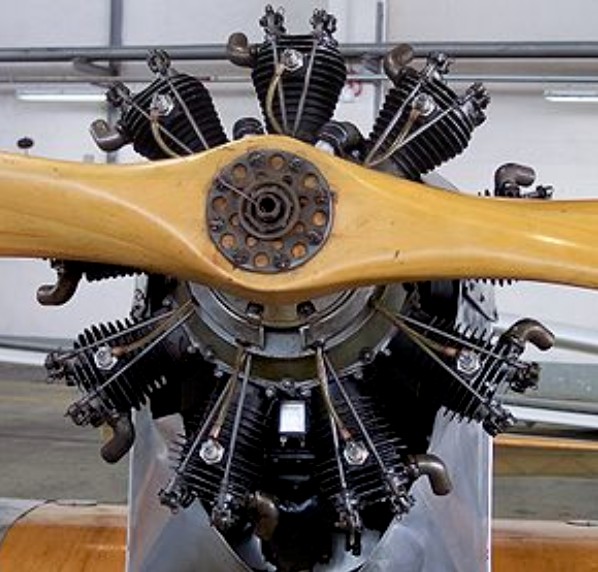
After their successful water-cooled radial engines, developed from 1908 to 1918, Salmson changed their focus to air-cooling to reduce weight and increase specific power (power per unit weight). The majority of the engines produced by Salmson were of radial type with a few other arrangements such as the Salmson T6.E. In common with other engines produced by this manufacturer, the air-cooled radial engines featured the unorthodox Canton-Unné internal arrangement that dispensed with a master rod in favour of a cage of epicyclic gears driving the crankpin. Built from 1920, production ended in 1951 with the liquidation of the manufacturing company.
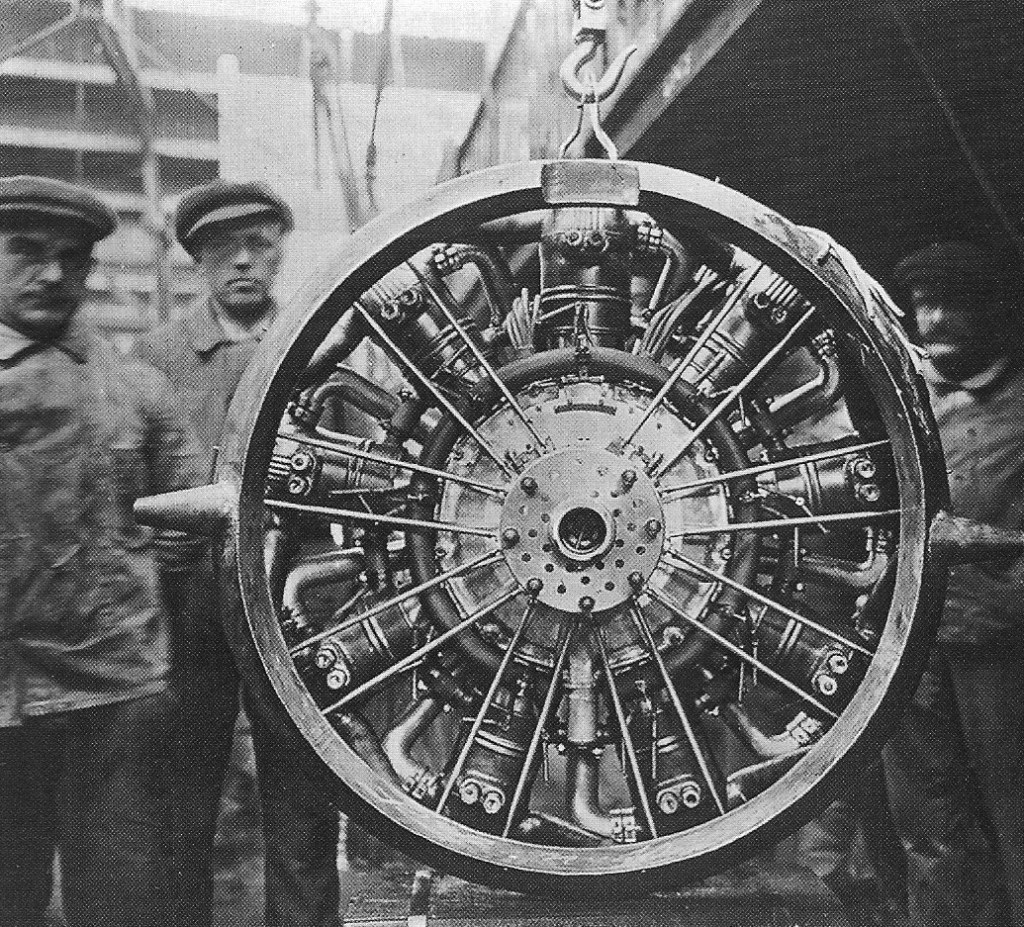
In common with several other French aero-engine manufacturers Salmson named their engines with the number of cylinders then a series letter in capitals followed by variant letters in lower-case.
The 3,7 and 9 cylinder Salmsons were license built in Great Britain, during the 1920s and 1930s, by the British Salmson engine company as the British Salmson AD.3, British Salmson AC.7, British Salmson AC.9, and British Salmson AD.9.
British Salmson aero-engines refers to a series of small French designed, air-cooled radial aero engine that were produced by British Salmson, under license from Société des Moteurs Salmson, in Great Britain during the late 1920s and 1930s.
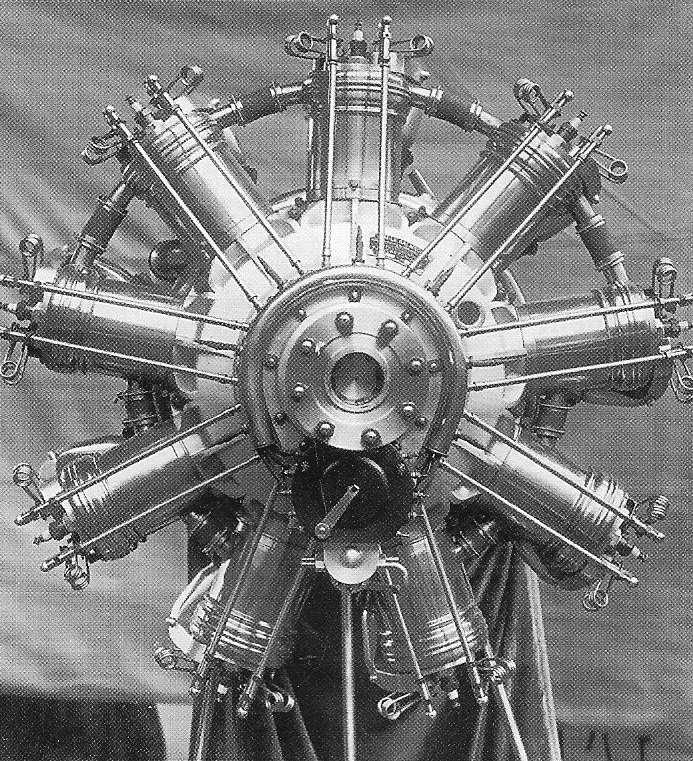
Due to the fact, that the relatively low power was divided among several cylinders, the running of the engines was particularly smooth, and the torque was very even. Adding to the smooth running of these engines was the use of the Canton-Unne system of planetary gears in a cage connecting pistons to crank-pin.

Unit price in 1929 was £175.
Variants:
AD.3
Three cylinder license production of the Salmson 3 Ad
AC.7
105 horsepower (78 kW) seven cylinder radial, capacity 7.15 litres (436 cu in)
AC.9
135 horsepower (101 kW) nine cylinder radial, capacity 9.2 litres (560 cu in)
AD.9
50 horsepower (37 kW) at 2000 rpm (normal power) or 55 horsepower (41 kW) at 2200 rpm (maximum power). Bore of 70 mm.
AD.9R
70 horsepower (52 kW), geared version of AD.9 with increased bore of 73 mm and increased compression ratio (6:1).
AD.9NG
203 horsepower (151 kW), increased bore and stroke. (100 x 140 mm, 10 L capacity).
9 AD
The standard production model with LH rotation direct drive.
9 ADb
British Salmson AD.9
Production of the Salmson 9AD in Great Britain by the British Salmson Company at New Malden, Surrey.
British Salmson A.D.9R srsIII
The A.D.9 with a 0.5:1 reduction gear
Applications:
AD.9
Angus Aquila
BA Swallow
Comper Swift
Boulton Paul P.41 Phoenix
General Aircraft Monospar
Hafner Revoplane
Hinkler Ibis
Parmentier Wee Mite
AD.9R
Arpin A-1
AD.9NG
Cierva C.40
Specifications:
9 AB
Type: Nine-cylinder single-row supercharged air-cooled radial engine
Bore: 125 mm (4.92 in)
Stroke: 170 mm (6.69 in)
Displacement: 18.765 l (1,145 cu.in)
Length: 1,000 mm (39.37 in)
Diameter: 1,180 mm (46.46 in)
Dry weight: 265 kg (584 lb)
Valvetrain: Two overhead valves per cylinder
Supercharger: Single-speed centrifugal type supercharger
Fuel system: Zenith 42D carburetor
Cooling system: Air-cooled
Power output: 191 kW (256 hp) at 1,780 rpm for takeoff
Specific power: 10.18 kW/l (0.22 hp/cu.in)
Compression ratio: 5:1
Specific fuel consumption: 328 g/(kW•h) (0.54 lb/(hp•h))
Oil consumption: 19 g/(kW•h) (0.49 oz/(hp•h))
Power-to-weight ratio: 0.72 kW/kg (0.44 hp/lb)
9 Aba
9 ABc
Power: 172 kW (230 hp)
9 AC
Type: 9-cyl radial
Bore: 100 mm (3.937 in)
Stroke: 130 mm (5.118 in)
Capacity: 9.189 l (560.75 cu in)
Power: 96.94 kW (130 hp) at 1,800rpm
9AD
Type: 9-cyl radial
Bore: 70 mm (2.756 in)
Stroke: 86 mm (3.386 in)
Capacity: 2.979 l (181.79 cu in)
Power: 33.56 kW (45 hp) at 2,000rpm
Dry weight: 68 kg (150 lb)
9 ADb
Type: 9-cyl radial
Bore: 70 mm (2.756 in)
Stroke: 86 mm (3.386 in)
Capacity: 2.979 l (181.79 cu in)
Power: 41 kW (55 hp) at 2,200rpm
9 ADr
Type: 9-cyl radial
Bore: 70 mm (2.756 in)
Stroke: 86 mm (3.386 in)
Capacity: 2.979 l (181.79 cu in)
Power: 48.5 kW (65 hp) at 2,700rpm
9 Az
9 A2c
9 M
9 NA
Type: 9-cyl radial
Bore: 140 mm (5.512 in)
Stroke: 160 mm (6.299 in)
Capacity: 22.140 l (1,351.07 cu in)
Power: 246 kW (330 hp) at 1,800rpm
9 NAs
Type: 9-cyl radial
Bore: 140 mm (5.512 in)
Stroke: 160 mm (6.299 in)
Capacity: 22.14 l (1,351.07 cu in)
Power: 41 kW (55 hp) at 1,800rpm
9 NC
Type: 9-cyl radial
Bore: 100 mm (3.937 in)
Stroke: 140 mm (5.512 in)
Capacity: 9.9 l (604.14 cu in)
Power: 111.85 kW (150 hp) at 1,800rpm
9 NCt
Type: 9-cyl radial
Bore: 100 mm (3.937 in)
Stroke: 140 mm (5.512 in)
Capacity: 9.9 l (604.14 cu in)
Power: 126.77 kW (170 hp) at 1,800rpm
9 Nd
131 kW (175 hp)
9 P
9 Y
British Salmson AD.9
Type: Nine-cylinder, single-row, air-cooled radial engine
Bore: 70 mm (2.8 in)
Stroke: 86 mm (3.4 in)
Displacement: 2,979 cm3 (181.8 cu in)
Diameter: 686 mm (27.0 in)
Dry weight: 70 kg (150 lb)
Valvetrain: Two overhead valves per cylinder, pushrod operated
Fuel system: Claudel carburettor
Oil system: Pressure lubrication
Cooling system: Air-cooled
Reduction gear: Direct drive
Power output: 37 kW (50 hp) at 2,000 rpm
Compression ratio: 5.6:1
Power-to-weight ratio: 0.42 kW/kg (0.26 hp/lb)
After their successful water-cooled radial engines, developed from 1908 to 1918, Salmson changed their focus to air-cooling to reduce weight and increase specific power (power per unit weight). The majority of the engines produced by Salmson were of radial type with a few other arrangements such as the Salmson T6.E. In common with other engines produced by this manufacturer, the air-cooled radial engines featured the unorthodox Canton-Unné internal arrangement that dispensed with a master rod in favour of a cage of epicyclic gears driving the crankpin. Built from 1920, production ended in 1951 with the liquidation of the manufacturing company.
The 3,7 and 9 cylinder Salmsons were license built in Great Britain, during the 1920s and 1930s, by the British Salmson engine company as the British Salmson AD.3, British Salmson AC.7, British Salmson AC.9, and British Salmson AD.9.
In common with several other French aero-engine manufacturers Salmson named their engines with the number of cylinders then a series letter in capitals followed by variant letters in lower-case.
7 AC
Type: 7-cyl radial
Bore: 100 mm (3.937 in)
Stroke: 130 mm (5.118 in)
Capacity: 7.150 l (436.32 cu in)
Power: 41 kW (55 hp) at 1,800rpm
7 Aca
7 Aq
7 M
7 Om
 All Aero