Germany
In early 1930s built cantilever low-wing two-seat monoplane with continuous head-fairing. Steel-tube construction.
Inter-Wars
Scheibe
Scheibe-Flugzeugbau GmbH
Egon Scheibe was a young German aircraft engineer, who designed and built some of the most successful gliders before WW2. After the war, he founded Scheibe Flugzeugbau and built a large number of successful gliders, most notably the Bergfalke tandem 2-seater.
Formed at Dachau, near Munich, in 1951 by Egon Scheibe, who at first built gliders designed by Scheibe in Austria. This company had some success with the Mü 13E Bergfalke 1 and then produced a number of conventional gliders. His Sperling two-seat light high-wing monoplane first flew August 1955, and was developed with new wing and tail as SF-23A and built in numbers until 1963. SF-24A Motorspatz built from 1959. SF-25 Motorfalke licencebuilt from 1970 by Slingsby Sailplanes Ltd in UK as Type 61 Falke. SF-28A Tandem-Falke tandem two-seat motorglider no longer offered. Available were the SF-25C Falke 2000 and Rotax-Falke two-seat motorgliders, and the SF-40 two-seat lightplane (first flown 1994), the latter originally offered in A and B versions with tailwheel undercarriages, but the latest version was the SF-40-C with a nosewheel undercarriage. SF-34B Delphin was produced in France as the S.N. Centrair Alliance 34 two-seat glider, while the SF-36 R two-seat motorglider was also expected to go into production in France.
The firm had produced more than 2300 machines by 1983 plus numerous kits for homebuilders.
1983-98: Scheibe Flugzeugbau GmbH, August Pfaltz-Strasse 23, Postfach 1829, D 8060 Dachau bei Mfinchen, West Germany.
Scheibe Flugzeugbau GMBH eventually closed its doors in 2006, partly because of the lack of a successor for Egon Scheibe, but probably also due to the increasingly difficult trading conditions after the boom of Ultralight/Microlight aircraft that have taken over a large portion of the market for fun, relatively cheap, and easy to fly recreational aircraft. The Motorfalke design was subsequently taken over by the newly formed Scheibe Aircraft GMBH based in Heubach (Germany), which has certified the Turbo-Rotax powered version with the glider towing market in mind.
Schuass-Lampman Sport
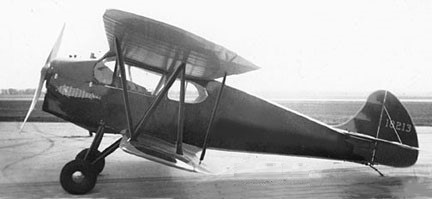
The 1935 Schauss-Lampman Sport was designed and built by Ed Lampman and Al Schauss as a two-place cabin biplane, powered by an 85hp Ford V-8 engine. Fitted with truss wing struts, it was registered N18213, the maximum speed was 120 mph and cruise was 105 mph.
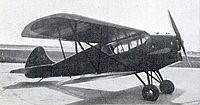
There was a plan to put a few into production but the financial backer passed away and the plan stalled.
It was rebuilt in 1937 as a three-seater powered by an 85hp LeBlond engine.
It was destroyed in a fire by vandals.
Schuass Model A
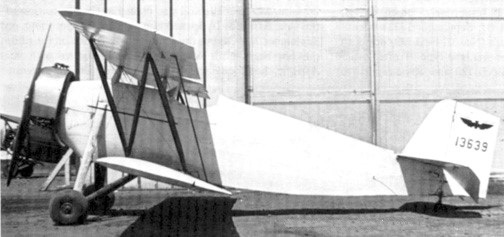
The 1932 Schauss Model A single place biplane was powered by a 35hp 3-cyl Anzani engine and registered N13639.
The Anzani engine was later replaced with a 45hp Szekeley SR-3.
Schuass 1931 Parasol monoplane
Designed and built by Al Schauss in 1931, the two place, open cockpit high wing monoplane was scratch-built with no prior knowledge or experience (even the hand-carved propeller).
This was also the parasol in which Schauss learned to fly (after its test flight by flight instructor Wally Neuman). Powered by a 120hp Salmson 9 engine and registered N10599, it was destroyed in a hangar fire.
Schauss / Schauss-Lampman
Al Schauss,
Minneapolis MN.
USA
1935: Schauss & (Edward C) Lampman.
Built three aircraft during 1931-35.
Schad 1927 monoplane
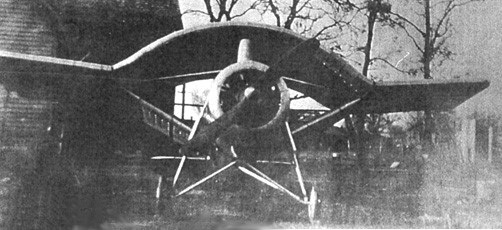
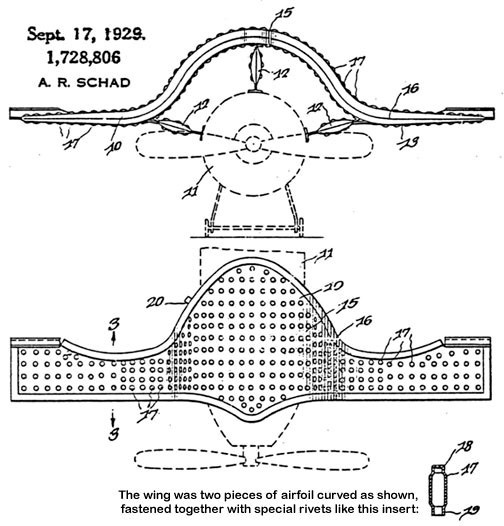
Built by German emigrate Schad, with partners Stacy Ashcraft, J C Bradley, Oscar Ford, Joe Kavecki, and (Mrs) A T Quattlebaum, to prove his unique, patented (#1,728,806) wing design based on Schad’s research, as a baker-turned-boilermaker, of tubular strengths.
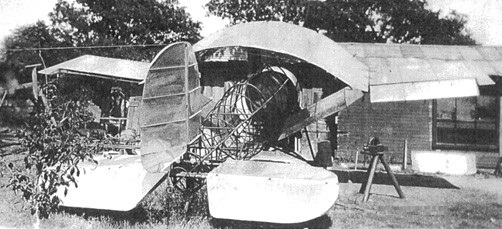
Built circa 1927, the aircraft was a single-place with a steel-tube frame covered with dural, with a war-surplus 80hp Le Rhône rotary engine.
The construction site was Schad’s back yard and the date of the first flight is unknown, but the pilot was Cal Murray. It was flown successfully by Schad and others from Cleburne’s Bluebonnet golf course and, later, Meacham Field, where on its second flight there the tail was broken. Unable to afford a much-needed more powerful engine, no repair was made on the plane and it was stored on a farm, finally dismantled and sold for scrap in 1941.
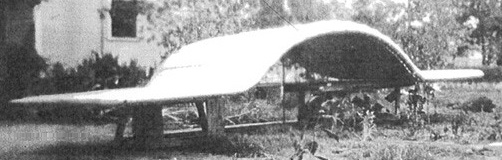
In 1942 the US government purchased the 1929 patent for possible use in the war, but what if anything came from it is unknown, as are data and performance specs for the ship.
Schad, Adolph R
105 Mechanic St,
Cleburne TX.
USA
Airplane builder circa 1927.
1936:
Keene TX.
USA
SCA T-34 / Roma
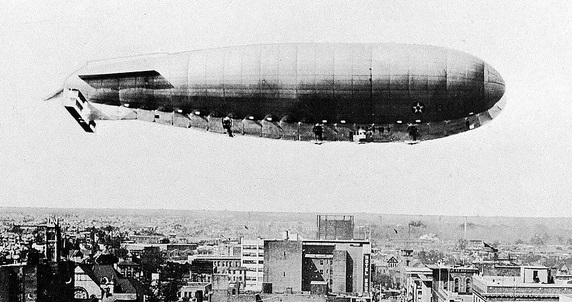
The Italian semi-rigid airship Roma was designed by Celestino Usuelli, the engineers Eugenio Prassone, Umberto Nobile and Colonel Gaetano Arturo Crocco. It was the first project of the Stabilimento Costruzioni Aeronautiche (“Aeronautical Construction Factory”), as the partnership of Umberto Nobile, Usuelli, Giuseppe Valle and Bennetto Croce was known. Originally designated T-34, it was designed for trans-Atlantic crossings and was the largest semi-rigid airship in the world at the tie.
As a semi-rigid design it was built about a rigid keel – though the keel was partially articulated to allow some flexibility. The passenger spaces and control cabin were within the keel. The engines, 400 hp Ansaldos, were mounted outside, angled such that the slipstreams would not interfere with each other. In addition to the 11 cells of hydrogen within its skin, it housed six cells of air, called ballonets, into which additional air could be pumped if the gasbag drooped or flattened.
It first flew in September 1920.
It was purchased by the United States from the Italian government for $250,000 in 1921. After purchase by the US, in March 1921 the Roma flew the 300 miles from Rome to Naples and back carrying the US Ambassador. After transportation to the US, Roma flew on 15 November 1921 with minor problems. When Langley crews unpacked the crated airship that August, they found its fabric skin mildewed and weakened. Six new, American-made Liberty motors, were ordered as replacements for the balky Italian powerplants.
It served in the US Army until February 21, 1922, when it crashed.
The Roma crashed in Norfolk, Virginia on February 22, 1922. The crash was caused by failure of the airship’s box rudder system, which allowed it to maneuver over tight areas. The airship contacted high voltage lines, and burst into flames. A total of 34 were killed, 8 were injured, and 3 escaped unharmed. Among the dead was the airship’s pilot, Captain Dale Mabry.
At 12:45 p.m., the preflight checks complete, 45 souls on the manifest – the crew, a few civilian mechanics, government observers – stepped aboard. The rain had stopped. The temperature had warmed to 46 degrees.
One hundred fifty men gripped lines holding the airship to earth as the Roma’s crew completed last-minute preparations for launch. The Libertys were fired up, then idled. All six worked.
Lines dropped away. The airship swept upward, tail first, then leveled.
At 500 feet, Mabry (the ship’s skipper) ordered cruising speed and, engines roaring, the Roma began making for the Chesapeake Bay. It reached it near the mouth of the Back River. Mabry ordered the ship south along the shoreline, toward Old Point Comfort. The crew waved to people below at Fort Monroe, looked down on the site of the burned Hotel Chamberlin, at crowds on the government pier. The Roma headed out over the water toward Willoughby Spit. The spit was dotted with waving Norfolkians agog at the mammoth craft overhead.
Mabry steered the Roma toward the Navy base.
After passing over the Spit and cruising over the Norfolk Naval Station, crewmembers noticed that the upper curve of the gasbag’s nose was flattening. The Roma, pitched nose-first toward the ground. From far astern came a cry: The keel was slowly buckling. Then another: The tail assembly was coming loose. The Roma began to bullet earthward at a 45-degree angle.
On the ground, sailors and civilian base workers watched the ship’s nose tilt, and warehousemen at the Army’s nearby Quartermaster Depot stepped outside to witness what was, clearly, an airship in trouble.
The skipper could see the greens and fairways of the Norfolk Country Club ahead, beyond the depot and the Lafayette River.
If they could get the Roma that far, they could put it down somewhat safely.
The passengers and crew, meanwhile, began to panic, to toss everything they could get their hands on through the keel’s windows – tools, furniture, spare engine parts. People on the ground watched a shower of equipment fall to earth.
But the Roma’s dive continued. The ground rushing to meet the falling ship was a scrubby field at the depot, split by a small road – and by a high-voltage electric line. The end came in a flash.
The Roma’s nose hit the ground, its massive girth brushed the electric line, and in an instant it was engulfed.
Its gas cells, loaded with more than a million cubic feet of hydrogen, blew to atoms.
The blast set off the ship’s gasoline tanks, creating a pyre of flame and smoke and din that leapt from the field and into the overcast sky.
Depot workers and sailors rushed to the wreckage, but the flames kept them back. Three fire companies spent five hours quelling the blaze, and watched as the Army’s greatest airship shrank to a pile of twisted aluminum that glowed red into the evening.
The event marked the greatest disaster in American aeronautics history at the time. It was the last hydrogen filled airship flown by the US military; all subsequent ships were inflated with helium.
Engines: 6 × Liberty L12, 300 kW (400 hp) each
Length: 125 m (410 ft 0 in)
Diameter: 25 m (82 ft 0 in)
Volume: 33,810 m3 (1,193,000 ft3)
Height: 92 ft
Empty weight: 34,500 kg (76,000 lb)
Useful lift: 19,100 kg (42,000 lb)
Maximum speed: 128 km/h (80 mph)
S.B.P.C.C. DS1 Papillon
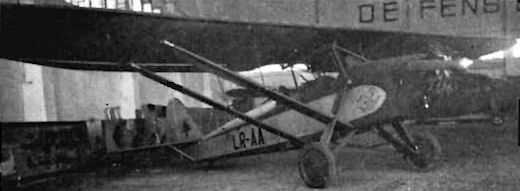
Air France personnel stationed in Damascus during the 1930s, mechanic at the Air France overhaul workshop in Damascus, and four of his work mates designed and built an amateur aircraft. Because of his five “fathers”, it was named S.B.P.C.C. DS1 “Papillon” (Moth).
The aircraft is a high-wing monoplane equipped with a 40 hp Salmson 9 Ad engine from a Klemm. The fuselage is made of molybdenum steel tubes, welded and crossed by piano strings with floor forming box. The front part is made of 0.6 mm duralumin and the rear part is clothed.
The wing is carried by a cabin in profiled and welded steel tubes and by nets in duralumin tubes profiled and covered. The wing is made of wood, consisting of a monospar forming a box with scythe spar to support the fins. The empennage is also made of wood. All the cover is in canvas.
The undercarriage is made of duralumin tubes triangulated by recoil legs. Bungee cords provide cushioning.
The tanks are made of sheet metal of welded aluminum and the controls in steel cables with torsion bar mounted on ball bearings. The aircraft is two-seater in tandem under an open cockpit.
Begun in September 1934, the aircraft flew on November 1, 1935 in Syria. It may never have been officially registered although there has been a pic sporting the S-YRIE registration.
After WW2 it may have gone to Lebanon as the DS-1 Papillon with 1947 registration LR-AAP. It was damaged in the same year.
Engine: 40hp Salmson
Wingspan: 10,00 m
Length: 6,50 m
Height: 2.05 m
Wing area: 14 sq.m
Weight: 320 kg
Max speed: 140 kph at SL
Stall: 45 kph
 All Aero