The first aircraft designed by Societatea de Exploatari Technice (SET) was the Proto SET 2. The prototype, powered by a 450hp (335kW) Lorraine Dietrich radial engine, was test flown in 1927.
Inter-Wars
SET / Fabrica de Avione S.E.T / Societatea de Exploatari Technice
The Societatea de pentru Exploatari Technice (SET) works, founded in 1923 Fabrica de Avione S.E.T as a manufacturing subsidary, and was the third Romanian company to manufacture aeroplanes. Its aircraft production actually started only in 1927 with the SET 3 trainer. Until then, since 1924, only repair work had been performed there.
Developed aircraft designed by Grigore C Zamfirescu for Divisia l-a Aeriana. Designs included S.E.T. 7 biplane trainer, S.E.T. 7K reconnaissance variant, S.E.T. 10 biplane advanced trainer, S.E.T. XV biplane fighter; also made Fleet 10G trainers. SET X was single-seat fighter/trainer biplane; SET XV single-seat fighter biplane with enclosed cockpit, built in small numbers for Romanian Air Force during early 1930s; SET 7 was a specially equipped trainer; SET 7K a reengined observation derivative ordered in series by Romanian Government. Later SET 31 also adopted officially.
Sessions 1925 biplane
In 1925 Claude Sessions built a two-place, open cockpit biplane. Powered by an 80hp Anzani engine, it was built in Owensburg KY.
Sessions 1922 biplane
In 1922 Claude Sessions built a single-place, open cockpit biplane. Powered by an Indian V-2 engine, it featured bicycle wheels and wing-warping controls.
A modified version was built in 1925 at Forsyth IL.
Sessions, Claude
Waynesville IN
USA
And
Owensburg KY.
USA
Built two aircraft, in 1922 and 1925.
Service Aviation Company
USA
Was based at Wabash, Indiana, trading as Sattco. In summer of 1922 built Liberty-engined transport largely from D.H.4 parts. Pilot sat behind cabin in ply-covered fuselage.
Sergant Type A
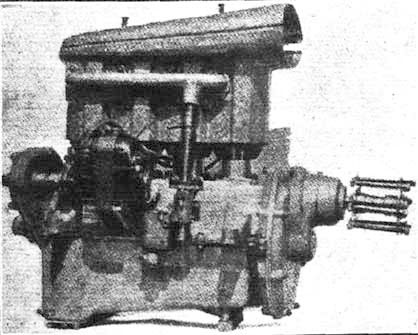
The Sergant Type A is a four-cylinder in-line, separate, air-cooled engine developed in the 1920s.
The housing is made of aluminum, the shaft of mangano-siliceous steel. The valves are in the bottom of the cylinders with rocker arms above.
The lubrication is done under pressure by a gear pump, in the bottom of the crankcase which contains the oil for 5 hours of flight. Distribution by camshaft. Variable advance Scintilla magneto ignition. Fuel supply loaded and Zénith carburetor.
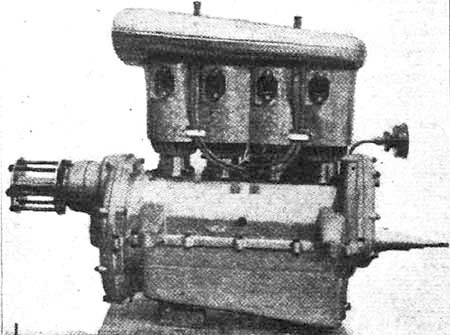
The propeller is mounted on a hub geared down by spur gears, following the steel flywheel wedged on the shaft. The propeller was in direct gear or three reductions were 14/35, 15/34 and 16/33, which at 3200 turns gives the propeller 1275, 1410 and 1540 turns.
The cooling is provided in an original way: a nozzle open towards the front channels the air in a chimney, the shape and section of which distribute the air current equally to all the cylinders which carry vertical fins.
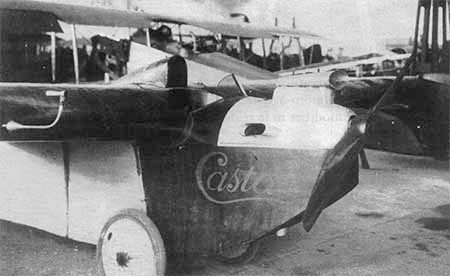
The Poncelet Vivette and Castar could easily be converted into a moto-cruiser by installing a Sergant engine.
4 cylinders in line
Displacement: 760 cc
Power: 16 HP at 3200 rpm, 17.5 hp at 3500 rpm
Bore 54.5 mm
Stroke 80 mm
Weight: 46 kg with accessories and propeller hub
Length with hub: 0.776 m
Height: 0.565 m
Width: 0.34 m
Sellmer Incubator
In 1929 Jacob P Sellmer built the Incubator. A home-built based on a Pietenpol, with a pivoting wing for minimum storage requirement, it was powered by a 28hp Lawrance engine.
Created for use by Sellmer’s son in his duties as a Fish & Game Dept warden, it was a single place, open cockpit, high-wing monoplane, registered N512K.
Sellmer Quadruplane
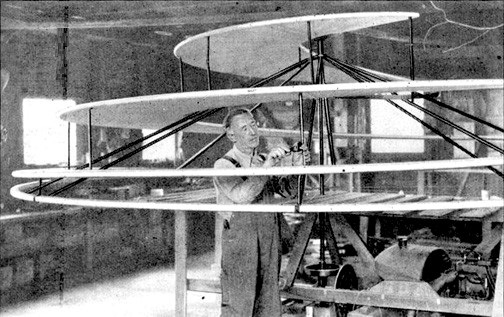
According to the 1932 photo and its press release, this was to be some form of an autogyro with a “large clutch-operated disc” (the spiral “lift”) arrangement. The caption explains: “Runways and landing fields will not be necessary if this creation of J P Sellmer works out. When the motor is started, the lift is started whirling to raise the ship straight up. When the right elevation is reached, the spiral folds up and the engine drives the plane as does any other. In large ships, two spirals are to be provided to eliminate torque, and in small ones, a propeller at the back of the plane will prevent spinning.” How far this grand idea progressed is unknown.
Sellmer, Jacob P
San Rafael CA.
USA
Built a homebuilt in 1929 and Quadruplane in 1932.
 All Aero