Edward F Smith,
354 W Anderson St,
Hackensack NJ.
USA
Built the Smith S-1 and ES-5 during 1928-29.
Edward F Smith,
354 W Anderson St,
Hackensack NJ.
USA
Built the Smith S-1 and ES-5 during 1928-29.

This glider was built by Charlie Smith in 1928 from plans. Mr C Smith was a garage proprietor in Palmerston, New Zealand. The glider was taken to Waikouaiti Beach in 1928 and towed into the air by his daughter Flossie driving his Studebaker car. Flossie is shown with the glider and towrope at the Matanaka end of the Waikouaiti Beach prior to the flight.
It was widely known locally that “Charlie was the pilot, it took off well and flew but as it got higher the wind took it out to sea and Charlie panicked and in getting it back to the beach, crash landed it. This was its one and only flight and thereafter it lay for years among the rafters in Smith’s Garage.
It was of wooden construction with fabric covering doped silver. The mainplane, tailplane and fin were all rectangular as were the rudder and elevators except they were cut away to allow free movement. The fuselage was a circular polygon in cross section.

The Hjordis, named after the heroine of a Norse saga, was designed by Sqn Ldr Mungo Buxton of the Royal Air
Force. Buxton, in partnership with Philip Wills, placed the order for its construction with Slingsby in 1934, but for some reason it never acquired a Slingsby type number. The drawings supplied by Buxton showed all the main features of the proposed aircraft, but most of the details remained to be worked out. A good deal was evidently done in the workshops and never fully committed to paper. Only one of the type was built.
The Hjordis had a cantilever wing of unusually high aspect ratio, strongly cambered and very thick at the root, mounted on a very tall, narrow pylon above the fuselage. Spanning just over 15.5m (51ft) the wing had a slight anhedral angle. Viewed from the front, the undersurface of the wing was flat from tip to tip. The taper in thickness resulted in the upper side of the wing descending. This unusual feature was never explained by Buxton, but he may have thought it would improve response to the lateral controls. There was a small
wheel on the control column instead of the familiar stick to operate the ailerons, as there was insufficient room to move a joystick laterally.
Buxton had in mind the needs of private-owner syndicates who would operate with minimal crew. He aimed to achieve the best possible soaring performance with a relatively modest wing span. A tapered planform was necessary, both to cut tip vortex drag and to ensure adequate depth of spar to accommodate bending loads at the inner end of the cantilever wing. The taper of the Hjordis wing was fairly pronounced, the ratio being about 4:1.
On the Rhonadler, large amounts of negative wing twist or ‘washout’ were used to ensure that the tips did not stall early. Hjordis incorporated similar ideas.
The choice of the thick, strongly cambered Gottingen 652 section for the wing root of Hjordis was influenced by the successes of the famous Fafnir sailplane designed by Alexander Lippisch, The section at the mid semi-span position was one Buxton s own devising, thinner and less strongly cambered than Go 652. From this position the profile changed gradually to RAF.32 at the extreme tips. The layout was cleverly devised so that, geometrically,
the base lines from which the various profiles were plotted remained in alignment, Buxton pointed out that the wing could be built on a flat bench. Each rib would touch the flat surface at two points and would automatically be at the required rigging angle, no complicated blocking up or jigging being needed. Because of the gradual variation of camber and thickness there was 6° of aerodynamic washout, although geometrically there appeared to be none. This stratagem was entirely successful, and tip stalling was never a problem with Hjordis. It was found impossible to make the sailplane spin.
The main wing spar was necessarily massive, the flanges laminated in spruce with plywood shear webbing and hefty steel fittings with horizontal pins to attach the wings separately to the fuselage pylon. A lighter rear spar carried the ailerons. The ribs, with narrow spruce booms and substantial plywood webs to stiffen them, were spaced at a pitch of 8in (203mm). This was less than usual, but obviated the need for intermediate sub-ribs ahead of the main spar. The most unusual feature of the wing was that it was covered with plywood back to the auxiliary spar, when the usual practice at this time was to use ply skin only around the leading edge and cover the rest with doped fabric. The advantages of the extended stressed skin were that the aerofoil section was more accurately preserved and the wing was very much stiffer in torsion.
The total weight of the aircraft was considerably increased, and unlike most sailplanes of the period the plywood covered areas were painted, which added a few more pounds. The colour was light grey, or turquoise grey according to some accounts, rather than white.
The fabric covered areas were clear doped and varnished, which was orthodox practice. After assembly, the gap between the wings was closed with a light plywood fairing. The fuselage was a nearly perfect cigar shape with only slight downward droop of the form near the nose. The usual semi-monocoque structure was employed, with four main longerons supported by circular crossframes and a complete plywood skin. The tall pylon was based on two very robust vertical spars connecting the wing fittings directly to the main skid attachments.
Buxton had seen various types of accidents to sailplanes with pylon-mounted wings. In some cases, when a tip dragged on the ground during a landing, the wing could twist completely off the fuselage. In a touchdown with a little sideways drift, the fuselage might be torn off and rolled under the wing. Minor errors of judgement could thus become bad accidents. The Hjordis pylon was stressed to withstand a side load of half a tonne applied at the skid, and 50kg (110lb) dragging force applied at the wingtip. The tailplane was of the all-moving type, mounted part way up the triangular fin. Hjordis had a large rudder with only a little aerodynamic balancing.
After the end of the 1935 BGA meeting, the editor of Sailplane and Glider reported that the new sailplane ‘seems to have a simply phenomenal performance’. Wills carried off the de Havilland Cup for height gain and the Manio Cup for a pre-declared out and return cross country flight of 38km (23.5 miles).
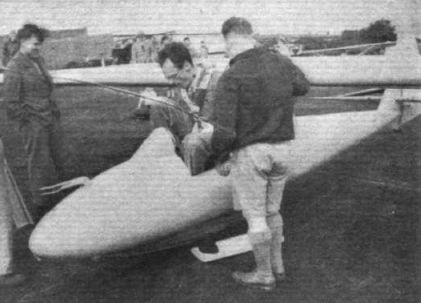
The wing itself, though torsionally stiff, was too flexiblein bending near the tips. After landing, a sailplane tilts over until the wingtip on one side touches the ground. The flexibility of the outer spars allowed the underside to be pressed down on to the surface for some distance, so any stones readily punctured the thin skin. Re- skinning with heavier plywood was necessary. Philip Wills wrote: ‘Quite soon it became apparent that designers have paid too much attention to aerodynamic form and far too little to the shape of the human behind and the needs of the human frame’. He was giving an account of the flight he made in July 1936, which, unpleasant though it was for him, broke the British distance record, 167km (103.5 miles) from Dunstable to the coast south of Lowest oft. The sun beating into the cockpit through the minute talc roof soon gave me a splitting headache. Constant circling and hard work rapidly transformed this into a sick headache. Then came a thirst like the Sahara, closely followed by cramp.’ Relief came only when he ‘burst thickly out of Hjordis’ and sensed ‘the fresh, cool smell of the sea.’ Additional vents were cut. The cramps were reduced a little by chopping out half-moon shaped pieces on either side of the canopy. From this time Wills flew Hjordis with his shoulders sticking out into the breeze.
Buxton himself admitted that the controls were not good. The elevator was too sensitive, and without a trim tab at high speeds the load on the stick was too great. The ailerons were also unsatisfactory. They lacked diagonal stiffeners and so deflected several degrees at the ends under load, giving poor control. The fin was too small. More directional stability was needed.
Probably most serious of all, the Hjordis had no spoilers or airbrakes. Philip Wills was beginning at this time, as he put it, to nibble nervously at clouds, and he had fitted some gyro instruments. On his first serious attempt to circle up blind inside a cumulus, at an Easter meeting in Derbyshire, he lost control within a minute or two. The airspeed indicator went twice round the dial and he ‘burst out of the cloud base in a dive rather over the vertical’ with the Hjordis ‘bellowing like a bull in considerable pain’. The sailplane did not break up, probably owing to the good torsional resistance of the plywood skinned wings.
It had originally been intended to fit an airbrake. The idea was to make the rudder in two pieces, split like a clamshell along the hinge line. When right or left rudder was applied in the normal way, the two clamshells would move together to the same side. To brake, both of the pilot’s feet would be pushed forward and the two shell halves would open out in opposite senses to create high drag. This rudder brake was never fitted. Buxton wrote that among so many new developments this seemed just one too much.
Apart from the dangers of cloud flying without airbrakes, it was a pity that the Hjordis was without even elementary spoilers for landing. Wills damaged it many times because there was no reliable way of getting safely down within a reasonable space. Sideslipping, turning the entire fuselage at an angle to the airflow, could help during the early phases of a landing approach, but the wings had to be levelled well before touchdown. Skimming a few feet off the ground, some extra drag could be created by fishtailing; using the rudder to yaw the aircraft from side to side. This also had to stop before landing. On levelling out and straightening up to flare-out, just when high drag was needed, it was reduced because of the proximity of the ground and its restraining effects on the induced down wash. After a cross-country flight Hjordis would float and float and float across a small field until it hit the upwind boundary or until the pilot deliberately ground-looped to prevent hitting it. In one landing Wills turned it over completely. Buxton mentioned another accident which broke one wing in two and severely twisted the pylon. Only his strong vertical members prevented the glider wringing its neck. There were many other occasions when it had to go back to Slingsby for repairs.
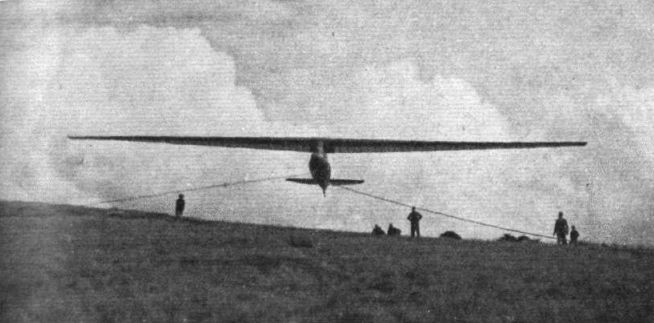
Despite the limitations of his aircraft, Wills had many successes. He captured national records for height gain as well as distance. In the 1936 BGA competitions at Camphill in the Peak District he won the cross-country flying prize, reaching Lincoln. It was not customary at this time to total up the scores and declare a National Champion. Separate prizes were awarded for slope soaring duration flights and gains of height as readily as for distance. It was recognised, nonetheless, that Wills and Hjordis were an outstandingly good combination.
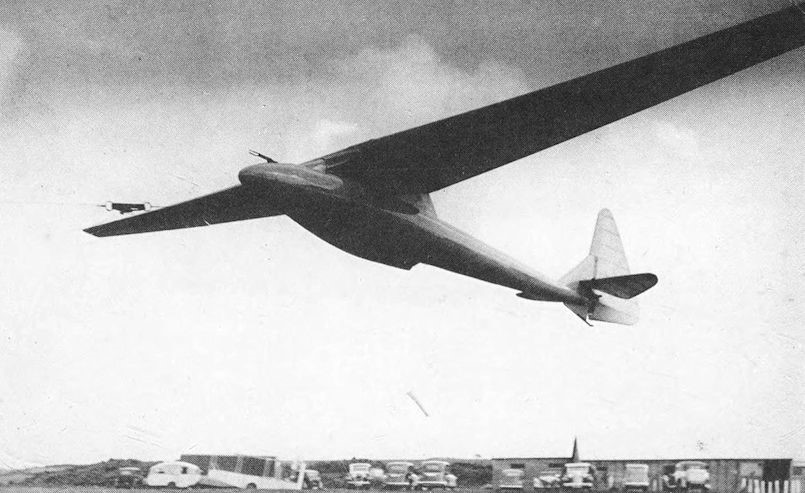
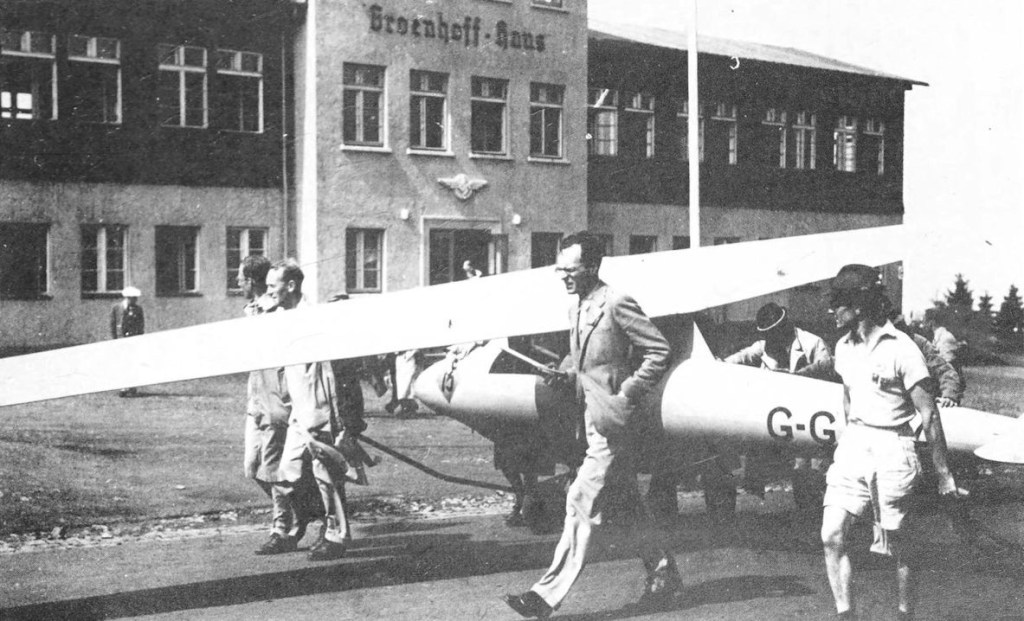
The first truly international soaring championships were held in Germany during July 1937. Five British sailplanes were entered. Wills preferred to take Hjordis, with which by now he was thoroughly familiar, rather than one of the new and, as it proved, unreliable King Kites. Wills placed 14th, exactly halfway down the list. He had his usual problems on landing, ending one flight with the sailplane’s nose in a stream but he and the rest of the British group learned a great deal by observing how the more experienced German and Polish pilots flew. Doubts about the thermal soaring capabilities of their large aircraft were entirely dispersed.
Advertisements appearing in Sailplane and Glider early in 1938 stated:
For sale, HJORDIS, the outstanding British high efficiency sailplane. It holds the British distance and goal flight record, placed first in the 1937 British competitions; holds most of the British Gliding trophies and awards. It has done over 850 miles of cross-country flying (on purpose), has been dived to 125mph in cloud (by accident), is extremely strong (by gum); won the distance trophy (by Wakefield); is in first class condition (by Slingsby); and is for sale by Philip Wills.
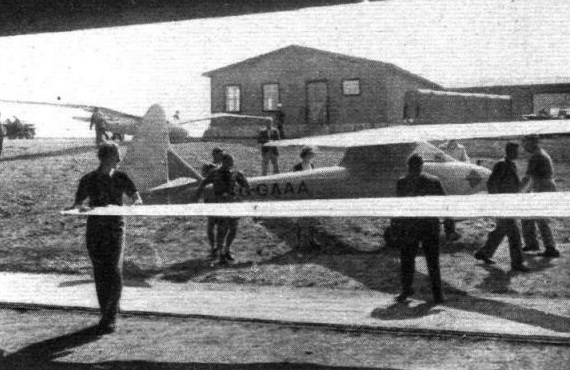
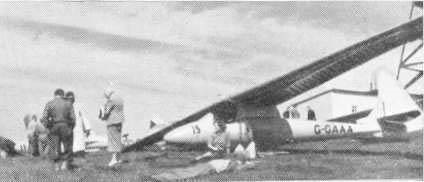
It was bought eventually by Messrs Brink & Horrell in Johannesburg. Very little was heard about its exploits after it left Britain, but it was flown in South Africa for some years. A rare photograph shows that, to begin with at least, it retained its British civil registration letters, G-GAAA, and the 1937 Wasserkuppe competition number 15 remained on the nose. Officially it was registered as ZS-23. It was used late in 1939 by E. Dommisse for a record height climb to 3,600m (12,000ft) above ground, which, since the take-off was from Quaggaport 1,740m (5,800ft) above sea level, represented an altitude of 5,340m (17,800ft) without oxygen breathing apparatus. The last 1,200m (4,000ft) of the ascent were in cloud without blind flying instruments, Dommisse relying on his airspeed indicator and a simple cross-level bubble.
What finally became of Hjordis is not known.
Slingsby Hjordis
Wingspan: 15.54 m (51 ft 0 in)
Wing area: 11.52 m2 (124.0 sq ft)
Aspect ratio: 21
Airfoil: Göttingen 652 at root, RAF 32 at tip
Length: 6.58 m (21 ft 7 in)
Empty weight: 144 kg (317 lb)
Gross weight: 218 kg (481 lb)
Rate of sink: 0.61 m/s (120 ft/min) minimum
Lift-to-drag: 24
Wing loading: 18.9 kg/m2 (3.9 lb/sq ft)
Crew: 1

Frederick N. Slingsbys first glider, the Falcon I, was a version of the Schleicher Falke, built from plans bought from the German Aero Club.
In 1932 he developed the Falcon 3 side-by-side sailplane.
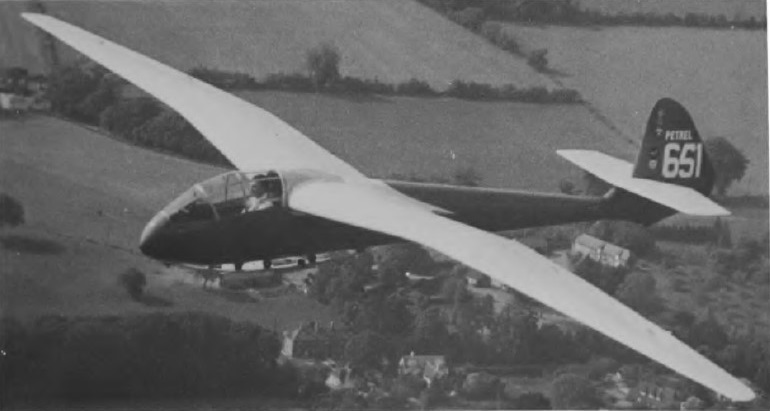
This high performance single-seater was one of the first prewar British attempts to produce a sailplane to rival such well-known German types as the Condor, Rhonadler and Minimoa in terms of performance and aerodynamic refinement. It was, in fact, based on the Rhonadler, with a gull wing of very similar plan form and long span ailerons, with a low wing loading suitable for the rather weak British thermals; no air brakes or flaps were fitted.
Of conventional spruce and birch plywood construction, the Petrel had an all-moving tailplane very similar in outline to the Rhonadler’s in its initial form, but later production aircraft had a larger, broader chord tailplane and elevators with a step in the rear fuselage underneath the tailplane.
The cockpit canopy was of a type later to become commonplace on many sailplanes, flush-fitting and completely faired into the fuselage line without a step, while the landing gear consisted of a long wooden skid under the fuselage, without a monowheel, and a tail bumper.
The Petrel first flew in prototype form in December 1938 and production aircraft, known as the Petrel 1, were offered to customers for a mere £266 in 1939, but only six were built before the war put a stop to further production. Two of these G-ALNP and GALPP, survived the war, the latter later being sold to Eire as IGA101.
T.I3 Petrel
Wing span: 17.3 m (56 ft 9 in)
Length: 7.25 m (23 ft 9.5 in)
Wing area: 16.72 sq.m (180 sq ft)
Wing section: Gottingen 535
Aspect ratio: 17.9
Empty weight: 199 kg (440 lb)
Max weight: 289 kg (637 lb)
Water ballast: None
Max wing loading: 17.3 kg/sq.m (3.54 lb/sq ft)
Max speed: 92 kt / 170 km/h / 105 mph
Stalling speed: 25.5 kt (47 km/h)
Min sinking speed: 0.64 m/sec / 2.1 ft/sec at 31 kt / 58 km/h / 50 mph
Best glide ratio: 27 at 36 kt / 67 km/h / 42 mph
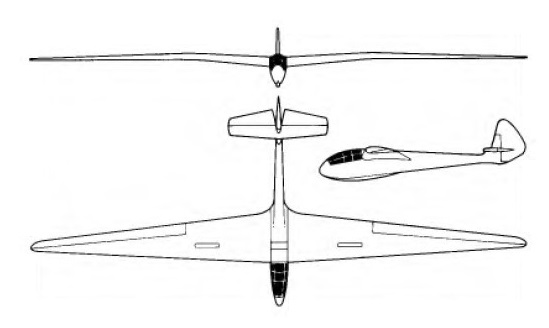
In the late 1930s the gliding movement in the UK did not receive the support from the government that was forthcoming in other European states. Fred Slingsby , John S. Sproule and Mungo Buxton designed the Type 12 Gull to be relatively inexpensive and easy to fly in the hands of the inexperienced pilots in the UK. Slingsby had had a bad experience with the Type 9 King Kite entering incipient spins at low airspeed which was ascribed to the use of a NACA 4312 aerofoil section at the wing-tips, so he designed the Gull with a modified RAF 34 profile at the tips. The cause of the wing drop problem on the King Kite was later found to be inaccurate manufacture, but the Gull retained the modified RAF 34 section.
Construction of the Gull aircraft was of semi-monocoque wood and plywood throughout, with a mixture of plywood and fabric skinning and covering. The wings were skinned with plywood forward of the main spar to form torsion boxes which increased their rigidity. They had a distinctive gull wing form, as the inner 2 metres carried marked dihedral out to the attachment points of the lift struts to the wing spars. Beyond, the wings lacked dihedral. The rectangular planform of the inner wings included the gulled portion and 2 metres beyond, with spoilers in the upper surface outboard of the gull joint in some later aircraft. Ailerons filled the trailing edge of the tapered outer wings.
The cockpit was enclosed with a faired multi-panel canopy which was removed for entry and egress. Ten Gulls were built, nine by Slingsby at Kirbymoorside and one by Herman Kursawe in the United States, from plans supplied by Slingsby.
The Gull 1 first flew in 1938, spoilers were fitted to all Gulls after the first production example, and in 1939, a Gull flown by Geoffrey Stephenson was the first sailplane ever to cross the English Channel in true soaring flight.
A Gull 1, originally the prototype and sold to Australia before World War II and later registered VH-GHL is on display at the Aviation Museum of Western Australia, Bull Creek near Perth, Australia.
The design was developed in 1939 to include what Slingsby called the cantilever Gull, designated as the T15. More commonly known as the Gull III, it had a slightly higher performance, and was fitted with spoilers on the upper surfaces of the wing. Built in 1939, it was not until January 1940 that the type first flew, and was such a success that Slingsby intended to put the type into production once the War was over.
With the tight post-war economy within Britain, gliders of simplified production quickly became a factor in being able to produce cost-effective sailplanes. This led to the Gull 4, which had a more conventional, less complicated straight wing.
The only Gull III to be built survived the war, and it went on to have a long and distinguished career, and was owned at one point by Prince Bira of Siam, who was at the time the World Motor Racing Champion. Bira had bought the Gull III in 1944 and flew it in the company of his dog on many epic flights, including one to 12000 ft.
The Gull III was later bought by a syndicate at the Oxford Gliding Club operating out of Weston on the Green. After a long rebuild, it was finally flown again in 1973. Its C of A expired again in July 1974 because its wing had been damaged by damp (casein glue failure) during the previous winter, when it had been left out in its closed trailer at St. Mary’s Farm, Clifton, near Deddington, Oxon. Restored in the 1980s by Mike Beach, it was initially loaned to Brooklands Museum as a non-flying exhibit but was later bought by the Museum in 1998.
There is one other Gull III in existence. Often referred to as the Gull 3 ½, this Gull is a faithful replica that was made from drawings that had come from Slingsby’s during the 1970s, with the drawings being developed for the project by a worker at Slingsby’s. The project was the brain-child of the late Mike Garnett, and completed by members of the Bowland Forest Gliding Club. It flew from Bowland Forest until 2011 when it was purchased by the current owner and moved to Lincolnshire. This Gull is currently the only airworthy example of either the Gull 1 or Gull III left in Britain. The only other airworthy Gull 1 went to the United States in 2010.
Variants
Slingsby T.12 Gull I / Blue Gull
Initial prototype and nine production gliders with strutted gull wings.
Slingsby T.14 Gull II
Enlarged Gull with two seats side by side, only one built.
Slingsby T.15 Gull III
Specifications:
Gull 1
Wing span: 15.33m / 50 ft 2 in
Wing area: 14.86sq.m / 160sq.ft
Airfoil: root: NACA 4416, tip:RAF34 (modified)
Length: 21 ft 8 in (6.61 m)
Empty Weight: 172kg / 384lb
Payload: 240lb /111kg
Gross Weight: 624lb / 283kg
Wing Load: 3.91lb/sq.ft / 19.1kg/sq.m
Aspect ratio: 15.8
Airfoil: NACA 4416
No of seats: 1
L/DMax: 24 @ 77 kph / 41 kt / 48 mph
MinSink: 142 ft/min / 0.72 m/s at 37 mph / 59.5 km/h / 32.2 kt
Never exceed speed: 80 mph / 70 kt / 129 km/h
Aerotow speed: 60 mph / 96.6 km/h / 52.1 kn
Winch launch speed: 50 mph / 80.5 km/h / 43.4 kn
G limits: +4.9
Number built: 10
Structure: strut-braced wood/ fabric wings, wood/ fabric tail, wood fuselage.
In 1938, at Kirbymoorside, Yorkshire, Slingsby Sailplanes Ltd built the Kirby Kitten single-seat monoplane, designed by F. N. Slingsby.
The initial layout of the Buxton Hjordis 2 were commenced by Mungo Buxton but it was built as the Slingsby T.9 King Kite. Many of the King Kite drawings were entitled Hjodris 2 (King Kite).
Slingsby had had a bad experience with the Type 9 King Kite entering incipient spins at low airspeed which was ascribed to the use of a NACA 4312 aerofoil section at the wing-tips, so he designed the Gull with a modified RAF 34 profile at the tips. The cause of the wing drop problem on the King Kite was later found to be inaccurate manufacture, but the Gull retained the modified RAF 34 section.
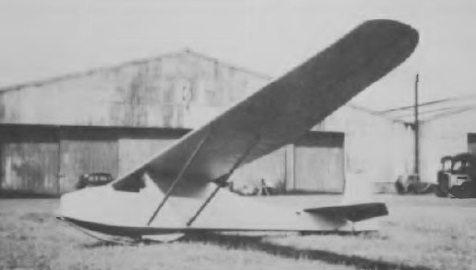
The T8 Tutor single-seater introduced in 1937 was an improved version of the Kirby Kadet with a new two-spar wing of increased span (43ft 3.75in) and tapered outer wing panels married to the same wooden fuselage and wooden tail unit with braced tailplane as the Kadet’s. At the same time a differential mechanism was introduced into the aileron control circuit. This wing was capable of being fitted to the Cadet TX Mk 1, most of which, by the early 1950s, had been converted to Tutor standard as the T8 Cadet TX Mk 2 by the fitting of this wing.
The Tutor prototype first flew in July 1937 and seven examples had been built by the outbreak of war; it re-entered production after the Cadet to meet the demands for an ATC trainer, and 62 more were built in the war as the Cadet TX Mk 2.
Total Tutor production was 106, and the price had risen from £99 10s (£99.50) in 1939 to £360 ex-works in 1948. A two-seater version for teaching the initial stages of flying, and suitable for the circuits and bumps of training, was the T31 Tandem Tutor.
Variation:
Osbourn Twin Cadet
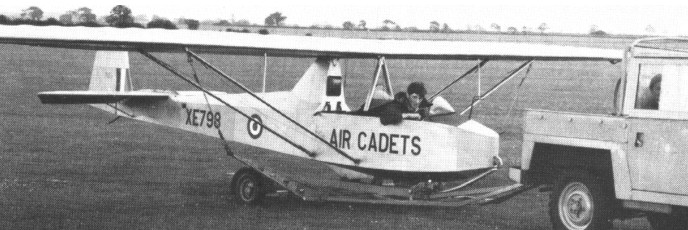
This single-seat intermediate trainer was originally designed by John S. Sproule in 1935 as a soarable version of the Slingsby T3 or Nacelled Primary glider, and was at first known as the T7 Kirby Kadet.
It first flew in prototype form at Sutton Bank on 11 January 1936.
It was of conventional wood and fabric construction, with a high-set, braced, two-spar constant chord wing that was, in fact, interchangeable with that of the later T8 Tutor; no flaps or air brakes were fitted, and the ailerons were fabric-covered. The plywood-skinned wing was mounted on a built-up centre portion of the fuselage, in front of which the pilot sat in an open cockpit. Early examples had a rubber shock absorbed skid for takeoff and landing, but later versions had a modified nose, a less tall rudder and a fixed main wheel and a tailskid. The Cadet’s Gottingen 426 wing section gave it gentle stalling characteristics and good lift at low speeds and this, allied to a simple design making for ease of repair as well as manufacture, made it an excellent trainer.
Only 22 Kadets had been built when the war put a stop to production, the price of a new one being £93 in 1939, which had risen to £325 by 1948, but the type was put back into production with an Air Ministry order for 200 for use by the ATC, the first aircraft from this order, later to be known as Cadet TX Mk 1s, being built in 1943; the ATC variant differed slightly from the prewar civil Kadet in having reduced rudder height and a monowheel in the fuselage as well as the nose skid. The ATC’s predecessor, the Air Defence Cadet Corps, had given its cadets some instruction at British gliding clubs before the war, but this stopped when war broke out, and it was not until 1942 that the first ATC gliding school was opened at Kirbymoorside, Yorkshire, where the Slingsby works were located, and an instructors’ course was started.
By December 1945 the ATC had 84 gliding schools with over 600 Service and civilian instructors, and about 4,500 cadets had received some gliding instruction, as well as instruction in winch-launching, and an equal number had reached the top proficiency stage of their training. The Royal Air Force air cadet training program eventually acquired 376, known as the Kirby Cadet T.X. Mk. 1.
During World War II, Total production by Slingsby and subcontractors (including Ottley Motors Ltd., a batch of 30) amounted to around 430, with some kits being supplied in addition. Plans were made available for license building.
Altogether 226 Cadets were built during the war by Slingsby and three other subcontractors, of which Martin Hearn Ltd of Hooton Park, Cheshire, was the most important; this firm also built 27 of the postwar production for gliding clubs, which brought the total built since 1936 to 431.
By the early 1950s most Cadet TX Mk 1s had been converted to Tutor standard (the RAF Kirby T8 Cadet TX Mk 2) by fitting the Tutor’s longer span (13.24 m / 43.4 ft) tapered wings. This in turn evolved into the T.31 Tandem Tutor (RAF Kirby Cadet T.X. Mk. 3) two-place trainer. Spare T. 7 Kirby Cadet TX Mk 1 wings were used to produce the Slingsby T38 Grasshopper TX Mk 1 post war, which was a version of the SG 38 primary glider with a simplified open-framework fuselage, modified tail unit and the surplus Cadet wings; production began in 1952 and 115 Grasshoppers were built.
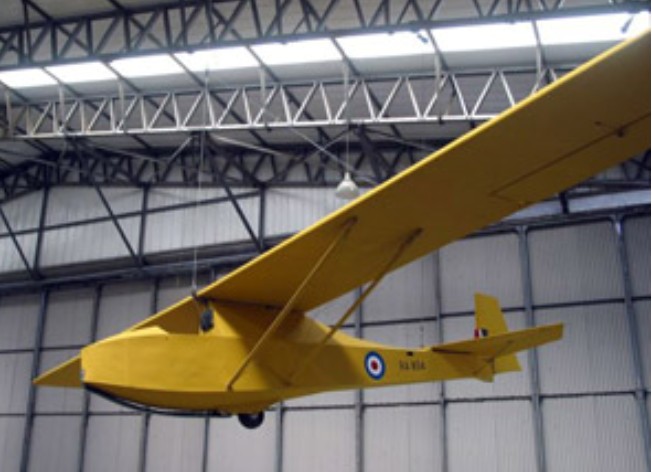
Variation: Cadet Aeronautics Cadet UT-1
Cadet TX Mkl
Wing span: 11.73 m / 38 ft 6 in
Wing area: 15.8 sq.m / 170 sq.ft
Length: 20 ft 10.5 in
Empty Weight: 134 kg / 295 lb
Payload: 218 lb / 99 kg
Gross Weight: 513 lb / 233 kg
Wing Load: 3.02 lb/sq.ft / 14.75 kg/sq.m
Aspect ratio: 8.67
L/DMax: 14 @ 48 kph / 26 kt / 30 mph
Best glide ratio: 16:1
Airfoil: Go 426
MinSink: 1.07 m/s / 3.5 fps / 2.07 kt at 32 mph
No. of Seats: 1

