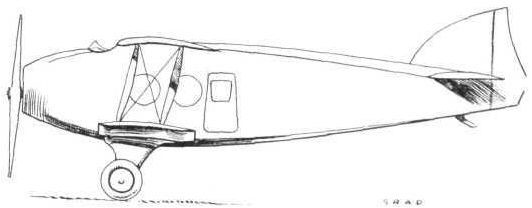
The 1927 S.R.A.P. T.7, also known as the Béchereau S.R.A.P. T.7 or Salmson-Béchereau S.R.A.P. T.7, was a two-bay biplane. Nine were built, powered by a 520 hp Salmson 18CMb radial engine, with a 16.90 m wingspan.
The 1927 S.R.A.P. T.7, also known as the Béchereau S.R.A.P. T.7 or Salmson-Béchereau S.R.A.P. T.7, was a two-bay biplane. Nine were built, powered by a 520 hp Salmson 18CMb radial engine, with a 16.90 m wingspan.
A two-seat monoplane powered by a 500hp Salmson engine.
Established at Billancourt in 1926 to build aircraft to the design of Louis Becherau, formerly with Deperdussin and SPAD. First production design was the C.2, a two-seat monoplane powered by a 500hp Salmson engine.
The Paris-based S.R.A.P. is often listed as the ‘Société pour la Réalisation d’Appareils’. Flight truncated the name as ‘Société pour la Réalisation d’Avions’. However, ‘Prototypes’ seems important as it suggests that S.R.A.P. did not intend to manufacture aircraft designs in series.
In early 1930s licenced to build Netherlands-designed Koolhoven F.K.43 four-seat high-wing monoplane as SAFA F.K.43.
Italy
Forerunner of the Siai-Marchetti organization (see Siai-Marchetti Societa Per Azioni). Founded 1915 by Luigi Cape at Sesto Calende, with a seaplane base on Lake Maggiore. As Idrovolanti Savoia built FBA flying-boats under license. Name “Savoia”had a geographical and historical connotation (House of Savoy), and after the war new flying-boats were known by the name Idrovolanti Savoia, or Savoia. These achieved early distinction, notably in the 1920 Schneider Trophy contest. Names Savoia and Marchetti were linked in 1922, when Alessandro Marchetti became technical director of company renamed Societa Idrovolanti Alta Italia—Savoia-Marchetti. In 1925 the company gained publicity when an S.16ter was flown to Australia and Tokyo and back to Italy by Francesco De Pinedo. Famous types included the twin-hulled S-55 which, though first flown in 1924, is remembered chiefly for General Balbo’s mass-formation flights of 1930 and 1933. Special long-range landplane S-64 broke world’s duration and distance records in June 1930. Initials S. M. for type numbers were not commonly applied until later, and then particularly in association with fast 3-engined civil and military types. Most famous was S.M.79 bomber and torpedo bomber of Second World War. Civil types included the record-breaking S.M.75 of 1939. Last Second World War aircraft was S.M.91 twin-boom fighter-bomber, but S.M.84 bomber served as transport until 1948.
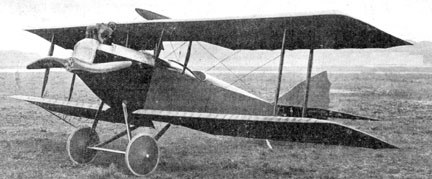
The 1921 Snyder-Macready Baby Bomber designed by O H Snyder was a single-place, open cockpit biplane, powered by a chain-driven 18hp Indian engine The Indian motor which had previously been in the builder’s motorcycle. The propeller was driven through a chain and sprocket reduction gear.
The landing speed was 20 mph and the plane usually stopped within 40 feet after touching the ground.
Of all-wood construction, it was popular with home-builders of the time, with plans published in magazines.
Engine: 18hp Indian
Wingspan: 21’7″
Length: 16’6″
Useful load: 186 lb
Max speed: 62 mph
Cruise: 50 mph
Stall: 35 mph
Seats: 1
Orville H Snyder & Lt John A Macready
Dayton OH.
USA
Built the Snyder-Macready Baby Bomber in 1921.
The high share price that G&R commanded prevented it from being nationalized before the war. However, this did come to pass after the Liberation. SNECMA, la Société nationale d’étude et de construction de moteurs d’aviation, was thus created on May 29, 1945. The company was an amalgamation of diverse design bureaus and workshops; it inherited a work force of 10,000 mostly part-time employees. Along with G&R, Snecma was given some of the factories of the Société des moteurs et automobiles Lorraine, formerly Lorraine-Dietrich, which had been nationalized as la Société nationale des moteurs and had been relegated to making parts for tanks. Some of Snecma’s other facilities had been devoted to the production of German Junkers engines by the thousands during the Nazi occupation. G&R also owned a factory of the Aéroplanes Voisin firm, which had gone bankrupt in 1938.
Unfortunately, the British government preferred to grant licenses for the newly acquired jet engine technology to rival Hispano-Suiza in the immediate postwar period. Snecma immediately after World War II suffered many of the same disadvantages as G&R had immediately after WWI. It was not until 1950, writes Chadeau, that budgetary crisis forced a restructuring that closed unproductive plants and re-equipped modern ones to give the firm some hope of a future.
The French made contact with Herman Oestrich, the chief designer of the German BMW factory, and smuggled him out of the American occupation zone into the French zone and then into France itself, giving him every technical support in return for his skills. By 1948 Oestrich had produced his first jet engine; the Atar
Given their already apparent importance in the future of military aviation, jet engines were the prime focus of Snecma’s development in the 1950s. However, the company did not abandon propeller-driven aircraft. In 1951, the firm acquired a license from the Bristol firm to produce the 2,080 h.p. Hercules engine for use in Noratlas military transports; nearly 1,400 of these were produced by 1964.
The creation of jet engines in the World War II propelled planes allowed a huge leap in aircraft performance. However, in the period immediately after the war, the devastated nations of Europe were unable to match American and Soviet research into jet engine design until the middle of the 1950s. A group of 120 former BMW engineers were assembled in the French controlled sector of Germany in 1946 and integrated into the Snecma team in France in 1950. From their efforts sprang the ATAR series of military engines, the first of which was created in 1948. Their first test of an engine equipped with afterburner came in 1953. The SO-4050 Vautour was the first plane powered by these engines; other better-known fighters such as the Mystère and Super-Mystère, and Mirage III, IV, and V. Planes powered by these engines set several speed records and enjoyed a lively export trade.
Meanwhile, Hispano-Suiza had been producing jet engines under license from Rolls-Royce, including the famous Tay engine, which it began building in 1954. The next year, it introduced its own turbojet, known as the Verdon, which was installed in Mystère IV aircraft.
Another French firm, Turboméca, was making quite low-powered jet engines, though in 1960 it began producing the Adour engine for the Jaguar fighter in cooperation with Rolls-Royce. Turboméca also produced engines for turboprops and, most notably turbine-driven helicopters, which it supplied to a variety of French and foreign firms. Yet another firm, Microtubo, was launched in 1961 to produce small turbojets.
While Hispano-Suiza and Turboméca were signing deals with Rolls-Royce, in November 1959 Snecma entered a contract to produce Pratt & Whitney’s popular JT8-D engine in France. The JT8-D powered several American military jets as well as the DC-8 and Boeing 707 airliners. Snecma signed an agreement with Bristol Engines in November 1962 to develop the Olympus engines for the Concorde supersonic transport.
In 1968, Snecma took control over Hispano-Suiza, which included the mechanical engineering firm Bugatti, the landing gear manufacturer Messier, and the engine maker Berthiez. All of these were at the edge of ruin.
Even though only a few examples of the Concorde would be produced, Snecma gained considerable experience and prestige through its participation. In 1969, the firm had begun development of its M56 engine, which would first appear on the market in 1976. An even more far-reaching program was launched in 1971 with General Electric, which was eager to break Pratt & Whitney’s domination of the U.S. market.
In this agreement, Snecma was to produce 20 percent of GE-s type CF6 engines (CF meaning “commercial fan”), which were destined for use in several Boeing airliners. In addition, they would also be used in the first planes made by Airbus Industrie, the new European consortium created to challenge U.S. control of the industry. A second contract provided for the joint production of the CFM 56 engine. The CFM International joint venture was formally created in 1974.
Snecma expanded its role in the CFM program after the CF6 engine was chosen for both the Airbus A310 and Boeing 767. In late 1980 Snecma and GE began planning a new $30 million plant in France to accommodate its production.
The French government mandated the merger of the Société Européenne de Propulsion (SEP) with Snecma in 1984. SEP produces rocket engines used in the Ariane space program and was merged with Snecma due to concerns it could not meet increasing production demands. By 1985, Snecma was taking a half share of CFM contracts, including a $2.7 billion order for 137 engines to re-equip the U.S. Air Force’s aerial refueling fleet.
The unprecedented airline industry downturn recession in the early 1990s resulted in consolidation among suppliers. In early 1994, Snecma merged its Messier-Bugatti landing gear subsidiary with Dowty, owned by the United Kingdom’s TI Group. Messier-Bugatti was effectively privatized for the merger. However, the two cultures of the merged parties clashed; TI Group exited the Messier-Dowty joint venture by the end of 1997.
In the mid-1990s, Snecma’s engine business was encountering its first civil market downturn ever, according to CEO Gerard Renon. It lost $100 million on sales of $1.8 billion in 1993. Workforce cuts and other measures were taken to increase productivity and shorten production cycles. Employment was reduced from 14,000 in late 1990 to 11,500 in December 1996.
A unique four-way alliance between Snecma, GE, Pratt & Whitney, and MTU to develop a small jet engine fell apart in September 1994. Meanwhile, CFM’s market share of engines for larger jets approached 70 percent.
When Jean-Paul Bechat became Snecma’s new head in the summer of 1996, following the brief reign of Bernard Dufour, he stated the company was close to bankruptcy and full of conflict. However, within a year things were closer to normal–operating profit rose 70 percent, to Ffr 440 million in 1996.
After losing Ffr 280 million in 1996, Snecma posted a net profit of Ffr 750 million ($122 million) for 1997. Exports accounted for about 70 percent of turnover, with more than three-quarters of these coming from the civil sector.
As the lifespan of jet engines increased, scheduled maintenance became a more important source of business. A new division, Snecma Services, was created in January 1997, which offered support services for landing systems and engines. By 1999, it had sales of $400 million and 2,000 employees. The Snecma group as a whole reported revenues of $5.3 billion for 1999. That year, CFM International celebrated the delivery of its 10,000th engine; the joint venture was widely held to be the most successful Europe-U.S. collaboration ever.
Snecma was converted into a holding company in January 2000. Snecma Moteurs was created to consolidate its air and space propulsion operations. Later in the year, Snecma acquired Labinal group for $1.1 billion but sold off its automotive businesses. Part of Labinal’s holdings included Turbomeca, which produced nearly $1 billion worth of turbine engines for helicopters and fixed-wing military planes. Snecma also acquired the British engine nacelle/thrust reverser manufacturer Hurel-Dubois in 2000, which it soon consolidated with Hispano-Suiza to form Hurel-Hispano.
Between 1995 and 2000, sales rose 100 percent, reaching FFr 36.9 billion (EUR 5.65 billion), mostly on the strength of acquisitions. Exports accounted for most of the increase, while rapidly growing commercial sales accounted for 84 percent of the total.
Plans to privatize Snecma were developed throughout 2001. A merger of Snecma’s ballistic propulsion activities with those of rocket engine and munitions manufacturer SNPE, was also under consideration. The French government planned to sell off a quarter of Snecma in an Initial Public Offering if market conditions were favorable, hoping to garner EUR 1.5 billion from the sale. These plans were put on hold after the September 11 terrorist attacks against the United States produced a downturn in the markets. The EUR 500 million SNPE merger, dubbed the Herakles project, had begun to fall apart over the question of leadership.
During the year, Snecma entered a joint venture with Rolls-Royce to produce engines for the next generation of European military aircraft. It had also tapped low-cost, quality Russian engineering talent from NPO Saturn to develop a new engine for regional jets. A collaboration between Snecma and FiatAvio (Italy), ITP (Spain), MTU Aero Engines (Germany), Rolls-Royce, and Techspace Aero (Belgium) was developing a turboprop engine for the Airbus A400M military transport. Meanwhile, Snecma Services entered a maintenance, repair, and overhaul venture with Sabena Technics.
Snecma was renamed Safran Aircraft Engines in 2016 as the main subsidiary of Safran. The Safran Aircraft Engines is headquartered in Courcouronnes, France. It has 15,700 employees working at 35 production sites, offices, and MRO facilities worldwide. It files an average of nearly 500 patents each year.

When the nationalisation of the French aircraft industry resulted in the creation of the Société Nationale de Constructions Aéronautiques du Centre (SNCAC) from the merger of Farman Aviation Works and Hanriot in 1936, the new company inherited Farman’s experience in high-altitude research, and this research continued.
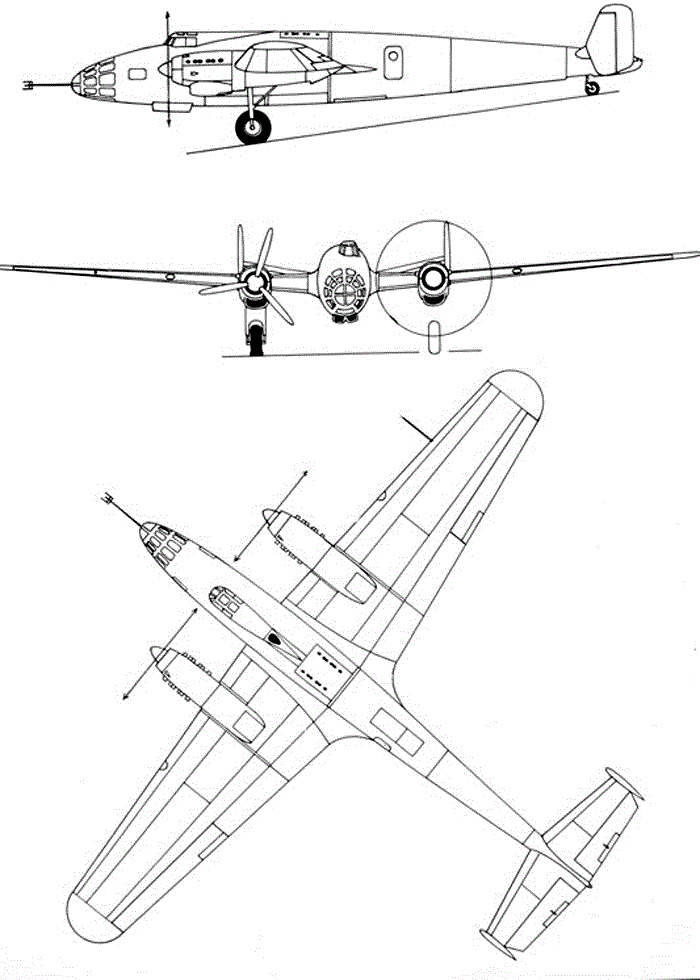
SNCAC continued work on high-altitude aircraft, proposing two pressurised bombers in 1938. The first, the NC.140, was a four-engined bomber using the wings of the Farman F.223.3 but was quickly abandoned in favour of the smaller, twin-engined NC.150. The NC.150 was a mid-winged monoplane with a retractable tailwheel undercarriage which was designed to make maximum use of non-strategic materials such as wood. The wings were of mixed construction, with a metal centre-section, and wood outer wings that had metal spars, wooden ribs and plywood skinning. Similarly, the fuselage had wooden forward and aft fuselage section connecting to the metal centre section, while the twin tail was of wooden construction with plywood skinning. It was to be powered by two Hispano-Suiza 12Y V12 engines, with power being maintained at high altitudes by using a single three-stage supercharger driven by a separate Hispano-Suiza 12X engine mounted in the fuselage.
SNCAC began work on two prototypes as a private venture in 1938. These two prototypes were not to be fitted with cabin pressurisation, although this was planned for a third prototype. The French Air Ministry placed an order for the two prototypes on 24 April 1939, with the second aircraft to carry full armament.
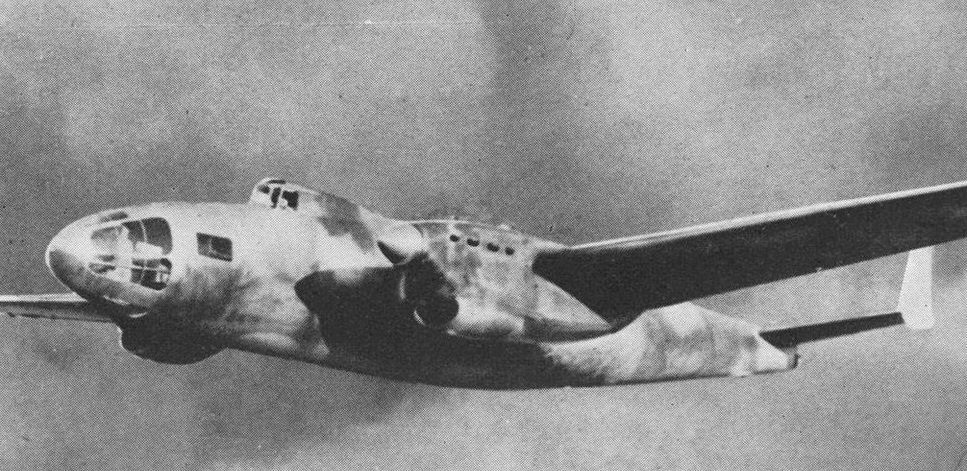
The first prototype, designated NC.150.01, made its maiden flight from Toussus-le-Noble on 11 May 1939. Following the tests, the aircraft received numerous improvements: modifications of compressors, addition of a glass nose, and modified rudders.
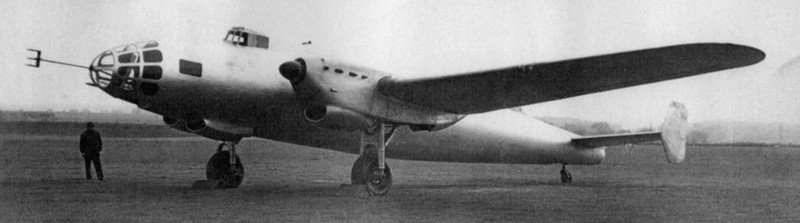
Meanwhile, the French Air Ministry had become worried about possible delays to the Lioré et Olivier LeO 45 and Amiot 354 twin-engined bombers which were planned to re-equip the medium bomber squadrons of the Armée de l’Air caused by shortages of light alloys, and after successful testing in early 1940, ordered a change of plans. Pressurisation was to be abandoned, and the unusual central supercharger with its dedicated engine (known as the “bi-tri” concept) was to be replaced by individually supercharged engines.
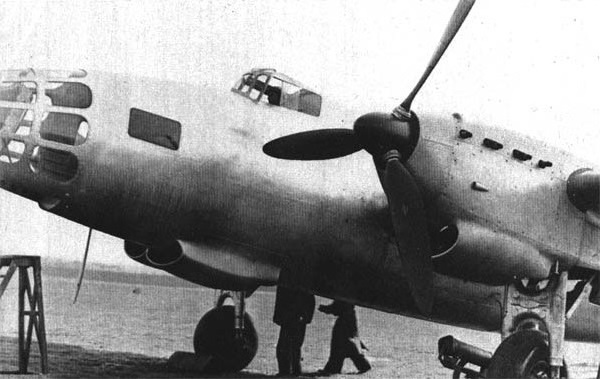
The NC150 was transferred to the CEMA (Test Center of the Air Materials) at the beginning of 1940, while the construction of the second prototype, equipped this time, of its armament. The events called into question the project and it was asked the SNCAC to abandon the pressurized bi-tri formula in favour of more conventional formulas using Hispano-Suiza 12Y compressor or Pratt & Whitney Double Wasp engines respectively NC152 and NC153.
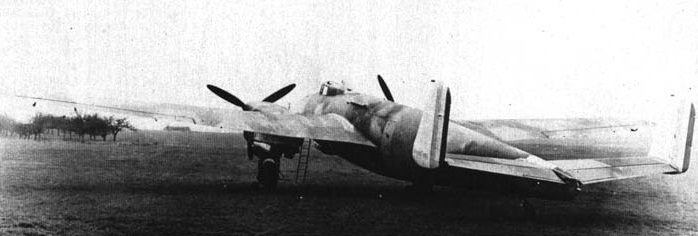
Two production versions were planned, the NC.152, powered by Hispano-Suiza engines, and the NC.153, with imported American radial engines. Although testing was promising, and orders were planned for a modified version as a back-up for the Lioré et Olivier LeO 45 and Amiot 354 bombers, the surrender of France in June 1940 ended development with only the single example being built, both the second and third prototypes being abandoned before completion. The first prototype, NC150-01, disappeared after its evacuation on Bordeaux-Mérignac, the second one was never finished, and the third, NC151-01, which was to be the final prototype equipped with pressurization, never came into being.
NC.150
Powerplant: 2 × Hispano-Suiza 12Y 32/33, 720 kW (960 hp) each
Powerplant: 1 × Hispano-Suiza 12Xirs liquid-cooled V12 engine driving NC-C2 supercharger, 510 kW (690 hp)
Wingspan: 21.882 m (71 ft 9.5 in)
Wing area: 61.10 sq.m (657.7 sq ft)
Length: 17.60 m (57 ft 9 in)
Height: 4.19 m (13 ft 9 in)
Empty weight: 7,733 kg (17,048 lb)
Gross weight: 10,077 kg (22,216 lb)
Maximum speed: 600 km/h; 324 kn (373 mph) at 8,000 m (26,250 ft)
Cruise speed: 510 km/h; 275 kn (317 mph) at 8,000 m (26,250 ft) (long-range cruise)
Range: 2,200 km; 1,188 nmi (1,367 mi)
Service ceiling: 11,380 m (37,350 ft)
Time to altitude: 19 min 7 s to 8,000 m (26,250 ft)
Crew: Four
In 1934 Everett Smith, W A McCurdy, and Arthur Lardin built the Smith-McCurdy-Lardin AL-1. It was a single-place, open cockpit monoplane, powered by an 85hp DH Gypsy engine, and registered NX12Y.
The registration was cancelled on 1 November 1937.

