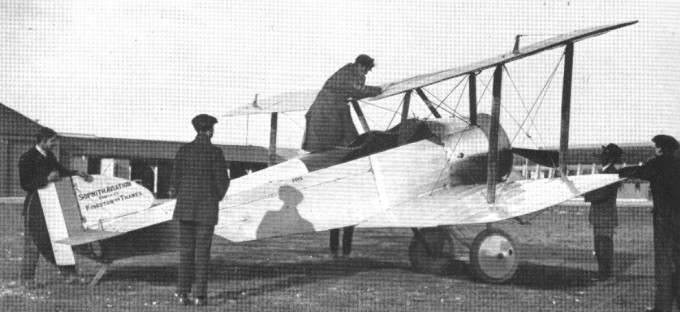
Post WW 1 Sopwith transformed the Pup fighter into the Dove lightplane.
Post WW 1 Sopwith transformed the Pup fighter into the Dove lightplane.
The Sopwith Aviation Company Ltd in Kingston-on-Thames was founded in a shed at Brooklands in 1912 by Tommy, Thomas Octave Murdoch Sopwith.
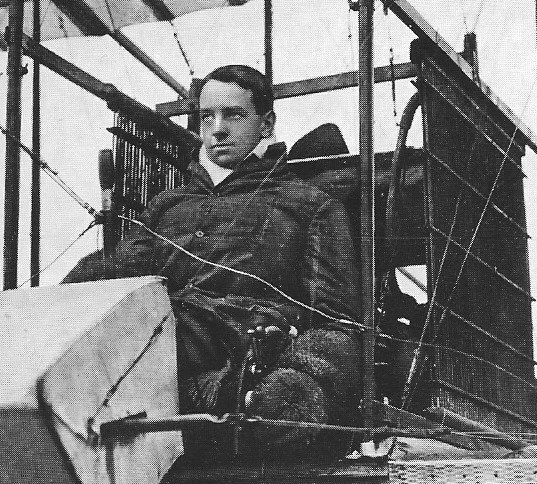
Sopwith rebuilt early aircraft before First World War, began development of own types and formed important associations with F. Sigrist (engineer and largely responsible for future success) and H. G. Hawker (pilot). Company registered March 1914.
Bat Boat of 1913 was notable flying-boat and Tabloid landplane of same year gained renown as floatplane by winning 1914 Schneider Trophy. Wartime developments were Schneider and Baby floatplanes.
Became world famous for fighter aircraft, built in great numbers by many companies, though first landplane fighter built in great numbers was two-seat 1 1/2-Strutter. Pup was smaller single-seater. Triplane of 1916 excelled in climb. Two-gun Camel, in service 1917, excelled in maneuverability; shipboard version had detachable rear fuselage. Cuckoo of 1917 was world’s first deck-landing torpedo-bomber. Snipe was intended to succeed Camel late in war, and remained in RAF service until 1926: Salamander was similar but armored for ground attack.
With an output of 90 ships a week at Kingston alone, due for commercial reasons this company had to end its activities in 1920 and the busi¬ness had to liquidate.
Sopwith wanted to stay in aviation and couldn’t start a company with the same name. So he called the new company the Hawker Engineering Company, with a capital of 20,000 pounds.
Built by John A Sons in 1929, the Sons Trainer was built with “parts purchased from local dealer.” A two-place open cockpit monoplane was registered NC3044 c/n S-8772. The registration was cancelled on 5 September 1930.
Wingspan: 34’6″
Length: 22’6″
Seats: 2
Humble TX.
USA
Built the Sons Trainer in 1929.
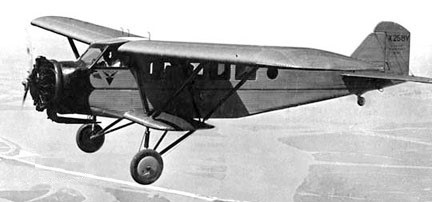
Designed by William L. Lewis, the 1930 Solar MS-1 (ATC 2-252) was a sesquiplane all-metal eight-passenger transport aircraft evolution of Prudden SE-1.
Its wings were braced to each other with warren truss-style struts. The lower stub wings carried the well separated legs of the fixed undercarriage. The fuselage was of rectangular cross-section and featured a fully enclosed flight deck and passenger cabin. The tail was of conventional design with strut-braced stabilizers and carrying a fixed tailwheel. Construction was of metal throughout with corrugated skins, and was powered by a single 420 hp (310 kW) Pratt & Whitney Wasp radial engine in the nose.
First flying on 21 January 1930, piloted by Doug Kelly, the one built was registered NX/NC258V. Kelly described it as “one of the finest closed planes I have ever flown”, and Charles Lindbergh also praised the MS-1 when he flew it a few days later. Despite this, the airlines did not order the type, although Northwest Airways and ten other airlines considered, and rejected buying examples due to the effect that the onset of the Great Depression was having on their traffic volumes.
A 6,000 mi (9,700 km) record flight from Los Angeles, California to Tokyo was planned, but never happened. The high point was a 7,000 mi (11,000 km) transcontinental flight over 25 states that the president of Solar took with his entire family, including his wife and three children, aged 9, 7 and 3, which attracted considerable interest from the media who dubbed it the “flying nursery”. A purchasing agent for a major airline then promised a substantial order, but dropped dead of a heart attack the day the order was to be signed, and his replacement called off the deal.
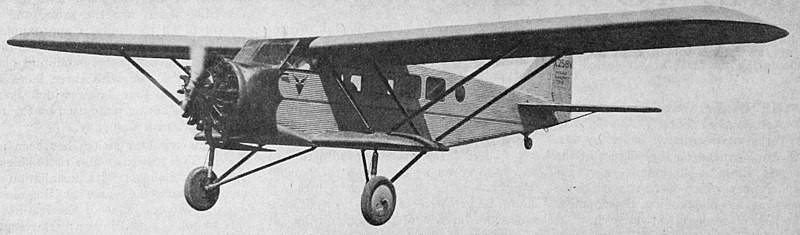
Solar made the prototype available for charter flights for a while, but in 1931 sold it to an operator in Mexico who used it to transport coffee beans. On the Mexican register as XB-AFK, the MS-1 was destroyed in a crash in 1936.
Solar would never build another aircraft after the MS-1, turning to saucepans to survive the depression, and later stainless-steel exhaust shrouds.
Solar MS-1
Powerplant: 1 × Pratt & Whitney R-1340 Wasp, 420 hp (310 kW)
Propeller: 2-bladed fixed pitch metal
Upper wingspan: 56 ft 6 in (17.22 m)
Upper wing chord: 100 in (2.54 m)
Upper wing dihedral: 2°
Lower wingspan: 18 ft 0 in (5.49 m)
Lower wing chord: 70 in (1.78 m)
Lower wing dihedral: 0°
Wing area: 496.5 sq ft (46.13 sq.m)
Airfoil: Göttingen 398
Length: 35 ft 11 in (10.95 m)
Height: 10 ft 2 in (3.10 m)
Empty weight: 3,650 lb (1,656 kg)
Gross weight: 7,000 lb (3,175 kg)
Fuel capacity: 135 US gal (112 imp gal; 510 l)
Oil Capacity: 8 US gal (30 l; 6.7 imp gal)
Maximum speed: 130 mph (210 km/h, 110 kn)
Cruise speed: 115 mph (185 km/h, 100 kn)
Landing speed: 60 mph (52 kn; 97 km/h)
Service ceiling: 15,000 ft (4,600 m)
Absolute ceiling: 18,400 ft (5,600 m)
Rate of climb: 750 ft/min (3.8 m/s) initial
Wing loading: 14 lb/sq ft (68 kg/sq.m)
Power/mass: 16.4 lb/hp (10.0 kg/kW)
Crew: Two
Capacity: Eight passengers
Undercarriage track: 9 ft 6 in (2.90 m)
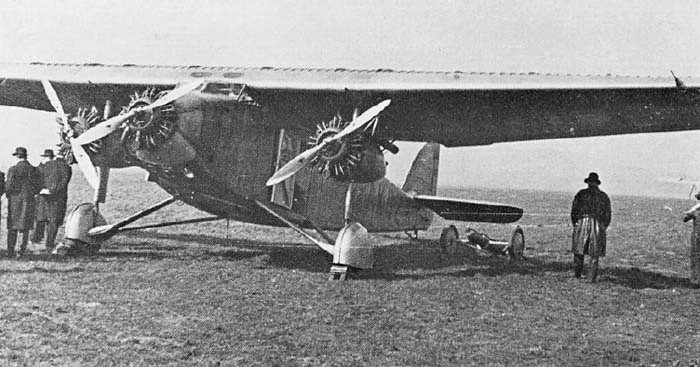
Type 40T was three-engined all-metal airliner which gave good service in early 1930s.
A big multiseat landplane fighter with two fuselages and central nacelle.
Under Paulhan-Pillard license-built E.5 three-engined monoplane flying-boat and T3-BN.4 twin-engined twin float coast-defense floatplane.
Under Paulhan-Pillard license-built E.5 three-engined monoplane flying-boat and T3-BN.4 twin-engined twin float coast-defense floatplane.
In March 1925 Societe Provencale de Constructions Aeronautiques acquired sole rights for construction of Meteore aircraft from Compagnie Generale de Constructions Aeronautiques. Built Meteore 63 three-engined flying boat.

