In 1930 Charles T Stedman of South Bend IN., USA, built a three-place, open cockpit biplane, powered by a 110hp Warner Scarab engine.
Inter-Wars
Stedman 1929 Biplane
In 1929 a two-place cabin biplane was the concept of Capt Charles R Bowers. Design work was done by Harold L Scholl, formerly of McCook Field, and J W Van Cleve. Money was put up by insurance broker Stedman plus Howard and Hugh Woolverton. They bought out (Clyde W) Shockley Flying Service and incorporated as Rainbow Flying Service and Rainbow Aircraft Corp.
Built at South Bend IN., USA, the biplane was registered NX294V c/n 1 and powered by a 75hp Rover engine.
St. Louis Aircraft PT-35
The 1936 PT-35 was entered in military evaluation for a primary trainer, but was beaten out by Stearman.
A two place open cockpit biplane.
Engine: Wright R-760, 225 hp
St. Louis Aircraft PT-15 / PT-1W
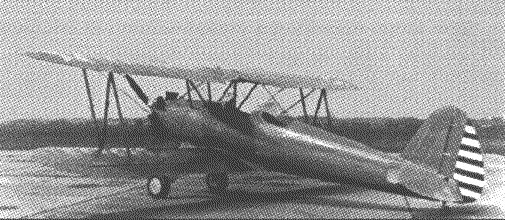
St. Louis Aircraft brought out a biplane primary trainer in 1935, hoping to win an Army production contract. Initially unsuccessful, St. Louis Aircraft continued to develop the airplane and demonstrate it (including a crash at Wright Field in 1936) for the Army, which eventually acquired a trial batch of 14 trainers in 1939. The Army identified these trainers as PT-15. All but one of them ended up being assigned to Parks College (at Cahokia, Illinois) for use in Parks’ Army aviation cadet training program. The hoped-for big production orders were not forthcoming, being won instead by the Boeing/Stearman PT-13/PT-17/N2S Army/Navy primary trainer.
PT-15 / PT-1W
Engine: Wright R-760, 225hp
Wingspan: 33’10”
Length: 25’0″
Useful load: 708 lb
Max speed: 124 mph
Cruise: 105 mph
Stall: 53 mph
Range: 355 mi
Ceiling: 14,500′
Seats: 2
XPT-15
1940
No built: 1 / 39-702
YPT-15
1941
No built: 13 / 40-001-013
St. Louis Aircraft C2 Cardinal / Senior Cardinal / Super Cardinal
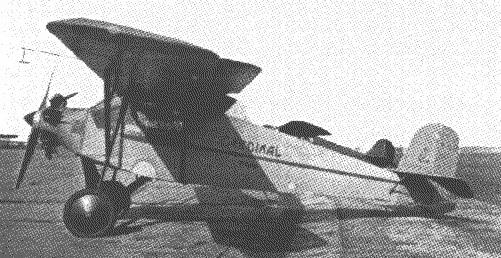
St. Louis Aircraft seized the opportunity afforded by the “Lindbergh Boom” in 1928 to produce a line of light, enclosed-cabin, two-seat, single radial-engine monoplanes christened Cardinals. At 1929 Detroit Aircraft Show exhibited the Cardinal high-wing monoplane, the company’s first airplane. Cardinal Senior which followed had more power.

Unfortunately, the Cardinal’s timing was not ideal: having been beaten into production by such highly successful similar private aircraft as the Monocoupe, Curtiss Robin, and others, the Cardinal did not sell well, becoming an early victim of the Depression-era aeronautical slump.

The last of 21 Cardinals was delivered in 1931.
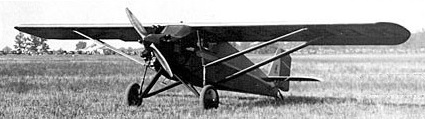
C2-60 Cardinal
1929
ATC 2-92, superseded by 273
Engine: LeBlond 5D, 60hp
Wingspan: 32’4″
Length: 20’7″
Useful load: 600 lb
Max speed: 105 mph
Cruise: 90 mph
Stall: 35 mph
Range: 500 mi
Seats: 2
Price: $3,700
No built: 10
1 later converted to C2-85 (N903K)
1 to C2-90 (NC31H)
1 to C2-110 (NC951K)
C2-65
1929
Modified C2-60 NC1111
C2-85 Cardinal
1930
ATC 350
Engine: LeBlond 5DF, 85hp
Length: 21’0″
Useful load: 580 lb
Max speed: 116 mph
Cruise: 98 mph
Stall: 40 mph
Range: 490 mi
Seats: 2
No built: 1 NC559N
Price: $3,750
C2-90 Senior Cardinal
1929
ATC 264
Engine: LeBlond 7D, 90hp
Length: 21’3″
Useful load: 545 lb
Max speed: 118 mph
Cruise speed: 102 mph
Stall: 40 mph
Range: 300 mi
Seats: 2
Designer: Harry McKay
Price: $3,750
No built: 6, 1 converted from C2-60.
C2-100 Super Cardinal
1929
Engine: 110hp Warner Scarab
Seats: 2
No built: 1 conversion, NX12319, for factory tests
C2-110 Super Cardinal
1929
ATC 277 / 2-188
Engine: Kinner K-5, 100hp
Length: 20’6″
Useful load: 557 lb
Max speed: 125 mph
Cruise speed: 107 mph
Stall: 39 mph
Range: 475 mi
Price: $4,250
No built: 6, with 1 converted from C2-60; 1 as C2-100 Special under (2-188)
Plush version of C2-90 with Kinner K-5
St. Louis Aircraft Corp
1929: St Louis Aircraft Co
8000 N Broadway
St Louis
MO
USA
The St. Louis Aircraft Corporation was incorporated as a subsidiary of the St. Louis Car Co. during the First World War, in response to the Army’s urgent need for large quantities of aircraft to support the training of military aviators needed to meet American commitments to the Allies. But St. Louis Car (a highly successful manufacturer of railway cars and streetcars) had already been actively exposed to the new world of aviation. In late 1915, Tom Benoist, St. Louis’ earliest aeronautical entrepreneur, had arranged to construct his large Type 15 twin engine, six-seat flying boat in the St. Louis Car shops, lacking sufficient room in his own facilities. Sensing an opportunity to sell flying boats to Allied combatants in the War, Benoist contracted with St. Louis Car in October, 1915 for the production of large numbers (lots of 1000) of similar flying boats. However, Benoist’s sales efforts in Europe were eclipsed by those of Glenn Curtiss, and consequently no flying boat production occurred at St. Louis Car.
Later, when the U.S. did enter the War, Edwin B Messner of the St. Louis Car joined with AJ Seigels’ Huttig Sash and Door Co. (also of St. Louis) to form the St. Louis Aircraft Corporation, which went on to manufacture 450 JN-4D Jenny trainers (a Curtiss design) for the U.S. Army. The company became one of six across the country to produce the Curtiss JN 4D Jenny with first deliveries in 1918. The first order was for 200 planes, the company delivered 30 aircraft per month, and 57 JN 4D October 1918.
Although St. Louis Aircraft continued to exist (as a wholly-owned subsidiary of St. Louis Car) after World War I, its hopes of producing aircraft for private use were stymied by the glut of surplus military aircraft that became available. The company remained dormant until the so-called “Lindbergh Boom” in aviation developed in the wake of Lindbergh’s heroic solo flight from New York to Paris in May, 1927. An ingredient of this surge in aviation activity was the advent of powerful, reliable, air-cooled radial powerplants to replace the bulkier W.W. I-vintage water-cooled OX-5 and Liberty engines. St. Louis Aircraft seized the opportunity afforded by the “Lindbergh Boom” in 1928 to produce a line of light, enclosed-cabin, two-seat, single radial-engine monoplanes christened Cardinals. At 1929 Detroit Aircraft Show exhibited the Cardinal high-wing monoplane, the company’s first airplane. Cardinal Senior which followed had more power.
Unfortunately, the Cardinal’s timing was not ideal: having been beaten into production by such highly successful similar private aircraft as the Monocoupe, Curtiss Robin, and others, the Cardinal did not sell well, becoming an early victim of the Depression-era aeronautical slump. The last of 21 Cardinals was delivered in 1931.
The company had ordered 100 100 hp Kinner radial engines to power the KT monoplane light, but production ceased in 1931 at the height of the depression.
Having survived for several years on development and production contracts for military aircraft parts and equipment, St. Louis Aircraft didn’t produce another airplane until it brought out a biplane primary trainer in 1935, hoping to win an Army production contract. Initially unsuccessful, St. Louis Aircraft continued to develop the airplane and demonstrate it (including a crash at Wright Field in 1936) for the Army, which eventually acquired a trial batch of 14 trainers in 1939. The Army identified these trainers as PT-15. The hoped-for big production orders were not forthcoming, however, being won instead by the now-famous Boeing/Stearman PT-13/PT-17/N2S Army/Navy primary trainer.
While continuing to manufacture crew cars for motorized Army observation balloons (many of which operated at nearby Scott Field), St. Louis Aircraft renewed its efforts to get into the trainer-production business, especially with the World-War-I -fueled major buildup in military pilot-training programs. With its own funds, St. Louis Aircraft developed and flew in 1940 the PT-LM-4, a low-wing, all-metal primary trainer with a Ranger in-line engine. Although tested by NACA, the Army, and in Canada, the PT-LM-4 was not put into production. Instead, the Army gave St. Louis Aircraft production contracts for the similar Fairchild designed PT-19 trainer. During 1942-44, St. Louis Aircraft built and delivered 350 of these primary trainers, in two versions: the PT-19A (44), with a Ranger in-line engine, and PT-23/PT-23A (306), with a Continental radial. These trainers were all test-flown at St. Louis Aircraft’s own flying field, adjacent to the St. Louis Car factory on North Broadway in St. Louis. (This field was operated as a private airfield, Ross Airport, for a time after W.W. II.)

Having already placed large-scale aircraft production contracts with the major airframe builders, the Army sought to employ secondary sources when it decided in 1941 to develop a significant glider assault capability. Not being burdened at the time with aircraft production contracts, St. Louis Aircraft was invited to participate in the Army’s glider program, obtaining contracts to develop eight-place and fifteen-place troop-carrying gliders. The eight-place XCG-5 demonstrated serious aerodynamic flaws during its first test flights (at Lambert Field) in 1942. The redesign necessary to correct the aerodynamic, as well as significant structural, problems doomed the XCG-5. The larger, heavier XCG-6 was never built.
St. Louis Aircraft once again went dormant following the end of World War II. It disappeared forever when the parent company, St. Louis Car, closed its doors for the last time in 1973. The historical record, the St. Louis Car and St. Louis Aircraft corporate archives were given to Washington University, where they now reside.
Stauffer Gyroplane
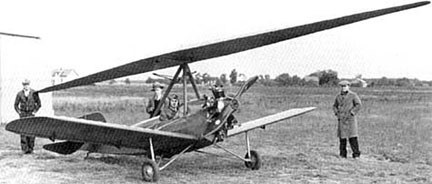
In 1939 O L Stauffer of Elkhart IN., USA, built a single-place gyrocopter on which the revolving upper wing locked in place to convert the aircraft into a biplane.
States Aircraft B-4
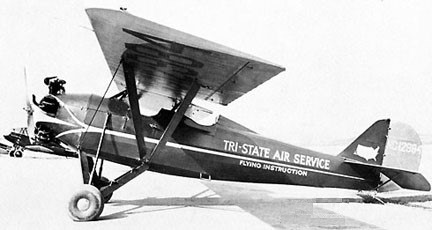
About five of the 1932 States Aircraft Co B-4 (ATC 477) were built, priced at $4,000. They included NC11984, NC12902, and NC12984, most of which were manufactured in Texas.
Engine: 125hp Kinner B-5
Wingspan: 32’0″
Length: 22’0″
Useful load: 555 lb
Max speed: 115 mph
Cruise: 97 mph
Stall: 38 mph
Range: 290 mi
Ceiling: 15,000′
Seats: 2
States Aircraft B-3 / S-E-5
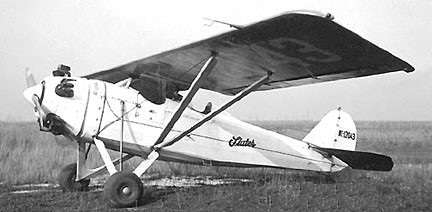
In 1930 States Aircraft Corp built, at Chicago Heights, Illinois, B-3 parasol monoplane, with two tandem seats.
Designed by Frederick Jolly, the B-3, or S-E-5 1930 (ATC 349 and ATC 2-438) was priced at $3,645.
Six were built; NC943N, NC10369, NC10556, NC10719, NC10723, and NC12043, and possibly a few more.
Engine: 100hp Kinner K-5
Wingspan: 32’0″
Length: 22’0″
Useful load: 552 lb
Max speed: 108 mph
Cruise: 90 mph
Stall: 35 mph
Range: 325 mi
Seat: 2
States Aircraft B-2 / Monoplane
The 1930 States Aircraft Co B-2 (ATC 2-254) was a two-place, open cockpit, high wing monoplane, powered by a 75hp Michigan-Rover engine.
Two were built: NX541V and NC625W.
NC625W c/n 1 was registered as States Monoplane in 1930 by Mountain States Aircraft Co, Waynesville WV, which might have been a distributor.

