In 1938 Charles L Stewart of Tulsa OK., USA, built the Model B. A single-place, open cockpit monoplane powered by a 36hp Aeronca engine and registered N17622.
Inter-Wars
Stewart Model 1
C M Stewart built the Model 1 two-place, open cockpit biplane N13979 in 1935. It was powered by a 90hp Wright-Gypsy and also shows having a 60hp Ford.
Stewart, C M
Loyal OK
USA
Built the Stewart Model 1 in 1935.
Stewart M-2

Designed by John Hunt and Lionel Kitchen, the 1931 W F Stewart Co M-2 (ATC 2-349) shoulder wing monoplane was also powered for a short time by a Packard DR-980 Diesel. The one built (X/NR493M) was eventually sold to Abrams Aircraft for photo-survey work and scrapped in 1940.

Engines: two 300hp Wright J-6
Wingspan: 52’10”
Length: 37’0″
Useful load: 1536 lb
Max speed: 155 mph
Cruise: 130 mph
Stall: 60 mph
Range: 350 mi
Seats: 5
Stewart M-1 / X-1
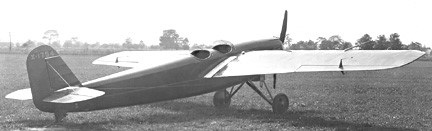
Designed by John Hunt, the 1928 W F Stewart Co M-1, or X-1, NX1754 featured a full-cantilever wing; two side-by-side cockpits with dual controls.
M-1 (X-1)
Engine: 90hp Curtiss OX-5
Wingspan: 38’6″
Length: 26’0″
Useful load: 953 lb
Max speed: 105 mph
Cruise: 85 mph
Stall: 43 mph
Seats: 4
W F Stewart Co
Grand Blanc and Flint MI.
USA
Built aircraft circa 1928-31.
Stepnic
In 1929 Stepnic built, in the USA, a single-place, open cockpit, high-wing monoplane, powered by a 40hp Lawrance engine.
Stephens & Fisher Scamp 36
The 1936 Stephens & Fisher Scamp 36 was a single-place, open cockpit monoplane, powered by a Salmson AD-9 engine. It was registered N15893 c/n 1.
It was sold on 26 February 1940, dismantled on 11 February 1940, and sold to Fleetcraft Co (Alexandria MN), who gave it to the National Guard as a ground-school instructional airframe.
The registration was cancelled on 26 April 1948.
Stephens & Fisher
Roy Fisher & Glen Stephens
2600 Onieda St
Denver CO.
USA
Built the Scamp 36 monoplane in 1936.
Stepanchonok Kacha
The “Kacha” (Russian: Степанчонок “Кача”) was designed by pilot Vasili Andreyevich Stepanchonok in 1930, during his time as an instructor at the Kacha flight school in Sevastopol.
The “Kacha” was designed as a cantilever high-wing glider. The wing had a double wooden spar structure and was covered with plywood sheets up to the position of the second spar. From there the covering was made of fabric.
The wide, angular fuselage featured a duralumin nose with the rest in plywood-coated wood. The bow area featured a removable aluminum deck. At the rear of the cabin there was another one made of plywood. A towing hook with release system was installed in the first frame of the fuselage.
The landing gear consisted of a central wheel with steel sheet.
The “Kacha” glider was completed in 1930 and his main purpose was to serve as a trainer at the Kacha Higher Flight School. It was presented without great success in the VII National Sailing Competitions, held in 1930 in Koktebel .
Despite the great wing aspect ratio (18.7), the good finish and the excellent construction lines, the flight characteristics of the “Kacha” were quite poor. This was largely due to the poor selection of the TsAGI-311 wing profile, of a high relative thickness and the poor aerodynamic shape of the wide fuselage, with resistance surfaces perpendicular to the air flow.
Kacha
Wingspan: 16.20 m
Wing area: 14.00 m²
Aspect ratio: 18.7
Length: 5.55 m
Empty weight: 150 kg
Wing loading: 16.4 kg / m²
Surface of the horizontal planes: 3.16 m²
Elevator area: 1.74 m²
Rudder surface area: 0.87 m²
Accommodation: 1

