Heldeberg Designs / Blue Heron Powered Parachutes

Founded in 1996, Heldeberg Designs was an American aircraft manufacturer, headquartered in Altamont, New York. The company specialized in powered parachutes.

Heldenberg Designs, 260 Benninger Rd. Delanson NY 12053

Originally marketing under its own name, the company marketed its aircraft under the brand name Blue Heron Powered Parachutes.

The company ceased manufacturing the Blue Heron line of powered parachutes in 2010. By early 2013 the company website stated: “After over 17 years of serving the aviation community, Heldeberg Designs LLC is wrapping up it’s operations and will no longer be manufacturing Blue Heron Powered Parachutes nor parts.”

Heeman WIGE

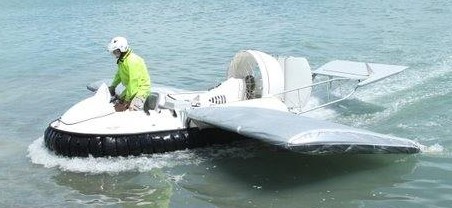
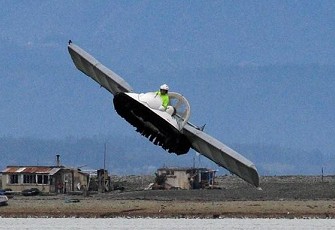
Rudy Heeman of Nelson, New Zealand, spent three years building and designing the hovercraft that can travel on water land and air.

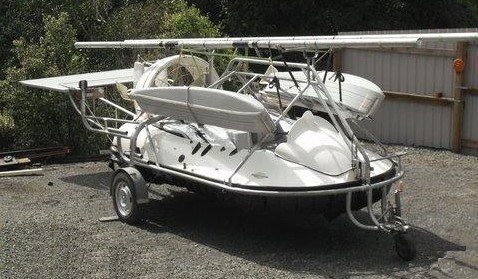
The craft has alloy wing spars, with foam cored ribs and fabric skins. The tail unclips but stays on for trailer transport.

He wanted to develop the flying hovercraft design, but had to sell a prototype to raise enough cash to do so.
It was listed on a ‘Trademe’ website expiring on 13 March 2010 with a reserve of NZ$20,000.
Mr Heeman, a mechanic, has been making hovercraft in his spare time for more than 13 years but was his first attempt at a flying version. He had spent 75 hours flying his completed bovercraft.
With a modified 1.8 litre Subaru car engine and a range of more than 225 kilometres, the hovercraft cruises at 90 kph when flying, and has a smooth ride above the waves.

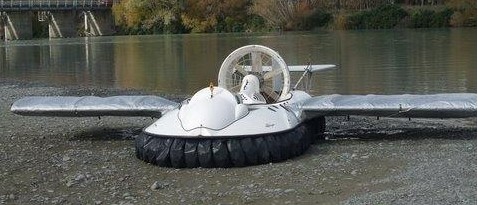
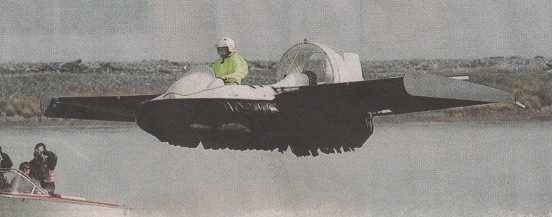
This machine is a W.I.G [wing in ground effect] in the form of a hovercraft. This machine, which is classed as a boat and comes under MSA rules, can operate as a hovercraft or, when the wings and tail put on, flying machine that can travel above the water or land. The engine is an EA81 subaru, modified with turbo, intercooler blow thru webber carb.

The construction of the hovercraft began in 2003 and conversion to WIGE began in 2007. The first flight was towards the end of 2007.
The wingtips have water skis on them so it doesn’t dig in.
The final wing shape was the third design. Skirt retraction is electric. The thrust diverter works electrically by pushing green or red buttons on the handlebars. The green button gives a 30% increase in thrust instantly by diverting lift sir to add to thrust once airborne.

Has alloy wing spars, foam cored ribs and fabric skins. The tail unclips if not required but stays on when transported. Has a retractable finger skirt, open cockpit, aerofoil wings, and thrust diverter.

The first test flight was 2007.

The WIGE was auctioned on the New Zealand Trademe website during 27 February – 13 March 2010. It was listed as designed and built by Rudy Heeman. Powered by a 100 hp inboard motor, it could operate as a hovercraft or, with the wings and tail put on, as a wing in ground effect flying machine. Built in 2003, the engine had run for 150 hours. With the 1.8 lt engine it could reach over115 kph, and a range of over 225 km cruising at 90 kph, using 30 lt of 96 octane fuel/hr.
The machine does not require any licence but must obey boat rules when on or above the water. The sale was for the machine only and did not include copyrights, intellectual properties, moulds etc.
In flying mode t could carry 160 kg (or three people as a hovercraft).
At that time it had flown over 75 hours with the Subaru EA81 engine, modified with turbo, and intercooler blowthru Webber carb.
Engine: 100 hp at 5000 rpm +7 lb boost, approx. 400 lb thrust.
The T/O distance is approximately 80m and, while it has flown in 25 kph winds, a max of 15 kph is recommended.

It was sold by Trademe auction for $27,500.

Engine: Subaru EA81, 100 hp 100HP at 5000rpm with 7 pounds boost
Wingspan: 7m
Length with tail: approx 6.3m
Length: 4 m (13 ft)
Approx weight: 320 kg + 50 kg wing and tail
Fuel capacity: 75 lt
TO speed: 70 kph

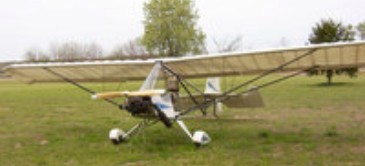
Heath LNB4 Parasol

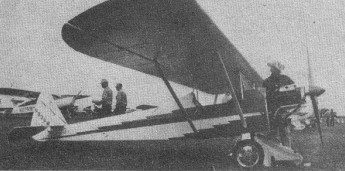
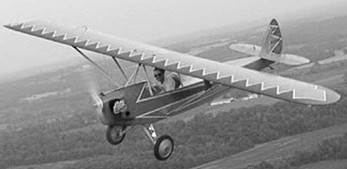
Designed and built originally in the U.S.A. by Ed. Heath during the early 1930s, this single seat sports aeroplane was built in large numbers prior to the 1939-45 War. The Parasol was powered mainly with Heath’s own conversion of the 25-hp Henderson motorcycle engine. Production was undertaken for an early version of this aircraft in Australia, as early as 1931 by the Adcock-Heath Co.

Heath LNB4 Parasol Article

Heath B-4 / OK-AT(V) Švec

The fuselage is built of welded steel tube and is fabric covered. The wings consist of two solid spruce spars, built-up wooden ribs, compression struts and internal bracing. Externally, the wings are braced by steel tubes to the fuselage. The empennage is built of wood, the fin and tailplane being externally braced. The whole aircraft is fabric covered. Two 5 Imp. gallon fuel tanks are installed at the root end of each wing half, the fuel being gravity fed to the engine.

While some were factory built, and the last model actually received an Approved Type Certificate (ATC) in 1932, the majority were homebuilt from factory-supplied kits or from magazine plans. Still being built, this single-seater is usually powered by either a Volkswagen conversion or a 65 hp Continental and is constructed of wood, fabric and tubular steel.

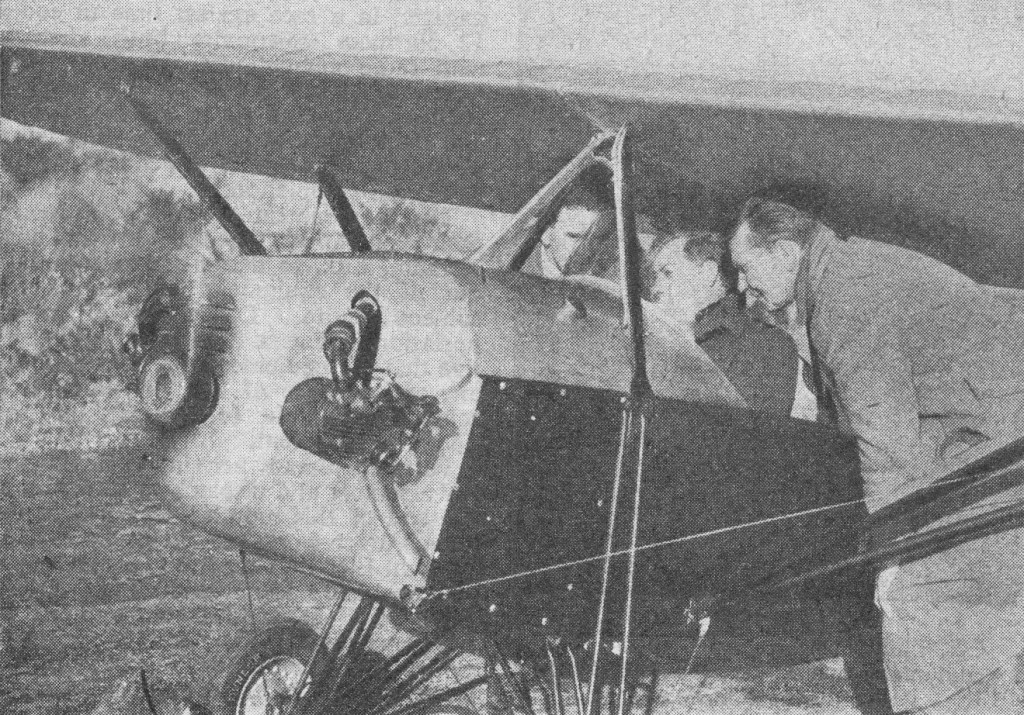
A Plymouth Aero Club member flew a Parasol in the UK powered by a Douglas dirt track motor cycle engine.

1949 A.B.C. Scorpion powered in the UK

Ultralight replica: Rag Wing RW 5 Heath Replica

Gallery

Engine: Continental A40
Wingspan: 31ft. 3 in
Length: 17 ft. 3 in
Wing Area: 135 sq. ft.
Empty Weight: 450 lb.
Gross weight: 700 lb
Fuel capacity: 9 USgals
Wing Loading: 5.2 lb/sq. ft.
Max. Speed: 85mph.
Top speed: 73 mph
Cruise speed: 62 mph
Stall Speed: 32mph.
Climb rate: 500 fpm.
Range: 330 miles.
Takeoff run 400 ft.
Landing roll 400 ft.

Heath Aircraft Co

Edward Bayard Heath

Edward Bayard Heath was born on November 17, 1888 in Brooklyn, New York to Clark Heath and Ada M. Johnson.

Heath designed and built a series of aircraft starting in 1909 with a Bleriot-inspired monoplane. His first flight was on 10 October 1909 in Amsterdam, New York resulting in a broken landing gear. On July 4, 1910 Heath made $500 in appearance fees and $200 in photograph revenues from his aircraft that flew 3 feet above the ground.

In 1911 Heath went to work for Glen Curtiss in Hammondsport, New York as a motorcycle mechanic, next to the Curtiss aircraft factory where he built a second aircraft with Walter Eales making short aerial runs. After purchasing the Chicago-based Bates Aeroplane Company in 1912, Heath founded the E.B. Heath Aerial Vehicle Co., later becoming the Heath Airplane Company.

His company produced the Heath Feather and Heath Favorite after World War I, and later the Heath Parasol series of aircraft powered with Henderson Motorcycle engines.

The 1928 Heath Baby Bullet mid-wing monoplane racer exceeded 100mph (160kmh) on only 32 hp. Heath Super Soarer biplane glider, built 1930, was first unpowered aircraft to loop-the-loop. Heath Parasol of 1931, designed to be powered by a converted motorcycle engine, sold in large numbers to amateur builders.

Married to Berna Heath, Heath died on February 1, 1931 (aged 42) in Maine Township, Cook County, Illinois. He was in an aircraft accident while testing a new low-wing aircraft design.

Heath’s company was eventually purchased and after World War II, changed its product to kit electronics. Heathkit filed for bankruptcy and closed in 2012. As of 2019, the company has a live website at http://www.heathkit.com.

HCI R 220

Horsepower 123 @ 2500 rpm
Cruise Power (70%) 85 @ 1750 rpm
Weight 160 lbs. installed
Installation Displacement 219.8 cubic inches
Bore 3-5/8
Stroke 3-1/2
Ignition Distributorless Electronic
Fuel Electronic Injection
Oil System Full Time Inverted
Electrical System Starter & Alternator Optional
Main/thrust bearings Tapered roller
Master rod bearings two row ball
Link rod bearings Plain journal bearings.

HCI R 180

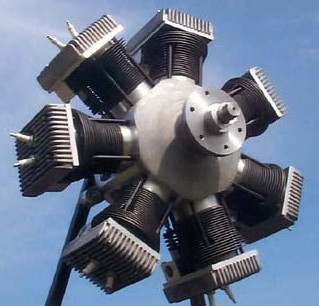
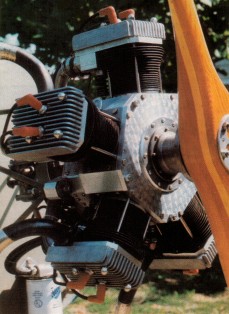
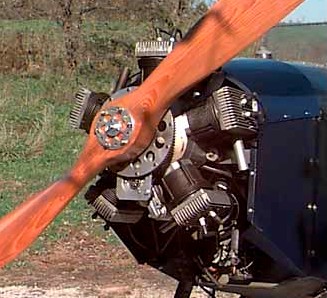
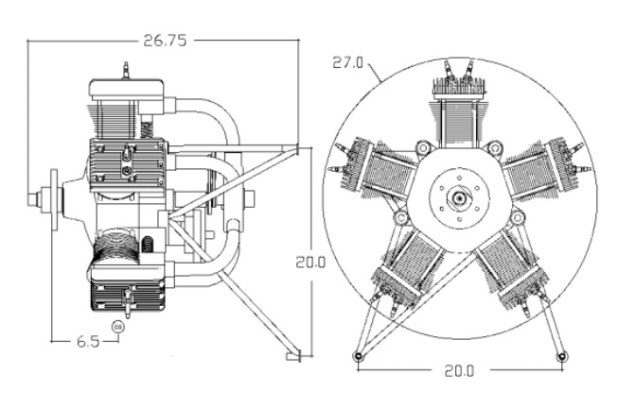
The R180 radial design uses five Volkswagon air cooled cylinders and a supercharger. The supercharger pressure filling of the cylinders overcomes the side valve’s tendency toward lower volumetric efficiency.
The side valves reduce the over all cylinder height and exposed diameter of the engine.

A feature of the R180 is the all cylinder compression relief. Originally added to make electric starting easier, with the relief valve open, there is no possibility of hydraulic lock in the bottom cylinder.
The crankcase of the first engine was built up from plate but further engines use castings.
Testing has been carried out in a Fly Baby.

In 2010 a complete set of engineering drawings and parts list with item numbers and suppliers for stock automotive components sold for US$130.00.
The kits available in 2010 were:

  • Unmachined aluminum castings US$1,400.00
  • Machinist kit, including machined case, heads, subheads, and mount lugs cam finished master rod and link rods (no bushings or knuckle pins) crank (main, pin, weights, cheekplate tail) complete drawings assembly guide video. It excludes standard automotive components
    $5,200.00
  • Complete kit, plans, and video. Complete and ready to assemble includes Ignition and Engine Mount Design, but Fuel System Sold Separately US$9,995.00
  • Assembled engine run tested and performance verified including Ignition and Engine Mount Design but Fuel System Sold Separately US$12,000.00

Standard automotive components
5 VW Piston, Ring, & Cylinder Sets
Tapered, Roller, and Ball Bearings
Valves, Valve Seats, Valve Springs, Valve Keepers, Valve Locks
Aircraft and Automotive Bolts, Nuts, and Washers
GM Ignition Components
A specific, itemized list is included with the kits.

Horsepower 75 @ 2150 rpm
Weight 122 lbs.
Displacement 180 cubic inches
Bore 3.625 inches
Stroke 3.5 inches
Compression Ratio 7:1
Intake Valve 1.8 in.
Exhaust Valve 1.2 in.
Valve Lift (all) 0.250 in.
Valve Clearance 0.014 in.
Ignition Timing Start TDC
Ignition Timing Run 38 deg. btc
Supercharger drive ratio 9:1
Supercharger flow 1450 fpm
Oil Pump Capacity 5.5 qt./min. @ 2150 rpm
Scavange/feed pump 8:3 ratio
Main/thrust bearings Tapered roller
Master rod bearings Two row ball
Link rod bearings Plain journal bearings

Cycle: 4 stroke
No cylinders: 5
Bore: 94 mm
Stroke: 89 mm
Compression: 8
Displacement: 3080 cc
Cooling: Air
Ignition: Double electronic
Reduction: None
Weight: 54 kg
Max pwr: 75 hp at 2150 rpm
Kit Price 1998: $9600

Hart Aero Zipster

Plans and manual on CD $25 Printed plans and Manaul $75 Materials Kits $3495 Quick Build Kit $4795 Deluxe Kit $5995 Partial kits available along with many options.

Stall: 23 kt / 27 mph / 43 kmh
Cruise: 55 kt / 63 mph / 101 kmh
VNE: 78 kt / 90 mph / 145 kmh
Empty Weight: 113 kg / 249 lbs
MTOW Weight: 249 kg / 550 lbs
Climb Ratio: 450 ft/min / 2 m/s
Take-off distance (50ft obstacle): 600 ft / 183 m
Landing distance (50ft obstacle): 600 ft / 183 m

Hart Aero Aero Sport

The Hart Aero Sport is our answer to the cry for an FAA legal, safe, three axis, back to basics aircraft that fits the Ultralight category using a Rotax 447 or the new Light Sport Aircraft and Sport Pilot rules using a Rotax 447 or Rotax 503. With three axis controls and dual controls, it handles just like a “real” airplane. The Hart Aero Sport is a full three axis aircraft with a center mount stick & is covered with the certified poly fiber or ceconite process. This kit comes ready to assemble with all machining & required welding pre-done. Assembly time is normally around 100/200 man hours depending on experience. Price 2009: 4999 US$

Stall: 22 kt / 25 mph / 41 kmh
Cruise: 70 kt / 81 mph / 130 kmh
VNE: 100 kt / 115 mph / 185 kmh
Empty Weight: 125 kg / 275 lbs
MTOW Weight: 261 kg / 575 lbs
Climb Ratio: 1000 ft/min / 5 m/s
Glide Ratio: 16:1
Take-off distance (50ft obstacle): 250 ft / 76 m
Landing distance (50ft obstacle): 250 ft / 76 m