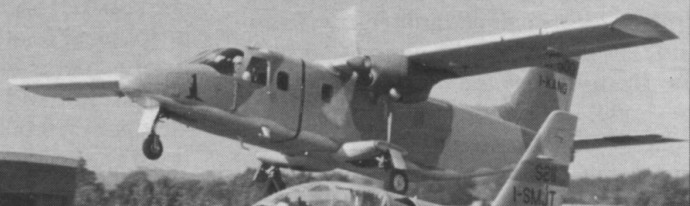
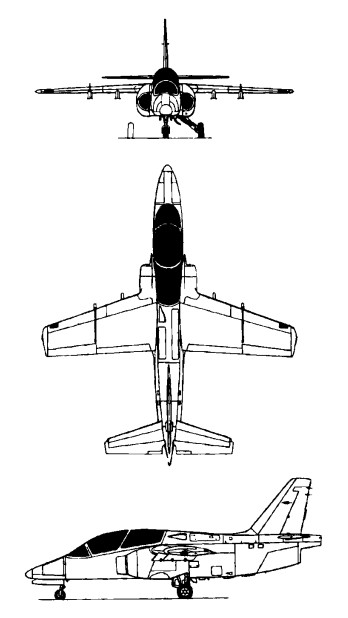
The prototype SF600TP Cangaru (Kangaroo) general utility transport was built by General Avia and made its first flight on 30 December 1978. Production examples entered service in an air taxi role on 8 April 1988.
A choice of fixed or retractable undercarriage versions was available, the engines being 450 shp (335 kW) Allison 250-B17F turboprops.
Projected military versions of the twin-turboprop SF.600TP Canguro include a swing-tail cargo transport, an electronic warfare aircraft, and a maritime surveillance variant with an undernose 360o -scan Bendix RDR-1400 search radar. Two underwing and two underfuselage hardpoints are provided.
The basic utility version can be equipped with 12 inward facing seats for paradropping, four stretchers for medevac, or Zeiss type cameras for photographic reconnaissance, and can also be used for target or glider towing.
In 1990 the PADC in the Philippines started assembling S 211s, followed by SF 260 TPWs and SF 600 Canguro in agreement with SIAI Marchetti of Italy.
The SF.600 Canguro was taken over by VulcanAir.
SF.600TP Engines: 2 x Allison 250-B17C turboprops, 450 shp (335 kW) Max take-off weight: 3300 kg / 7275 lb Wingspan: 15 m / 49 ft 3 in Length: 12.15 m / 40 ft 10 in Height: 4.6 m / 15 ft 1 in Max. speed: 305 km/h / 190 mph Ceiling: 7300 m / 23950 ft Range: 1580 km / 982 miles
The prototype for the SF.260 series, known as the F.250, flew for the first time on 15 July 1964. The version developed initially for civil production was manufactured at first under licence from Aviamilano by SIAI-Marchetti and is designated SF.260 (initials in SF.260 denoted design by Stelio Frati). Subsequently SIAI-Marchetti became the official holder of the type certificate and of all manufacturing rights of the SF.260.
A cabin monoplane with a cantilever low wing, the fuselage is an all-metal semi-monocoque structure of relatively thick skins and minimal stringers. The wing has a metal single spar, Friese type ailerons and electric slotted flaps. The wing is NACA 64-212 at the root and NACA 64-210 at the tip. The empennage contains cantilevered flying surfaces, with a manually operated trim tab on the elevator. The retractable tricycle undercarriage has oleo-pneumatic shock absorbers and a steerable nose wheel.
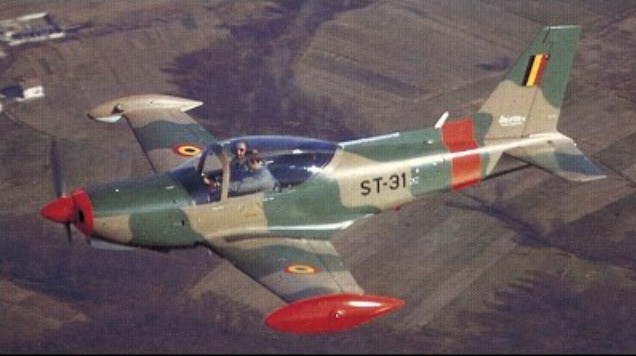
Designed by Stelio Frati and built in Italy, it is a 4 seater low-wing aircraft powered by a 260 hp Lycoming and has been predominantly sold in military versions since first flying in 1966. The SF.260 received FAA certifica¬tion on 1 April 1966.
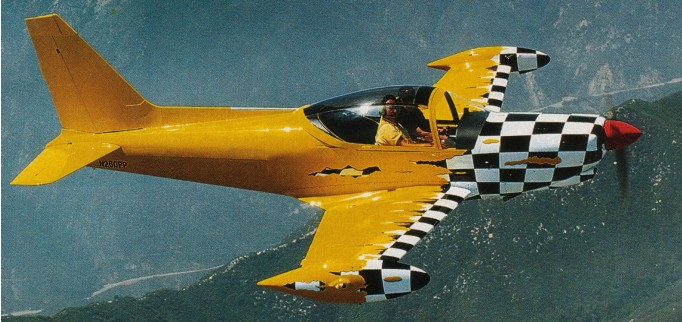
Production of SF.260s for military use continued into 1987 in three versions: the SF.260M basic trainer, the armed SF.260W Warrior trainer and light attack aircraft, and the SF.260TP, powered by an Allison 250-B17C turboprop in place of the Lycoming 0-540 piston engine of the earlier models. The airframe is common in each case, except for a lengthened fuselage for the turboprop version. The SF.260W and TP have up to four underwing pylons for a variety of light stores, including rocket and gun pods to a maximum of 300kg.
Replacing the earlier C model, the SF.260D is powered by a 260 hp (194 kW) Textron Lycoming O-540-E4A5 engine and has the aerodynamic and structural improvements developed for the military SF260M. The similar SF260W Warrior can also double as a tactical support/liaison aircraft with light weapons. Production continues in 1990 of the SF.260TP, of which more than 60 had been ordered powered by the 350 shp (261 kW) Allison 250-B17D turboprop.
Some 350 SF260s were built in the 14 years since the type first flew. By 1993 more than 700 civil and military SF.260s of all models had been completed, most of which were for export.
Waco Aircraft was founded in 1966 to build SF.260 (as Waco Meteor), and Socata Rallye Commodore (as Waco Minerva).
Waco Meteor
In 1990 the PADC in the Philippines started assembling S 211s, followed by SF 260 TPWs and SF 600 Canguro in agreement with SIAI Marchetti of Italy.
SIAI-Marchetti SF.260 Engine: Lycoming O-540-E4A5, 260 hp TBO: 2000 hr Fuel type: 100LL Propeller type: CS Landing gear type: Tri./Retr Max ramp weight: 2430 lb Gross weight, utility: 2430 lb Gross weight, aerobatic: 2205 lb Landing weight: 2430 lb Empty weight, std: 1664 lb Useful load, std: 766 lb Useable fuel, std: 62 USG Payload, full std. fuel: 377 lb Wingspan: 27 ft. 5 in Overall length: 23 ft. 4 in Height: 7 ft. 11 in. Wing area: 109 sq. ft Wing Loading: 22.3 lbs./sq.ft Power loading: 9.3 lbs./hp Seating capacity: 3/4 Cabin width: 40 in Cabin height: 36 in Cruise speed, 75% power: 186 kt Fuel consumption, 65% power: 12.4 USgph Max range, 75% power: 800 nm Max range, 55% power: 1040 nm Vso: 57 kt Best rate of climb, SL: 1700 fpm Service ceiling: 21,370 ft Takeoff ground roll: 820 ft Takeoff over 50-ft. obstacle: 1610 ft Landing ground roll: 790 ft Landing over 50 ft. obstacle: 1610 ft
SF-260 Engine: Lycoming O-540-E4A5 or D4A5, 260 hp Prop: Hartzell 2 blade CS 76 in Wingspan: 27 ft 5 in Wing area: 108.7 sq.ft. Aileron area total: 8.5 sq.ft. Flaps area total: 12.7 sq.ft. Fin area: 8.05 sq.ft. Rudder area: 5.38 sq.ft. Tailplane area: 14.9 sq.ft. Elevator area: 10 sq.ft. Length: 23 ft Height: 7 ft 7 in Wheel track: 7 ft 5 in Wheel base: 5 ft 3.5 in Tire size mains: 6.00 x 6 Tire size nose: 5.00 x 5 Seats: 3 MTOW normal: 2430 lb MTOW aerobatic: 2095 lb Empty wt: 1488 lb Useful load: 937 lb Wing loading: 22.4 lb/sq.ft Power loading: 9.3 lb/sq.ft Fuel cap wing total/useable: 26 /25.4 USG Baggage capacity: 90 lb Fuel cap tip tanks total/useable: 38 /36.6 USG Max cruise SL: 230 mph Range max cruise 30min res: 1275 sm 75% cruise fuel burn: 19 USG/hr 60% cruise fuel burn: 14 USG/hr Stall: 65 mph Vy: 125 mph ROC SL: 1880 fpm Service ceiling: 21,235 ft Take off ground roll: 790 ft Landing ground roll: 790 ft Landing over 50ft obst: 1610 ft
SF.260C
SF.260D Engine: Textron Lycoming O-540-E4A5, 260 hp (194 kW). Rear seat load limit: 260 lb Max cruise@ 10 000 ft: 186 kts. Max range: 1,100 nm
SF.260E
SF.260M
SF.260TP Engine: 1 x Allison 250-B17D turboprop, 350 shp (261 kW). Span: 8.35 m Length: 7.4 m. Wing area: 10.1 sq.m Empty wt: 750 kg. MTOW: 1300 kg. Warload: 300 kg. Max speed: 380 kph Initial ROC: 660 m / min. Ceiling: 8500+ m T/O run: 300 m. Ldg run: 305 m Fuel internal: 235 (+144) lt. Range: 950 km Endurance: 3hr 20min. Combat radius lo-lo-hi: 150 km
SF.260W Warrior Max take-off weight: 1300 kg / 2866 lb Loaded weight: 830 kg / 1830 lb Wingspan: 8.35 m / 27 ft 5 in Length: 7.1 m / 23 ft 4 in Height: 2.41 m / 8 ft 11 in Wing area: 10.1 sq.m / 108.72 sq ft Max. speed: 305 km/h / 190 mph Ceiling: 4480 m / 14700 ft Range w/max.fuel: 1715 km / 1066 miles Armament: 300kg on underwing pylons
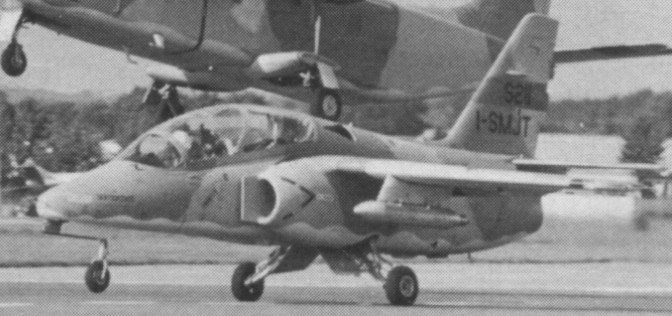
Probably the first trainer to employ a supercritical wing section, the intention of the private venture design was to combine low unit cost with advanced technology and utilising the PWC 1T15D turbofan.
The first prototype of SIAI Marchetti’s S.211 two-seat basic trainer powered by a single Pratt & Whitney JT15D4C turbofan of 2,500 lb (1134 kg) was flown on 10 April 1981 at Milan-Malpensa airport with Siai Marchetti’s chief test pilot, Cmdte Alessandro Ghisleni, at the controls. Five further flight tests were made during the following week.
The type was being developed as an “attack optimised” trainer with a light¬weight HUD and navigation computer in association with the Republic of Singapore Air Force.
Also under test in a production S.211 was the 5 version of the JT15D, offering 3190 lbs thrust with a dry weight 50 kg more than the -4C fit.
An S.211A was test flown with a PWC JT15D 5 turbofan, providing 3200 lbs of thrust (2500 lbs from the 4C) for an additional 50 kgs of dry weight. As well as the 28 percent in¬crease in thrust, designed to make the S.211A more competitive with close contender MB339 at the top end of the scale, the aircraft has a stronger wing and a greater fuel capacity, boosted to 1440 lbs. The reinforced wing structure is to +7.33 and 3G’s.
Singapore Aircraft Industries (SAI) continues to assemble S.211 single-turbofan two seat basic trainers for the Rebublic of Singapore Air Force, which has ordered 30 aircraft, in 1987. Six of these were delivered in CKD form for reas¬sembly by SAI, while the remainder are being delivered in kit form for complete assembly in Singapore. Haiti is the only other confirmed customer for the S.211.
Siai-Marchetti (as part of the Agusta group) teamed with Grumman as a contender for the USAF’s PATS (Primary Aircraft Training System) requirement for a lightweight, low-cost basic trainer and attack aircraft.
Customers to 1990 were the Philippines (18), where the type is being assembled by PADC, Singapore (30), where a similar arrangement involves SAI, Haiti (4) and Uganda (4).
In 1990 the PADC in the Philippines started assembling S 211s, followed by SF 260 TPWs and SF 600 Canguro in agreement with SIAI Marchetti of Italy.
It can carry external loads of four underwing pylons although the difference between clean gross weight and maximum take off weight is only 1323 lb with the -4C engine.
S.211 Engine: 1 x Pratt & Whitney Canada JT15D-4C turbofan, 2,500 lb st (1134 kgp) Span: 8.43 m / 28 ft 8 in Length: 9.5 m / 31 ft 7 in Wing area: 12.6 sq.m / 135.63 sq ft Height: 3.8 m / 12 ft 6 in Empty wt: 1645 kg MTOW: 3100 kg TO wt clean: 6000 lb Warload: 660 kg Max speed: 452 kt, 667 kph / 413 mph Initial ROC: 1280 m / min Ceiling: 12,200 m / 40000 ft T/O run: 390 m Ldg run: 360 m Fuel internal: 800 lt Range/Endurance: 2480 km / 3hr 50min Combat radius hi-lo-hi: 550 km Hardpoints: 4 Loading limit: 3.5G Fuel burn: 700 lbs/hr Ejection seat: zero/zero Crew: 1-2
The four-seat twin-turboprop Condor was designed and developed to the prototype stage by General Avia for military duties such as multiengine and weapons training, maritime surveillance, SAR, anti-tank, and ground attack.
Following the first flight in May 1983, SIAI-Marchetti has been responsible for flight testing the F.20TP Condor aircraft, which can be fitted with two stores pylons under each wing. Low-priority development continued for some time.
Societa Idrovolanti Alta Italia Siai-Marchetti Societa Per Azioni
The original company was founded in 1915 as SIAI (Società Idrovolanti Alta Italia – Seaplane company of Northern Italy). After World War I gained the name Savoia, when it acquired the Società Anonima Costruzioni Aeronautiche Savoia, an Italian aircraft company founded by Umberto Savoia in 1915.
The name Marchetti was added when chief designer Alessandro Marchetti joined the company in 1922. Savoia-Marchetti gained prominence with the successful S.55 flying boat. Savoia-Marchetti became famous for its flying boats and seaplanes, which set numerous endurance and speed records. Favoured by Air Marshal Italo Balbo, the company began rapidly prototyping and developing a number of other aircraft, increasingly focusing on warplanes in the lead-up to World War II. However, most of S.M.’s manufacturing capabilities were destroyed in World War Two. It was renamed SIAI-Marchetti in 1943.
Since 1946 engaged in overhaul and repair work and developed new aircraft. SIAI-Marchetti only survived in postwar Italy by building trucks and railway equipment. However it still struggled with insolvency for 6 years after the war before declaring bankruptcy in 1951.
In 1953, the company reopened. Types have included SA.202 Bravo trainer produced jointly with FFA in Switzerland; S.205 four-seater and S.208 development. First flew SF.250 aerobatic trainer in July 1964; became highly successful SF.260 production aircraft for civil and military use (initials in SF.260 denoted design by Stelio Frati). In 1968 company formed a Vertical Flight Division, but increasing helicopter work became associated with Agusta and Elicotteri Meridionale. SM.1019 light multipurpose high-wing monoplane followed 1969, SF.600 Canguro transport 1979 (recently taken over by VulcanAir), and S211 jet trainer and light attack aircraft 1981.
Agusta, which had acquired 30% of SIAI-Marchetti in 1970, had increased its stake to about 60% by 1973 and reached complete ownership in 1983.
Founded by brothers Horace, Eustace and Oswald Short in November 1908 as Short Brothers Ltd., though Eustace and Oswald had made balloons since 1898. The capital was £600, equally shared between the brothers Horace Leonard, Albert Eustace, and Hugh Oswald.
At Leysdown, Isle of Sheppey, completed first biplane glider, construction of which had begun at Battersea, London, in 1909. It was designed by Horace Short from photographs of the Wright Flyer.
Received order for six Wright biplanes, in one of which Hon. C. S. Rolls made first return crossing of English Channel.
The Short Brothers moved their factory from Battersea to Leysdown in 1909 and completed a tailess biplane of their own design.
In February 1909, Eustace Short and Wilber Wright signed a licence agreement for six of the Wright biplanes. The deal was worth £8400 to the Wright Brothers. The Short brothers already had cash buyers for the aircraft.
Company pioneered multi-engine and multi propeller types, and tractor biplanes with folding wings for naval use. Did more to aid development of early naval flying than any other British firm. New works at Rochester, Kent, started 1914. Most famous type was 184 torpedo-bomber, which was used at Battle of Jutland and was also the first to sink a ship at sea. During First World War established airship works at Cardington, Bedfordshire.
After First World War developed Cromarty flying-boat but diversified in other fields. Gave special attention to all-metal aircraft (Silver Streak of 1920 and derivatives) and concentrated later on large civil and military flying-boats (Singapore biplane series for RAF from 1926; Calcutta and Kent for Imperial Airways). Six-engined Sarafand of 1936 was then largest British flying-boat. Wing form developed for Scion and Scion Senior monoplanes used for famous fleet of Empire flying-boats in 1936, for equally-famous Sunderland military development; also on Short-Mayo composite aircraft and Stirling four-engined monoplane bomber.
Jointly established Short and Harland Ltd. in 1936 with shipbuilder Harland & Wolff; became British Government run 1943, leading to integration of Short Brothers (Rochester & Bedford) Ltd. and Short and Harland into Short Brothers and Harland Ltd. in 1947.
In Second World War built and had built under subcontract Short Stirling four-engined bombers and Sunderland flying-boats; also Handley Page Herefords. In 1947 Short & Harland joined Short Brothers (Rochester & Bedford) Ltd. and altered name to Short Brothers and Harland Ltd., concentrating activities at Belfast, Northern Ireland. Sealand twin-engined amphibian flying-boat of 1948 was produced in small numbers. Sandringham and Solent flying-boats used by BOAC stemmed from the Sunderland. Of great technical significance was the SC.1 VTOL (jet-lift) research program, which followed exploratory research by Rolls-Royce. First free vertical take-off made October 25,1958. Company became heavily involved in production of English Electric Canberra and Bristol Britannia. From 1963 built Belfast heavy transports (four turboprops) and many Skyvan light piston-engined transports (first flown January 1963). Twin-turboprop Shorts 330 30-passenger regional airliner flown August 1974, with Sherpa offered as freighter derivative. Much important manufacture and modification work carried out for leading international constructors and operators under subcontract.
Name Short Brothers Ltd. readopted June 1977, but named Short Brothers PLC, as part of Bombardier Aerospace Group since Bombardier acquired, in October 1989, Short Brothers of Northern Ireland.
Operating three principal business units, as Aerospace producing aircraft components and engine nacelles, Missile Systems, and Belfast City Airport. Shorts 360 36- passenger transport (first flown June 1981) followed Shorts 330/Sherpa, with final complete aircraft built by Shorts becoming the Tucano for the RAF, a variant of the EMBRAER turboprop trainer.
The Big Cootie is a modernized version of the Powell PH Racer biplane for homebuilt construction. The aircraft is a single seat biplane with conventional landing gear, designed for mild aerobatics. The fuselage is welded steel tube construction with aircraft fabric covering. The cowling is fiberglass. The ailerons are controlled with push-pull tubes. The wings use wooden spars with plywood leading edges.
The prototype, N84Z, survived an in-flight impact with powerlines during its initial testing. It was rebuilt at the Piedmont Aerospace Institute at Smith Reynolds Airport in Winston-Salem, North Carolina. A Continental A-80 80 hp (60 kW) engine replaced the Lycoming O-145 65 hp (48 kW) engine installed in the prototype.
The kits included all premolded composite parts. All metal parts and fuselage are welded. The wings and tail are attached like a glider and a removed in 5 minutes.
Shirlen Big Cootie Engine: 1 × Lycoming O-145, 65 hp (48 kW) Propeller: 2-bladed Length: 15 ft 9 in (4.80 m) Wingspan: 15 ft (4.6 m) Airfoil: RAF 15 Empty weight: 467 lb (212 kg) Gross weight: 750 lb (340 kg) Fuel capacity: 12 U.S. gallons (45 L; 10.0 imp gal) Maximum speed: 122 kn; 225 km/h (140 mph) Cruise speed: 104 kn; 193 km/h (120 mph) Stall speed: 55 kn; 101 km/h (63 mph) G limits: -4g Crew: 1
Gross Wt. 750 lb Empty Wt. 467 lb Fuel capacity 12 USG Wingspan 18’9” Length 14’ Top speed 140 mph Cruise 120 mph Stall 63 mph Takeoff run 500 ft Landing roll 500 ft Range 300 sm
Engine: Rotax 912, 80 hp HP range: 80-120 Height: 6.4 ft Length: 20.4 ft Wing span: 29.4 ft Wing area: 113.8 sq.ft Empty weight: 550 lb Gross weight: 1200 lb Fuel capacity: 18 USG Top speed: 190 mph Cruise: 160 mph Stall: 40 mph Range: 690 sm Rate of climb: 1600 fpm Takeoff dist: 230 ft Landing dist: 230 ft Seats: 2 Landing gear: nose or tailwheel
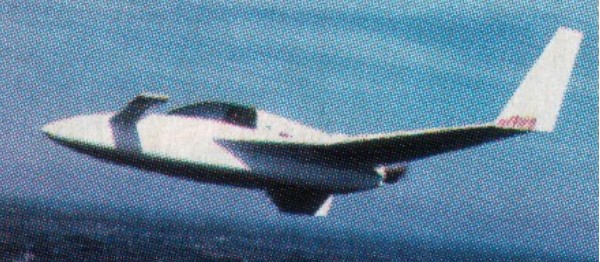
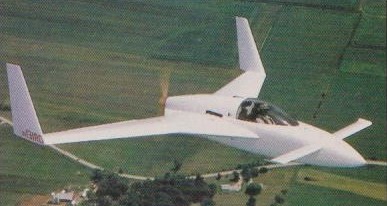
A derivative of the Rutan Long EZ, the E-Racer has retractable undercarriage. There were various options including the Mk.1 (auto engine), Mk.2 (aero engine), and the King Racer (enlarged cockpit).
Five were flying by 1998.
Mk.1 Engine: Buick V8, 240 hp HP range: 160-250 Height: 7.8 ft Length: 17 ft Wing span: 26.2 ft Wing area: 94 sq.ft Weight empty: 1000 lb Gross: 1800 lb Fuel cap: 46 USG Speed max: 240 mph Cruise: 220 mph Range: 1000 sm ROC: 2500 fpm Take-off dist: 1200 ft Landing dist: 1500 ft Service ceiling: 25,000 ft Seats: 2 Landing gear: retractable nose wheel
Engine: Lycoming/Buick, 240 hp Wing span: 7.99 m Wing area: 8.65 sq.m MAUW: 816 kg Empty weight: 454 kg Fuel capacity: 174 lt Max speed: 386 kph Cruise speed: 354 kph Climb rate: 12.5 m/s Seats: 2 Plan price (1998): $250