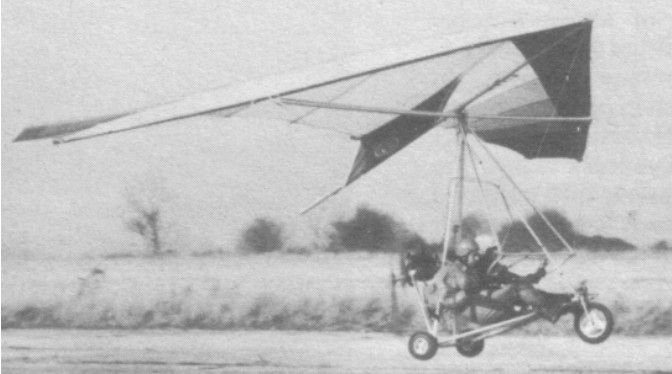
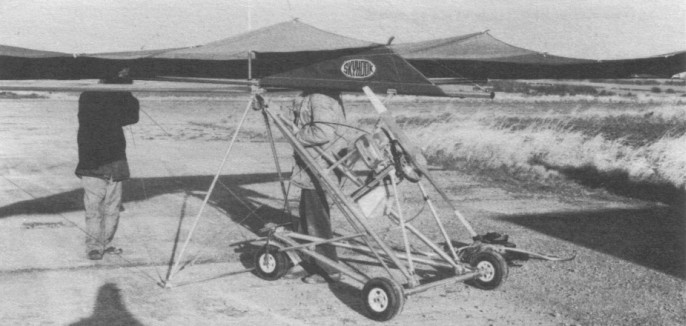
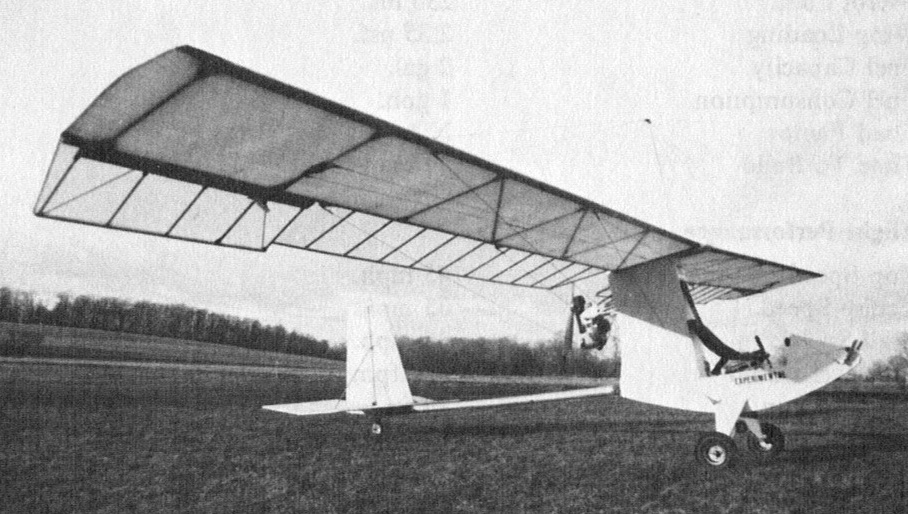
A single seat single engined flex wing aircraft with conventional three axis control. Rogallo wing. Undercarriage has three wheels in tricycle formation; no suspension on any wheels. Push right go right nosewheel steer¬ing connected to yaw control. No brakes. Aluminium tube trike unit, without pod. Engine mounted below wing driving pusher propeller.
This experimental machine is an attempt to mate three axis controls to a Rogallo wing. It uses the same power pack as the TR1 MkII trike unit, plus a modified Sabre wing. The trike unit is fixed to the wing structure rather than being sus¬pended from it, and the wing is mounted much lower than the normal hang point of a trike. No test flights have been carried out on this aircraft by 1982.
Engine: Engine: Solo 210 cc, 12 hp at 5500 rpm Propeller diameter 50 inch, 1.28m V belt reduction, ratio 2.5/1 Max static thrust > 100 lb, 45 kg
The Skyhook Sailwings TR2 Mk.I/Cutlass CD is a side by side two seat twin engined flex wing aircraft with weight shift control. Rogallo wing with keel pocket. Pilot suspended below wing in trike unit, using bar to control pitch and yaw/roll by altering relative positions of trike unit and wing. Wing braced from above by kingpost and cables, from below by cables, fixed cross tube construction with 30% dou-ble surface not enclosing cross tube; pre¬formed ribs. Undercarriage has three wheels in tricycle formation; no suspension on any wheels. Push right go left nosewheel steering independent from yaw control. Brake on nosewheel. Aluminium tube trike unit, with¬out pod. Engines mounted below wing driving pusher propellers. Trike unit and wing use aluminium tube to British HT30TF specifica¬tion, bright polished and sleeved at stress points. Wing rigged with plastic coated stain¬less steel wires; wing material is Bainbridge Dacron.
At the beginning of 1981, Len Gabriels was seeking an engine powerful enough to turn his TR1 Mk.I trike unit into a two seater. He was not satisfied with the reliability of any of the larger engines then available, so he decided instead to build a power pack using two of the 210cc Solo engines.
Rather than use two engines to drive one large propeller, he doubled up the drive system as well, creating a power pack with two contra rotating propellers driven from concentric shafts, each by its own engine an reduction drive. The safety attractions of such duplication are obvious, as the aircraft can at least maintain height after an engine failure.
The rest of the trike unit needed little alteration beyond the inclusion of a dual seat and a nosewheel brake. Allied to the Cutlass CD wing, the TR2 proved itself to be a viable training machine, but was dropped from production at the end of 1982 in favour of the TR2 Mk.II.
The Skyhook Sailwings TR2 Mk.I (Single Seat Special)/Cutlass CD is a single seat twin engined flex wing aircraft with weight shift control. Rogallo wing with keel pocket. Pilot suspended below wing in trike unit, using bar to control pitch and yaw/roll by altering relative positions of trike unit and wing. Wing braced from above by kingpost and cables, from below by cables; fixed cross tube construction with 30% double surface not enclosing cross tube; pre¬formed ribs. Undercarriage has three wheels in tricycle formation; no suspension on any wheels. Push right go left nosewheel steering independent from yaw control. Optional brake on nosewheel. Aluminium tube trike unit, with optional pod. Engines mounted below wing driving pusher propellers. Trike unit and wing use aluminium tube to British HT30TF specification, bright polished and sleeved at stress points. Wing rigged with plastic coated stainless steel wires; wing mate¬rial is Bainbridge Dacron.
Although the TR2 Mk I was intended as a two seater trike unit, it was also offered in single seat form a simple conversion, as with the TRI Mk.l. Like the TR2 Mk 1 from which it is derived, this variant is now discontinued. The Skyhook Sailwings TR2 Mk.II/Cutlass CD is a side by side two seat single engined flex wing aircraft with weight shift control. Rogallo wing with keel pocket. Pilot suspended below wing in trike unit, using bar to control pitch and yaw/roll by altering relative positions of trike unit and wing. Wing braced from above by kingpost and cables, from below by cables; fixed cross tube construction with 30% dou-ble surface not enclosing cross tube; pre¬formed ribs. Undercarriage has three wheels in tricycle formation; no suspension on any wheels. Push right go left nosewheel steering independent from yaw control. Brake on nosewheel. Aluminium tube trike unit without pod. Engine mounted below wing driving pusher propeller. Trike unit and wing use aluminium tube to British HT30TF specifica¬tion, bright polished and sleeved at stress points. Wing rigged with plastic coated stain¬less steel wires; wing material is Bainbridge Dacron.
The TR2 Mk.II was the 1982 two seat trike unit from Skyhook Sailwings and is identical in all respects to the Mk.I except that the twin engined power pack is replaced by a Hunting HS525A twin-¬cylinder engine, with conventional reduction drive and propeller.
TR2 Mk.I/Cutlass CD Engines: 2 x Solo 210 cc, 12 hp each at 5500 rpm Two propellers diameter and pitch 50 x 30 inch, 1.28 x 0.76 m V belt reduc¬tion, ratio 2.7/1 Max static thrust 200 lb, 91 kg Power per unit area 0.12 hp/sq.ft, 1.3hp/sq.m Fuel capacity 3.6 US gal, 3.0 Imp gal, 13.6 litre Length overall 12.7 ft, 3.87 m Total wing area 198 sq.ft, 18.4 sq.m Nosewheel diameter overall 12 inch, 305 mm Main wheels diameter overall 12 inch, 305 mm Empty weight 2251b, 102kg Max take off weight 640 lb, 290kg Payload 392 lb, 178kg Max wing loading 3.23 lb/sq.ft, 15.8 kg/sq.m Max power loading 26.7 lb/hp, 11.9kg/hp Load factors; >+3.75 ultimate Max level speed >60mph, >97kph Economic cruising speed 40 mph, 64 kph Stalling speed 32 mph, 51 kph Max climb rate at sea level 200 ft/min, 1.0m/s Min sink rate 500ft/min at 32mph, 2.5 m/s at 51 kph Take off distance 150 ft, 45 m
TR2 Mk.I (Single Seat Special)/Cutlass CD Engines: 2 x Solo 210 cc, 12 hp each at 5500 rpm Two propellers diameter and pitch 50 x 30 inch, 1.28 x 0.76 m V belt reduc¬tion, ratio 2.7/1 Max static thrust 200 lb, 91 kg Power per unit area 0.12 hp/sq.ft, 1.3hp/sq.m Fuel capacity 3.6 US gal, 3.0 Imp gal, 13.6 litre Length overall 12.7 ft, 3.87 m Total wing area 198 sq.ft, 18.4 sq.m Nosewheel diameter overall 12 inch, 305 mm Main wheels diameter overall 12 inch, 305 mm Empty weight 220 lb, 100kg Max take off weight 640 lb, 290kg Payload 392 lb, 178kg Max wing loading 3.23 lb/sq.ft, 15.8 kg/sq.m Max power loading 26.7 lb/hp, 11.9kg/hp Load factors; >+3.75 ultimate
Skyhook Sailwings TR2 Mk.II/Cutlass CD Engine: Hunting HS525A Propeller diameter and pitch 54 x 36 inch, 1.37 x 0.91 m Length overall 12.7 ft, 3.87 m Total wing area 198 sq.ft, 18.4 sq.m Nosewheel diameter overall 12 inch, 305 mm Main wheels diameter overall 12 inch, 305 mm
The TRI Mk.I / Sabre C is a single seat single engined flex wing aircraft with weight shift control. Rogallo wing with keel pocket. Pilot suspended below wing in trike unit, using bar to control pitch and yaw/roll by altering relative positions of trike unit and wing. Wing braced from above by kingpost and cables, from below by cables; floating cross tube construction with 55% double surface enclosing cross tube; preformed ribs. Undercarriage has three wheels in tricycle formation; no suspension on any wheels. Push right go left nosewheel steering independent from yaw control. No brakes. Aluminium tube trike unit, without pod. Engine mounted below wing driving pusher propeller. Trike unit and wing use aluminium tube to British HT30TF specification, bright polished and sleeved at stress points. Wing leading edge stiffened with Mylar sheet. Wing material is Bainbridge Dacron. Wheels run on taper roller bearings.
The TR1 Mk.I represented the first venture of Len Gabriels’ Skyhook Sailwings company into triking after ten years of hang glider and powered hang glider manufacture but went out of production in mid 1982. The design of the trike frame is common to all the company’s trikes. A double pole design, this trike unit used a twist grip throttle in front of the B bar, controlling a 210cc Solo engine which, though reliable, gave a fairly low climb rate, especially with a pilot of above average weight. Typically, it was fitted with a Sabre C wing, largest of the company’s solo wings. This wing is often used with the Mk.II version of the TR1. Like all Skyhook’s wings, the Sabre C features Len Gabriels’ own patented folding control frame, which has no loose or removable parts to get lost during transportation.
The trike frame is stressed for two people and the seat frame is not a structural component, allowing it to be unbolted and replaced by a dual seat. With the original 12 hp engine and the solo only Sabre C wing, this potential was academic, but by ordering the TR l MkI with a Cutlass CD, which can be flown solo or dual, a customer could buy a single seat machine and re engine it later to turn it into a two seater. The company itself later produced a suitable two seater power pack, which allowed various permutations of wing, trike unit and seating arrangement to be produced entirely from in house components.
The TR1 Mk.I was available without wing, for customers who wished to supply their own, a facility which is still available with current models.
The TRI Mk.II/Sabre C is a single seat single engined flex wing aircraft with weight shift control. Rogallo wing with keel pocket. Pilot suspended below wing in trike unit, using bar to control pitch and yaw/roll by altering relative positions of trike unit and wing. Wing braced from above by kingpost and cables, from below by cables; floating cross tube construction with 55% double surface enclosing cross tube; preformed ribs. Undercarriage has three wheels in tricycle formation; no suspension on any wheels. Push right go left nosewheel steering independent from yaw control. No ground steering. No brakes. Aluminium tube trike unit, with optional pod. Engine mounted below wing driving pusher propeller. Trike unit and wing use aluminium tube to British HT3OTF specification, bright polished and sleeved at stress points. Wing leading edge stiffened with Mylar sheet. Wing material is Bainbridge Dacron. Wheels run on taper-¬roller bearings.
The TR1 Mk.II is identical to the Mk.I in all except the engine. Realising that customers were demanding more power than the Solo engine could produce, designer Len Gabriels fitted the single cylinder Hunting engine in 1982 and promptly transformed the performance of the aircraft.
The Sabre C wing remains the typical fitment, and in this guise the aircraft competed successfully, with Len as pilot, in the 1982 London Paris microlight competition. Extra instruments, extra fuel capacity, and minor switchgear modifications were made, but otherwise the only change to the standard specification was the addition of the optional pod.
For 1983 the aircraft has been further improved with the option of fabric fairings for the bottom tubes of the trike unit.
TRI Mk.I Sabre C Engine: Solo 210 cc, 12 hp at 5500 rpm Propeller diameter 50 inch, 1.28m V belt reduction, ratio 2.5/1 Max static thrust > 100 lb, 45 kg Power per unit area 0.06 hp/sq.ft, 0.7 hp/sq.m Fuel capacity 2.2 US gal, 1.8 Imp gal, 8.2 litre Length overall 12.7 ft, 3.87 m Total wing area 195 sq.ft, 18.1 sq.m Nosewheel diameter overall 12 inch, 305 mm. Main wheels diameter overall 12 inch, 305 mm. Empty weight 155 lb, 70 kg Load factors, 3 design; >+4 ultimate
TRI Mk.II/Sabre C Engine: Hunting HS260A 260 cc, 25 hp at 7000 rpm Propeller diameter and pitch 50 x 30 inch, 1.28 x 0.76 m V belt reduction, ratio 2.7/1 Max static thrust 156 lb, 71 kg Power per unit area 0.13hp/sq.ft, 1.4 hp/sq.m Fuel capacity 2.2 US gal, 1.8 Imp gal, 8.2 litre Length overall 12.7 ft, 3.87 m Total wing area 195 sq.ft, 18.1 sq.m Nosewheel diameter overall 12 inch, 305 mm Main wheels diameter overall 12 inch, 305 mm Empty weight 215 lb, 98kg Max take off weight 455 lb, 206 kg Payload 224 lb, 102 kg Max wing loading 2.33 lb/sq.ft, 11.4kg/sq.m Max power loading 18.2 lb/hp, 8.1 kg/hp Load factors, 3 design; >+4 ultimate Max level speed 45 mph, 72 kph Economic cruising speed 35 mph, 56 kph Stalling speed 26 mph, 42 kph Max climb rate at sea level 300 ft/min, 1.5m/s Min sink rate 270ft/min at 28mph, 1.4 m/s at 45 kph Best glide ratio with power off 9/1 at 28 mph, 45 kph Take off distance 105 ft, 30 m
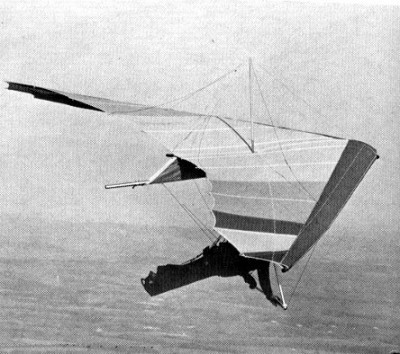
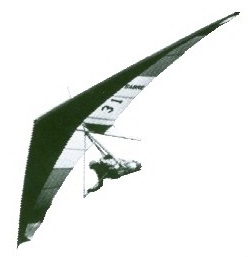
A 1989 hang glider the Sabre was Skyhook’s first double surface machine.
A notable flight has been achieved on the Sabre by by Jim Brown. On the 10th April 81 he flew from Semerwater in the Yorkshire Dales to a landing in Scotland for a distance of 78.1 miles.
Amongst the early enthusiasts who were amongst the first to buy, build or fly a hang glider during early seventies who later went on to become manufacturers was Len Gabriels who founded Skyhook.
Single seat single engined high wing monoplane with conventional three axis control. Wing has unswept leading and trailing edges, and constant chord; conventional tail. Pitch control by elevator on tail; yaw control by fin mounted rudder; roll control by half span ailerons; control inputs through stick for pitch/roll and pedals for yaw. Wing braced from above by kingpost and cables, from below by cables; wing profile; double-surface. Undercarriage has three wheels in tail dragger formation; suspension on tailwheel and bungee suspension on main wheels. Push right go right tailwheel steering connected to yaw control. No brakes. Aluminium tube/wood/steel tube fuselage partially enclosed. Engine mounted below wing driving pusher propeller.
The single seat Skybaby is aimed at homebuilders and is therefore only sold as sets of plans. It is intended to have a McCulloch Mc101 engine developing 12.5 hp at 9000rpm or, for heavier pilots, the Yamaha KT100S of 15 hp at 10,000 rpm. Certain parts are available from Skyhigh Ultralights, for example the landing gear, controls, reduction drive, seat etc.
The price of the plans was $55 in 1982. According to Skyhigh, the construction time for the Skybaby should not exceed 200h.
Engine: McCulloch Mc 101, 12.5hp at 9000rpm Power per unit area 0.09hp/sq.ft, 1.1 hp/sq.m Fuel capacity 3.0 US gal, 2.5 Imp gal, 11.4 litre Length overall 17.0 ft, 5.18 m Height overall 5.0ft, 1.52m Wing span 32.0ft, 9.75m Constant chord 4.0 ft, 1.22 m Sweepback 0 deg Total wing area 128 sq.ft, 11.9sq.m Wing aspect ratio 8.0/1 Empty weight 155 lb, 70kg Max take off weight 360 lb, 163kg Payload 205 lb, 93kg Max wing loading 2.81 lb/sq.ft, 13.7 kg/sq.m Max power loading 28.8 lb/hp, 13.0kg/hp Load factors; +5.0, 3.0 ultimate Max level speed 40 mph, 64 kph Never exceed speed 50 mph, 80kph Max cruising speed 35mph, 56kph Stalling speed 24 mph, 39 kph Max climb rate at sea level 225 ft/min, 1.1 m/s Best glide ratio with power off 9/1 Take off distance 200 ft, 60 m Landing distance 100 ft, 30 m
To meet market demand CA-22 were again reworked and a new type certificate was gained for the CA-25N (nose-wheel) Gazelle. This name stems from the fact that the redevelopment finance for this aircraft was obtained from the Swiss agents Gisela. Production of the CA-22 Elan and the CA-25 Impala (both with tail-wheels) continued but sales of the CA-25N (nose-wheel) went at about l0 to 1.
The CA-25N nose wheel development, first flew 1995.
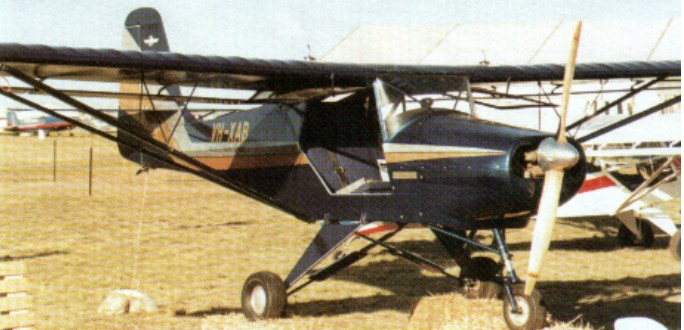
The airframe is built from 4130 chrome molyb¬denum steel, with the wings built up on tubular spars with an internal web, along with metal drag and anti drag braces. Plywood ribs are epoxy bonded to the spars. They are then covered with Stits polyfibre and Dulux paint. Power is from a Rotax 912, which gives the aircraft the flatter engine cowl¬ing — the easiest way to differentiate this machine from the radial type cowl of the US Kitfox.
Production ceased in late 1999 after about 106 tail-draggers and 83 nose-wheeled machines had been constructed.
About 100 CA-22 tail-wheel machines were built and registered either as CA-22s in the ultralight (AUF) class, or as CA-22As under full VH registration marks. To meet market demand these models were again reworked and a new type certificate was gained for the CA-25N (nose-wheel) Gazelle. Production of the CA-22 Elan and the CA-25 Impala (both with tail-wheels) continued but sales of the CA-25N (nose-wheel) went at about l0 to 1.