Soviet Central Hydrofoil Design Bureau

The Central Design Bureau for Hydrofoil named after R.Ye. Alekseev (Central Design Bureau for SEC) was developing a project for an ekranoplan ocean zone with a take-off weight of about 500 tons. About this on Tuesday at the forum “Marine Industry of Russia” said the director and chief designer of the concern “Morinformsystem-Agat” Georgy Antsev.

The International Forum “Marine Industry of Russia” takes place from May 19 to 21, 2015 in Moscow, in the Gostiny Dvor exhibition complex. The forum presented a project of a coastal zone WIG with a take-off weight of 60 tons.

“We need WIG ocean zone with a take-off weight of 500 tons. Such developments are conducted in the CDB Alekseev. Today there is a reboot of the Soviet period, a search is underway for the customer, certain research and development, modeling, and prototyping, ”said Antsev. – It has a very good direction – it is necessary both for passenger transportation, and for northern tasks, and for tasks of protecting state borders. He can use the airfield infrastructure and be at some point, in essence, an airplane. “

The ekranoplan, or a ship on a dynamic air cushion is a high-speed vehicle flying at a height of up to several meters from the surface of water, land, snow or ice. This is a kind of hybrid between an airplane and a watercraft, with equal mass and speed, the winged surface of an ekranoplan is much smaller than that of an airplane, and according to the international classification it belongs to sea vessels. Ekranoplans capable of tearing themselves off the surface for a long time and moving into “airplane” flight mode are called echo flight.

The very first developments, as well as actually operating samples, were obtained by designers of the USSR. The direction was developed by two independent teams. One, under the leadership of Rostislav Alekseev, who, as early as October 1, 1941, defended his thesis “Hydrofoil Glider”. After that, he devoted his life to the development and creation of ekranoplanes. The CDB for SEC was founded in the early 50s.
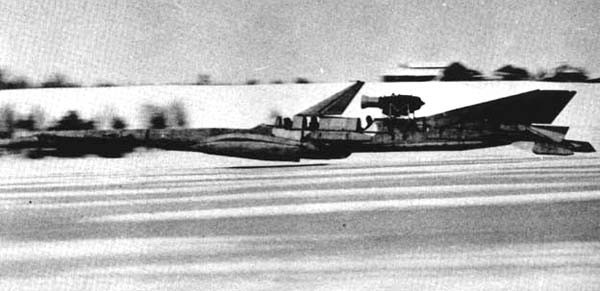
СМ-1

In the early 60s, a test base for these devices was built on the Gorky Reservoir. In 1961, the first flight of the SM-1 / CM-1 screening vehicle took place, and the following year, the SM-2 / CM-2.

СМ-2

Developed by the Soviets from the 1960s onwards, particularly by Dr Rostislav Alexeyev’s Central Hydrofoil Design Bureau, the leading exponents in the design and operation of Wing in Surface Effect types are now located in the Russian Federation. Far ahead of the West in terms of construction and flying experience, the Soviets planned a fleet of 120 surface skimming WISE military transports in the 1980s and four prototypes were built. However, with the end of the Cold War the funds and the cause for the manufacture of the planned balance-of-power-altering transport fleet ceased.

Southern Microlight Developments Gazelle

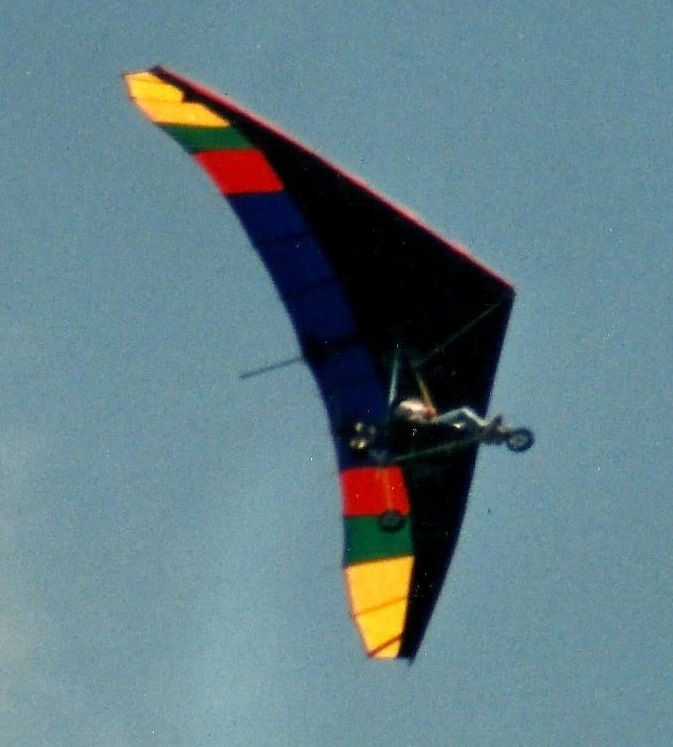
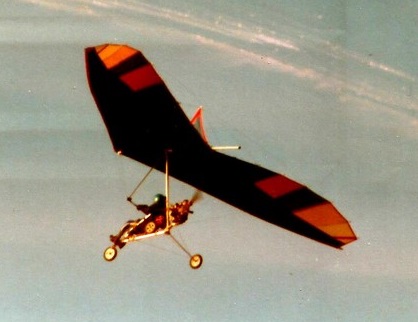
SMD/Flexiform Sky Sails Gazelle/Medium Striker is a single seat single engined flex wing aircraft with weight shift control. Rogallo wing with keel pocket. Pilot suspended below wing in trike unit, using bar to control pitch and yaw/roll by altering relative positions of trike unit and wing. Wing braced from above by kingpost and cables, from below by cables; bowsprit construction with >70% double-surface; pre formed ribs. Undercarriage has three wheels in tricycle formation; no suspension on any wheels. Push right go left nosewheel steering independent from yaw control. Optional brakes on main wheels. Aluminium -tube trike unit, without pod. Engine mounted below wing driving pusher propeller.

Chris Scoble of Southern Microlight Developments builds only the trike unit, and normally mates it to a Flexiform Sky Sails Medium Striker wing, which he strengthens in a similar fashion to the one plus one Striker wing used on the Mainair Rapier.

Gazelles tend to be tailored to the customer’s own requirements and therefore vary in specification, but they are all double pole machines with the poles placed at the extreme ends of the axle for maximum strength, rather in the manner of a UAS Storm Buggy. Normal engine fitment is a 440 cc Robin, with electric start. Heavy duty alloy main wheels are standard.

Living near the sea has encouraged Chris to take an interest in float flying and in spring 1983 he introduced them as an option. The SMD floats can be fitted without disturbing the wheels and are constructed from glass-reinforced polyester in a colour to the customer’s choice. Each has three separate compartments to minimise the effect of leakage. Along the top of each float is a GRP beam which allows the fixing points to be moved at will until correct weight distribution is attained.

Engine: Robin EC44, 40 hp at 6500 rpm
Propeller diameter 58 inch, 1.47 m
V belt reduction, ratio 2.4/1
Max static thrust 270 lb, 122 kg
Power per unit area 0.20 hp/sq.ft, 2.2 hp/sq.m
Fuel capacity 6.0 US gal, 5.0 Imp gal, 22.7 litre
Length overall 11.0ft, 3.35m
Wing span 34.5ft, 10.52m
Sweepback 15 deg
Total wing area 200 sq.ft, 18.6 sq.m
Wing aspect ratio 7.5/1
Wheel track 5.0 ft, 1.52 m
Wheelbase 5.6ft, 1.70 m
Nosewheel diameter overall 13 inch, 33 cm
Main wheels diameter overall 16 inch, 41 cm
Optional floats: length 12.5 ft, 3.81 m; weight 38 lb, 17 kg each

Southern Aero Sports Scorpion

The Scorpion was grounded by the UK Civil Aviation Authority. This followed a series of three in flight structural failures, two on single seaters and one on a two seater, which resulted in three deaths and one serious injury. Subsequent investigation by the Accident Investigation Branch revealed a lack of torsional stiffness in the main structural components, as well as a poor standard of detail engineering. The company went into liquidation shortly after the accidents. By 1982 were no longer trading.

Between 30 and 40 Scorpions were made, in various guises, all using Robin engines of either 330 or 440 cc.

Southern Aeronautical Renegade

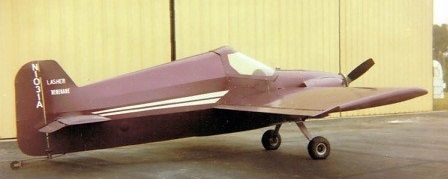
This Formula-V sport racer features a straight-line midwing design. The design was largely based on the Cassutt Special III, but was made suitable to accept VW or VW-based engines. Its designer, Charles Lasher, has chosen steel-tube construction for the fuselage and tail because of its ability to withstand the shock of a crash better than other materials

The wings are a wood-frame structure with fabric covering. The ship is made to handle any Volkswagen from 35 to 65 hp.

The first aircraft was built by M. Ricketts and after eighteen months of construction it was first flown in 1974, registered N73RL (c/n B15). Of conventional construction with all-wood wings and fabric-covered fuselage, the single-seat aircraft was powered by one 55 hp Volkswagen VW1600 motor car engine.

N73RL took second and third places in the Formula V competition at the 1978 and 1979 Cleveland National Air Races respectively, and was used for aerobatic displays.

Plans for amateur construction were marketed via Southern Aero Corporation of Miami Lakes, Florida, after 1983 via Charles Lasher.

Lasher Renegade I (N1031A c/n B96)

At least four Renegade I aircraft were completed in the USA:
N73RL, N1031A, N35DE, and N64JM (designated Michalak R-1).

Biplane Racer Andrew Buehler has set up an LLC and negotiated to acquire the design and manufacturing rights for the Renegade from Creighton King in 2014. Initial planning was for Ed Fisher of Raceair Designs to help with the development and construction of a new Renegade airframe, to use in the promotion of the design. Several minor improvements, and a new wing design were in the works.

Engine: VW 40-hp
Wingspan 16 ft
Length 14 ft
Gross Wt. 652 lb
Empty Wt. 400 lb
Fuel capacity 7.5 USG
Top speed 130 mph
Cruise 120 mph
Stall 49 mph
Climb rate 1000 fpm
Takeoff run 560 ft
Landing roll 400 ft
Range 375 sm

Span: 17 ft 0 in (5.18 m)
Wing chord, constant: 5 ft 0 in (1.52 m)
Length: 15 ft 0 in (4.57 m)
Height: 4 ft 3 in (1.30 m)
Empty weight: 451 lb (205 kg)
Max takeoff weight: 670 lb (304 kg)
Max speed: over 170 mph (273 kmh)
Max cruise speed: 145 mph (233 kmh)
Landing speed: 50 mph (81 kmh)
Max climb at sea level: 850 ft (259 m)/min
Service ceiling: 12,000 ft (3,660 m)
Range: 225 mls (362 km)

Southdown Sailwings Sigma

The 1980 Sigma was the first offering from Southdown Sailwings. It follows the basic concept of the Chargus Cyclone by appealing to the more experienced pilot for use in competition and cross country flying.

Sigma

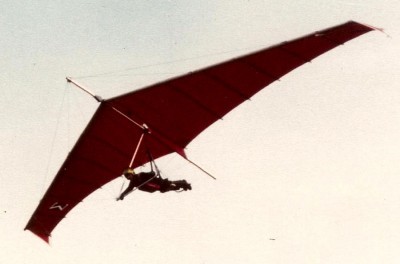
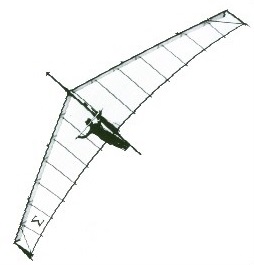
The Sigma is a crosstube-less bowsprit design. The machine has a high aspect ratio with a tight sail and drooped tips which lock up at the minimum desired angle of attack to aid pitch stability. Rigging is straightforward and quick, the longest operation being fitting the flexible battens. The Sigma came in two sizes, 11 sq m and 12 sq m.

The 1979 Southdown Sailwings Sigma had to be flown all the time, and if you did not get the push out right in turns, then don’t bother with light ridge lift. The nose would drop on landing.

In 1979 Southdown Sailwings made the first 12 Sigma 12m. Alan Garard and Rod Stuart from NZ test flew all 12 gliders and loved them. Stuart’s Sigma hangs in the transport museum in Wanaka, New Zealand.
The Sigma was followed by the 1981 Sigma Floater.

Sigma Floater

The Sigma Floater is an open cross boom design glider, this is different from the first Sigma which used a bowsprit design. This type of glider was more appealing to novice or intermediate pilots for use in coastal flying. Rigging is straightforward but slower than the Sigma.

The Sigma Floater was priced at £937.00.

Sigma 12 m
Span 38 ft
Sail area 188 sq ft
Aspect ratio 7.5
Nose angle 140 deg

Southdown Sailwings Puma

A Puma is a combination of the South¬down Sailwings Lightning DS wing and a Southdown Sailwings approved two seat trike unit. The first such combination used an Ultra Sports trike unit and is known simply as the Puma. Later combinations carry a suffix to show the trike unit manufacturer, viz: Puma MS (Mainair Tri Flyer Two Seater trike unit) and Puma SS (Southdown Sailwings’ own trike unit).

A Puma Sprint is a combination of the Southdown Sailwings Sprint wing and a Southdown Sailwings approved two seat trike unit. The first such combination used Southdown Sailwings’ own trike unit and is known simply as the Puma Sprint. Later combinations carry a suffix to show the trike unit manufacturer. One such combination uses the Mainair Tri Flyer Two Seater trike unit and is called the Puma Sprint Ms.

The Sea Puma is a combination of the modified Southdown Sailwings Lightning DS wing and a modified version of Southdown Sailwings’ own two seater trike unit.

Thus there is no such thing as a single seat Puma.

Puma MS

Puma Sprint MS

Southdown Sailwings Lightning

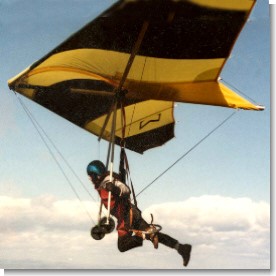
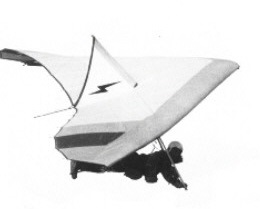
The 1980 Lightning was a new double surface glider from Southdown Sailwings, with superior sink rate, glide and penetration, plus high stability and superb handling. It could be distinguished from other clones of the Comet by its shark fin which stretches from king post to trailing edge. The Lightning came in two sizes, L 170 and L 195 to cover pilot weight ranges from 9-15 st. The recommended change over weight was 11 st.

Southdown Sailwing Lightning 190 Wing and Stainless Steel Trike (Courtesy Job Chithalan)

The 1981 Lightning double surface wing hang glider was recognizable for its aileron. The finishing touch not too great and mounting the wing a bit long.

Southdown Sailwings Lightning 190

Gallery

Lightning 195
Sail area: 195 sq ft
Nose angle: 130 deg
Span: 32 ft
Aspect ratio: 6.3
Weight: 60 lb

Lightning DS