In 1993, ASAP began providing parts and service for the existing Beaver RX550, RX28 and RX35 all aircraft manufactured by a company no longer operating. The demand to continue offering the Beaver aircraft as a kit was high and so in 1996 ASAP introduced the new Beaver RX 550 Plus with new wings, new tail, stronger shock system, better performance but still keeping with its famous docile easy flight of the original Beaver.
1980->
Spectrum RX-28 Beaver

Single seat single engined high wing monoplane with conventional three axis control. Wing has swept back leading and trailing edges, and constant chord; conventional tail. Pitch control by elevator on tail; yaw control by fin mounted rudder; roll control by three-quarter span ailerons; control inputs through stick for pitch/roll and pedals for yaw. Wing braced from below by struts; wing profile double surface. Undercarriage has three wheels in tricycle formation; bungee suspension on all wheels. Push right go right nosewheel steering connected to yaw control. No brakes. Aluminium tube framework, with optional pod or full enclosure. Engine mounted at wing height driving pusher propeller.
Since a prototype, the aircraft has been changed considerably. It features almost full span ailerons of 10.0 ft (3.05 m) length, which should give very powerful roll control. Another change has been the inclusion of an optional pod, which can be extended as a further option to become a full cockpit enclosure, rather in the manner of a Birdman Chinook.
Spectrum says that the Beaver takes 30 hr to assemble from kit. Construction is of double surface, strut braced, high wing with aluminium spars and ribs. Stressed to + 7.5 G’s and – 3 G’s. Mylar reinforced leading edge for smooth air flow. Conventional 3-axis controls, centre mounted joy stick, rudder pedals, tricycle undercarriage (with castering nosewheel) and tail skid. Independent shock absorbers give excellent rough field capabilities.
In 1993, ASAP began providing parts and service for the existing Beaver RX550, RX28 and RX35 all aircraft manufactured by a company no longer operating. The demand to continue offering the Beaver aircraft as a kit was high and so in 1996 ASAP introduced the new Beaver RX 550 Plus with new wings, new tail, stronger shock system, better performance but still keeping with its famous docile easy flight of the original Beaver.
The ASAP Single seat Beaver SS standard kit includes: Beaver SS Airframe, Rotax 447 Engine – 40 hp pull-start, Engine accessories, Basic Instrument Package (EGT, CHT, RPM, Airspeed), GSC – 2 blade, 60″ TECH2 prop (ground adjustable, wooden blades w/composite leading edge, Single colour primer and paint package (Endura, 2 part catalyzed polyurethane), Ceconite covering material and edge tape, 3M Latex adhesive, Azusa Tires, nose wheel brakes.
The Beaver SS offers a high useful load with a maximum gross take-off weight of 650 pounds and a typical empty weight of 340 pounds, the Beaver offers more than 300 pounds of useful load. The Beaver SS has a newly designed and cleaner wing, and full span ailerons. Pre-cut, pre-drilled components combined with a modern Assembly Manual (light on cad drawings, heavy on photos) makes for easy assembly even for first time builders.
Cenconite fabric is attached to the structure using a 3M, water-based latex glue before being “shrunk to fit” with a simple home iron. The standard kit includes an educational video to show how. The Beaver kit even includes a high end, catylized polyurethane primer and paint package by Endura incorporating UV protection, flex agent, and instructions. The Standard Beaver SS kit includes everything needed to assemble the aircraft. Everything is jig drilled at the factory with all of the difficult work done.
Complete kit includes airframe, engine, engine accessories, 3 Bld GA prop, paint package, front brake, standard wheels, upright engine mount, instruments steerable nosewheel, ceconite fabric, adapts to floats and skis. Price 2009: US$13150
The Beaver SS first flew in 2000. In 2007 10 were built.
ASAP marketed in kit form the Beaver RX-550 tandem two-seat microlight (as a variant of Spectrum Beaver RX-550), the Beaver RX-28 two-seat training model, and the Chinook Plus 2 tandem two-seat microlight.
Engine: Rotax 277 (268cc) 28 hp
Static thrust: 210 lb
Prop: 127cm x 71 cm pitch
Empty wt: 252 lb
Max wt: 524 lb
Wing span: 31ft
Wing area: 148 sq.ft
Height: 5’8”
Length: 17’8”
Fuel cap: 5 USG
Construction: Aluminium: Dacron
Wing loading: 3.54 lbs/sq.ft
Power loading: 18.71 lbs/hp
Max speed: 72 mph
Cruise: 50 mph
Stall: 24 mph
Vne: 75 mph
Climb rate: 800 fpm @ 50 mph
Design limits: +7.5, -3g
Glide ratio: 8-1
Seats: 1
Beaver SS
Engine: Rotax 447, 40 hp
Engine range: 40-50 hp
Empty wt: 340 lbs
MTOW: 650 lb
Wingspan: 31 ft
Length: 17.6 ft
Wing area: 138 sq.ft
Fuel cap: 5 USG
Cruise: 67 mph
Stall: 30 mph
ROC: 800 fpm
Seats: 1
To dist: 90 ft
Ldg dist: 65 ft
Cockpit width: 39 inch
Aircraft Sales and Parts Ltd (ASAP)
Beaver SS-single place
Stall: 26 kt / 30 mph / 48 kmh
Cruise: 58 kt / 67 mph / 108 kmh
VNE: 78 kt / 90 mph / 145 kmh
Empty Weight: 154 kg / 340 lbs
MTOW Weight: 295 kg / 650 lbs
Climb Ratio: 850 ft/min / 4 m/s
Glide Ratio: 7:1
Take-off distance (50ft obstacle): 90 ft / 27 m
Landing distance (50ft obstacle): 75 ft / 23 m
Spectrum Aircraft
1984: #3-9531-192nd St, Surrey, B.C., Canada V3T 4W2.
UL builder
Spectra Aircraft Sonic
A double surfaced, internal crossbar hang glider design followed the Aolus, called the Sonic.
Spectra Aircraft Aolus

The 1981 Aolus was the first version of this planform from Spectra Aircraft, by design engineer Carlos Moralles. It had a wide 150 degree nose angle to minimize spanwise flow and maximize span efficiency. The tail was added to provide for pitch stability which would be lost due to the minimal sweep in the wings.
The Aolus was available in three sizes: 150, 170, and 190.
It has been described as “pitch weird and yaw funky. Tests had shown the washout tubes to have no needed pitch effect, but that they were put on for pilot expectations. Assembly was flat on the ground, with tricky ways of getting that high tension sweep cable/bow sprit in place.
In 1981 Carlos Miralles taught flying on the second prototype off Cuesta Ridge in San Luis Obispo, California, and sold it for $500.
It was a superb thermalling machine. In a strong, smooth core, you could push out past stall and flat-spin at 2000 fps. With that reflexed tail, it gave you a very secure feeling that it would recover from going over the falls in violent thermals. And fast landings in high-altitude-density air were helped by that bowsprit. When it dropped, you’d fly through the bars and hit the sail (no crossbar). But the thing that made the Aolus such a great thermalling machine, that huge tail, may have kept it from attaining the best l/d between thermals.
Specter Aircraft Specter II
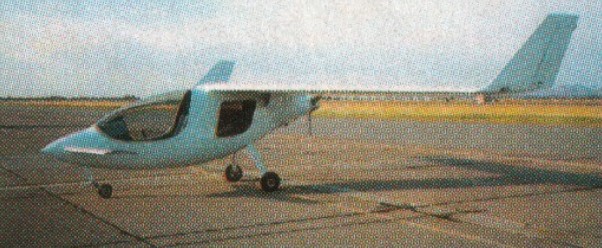
First flown in May 1997.
Top speed: 170 mph
Cruise: 140 mph
Stall: 54 mph
Range: 546 sm
Engine: Subaru EA81, 118 hp
Fuel capacity: 22 USG
Empty weight: 900 lb
Gross weight: 1600 lb
Height: 10 ft
Length: 16.5 ft
Wing span: 34 ft
Wing area: 147 sq.ft
Seats: 2
Landing gear: nose wheel
Specter Aircraft Inc
1997: 12 South 100 East, PO Box 87, Bancroft, ID 83217, USA.
UL builder
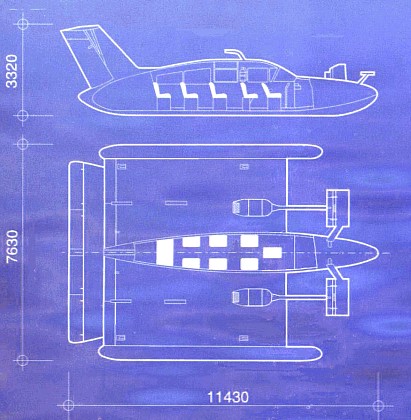
Soviet Central Hydrofoil Design Bureau Volga-2

The Soviet Central Hydrofoil Design Bureau developed the eight-seat Volga-2 in 1985.
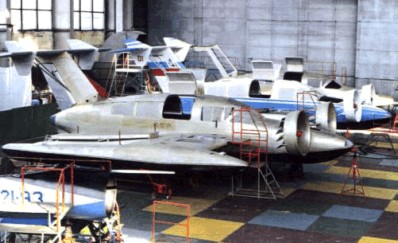

Engines: 2 x Toyota, 155 HP
Empty weight: 1950 kg
Weight full load: 2850 kg
Cruising speed: 120 km/h
Range: 400 km
Crew: 1
Capacity: 8
Soviet Central Hydrofoil Design Bureau KM / Caspian Sea Monster / Lun Class / Alexeyev Hydrofoil Design Bureau Lun Class
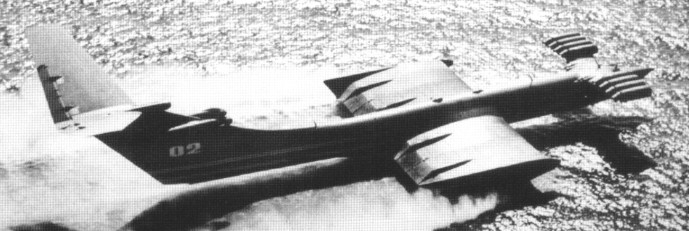
The Monster (its Russian designation was KM, derived from the words Korabl’ Maket or “ship model”) was nothing less than a juggernaut, one of the largest heavier-than-air flying machines ever built. At 500 tonnes it had a 100-tonne MAUW advantage over its fellow winged heavyweight the Boeing 747. No less than ten jet turbines constituted its propulsion system, an array of power used for take-off rather than cruise. Eight turbines were arranged in a shoulder-mounted stub-wing battery just aft of the cockpit. Capable of being deflected under the mainplane where a full-span trailing edge flap would trap their thrust, their combined power could generate an immense lifting force via a hovercraft-like static air cushion to cruise 4 metres above the water
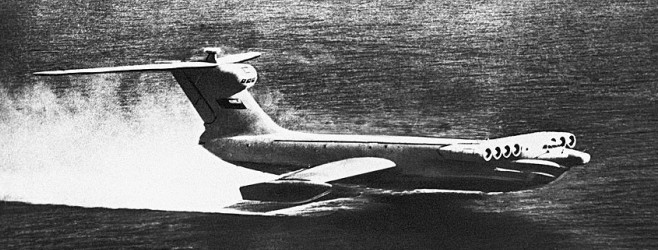
The Lun-class ground effect vehicle (GEV), or sea skimmer, was developed by Russian engineers at the Alexeyev Hydrofoil Design Bureau.
During the Cold War, ekranoplans were sighted for years on the Caspian Sea as huge, fast-moving objects. The name Caspian Sea Monster was given by U.S. intelligence operatives who had discovered the huge vehicle, which looked like an airplane with the outer halves of the wings removed. After the end of the Cold War, the “monster” was revealed to be one of several Russian military designs meant to fly only a few meters above water, saving energy and staying below enemy radar.
The KM, as the Caspian Sea Monster was known in the top secret Soviet military development program, was over 100 m long (330 ft), weighed 540 tonnes fully loaded, and could travel over 400 km/h (250 mi/h), mere meters above the surface of the water.
These craft were originally developed by the Soviet Union as very high-speed (several hundred km/hour) military transports, and were mostly based on the shores of the Caspian Sea and Black Sea. The largest could transport over 100 tonnes of cargo. The only three operational A-90 Orlyonok ekranoplans built (with renewed hull design) and one Lun-class ekranoplan remained at a naval base near Kaspiysk.
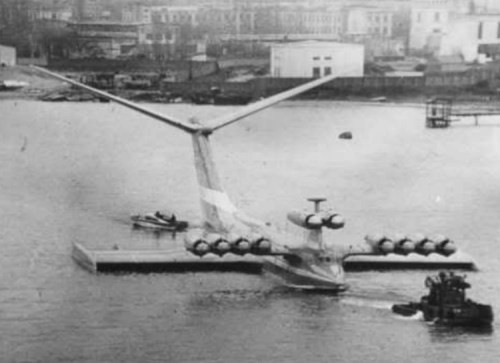
The Lun-class (“Harrier”) Ekranoplan MD-160, dubbed the “Caspian Sea Monster” by US Intelligence services, was one of a kind. It was capable of carrying up to 124 tonnes of troops and equipment, including as many as six nuclear missiles, at speeds up to 560km/h as far as 2000km. Eight Kuznetsov 128.9kN NK-87 turbofans mounted on the front cannards provided the thrust to get the seaplane’s hull up and out of the water and engage the ground effect.
While ground-effect vehicles are a highly efficient way to transport cargo over long distances, the MD-160 had significant drawbacks in its military applications. For one thing, manoeuvrability. Anything resembling a sharp turn was right out, and allowing a wing tip to even sniff the water could result in 500 tonnes of seaplane cartwheeling along the surface of the Caspian. And since the ground effect didn’t actually take effect until the plane was out of the water, the MD-160 had to always take off into the wind.
In 1987, the first flight was made by Lun, an ekranoplan-rocket carrier. It was armed with six guided anti-ship missiles “3M-80 Mosquito”.
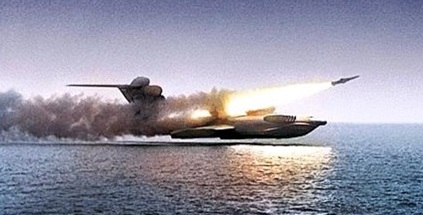
After the successful completion of state tests “Lun” was in 1990 transferred to trial operation. However, the collapse of the Soviet Union led to the cessation of work in this area and the disbanding of the 11th Air Group of the Black Sea Fleet E-Wing.
So while the MD-160 was thoroughly impervious to subsurface mines and torpedoes, its size and complete lack of manoeuvrability made the planes sitting ducks against Western air forces (hence its NATO designation: Duck), often requiring armed escort and forward scouting boats to avoid obstacles. The Ekranoplan carried anti-ship P-270 Moskit guided missiles in six pairs mounted onto its fuselage as well as a pair of 23mm Pl-23 cannons in a tail turret and forward-facing pair under the forward missile tubes.
Despite the the MD-160’s shortcomings, Soviet high command continued to move forward with the program right up until the Soviet Union fell. A second MD-160, destined to be a mobile field hospital, was 90 per cent complete and another 30 A-90 Orlyonok GEVs, meant to strengthen the Black Sea Fleet, were on order when the program’s funding was cut. The MD-160 currently resides at a naval station in Kaspiysk.

MAUW: 540 tonne
Engines: 10
Cruise: 300 kt
Soviet Central Hydrofoil Design Bureau Strizh
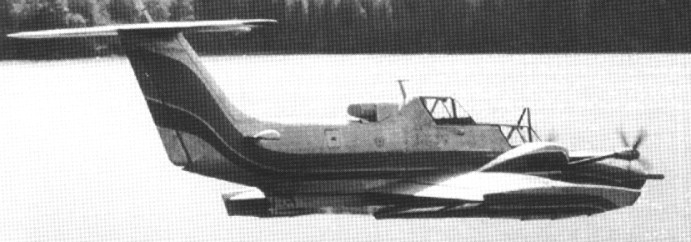
The Strizh was built in 1989 as a two-seat wing in surface effect trainer for Russian naval pilots.
Seats: 2

