RUSSIA
Established 1990 to develop the MiG-TA4 general-purpose lightplane with air-cushion landing system.
1980->
AKS Apex Eco 6
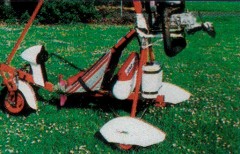
Engine: Rotax 503, 46 hp
hp range: 46-65
Fuel capacity: 4.5 USG
Empty weight: 70.5 lb
Gross weight: 475 lb
Height: 8 ft
Length: 6.5 ft
Seats: 1
AKS Apex Cross 5

Engine: Rotax 503, 46 hp
hp range: 46-65
Fuel capacity: 10 USG
Empty weight: 143 lb
Gross weight: 990 lb
Height: 8 ft
Length: 8.5 ft
Seats: 2
Akrotech Europe
A subsidiary of Aeronautical Service, Akrotech Europe has taken over assets of Avions Mudry et Cie, continuing production of the CAP 10B two-seat aerobatic and club trainer (first flown 1968) and CAP 232 single-seat aerobatic competition monoplane (first flown July 1994). Also produces the CAP 222, a version of the US AkroTech Giles G-202 two-seat kit-built aerobatic competition aircraft and trainer.
Akrotech Aviation Giles G-202

First flown in 1995, the G-202 is a two seat development of the single seat G-200. A tandem carbon fibre aerobatic machine.

Akrotech Europe produces the CAP 222, a version of the US AkroTech Giles G-202.
Variation:
Mudry CAP 222
Engine: Lycoming IO-360, 200 hp.
Height: 5.58 ft
Length: 19.75 ft.
Wing span: 22 ft.
Wing area: 90 sq.ft.
Fuel cap: 58 USG.
Weight empty: 950 lbs.
Gross: 600 lbs.
Speed max: 253 mph.
Cruise: 203 mph.
Range: 900 sm.
Stall: 58 mph.
ROC: 2500 fpm.
Take-off dist: 400 ft.
Landing dist: 700 ft.
Seats: 2.
Landing gear: tail wheel.
Engine: Lycoming AEIO-360EXP, 235 hp.
Loading: +/- 12g.
Engine: Lycoming, 220 hp
Wing span: 6.7 m
Wing area: 8.3 sq.m
MAUW: 726 kg
Empty weight: 431 kg
Fuel capacity: 220 lt
Max speed: 407 kph
Cruise speed: 327 kph
Minimum speed: 93 kph
Climb rate: 12.5 m/s
Seats: 2
Fuel consumption: 40 lt/hr
Price (1998): $120,000
Kit price (1998): $59,500
Akrotech Aviation Giles G-200

First flown in 1992.
Engine: Lycoming AEIO-360, 200 hp.
HP range: 180-200.
Speed max: 253 mph.
Cruise: 212 mph.
Range: 1000 sm.
Stall: 65 mph.
ROC: 3550 fpm.
Take-off dist: 300 ft.
Landing dist: 600 ft.
Fuel cap: 48 USG.
Weight empty: 750 lbs.
Gross: 1300 lbs.
Height: 5.33 ft.
Length: 18 ft.
Wing span: 20 ft.
Wing area: 75 sq.ft.
Seats: 1.
Landing gear: tail wheel.
Akrotech Aviation
1996-8: 53774 Airport Rd, Scappoose. OR 97056, USA.
Offers kits to build Giles G-200 single-seat aerobatic monoplane (first flown 1992) and Giles G-202 tandem two-seat aerobatic monoplane (first flown 1995).
Akaflieg Stuttgart FS-35 Harpyie

The fs35 Harpyie was created by the Stuttgart Academic Aviation Group in 2003 as a motor glider designed for glider towing with good climbing performance and a large fuel tank, after Porsche had announced the discontinuation of model support for the PFM 3200 aircraft engine for 2005. This engine was installed in the club’s Robin DR 400 tow plane. The following requirements were defined: high aerodynamic quality in aircraft towing in the speed range 90–150 km / h, short take-off roll distance, use of an efficient diesel engine, approval as a motor glider and design as a two-seater with dual controls for training.

The design of the wing began with the assumption of 120% of the fuselage resistance of the Diamond HK36 Super-Dimona and the drive with a Thielert Centurion 1.7 with 125 hp (approx. 90 kW). The two-part Dimona wing was chosen, which was extended inwards, swept and provided with winglets. In April 2007, the moulding of the three-part half-span master model began, and in 2009 the construction of the fracture wing with integrated strain gauges began in the resulting negative form. A load test of this component on November 4, 2010 failed because the wing broke at 80% of the load to be verified. The wing construction began after reinforcement of the original construction and its mathematical proof of strength in April 2011.
The wing consists of a carbon fiber sandwich shell with carbon fiber belts and GRP -Steg. The I-shaped spar merges into a box spar in the spar stub.
The fuselage is also based on the Dimona, but the position of the wing had to be moved forward because of the heavier engine. The four-cylinder in-line engine Centurion 2.0s, now called the Continental CD-155, serves as the drive as a further development of the Centurion 1.7.
The vertical tail of the Dimona was built with the Eppler profile E 522 and increased profile depth as a GRP shell with CFRP belts in the spar. At the end of the fuselage tube, a tow coupling is installed on a boom under the tail unit.
The main landing gear comes from the Van’s Aircraft RV-8, the nose landing gear from the Super Dimona.

The first flight of the aircraft with the aircraft registration D-KTOW took place on August 13, 2019 in Schwäbisch Hall, the tug trials started at the Idaflieg 2020 summer meeting in Stendal-Borstel.
Engine: Continental CD-155, 155 hp (approx. 110 kW)
Wingspan: 17.67 m
Wing area: 16.9 m²
Wing extension: 18.5
Wing profile: FX 63-K-137 (mod)
V position: 3°
Empty weight: 600 kg
MTOW: 850 kg
Top speed: 270 km / h
Crew: 1 + 1
Akaflieg Stuttgart FS-33 Gavilán
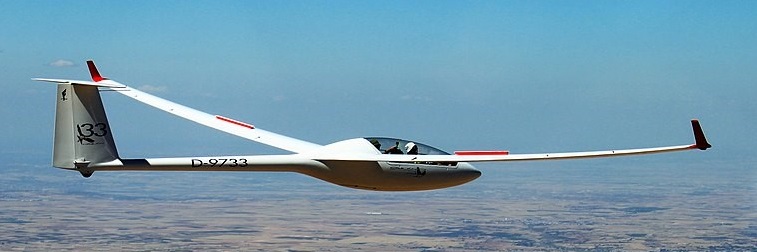
The fs33 is a high performance two-seat glider with a 20m wingspan, developed in reaction to the then newly created FAI Two Seater class in 1989. By the standards of an Akaflieg, the aircraft’s concept and design is relatively conventional. On the other hand, the optimization of the individual parts and the consequent implementation of lightweight construction were key aspects of the project. This led, among other things, to the use of carbon fiber reinforced composites for the entire structure. Only the cockpit was exempt from this, being made of a carbon-kevlar hybrid construction as with the fs31 for safety reasons. Additionally, the wing spars were made of carbon fiber scrims instead of fabric as specified by the Federal Aviation Office. The fs33 was designed to have pleasant flying characteristics to simplify operation of the aircraft.
A further consideration while planning the project was that during the 10-year long design and construction phase of the previous prototype, the fs32 “Aquila”, it was impossible for any member to actively work on the project for its entire duration. Furthermore, the demanding nature of studies with shorter periods led to the conclusion that a quick development of the aircraft had to be feasible.
To maintain the advantages of construction using negative moulds without having to spend a large amount of time to construct a master model, pre-existing moulds were used for all major components:
the fs31’s fuselage mould due to the former’s aerodynamic qualities
the fs32’s wing moulds, modified to remove the slotted flaps and extend the wingspan to 20 meters
the Schempp-Hirth Nimbus 4’s tail form
Due to the usage of lengthened fs32 wing moulds, the wings of the fs33 had a high aspect ratio. The skin of the wings are made from unidirectional scrims, which can be loaded even more than those from regular fabrics. The aileron and flap function of the 3-piece wing flaps are regulated by a mixer located at the wing root to maintain an elliptical lift distribution as much as possible and to allow for enough controllability and prevent spins.
Apart from the tail, the fs33’s fuselage form is identical to that of the fs31. The control system had to be totally overhauled to incorporate the flaps. To save time, as many parts from the glider manufacturer Alexander Schleicher as deemed feasible were used in the cockpit region. Adapting said parts for the fs33 was a simple operation as the ASH 25’s fuselage design was based on that of the fs31. Experience gained during the construction of the fs31 allowed for changes that made the fs33‘s cockpit somewhat roomier. The principle of splitting the fuselage into an upper and lower shell, as in the fs31, was preserved. When compared to the typical design which splits it into a left and right shell, the former allows for a higher degree of safety in the event of a crash as there is no seam under the pilot which can burst open on impact.
First public display of the aircraft was during the AERO Fair of 1997 in Friedrichshafen. The fs33 achieved its first flight on 28 May 1998 in Aalen-Elchingen. Flight tests in the following years showed that the airbrakes were prone to spontaneously deploying, though this could usually be rectified by simply retracting the airbrakes. There were however two cases in which the airbrakes spontaneously deployed and jammed. The first led to a cancellation of tests and a safe landing on the airfield. The second case of jamming, this time of both airbrakes, led to a crash landing on 11 June 2000, which heavily damaged the aircraft’s wings, fuselage, and undercarriage, though both pilot and passenger remained unhurt.
Repairs, which were almost cancelled due to the extensive amount of damage along with the start of the Akaflieg Stuttgart fs34 project, began in October 2000. Work on the wings was done with assistance from Rolf Schmid from Technoflug. Originally, the retractable undercarriage was made of carbon fiber composites with steel fittings to save weight. Due to the damage sustained during a crash landing however, which necessitated the construction of a new undercarriage, it was decided to replace it with a regular steel one instead. Repairs were finished by 2002, with the aircraft flying again on 15 May of that year. Damages were discovered on the aileron hinges in 2014, leading to a complete replacement of the ailerons. The aircraft was again taken out of service in 2016 due to damages to one of the wings.
The fs33 is commonly used by the Akaflieg Stuttgart for gliding competitions.
Construction: 1992 – 1998
Wingspan: 20 m
Wing area: 14,4 m²
Aspect ratio: 27,7
Profile: AH 81 K 4/20
Length: 8,98 m
Empty weight: 408,5 kg
MTOW: 640 kg
Vne: 280 km/h
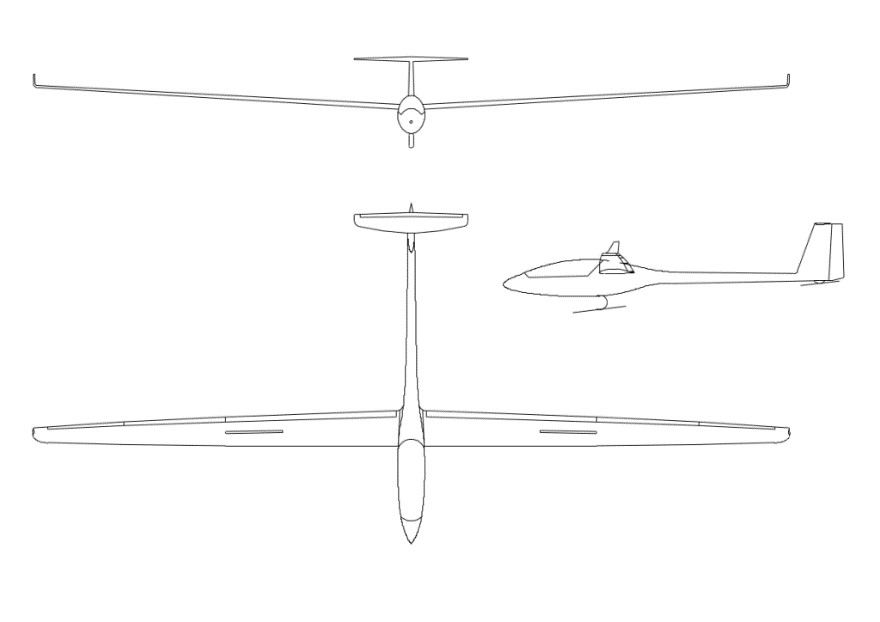
Akaflieg Darmstadt D-41

Wing span: 20m
Wing area: 14sq.m
Empty Weight: 360kg
Gross Weight: 750kg
Wing Load: 53.6kg/sq.m
Aspect ratio: 28.6
Airfoil: LS 6
Structure: GFRP
No. of Seats: 2
No. Built: 1

