An improved search-and-rescue variant of the Be-40 became the Be-42 (sometimes referred to in the West as A-45).
1980->
Beriev A-40 / Be-40 Albatross
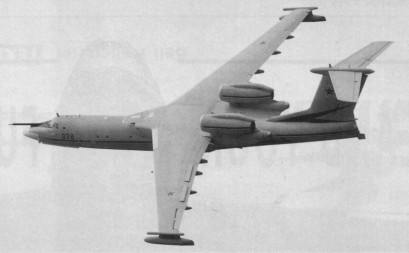
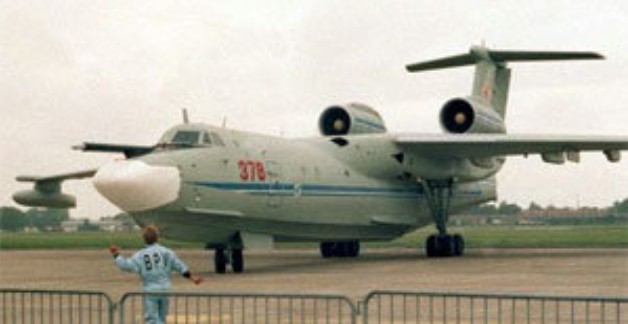
The A-40/Be-40 Albatross Mermaid turbofan-powered intermediate-range antisubmarine, search-and-rescue and patrol amphibian, first flown December 1986 and ordered for the Russian Navy in 1992 but not funded.
The A-40 amphibian aircraft is intended for antisubmarine warfare in the near coastal zone at any time of the day and year, in VFR and IFR weather conditions.
The aircraft is provided with an inflight refueling system.
Its onboard equipment provides for automatic solution of flight/navigation problems, search, detection, tracking and destruction of hostile submarines both in surface and submerged positions and on the sea bottom.
The equipment comprises a search/sighting system, a flight control and navigation complex, communications facilities, and other equipment. The search/sighting system consists of radar, sonar and magnetometric subsystems.
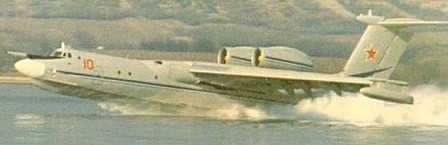
The engines are started by an auxiliary power unit and the cruise turbofans are equipped with a thrust reverser, thereby reducing the landing roll and the abortive takeoff distance.
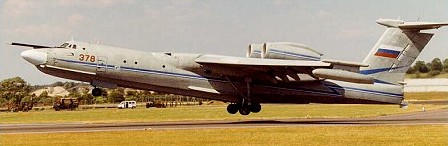
The type first showed up in US reconnaissance photographs during 1988 satellite passes over Taganrog but the first “closeups” came with the amphibian’s surprise debut at an air show in August 1989. NATO dubbed the aircraft, christened Albatross by the G M Beriev Taganrog Aviation Scientific Engineering Complex, “Mermaid”.
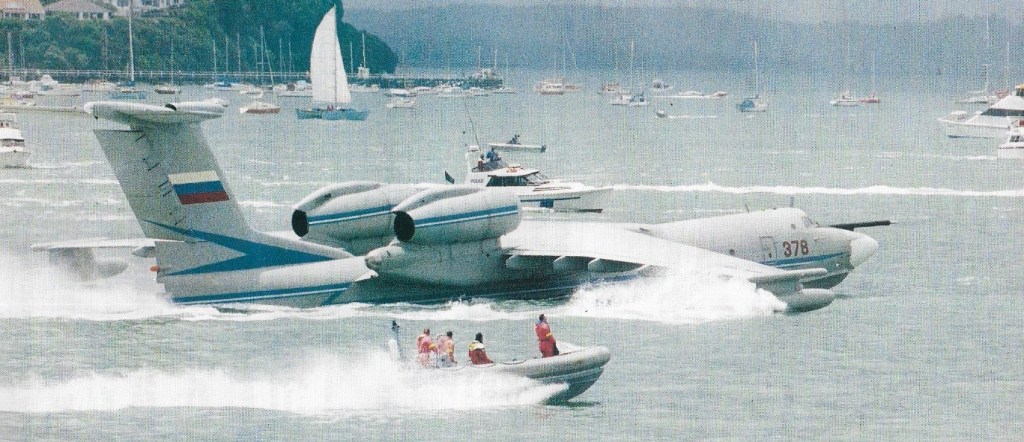
A requirement for the two large 26,455 lb static thrust PERM Soloviev D 30KPV engines to be placed away from ingesting water saw an over wing configuration incorporated in the design. The rear part of the pylon ac¬commodates RD 60 booster engines providing an increase in thrust by 6065 lbs st apiece. In the SAR role the A 40 can cover 1240 nm (2000km) from its base and take on board up to 54 survivors. The crew usually totals five plus a rescue team of around four to six.
An improved search-and-rescue variant became the Be-42 (sometimes referred to in the West as A-45).
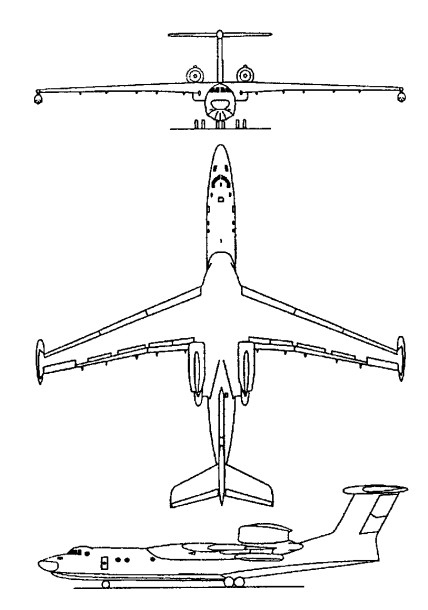
Engines: 2 x PERM Soloviev D-30KPV turbofan, 117.7 kN (26,455 lb) and 2 x Klimov RD-36-35AFV, 24.5 kN
Take-off weight: 86000 kg / 189599 lb
Wingspan: 41.6 m / 136 ft 6 in
Length: 43.8 m / 143 ft 8 in
Height: 11.1 m / 36 ft 5 in
Wing area: 200.0 sqm / 2152.78 sq ft
Max. speed: 760 km/h / 472 mph
Cruise speed: 720 km/h / 447 mph
Ceiling: 9700 m / 31800 ft
Range w/max.fuel: 5500 km / 3418 miles
Range w/max.payload: 4100 km / 2548 miles
Armament: 6500kg
Crew: 8
Beriev
Starting seaplane design in 1928, Georgi. M. Beriev became the leading designer of Russian waterbased aircraft. Beriev had gained considerable expertise as an assistant to French designer, Paul-Aime Richard, during the latter’s stay in the Soviet Union from 1928 to 1930.
Chief designer of the TsKB seaplane group and the bureau of G M. Beriev, at Taganrog on the Azov Sea.
In 1930, he was responsible for the twin-engined MBR-2 flying-boat, Be-2 reconnaissance seaplane and Be-4 flying-boat. Beriev design bureau became center of Soviet seaplane development in 1945, a major flying-boat project being the twin-jet Be-10. Be-12 twin-turboprop antisubmarine and reconnaissance amphibian manufactured between 1963 and 1973 and used widely by Soviet/Russian Navy until about 1997, when withdrawn; several Be-12s have been modified for civil uses, including transport and firefighting. A-40/Be-40 Albatross Mermaid turbofan-powered intermediate-range antisubmarine, search-and-rescue and patrol amphibian, first flown December 1986 and ordered for the Russian Navy in 1992 but not funded.
An improved search-and-rescue variant became the Be-42 (sometimes referred to in the West as A-45).
A laser-gun test-bed aircraft based on the llyushin II-76 was produced by Beriev and has been flown since 1980s as A-60, while in 1978 the first flight took place of the Beriev A-50 Mainstay airborne early warning and control aircraft, also based on the II-76 and in Russian operational service since 1984. Beriev Be-32 16-passenger twin-turboprop transport (first flown 1976), similar to earlier Be-30 (first flown 1968), was still to enter production in 1998. Be-102 multipurpose amphibian designed in 1993 but remained project in 1998. Be-112 Pelican larger multipurpose amphibian under consideration for development, while Be-200 twin turbofan multipurpose amphibian (initially for firefighting) first flew in 1998. Be-103 six-seat light amphibian, also suited to cargo carrying, survey and other roles, first flew July 1997; has twin piston engines carried on mounts either side of the rear fuselage. Very heavy lift cargo and passenger amphibians have been projected as Be-1200 and Be-2500, possibly to fly next century. Company then named Joint Stock Company “Taganrog Aviation Scientific- Technical Complex named after G.M. Beriev,” and became part of the AVPK Sukhoi organization.
Bensen
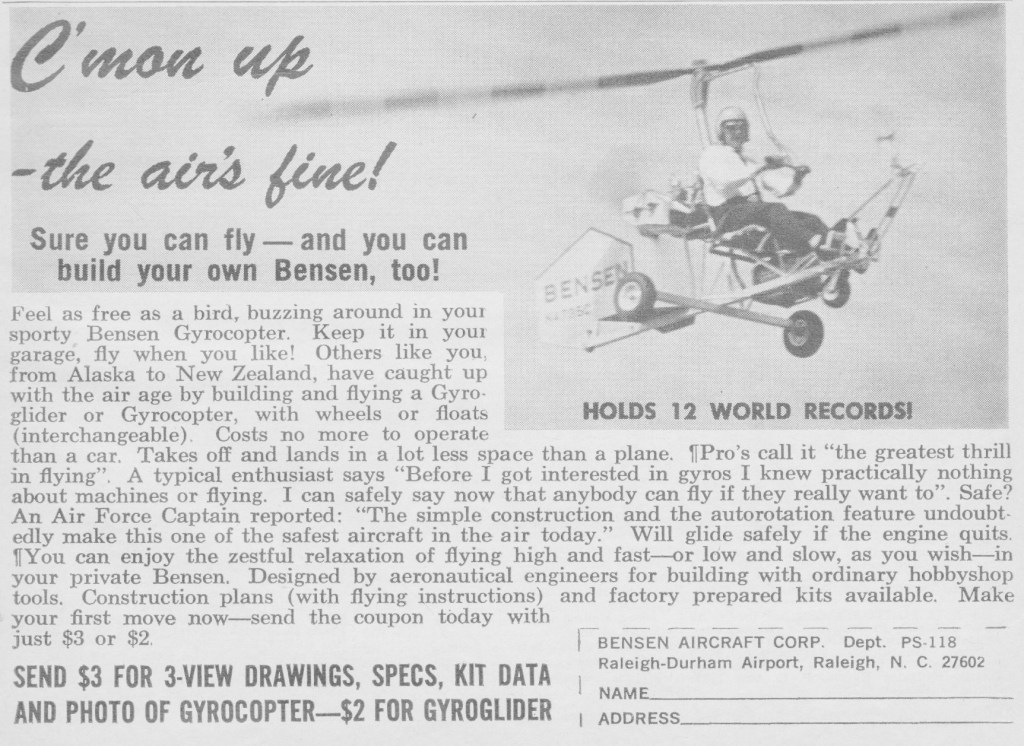
Founded by Dr. Igor B. Bensen, formerly chief research engineer of the Kaman Corporation, to develop a series of lightweight autogyros. Examples built and supplied to USAF for research purposes, but marketed primarily in kit form for amateur construction. Also attempted to develop Cargolifter as multi-helicopter lifting platform, with eight-rotor sub-scale prototype flown in early 1980s.
Benjamin Gee Bee Super Sportster Replica

Replica Granville brothers’ R-2
Engine: P&W R-985 Wasp Jr, 450 hp
Span: 25 ft
Wing area: 102.2 sq.ft
Aspect ratio: 6.1:1
Length: 17 ft 9 in
Empty wt: 2150 lb
Gross wt: 3100 lb
Max level speed: 257 mph
Fuel cap: 66+38 USG
Root chord: 53 in
Wing incidence: 2.5 deg
Dihedral: 4-5 deg
Wheel tread: 76 in
Max fuse diameter: 61 in
Airfoil: 65% thick M-6
Tail span: 8 ft
Tail area: 15.5 sq.ft
Vertical tail area: 13.5 sq.ft
Belworthy Figaro

The Figaro ZK-PUR is another creation from Alan Belworthy. This microlight has a two-seat tandem cockpit and is flown solo from the rear seat. Power is from a Ford two-litre Sierra with 9:1 pistons and a slightly ground camshaft. The aircraft is constructed from wood except for the steel tube and fabric covered elevator and rudder. The wings are basically Jodel and the fuselage is built along the Pietenpol style.
Engine: Ford Sierra 2-litre.
Belworthy Moa

The design by Alan Belworthy was initiated in 1992 with construction beginning in 1995. First flown on 20 May 2000.
Engine: Ford 3.8 lt V-6.
Seats: 4.
Bell 427
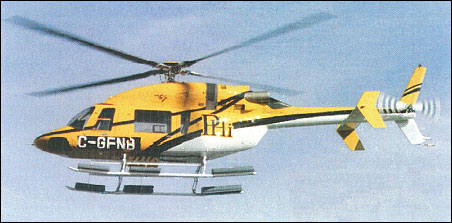
Launched as the New Light Twin (NLT) in February 1996 on signature of collaborative agreement with Samsung Aerospace Industries of South Korea. The Bell 427 prototype assembly began early 1997.
An enlarged and lengthened by 13 inches version of Model 407 with wider cabin, centre-section fuel tank, OH-58D composite four-blade main rotor, and 2705kg TOGW, powered is from two 600shp Pratt & Whitney PW206D turboshafts.
The first flight of the first prototype (C-GBLL) was on 11 December 1997 at Mirabel, Quebec. The second prototype (C-FCSS) was completed in February 1998 and the two prototypes undertook flight test programme, gaining Transport Canada certification on 19 November 1999, FAA VFR certification achieved in 24 January 2000, followed by Dual Pilot IFR (DPIFR) Category A certification on 24 May 2000.
The first production aircraft (C-GDEJ) was flown in June 1998. Compared with prototypes, the production 427 has longer exhausts and revised upper surface contours.
Similar in appearance to the Bell 407, with a cabin stretch of 33cm, the 427 is all-new design, incorporating twin-engine safety margins. Flight dynamics are based on the four-blade rotor system of Bell OH-58D Kiowa, allied to tail rotor of Bell 407, and folding main blades.
A purpose-designed ‘flat pack’ main transmission, with direct input from both engines, has only four gear meshes to simplify design and operation. The transmission is attached to the airframe by four liquid-inertia vibration eliminators. It was the first Bell helicopter designed entirely with use of computer (Dassault CATIA programme).
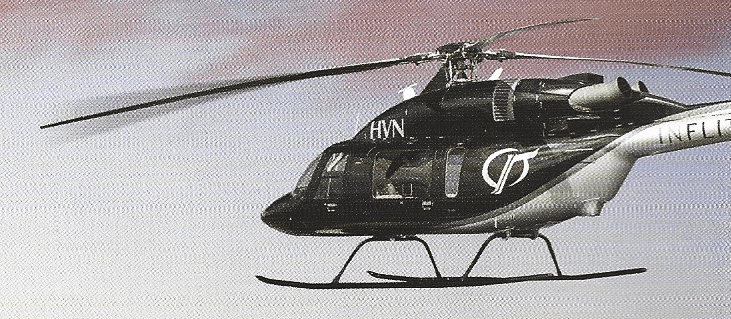
The structure is generally as for the Bell 206, but extensive use of carbon/epoxy composites reduces airframe parts count by some 33%. Cabin floor and roof are flat panels for ease of manufacture; minimal use of curved panels elsewhere. Composites main and tail rotors; main blades have nickel-plated stainless steel leading-edges. Soft-in-plane hub of main rotor employs a composites flexbeam yoke and elastomeric joints, eliminating lubrication and maintenance requirements. Brake and main rotor blade folding optional. Composites cabins and rolled aluminium tailbooms built by Samsung; assembly in Canada, except for sales to Korea and China; Hexcel honeycomb as stiffener. The landing gear is twin skids with dynamically tuned cross tubes to reduce ground resonance. Low skids standard; optional high skids and emergency floats.
Fuel is contained in three crash-resistant tanks; two forward, one aft, with a total usable capacity of 770 litres. One forward fuel tank can be removed in EMS configurations to provide additional stretcher space in cabin or to permit stretcher to extend into port side of cockpit. Oil capacity (total, both engines) 10.2 litres.
Standard accommodation is for two crew in cockpit, on 20g energy-attenuating seats, and six passengers in cabin on two rows of three, seats in club configuration (all-forward-facing scats optional); all scats equipped with inertia-reel shoulder harnesses. Optional EMS interiors provide for carriage of one or two stretchers with up to two medical attendants, affording either full patient or head-only in-flight access, with single- or two-person crew. In cargo configuration, with all passenger seats removed, an optional removable flat cargo floor can be installed, equipped with integral tie-downs. Two forward-hinged doors each side; cabin doors, both sides, are forward-hinged, but port unit can be replaced by optional rearward-sliding door for cargo handling. External door on starboard side to rear baggage hold.
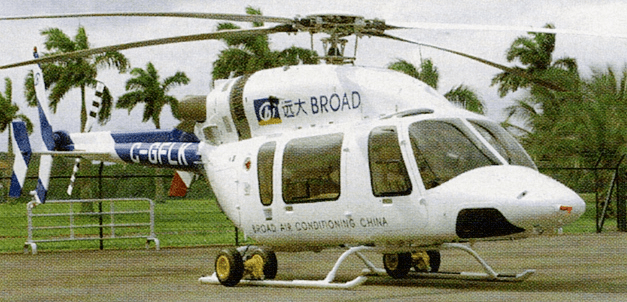
Orders for 22 were placed during the mockup’s first public display at Farnborough Air Show 1996, and 85 were on order by May 2000 from 50 customers. Deliveries began 2000 five delivered that year, 15 in 2001 and five in 2002.
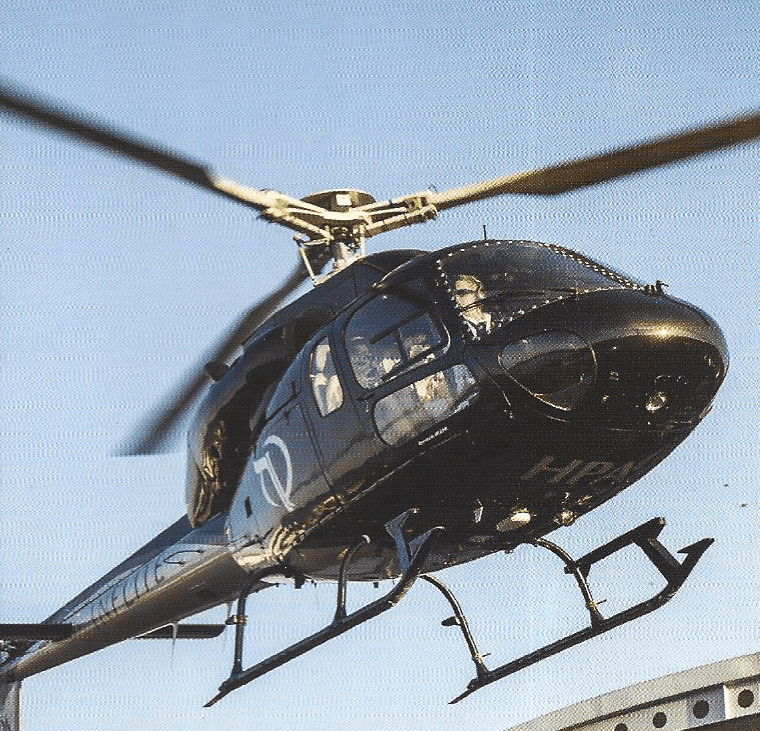
Engines: Two Pratt & Whitney Canada PW207D turboshafts with FADEC, each 529kW for T-O (5 min) or 466kW max continuous
OEI ratings: 611kW for 30 sec, 582kW for 2 min, 559kW for 30 min or 529kW max continuous.
Twin-engine transmission rating: T-O & max continuous: 597kW.
OEI transmission rating: 485kW for 30 sec: 451kW for 2 min; 343kW max continuous.
Main rotor rpm: 395
Tail rotor rpm: 2,375
Main rotor diameter: 11.28m
Fuselage length: 10.9m
Take-off weight: 2722kg
Empty weight: 1581kg
Max speed at sea level: 252km/h
Cruising speed at sea level: 240km/h
Hovering ceiling, OGE: 4235m
Hovering ceiling, IGE: 4940m
Range at sea level: 663km
Crew: 1
Passengers: 6-7
Bell 407
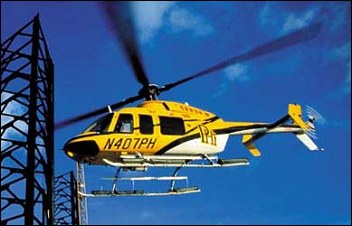
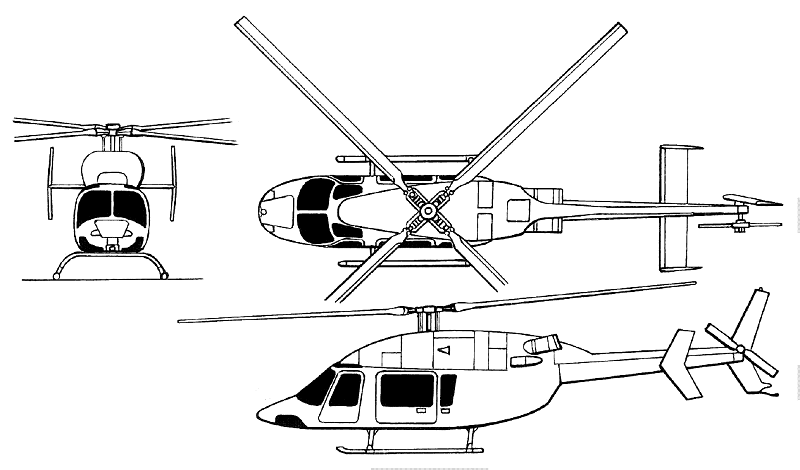
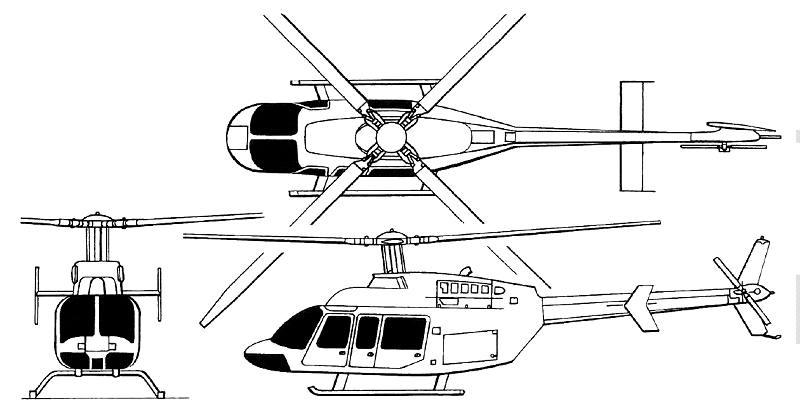
With the design definition launched in 1993, the Bell 407, developed from the 206L-4 offered wider cabin, 815 shp 250-C47B derated to 675 shp for takeoff and four main rotor blades. From the windscreen pillars the cabin swells outwards to a width 178 mm more than the LongRanger’s, not tapering in again until it meets the baggage compartment forward bulkhead. Aft of that it’s normal LongRanger, although with a different tail rotor system. The extra width is gained through curved door pillars and skins of carbon fibre composites. Cabin windows are greatly enlarged, coming down to the level of the windscreen and curving well up towards the cabin roof. The doors are interchangeable between 407s, handles are flush-mounted car-type.
The LongRanger’s extra left-hand cabin door is retained for loading a stretcher, with the aft-facing left-hand seat wider than its counterpart behind the pilot. The rear seat usually takes three passengers, but in the VIP configuration the centre space is taken by a folding armrest and there’s adequate room for four passengers in the main cabin. Lap and inertia reel shoulder harness is supplied for all passenger seats.
Bell used the four-blade main rotor and complete tail rotor drive train from the OH-58D Kiowa Warrior, and the transmis¬sion also comes from the OH-58D, with larger bearings and redesigned gears to increase fatigue life.
The four 255 mm chord composite blades (Nomex honeycomb core, glass fibre reinforced plastic spar and skin) have tapered tips and unlimited fatigue life, and are attached to a flexible GFRP yoke which accom-modates flapping motion, with elastomeric dampers and bearings for lead-lag and pitch-change motion. A Frahm damper on top of the hub takes care of rotor vibration, and the transmission is attached to the airframe by SAVITAD (system for attenuating vibration independent of tuning and damping) which comprises two beams with elastomeric mounts and retained by springs.
The “avoid curve” is at 800 ft or 70 kts, almost twice that of the JetRanger. The low-inertia rotor also leads to a restriction in climb rate to 2000 ft/min. Although the 407 is capable of much more, over 4000 ft/min.
Although the tail rotor system is taken from the OH-58D, the Kevlar/Nomex blades are longer and give enough authority to allow takeoffs in 35 kt winds from any direction. Tail rotor control is also hydraulic.
Normal MTOW is 2267 kg, increased to 2499 kg with an external jettisonable load, as the gross weight is dictated by the landing skids and structure. Maximum external load is 1200 kg, but for normal passenger use it can take full fuel and seven people with light baggage and still be under gross weight.
The Rolls-Royce Allison 250-C47B turboshaft is controlled by a full-authority digital engine control system, the first to be fitted to a single¬ turbine light helicopter.
The 407 can handle slopes 5 degrees nose down or 10 degrees nose up or to either side, due in part to a pivoted rear undercarriage cross member.
A proof of concept demonstrator featuring bulged cabin door, a four blade rotor system (off the 406) and Allison 250-C47 turboshaft. A Law Enforcement demostrator was demonstrated in 2002, with a Rolls-Royce/Allison 250-C47B engine.
The concept demonstrator 407 (N407LR) was first flown on 21 April 1994 (standard Bell 206L-3 modified with tailboom and dynamic system of military OH-58D, plus sidewall fairings to simulate broader fuselage), and the programme was first revealed at Heli-Expo ’95, Las Vegas, January 1995. Two prototype/ pre-production 407s (C-GFOS and C-FORS) were first flown on 29 June and 13 July 1995, respectively.
The first producrion airframe (C-FWQY/N407BT) was flown 10 November 1995 and Transport Canada certification was received on 9 February 1996 with FAA certification following on 23 February.
The first customer delivery was at Heli-Expo ’96, Dallas, in February 1996.
A MoU of June 1996 provided for licensed assembly and marketing by Dirgantara (formerly IPTN) of Indonesia.
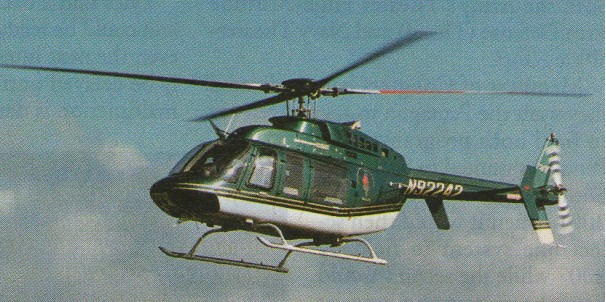
After extensive flight testing in the wake of three accidents, Transport Canada and the FAA approved an increase in the Bell 407’s maximum speed to 130 kt. from 100 kt., and company officials expected to restore the light helicopter’s 140-kt. never exceed speed (Vne) by the third quarter of 1999.
The latest approval is predicated on compliance with a Bell Helicopter Textron Alert Service Bulletin (ASB) that calls for installation of a redesigned tail rotor hub and blades as well as addition of mechanical stops on the anti-torque pedals. A Bell official said the stops restrict left pedal travel to 20.75 deg. from 28 deg., but right pedal travel remains at 14 deg.
In addition, the hub design moves the tail rotor centerline outboard 0.86 in. and provides an additional 2.4 in. of clearance between the tail boom and the tail rotor blades at maximum flapping angle. The chief performance penalty is reduced tail rotor authority at high altitudes, a Bell official said. The company has begun incorporating the changes into production 407s at its facilities in Mirabel, Quebec.
Bell also plans to provide parts to complete the modifications at no expense to operators in the field. According to the official, there were more than 350 of the single-engine 407s in operation worldwide in 1999. The helicopter entered service in 1996.
Company engineers and test pilots developed ancl evaluated the latest fix during a series of special flight tests in March and April that exceeded normal Transport Canada certification requirements by a significant margin, the official said. The tests centered on flying a 407 at 130 kt. indicated airspeed and using each anti-torque pedal to its mechanical stop in less than 0.4 sec. Although the abrupt applications were applied repeatedly, the tail rotor blades did not contact the tail boom structure and several inches of clearance were maintained, he said.
The 130-kt. approval comes about two months after Bell began conducting a series of special flight tests to increase Vne above a 100-kt. limit imposed on the aircraft early in 1999. The restriction was imposed after the tail booms of three 407s were severed following left pedal inputs. The first accident occurred in 1997 in the U.S., the second in 1998 in South Africa, and the third occurred in Brazil.
According to a Bell official, investigation has revealed that each f the accidents was cause by a sudden, full input of the left tail rotor pedal at cruise airspeed.” The sudden input “caused exceptional flapping (deflection) of the tail rotor” blades that damaged pitch stops and the pitch control links. As a result, the blades struck the tail boom aft of the horizontal stabilizers, severing it. The cause of the pedal input, however, has not been fully explained but pilot error is not being ruled out.
To reinstate the 407’s original 140-kt. Vne, Bell was instrumenting a 407, at its Mirabel site, in preparation for beginning flight tests of a solenoid-operated airspeed sensing system that will automatically engage/disengage the pedal stops depending on airspeed. If the helicopter is flying below 50 kt. the stops will be retracted to permit 28 deg. of left pedal travel and maximum tail rotor authority. Above 55 kt., the solenoid will engage the stops and limit left pedal travel to 20.75 deg.
The system, which is redundant and features a mechanical override, will be standard equipment in the twin-engine Bell 427. That aircraft was completing certification by Transport Canada and FAA.
The 500th production Bell 407 was delivered in October 2001 to Pabst Air, Germany, and 550 had been delivered to operators in 45 countries by early 2003; fleet time then totalled more than 745,000 hours.
Total of 62 delivered in 1999, 62 in 2000, 47 in 2001 and 33 in 2002.
COSTS: US$1.37 million (1999) flyaway.
Development cost were estimated as US$50 million, of which US$9 million provided by Canadian government.
Bell 407
Engine: One Rolls-Royce 250-C47B turboshaft, 606kW for T-O, 523kW
Max continuous pwr: 630 shp
Transmission rating: 503kW for T-O, 470kW continuous op
Main rotor diameter: 10.7m
Rotor speed: 413 rpm
Length: 12.7m
Height: 3.7m
Take-off weight: 2267kg
Empty weight: 1178kg
Useful load: 1058 kg.
Standard usable fuel: 484 lt
Optional aux fuel: 72 lt
Max speed at sea level: 252km/h
Vne: 204km/h / 140 kts
Max cruise: 133 kt.
LR cruise: 121 kt
Hovering ceiling, OGE: 2470m / 12,200 ft
Hovering ceiling, IGE: 3440m / 10,450 ft
Service ceiling: 5460m
Max ROC: 2000 fpm
Range: 608km
Loiter @ 60 kt: 3.8 hr.
Internal payload: 1089kg
External payload: 1200kg
Crew: 1
Passengers: 6
Bell D-292 ACAP
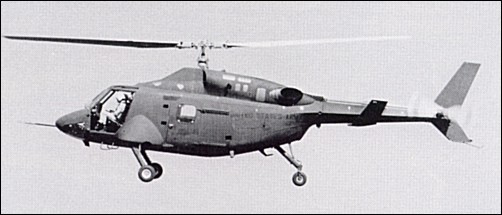
In February 1981 the US Army’s Applied Technology Laboratory announced that Bell Helicopter and the Sikorsky Aircraft Division of United Technologies had both been awarded contracts for the design, construction, and initial flight testing of composite airframe research helicopters as part of the Advanced Composite Airframe Programme (ACAP). The programme is the development of an all-composite helicopter fuselage lighter and cheaper to build, per production airframe, than conventional machines. Bell and Sikorsky were each awarded contracts for the production of three machines; a tool-proof vehicle, a static test vehicle, and a flight test vehicle. Bell’s ACAP machine, which carries the company model number D292, made its first hover flight on 30 August, 1985. By mid-January 1986 the aircraft had completed twelve of its projected fifty flight test hours.
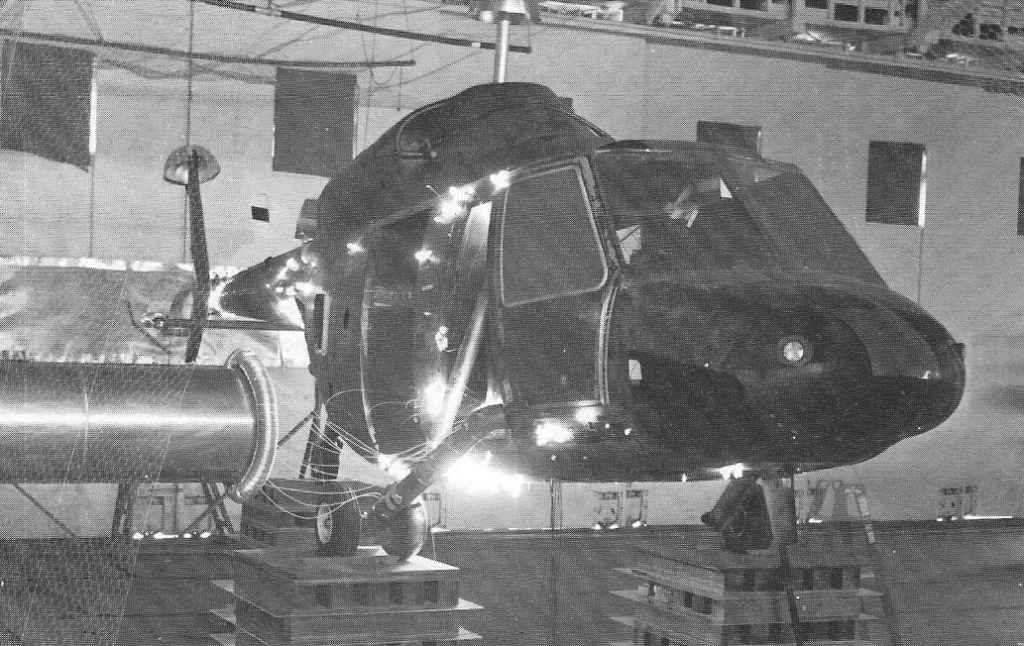
The D292 was based on Bell’s commercial Model 222 twin- turbine light helicopter and used that machine’s Avco Lycoming engines, transmission, and two-bladed main and tail rotors. The ACAP’s tailboom, vertical fin, and rotor pylon are almost identical in appearance to those of the 222, though the D292’s entire elongated pod-and-boom airframe is constructed of glass-reinforced plastic (GRP), graphite, and Kevlar. The use of a particular composite material for a specific aircraft component is determined by the strength, flexibility or other primary characteristic required of that component. The D292’s basic load-bearing structure is thus constructed primarily of graphite or graphite/epoxy, while the flooring and most of the craft’s exterior ‘skin’ is made of a more ballistically-tolerant Kevlar/ epoxy or glassfiber/epoxy blend. The seats for the helicopter’s two crew members and two passengers are of Kevlar/epoxy and are designed to absorb the high vertical loads of a forty-foot- per-second crash landing, as are the legs of the craft’s non-retracting tailwheel landing gear.
In addition to 15 hours of ground running and 50 hours of flight testing, which were completed in October 1985, the D-292 was used for shake testing and controls proof loading. A five-phase militarisation test and evaluation programme (MT&E) began in 1985 and was completed in 1988, following evaluation of undercarriage crashworthiness, lightning protection system, internal acoustics and additional repairability demonstrations. This programme included dropping the helicopter airframe from 12m in September 1987 at the NASA Langley Research Centre to demonstrate the capability of meeting stringent military crash survivability requirements. This included a 15m/s impact velocity at an aircraft attitude of ten degrees roll and ten degrees nose up pitch without any apparent serious injuries to the four dummy occupants (this impact velocity was comparable to a free fall from a three-storey building). Another major advancement demonstrated by the Bell ACAP design during these tests was the fuel system which totally contained the fuel during the drop test, thus reducing the risk of post-crash fires. But the main purpose of the ACAP programme was to achieve the US Army’s goal of reducing weight and cost, as well as improving military helicopter characteristics, by demonstrating the application of advanced composite materials. In this sphere, the Bell D-292 featured a weight reduction of 22% in the airframe structure, a 17% saving in cost, survivability in a vertical crash, and reduced radar signature. These comparisons were made possible because Bell and Sikorsky each also designed a duplicate aircraft of current conventional metal construction.
D292 ACAP
Engine: 2 x Avco Lycoming LTS 101-750C-1 turboshaft, 510kW
Main rotor diameter: 12.80m
Fuselage length: 12.32m
Height: 3.40m
Take-off weight: 3395kg
Empty weight: 2615kg
Crew: 2
Passengers: 2

