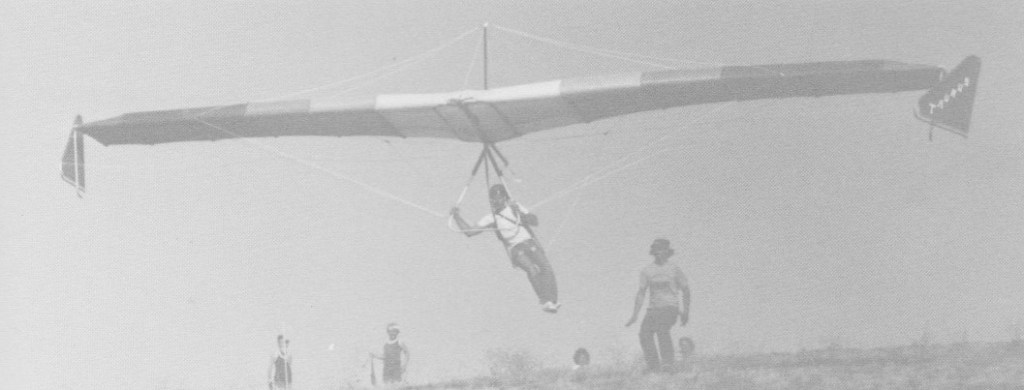
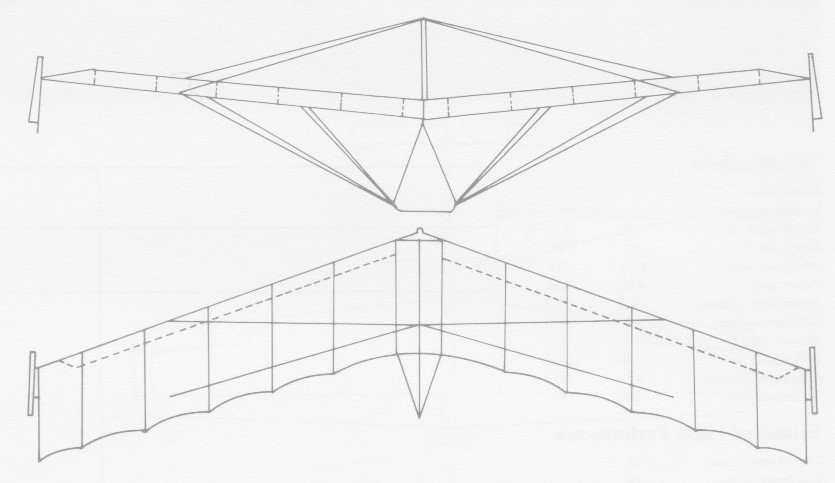
A 1980 hang glider, the Comanche was a new concept into higher performance wings. This was achevied by creating a much larger double surface area, also the wing was shaped by using pre-formed battens.
The Comanche was then distinguished by its 125 ° nose angle, its very fast assembly, and very pure sail cut. The elliptical wingtips that existed on the first Comanche were abandoned.
The slats are semi-flexible type, that is to say, aluminum and shaped on the front, then flexible fiber on the back. The lower leading edge sheath is a 30% double sail and the profile is very arched, with the maximum camber point very forward. The aircraft really has an excellent sink rate but unfortunately because of its 6.6 lengthening and its very tight sail, the manufacturer could not make it manoueverable.
This was to be the last model produced by Birdman Sports and there was thought to be only four Comanche made.
Wing area: 17 m² Wing span: 10.6 m Aspect ratio: 6.6 Hang glider weight: 24 kg Packed length short: 3.5 m Nose angle: 125°
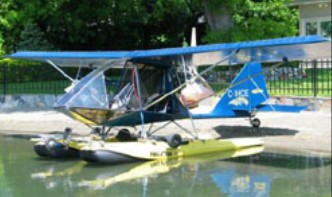
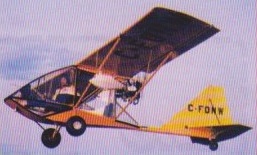
First flown in 1988 the Chinook single seat single engined high wing monoplane had conventional three axis control. Wing has unswept leading and trailing edges, and constant chord; conventional tall. Pitch control by elevator on tail: yaw control by fully flying rudder; roll control by one third span ailerons; control inputs through stick for pitch/roll and pedals for yaw. Wing braced from below by struts; wing profile double surface. Undercarriage has two wheels with tailskid; bungee suspension on tailskid and bungee suspension on main wheels. Push right go right nosewheel steering connected to yaw control. No brakes. Aluminium tube framework, totally enclosed. Engine mounted at wing height driving pusher propeller. The Chinook WT 11 was a completely new design, bearing no relationship to the Atlas, and powered by a Rotax 277 engine. Developed by a homebuilder from Poland, Vladimir Talanczuk, the Chinook had over 150 are on order, with around 10 delivered by 1983. The Chinook WT 11 uses a steerable tailskid. The emphasis with the Chinook is very much on attracting pilots used to conventional light aircraft, and the manufacturer points out that the controls will fall naturally to hand for such pilots, with floor mounted stick and conventionally operated rudder pedals and steering. A set up time of 15 min from trailer is claimed, with two persons. Option of Rotax 377 on WT-11. Aircraft Sales and Parts, established in 1988, was ultimately started by Brent Holomis (now, President of ASAP) who began his ultralight flying in the original Birdman Chinook WT2S. His dreams were to resurrect the Chinook aircraft of the early 1980’s. In late 1989, after nearly 2 years of redesign work was completed with the assistance of engineers from the University of Alberta, he was able to introduce the new Chinook Plus 2, with the wider cabin, the stronger undercarriage, the new modified wings and tail along with the more resilient ceconite fabric.
Chinook Plus 2 Speed max: 95 mph Cruise: 83 mph Range: 298 sm Stall: 32 mph ROC: 1200 fpm Take-off dist: 250 ft Landing dist: 450 ft Service ceiling: 15,000 ft Engine: Rotax 582, 65 hp HP range: 44-75 Fuel cap: 9 USG Weight empty: 380 lb Gross: 900 lb Height: 5.83 ft Length: 17.67 ft Wing span: 32 ft Wing area: 154.5 sq.ft Seats: 2 tandem Landing gear: tail wheel.
Chinook PLUS 2 Stall: 28 kt / 32 mph / 51 kmh Cruise: 63 kt / 72 mph / 116 kmh VNE: 100 kt / 115 mph / 185 kmh Empty Weight: 191 kg / 420 lbs MTOW Weight: 476 kg / 1050 lbs Climb Ratio: 1000 ft/min / 5 m/s Glide Ratio: 10:1 Take-off distance (50ft obstacle): 200 ft / 61 m Landing distance (50ft obstacle): 300 ft / 91 m Price 2009: 17995 USD
Chinook PLUS 2 Engine: Rotax 582 Stall: 28 kt / 32 mph / 51 kmh Cruise: 72 kt / 83 mph / 134 kmh VNE: 100 kt / 115 mph / 185 kmh Empty Weight: 209 kg / 460 lbs MTOW Weight: 476 kg / 1050 lbs Climb Ratio: 1200 ft/min / 6 m/s Glide Ratio: 10:1 Take-off distance (50ft obstacle): 200 ft / 61 m Landing distance (50ft obstacle): 300 ft / 91 m Price 2009: 19995 USD
Chinook PLUS 2 Engine: HKS 700E Stall: 28 kt / 32 mph / 51 kmh Cruise: 65 kt / 75 mph / 121 kmh VNE: 100 kt / 115 mph / 185 kmh Empty Weight: 218 kg / 480 lbs MTOW Weight: 476 kg / 1050 lbs Climb Ratio: 1200 ft/min / 6 m/s Glide Ratio: 10:1 Take-off distance (50ft obstacle): 200 ft / 61 m Landing distance (50ft obstacle): 300 ft / 91 m Price 2009: 20995 USD
Chinook Plus 2 Engine: Rotax 912 Stall: 30 kt / 35 mph / 56 kmh Cruise: 72 kt / 83 mph / 134 kmh VNE: 100 kt / 115 mph / 185 kmh Empty Weight: 236 kg / 520 lbs MTOW Weight: 476 kg / 1050 lbs Climb Ratio: 1400 ft/min / 7 m/s Glide Ratio: 10:1 Take-off distance (50ft obstacle): 100 ft / 30 m Landing distance (50ft obstacle): 350 ft / 107 m Price 2009: 27500 USD
Chinook WT-11 Construction: Aluminium, Dacron. Engine: Rotax 277 (268 cc) 28 hp. Propeller diameter and pitch: 50 x 30 inch, 1.27 x 0.76 m. V belt reduction, ratio 2.0/1. Max static thrust 175 lb, 79 kg. Length overall: 17.5 ft, 5.33 m. Height overall 5.5ft, 1.68m. Wing span 35.0ft, 10.67m. Constant chord 3.9 ft, 1.20 m. Sweepback 0 degs. Total wing area 138 sq.ft, 12.8 sq.m. Wing aspect ratio 8.9/1. Glide ratio: 10-1. Power per unit area 0.20 hp/sq.ft, 2.2 hp/sq.m. Fuel capacity 5.0 US gal, 4.2 Imp gal, 18.9 litre. Empty weight 230 lb, 104 kg. Max take off weight 590 lb, 268 kg. Payload 360 lb, 163 kg . Max wing loading 4.28 lb/sq.ft, 20.9 kg/sq.m. Max power loading: 21.1 lb/hp, 9.6kg/hp. Load factors; >+5.5, > 2.0 ultimate. Max level speed 63 mph, 101 kph. Never exceed speed 90 mph, 145 kph. Cruising speed 55 mph, 88 kph. Stalling speed: 25 mph, 40 kph. Max climb rate at sea level 750 ft/min, 3.8 m/s.
Chinook HKS – Engine: HKS 700E, 60 hp. Length: 18 ft Height: 5 ft 10 in Wing Span: 32 ft Wing Area: 154.5 sq.ft Seats: Tandem Empty Weight: 460 lb Gross Weight: 1050 lb Fuel Capacity: 9 USG Strut Tanks (Opt 14 USG Wing Tanks) Design Load Factors: +4/-2G Vne: 115 mph Top Level Speed: 90 mph Cruise Speed: 75 mph Power Off Stall clean:35 mph Power Off Stall, Flaperons: 32 mph Rate of Climb: 1000-1200 fpm Take of Distance: 200-250 ft Glide Ratio: 10:1 Service Ceiling: 15,000 ft
Engine: Rotax 582, 65 hp Vne: 115 mph Top Level Speed: 95 mph Cruise Speed: 83 mph Power Off Stall clean: 35 mph Power Off Stall Flapersons: 32 mph Rate of Climb: 1200 fpm Take of Distance: 200 ft Glide Ratio: 10:1 Service Ceiling: 15, 000 ft Propeller: 2 or 3 blade Wooden or Composite Diameter: 67″ in Max
Engine: Rotax 503, 50 hp Empty Weight: 406 lbs Length: 17 ft 8 in Height: 5 ft 10 in Wing Span: 32 ft Wing Area: 154.5 sq.ft Seats: Tandem Gross Weight: 1050 lbs Fuel Capacity: 10 USG Design Load Factors: +4/-2G Vne: 115 mph Top Level Speed: 85 mph Cruise Speed: 72 mph Power Off Stall clean: 35 mph Power Off Stall Flapersons: 32 mph Rate of Climb: 1000 fpm Take of Distance: 250 ft Glide Ratio: 10:1 Service Ceiling: 15,000 ft Propeller: 2 or 3 blade Wooden or Composite Diameter: 67″ in Max
Chinook 912 Engine: Rotax 912, 80HP Prop: 2 or 3 blade Wooden or Composite Diameter: 64″ in Maximum Diameter Length: 18 ft Height: 5 ft 10 in. Wing Span: 32 ft Wing Area: 154.5 sq.ft Seats: Tandem Empty Weight: 520 lbs Gross Weight: 1050 lbs Fuel Capacity: 9 USG Strut Tanks (Opt 14 USG Wing Tanks) Design Load Factors: +4/-2G Vne: 115 mph Top Level Speed: 95 mph Cruise Speed: 80 mph Power Off Stall clean: 36 mph Power Off Stall Flaperons: 33 mph Rate of Climb: 1300 fpm Take of Distance: 150 ft Glide Ratio: 10:1 Service Ceiling: 15,000 ft.
ASAP Chinook Plus Empty weight: 172 kg Wing span: 9.75 m Wing area: 14.40 sq.m Fuel capacity: 2 x 34 lt Engine: Rotax 503, 52 hp MAUW: 407 kg Seats: 2 Max speed: 135 kph Cruise speed: 115 kph Minimum speed: 51 kph Climb rate: 5 m/s Fuel consumption: 9.5 lt/hr Kit price (1998): Can$7250
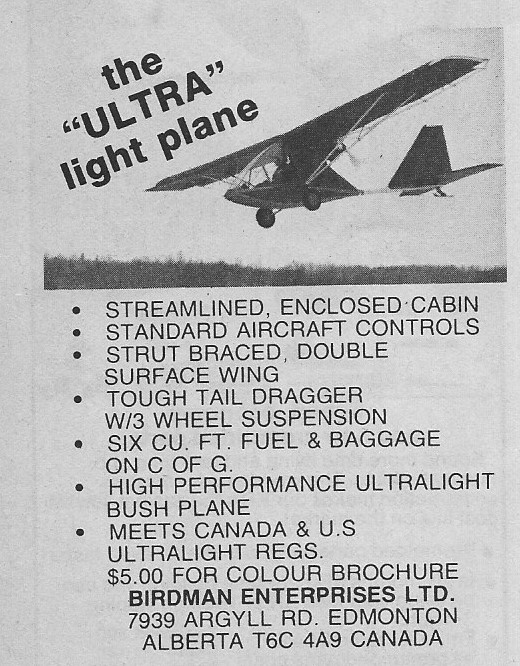
Birdman Enterprise’s first Ultralight design was called the Atlas and was similar in concept to the Eipper formance Quicksilver. Like the Quicksilver, it was offered with two control systems, the hybrid Atlas XC or the three axis Atlas 3A.
Amongst the early enthusiasts who were amongst the first to buy, build or fly a hang glider during early seventies who later went on to become manufacturers was Ken Messenger who founded Birdman.
Birdman Enterprises has been making hang‑gliders since 1972 and ultralights since 1977.
Designed by Emmett M. Tally III, the Birdman TL-1 is an ultralight craft emphasiing ease of construction and light weight. The fuselage is a standard plywood monocoque, and the tail section is a V-type, and synthetic skin, Monokote heat shrink film, is used to cover the wood and foam-reinforced wings. It features sequential spoilers for lateral control. While the main gears are at¬tached under the wing, the pilot’s legs and feet take the place of a nosegear. The pilot is seated at the CG, enabling him to rotate into a standing position as an aid to ground handling. The standing pilot actually becomes the nosewheel. The TL 1A was powered by a 15 hp McCulloch single cylinder air cooled engine. Two gallons of fuel give it a range of 320 km (200 miles) at 54 kg (120 lb), and marketed in 1980 by a Dayton Beach accountant who sells complete kits for less than $2000.
TL-1 Gross Wt. 350 lbs Empty Wt. 100 lb Fuel capacity: 4 USG Wingspan: 34 ft Length: 20 ft Engine: 15-hp Tally Aircraft MC101 DT Top speed: 60mph Cruise speed: 54mph Stall speed: 19mph Climb rate: 350 fpm Ceiling: 12,500 ft Takeoff run: 75 ft Landing roll: 25 ft Range: 200 sm
TL-1A Cruise 38 mph Top speed: 44 mph ROC: 300 fpm Stall: 14 mph Wing span: 34 ft
The Taurus double-surface wing featured a cable-tensioned trailing edge. Control is through balanced wing tip drag rudders, operated by either swing seat or optional twist grips. Pitch control is through weight shift. It is fully collapsible and breaks down to a package approximately 14 ft x 10 ft x 20 ft 6 in long.
The leading edge spars are 1.75in x .049in 6063 T-832 and the trailing edge is 1.5in x .049in 6063 T-6. All other tubing is 1in 6061 T-6 of various wall thicknesses. The upper and lower ribs are .5in x .035 6061 T-6. The spars are sleeved at stress points and all joints are either wood dowelled or aluminium bushed.
Cables are 3/32in 7×7 stainless steel white vinyl coated. All thimbles are stainless steel and the cable ends have double nico press sleeves. All tangs have spar saddles. Wing root channels, shackles and tangs are all stainless steel. All other channels are anodised aluminium. Injection moulded saddles are used throughout. Nuts, bolts, turnbuckles and quickpins are all aircraft quality.
The Taurus has an adjustable kingpost for tight rigging, drag and anti-drag wires, as well as the cable-tensioning trailing edge, both fully adjustable. Prone flying was available as a special option.
The sail is Howe and Bainbridge 3.8 ox dacron in 11 standard colours. All stress points are reinforced. Stitching is boh zig-zag and straight, depending on application. The sail features .035in fibreglass sheet battens on the leading edge for smoothness. 2in velcon Velcro is used on the centre section panels.
The Taurus came standard with a supine harness and features individual leg straps and 4in wide back strap.
Leading edge: 19 ft Chord length: 5 ft Wing span: 34 ft Wing area: 155 sq,ft Aspect ratio: 7.6:1 Nose angle: 20˚ Weight: 70 lb Pilot weight: 135-200 lb Takeoff speed: 18 mph Stall speed: 16 mph Max speed: 60 mph Best glide ratio (L/D): 10:1 Best L/D speed: 25 mph Min sink: 180 fpm
In 1989, Cory Bird was a shop fabricator at Scaled Composites, aviation designer Burt Rutan’s company, when he decided to use his knowledge of composite construction to build the Bird Symmetry.
The 53-year-old Bird, a project manager at Scaled, was hard at work on another design for a plane that will carry two and land on shorter airstrips than Symmetry.
Wing area: 16.5 m² Wing span: 10.6 m Aspect ratio: 6.8 Hang glider weight: 30 kg Minimum pilot weight: 65 kg Maximum pilot weight: 170 kg Minimum speed: 27 km/h Maximum speed: 80 km/h Packed length: 5.5 m Packed length short: 3.9 m Nose angle: 134°