1998: via Umberto Nobile 14, 1-36071 Arzignano (VI), Italy
Owned by Elvio Bevilacqua, Stephano Cocco and Albert Zane.
1980->
Hinz BL.1 Kea
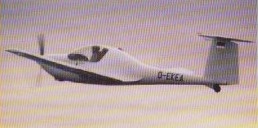
A plans built two-seat composites monoplane. Built without moulds, the wings and tailplane can be detached like a glider.
Engine: Limbach L2400, 90 hp
Wing span: 10 m
Wing area: 12 sq.m
MAUW: 720 kg
Empty weight: 440 kg
Fuel capacity: 100 lt
Max speed: 270 kph
Cruise speed: 245 kph
Minimum speed: 85 kph
Climb rate: 5 m/s
Seats: 2
Fuel consumption: 13 lt/hr
Plan price (1998): 1500 DM
B & L Hinz-Lorentz
Provides plans to construct the Hinz BL.1 Kea two-seat composites monoplane.
1998:
Bei der Kirche 17
D-70794 Filderstadt 1
Germany
Blavier GB.8C2

The GB.8C2 is an all-wood design, covered in plywood, designed over a five year period.
Lavier first flew the one off aircraft in September 1996 at Toussus-le-Noble, near Versailles in Paris.
The design features a fixed maingear and retractable nose wheel.
Engine: Lycoming O-320, 160 hp
Prop: Constant speed
Max speed: 172 mph
Cruise: 160 mph
Stall: 63 mph
Endurance w/res: 3.5 hr
MTOW: 1760 lb
Seats: 2
Blavier
1998: Gerrard Blavier, 2 sente du Buisson, 78470 Milon-la-Chapelle, France.
Built the Blavier GB.8C2
Blanton V-6 STOL

The prototype was built from a salvaged PA-22.
Top speed: 135 mph
Cruise: 120 mph
Stall: 48 mph
Range: 600 nm
Rate of climb: 1700 fpm
Takeoff dist: 500 ft
Landing dist: 500 ft
Service ceiling: 18,000 ft
Engine: Ford V-6, 230 hp
HP range: 230-300 hp
Fuel capacity: 36 USG
Empty weight: 1250 lb
Gross weight: 2200 lb
Height: 7.2 ft
Length: 22.3 ft
Wing span: 32 ft
Wing area: 168 sq.ft
Seats: 4
Undercarriage: tailwheel
Blanton Sport Racer

The Blanton Sport Racer N87SR first flew on 23 April 1988.
Top speed: 200 mph
Cruise: 175 mph
Stall: 62 mph
Range: 525 nm
Rate of climb: 900 fpm
Takeoff dist: 1600 ft
Landing dist: 1800 ft
Service ceiling: 18,000 ft
Engine: Ford Javelin , 230 hp
HP range: 150-260 hp
Fuel capacity: 30 USG
Empty weight: 1175 lb
Gross weight: 1825 lb
Height: 5.7 ft
Length: 21 ft
Wing span: 22 ft
Wing area: 81 sq.ft
Seats: 2
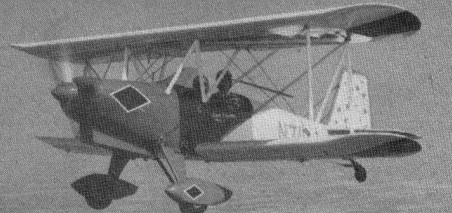
Blanton Wichawk
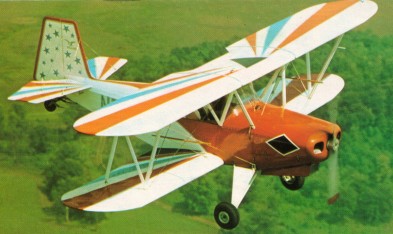
Designed by Dave Blanton, the Wichawk is structurally similar to the Boeing Stearman biplane and is stressed for up to 12g’s positive and six g’s negative. Standard seating is for two in a side-by-side or tandem configuration, which is rather unusual for a sport biplane of its type. Optional tandem or three-place seating is also available. Designed to take the Continental O-470-11 engine of 225 hp, the 180-hp Lycoming is most often used, and can be adapted to house various horizontally opposed or radial engines. The wings make use of wooden spars with light alloy ribs, while the fuselage is constructed from welded steel tubes.
Engine: Lycoming O-360, 180 hp.
HP range: 160-300.
Length: 19 ft.
Wing span: 24 ft.
Wing area: 180 sq.ft.
Weight empty: 1281 lbs.
Gross: 2400 lbs.
Fuel cap: 40 USG.
Speed max: 140 mph.
Cruise: 127 mph.
Range: 500 sm.
Stall: 56 mph.
ROC: 1700 fpm.
Take-off dist: 150 ft.
Landing dist: 400 ft.
Service ceiling: 18,000 ft.
Seats: 2/3.
Landing gear: tail wheel.
Blaim Nagel System
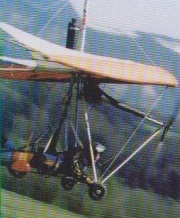
Circa 1998, the Hagel system provided a tractor power system for hang gliders.
The system was certified in Austria and Germany using the Wills Wing Supersport and Ultrasport wings, but could be adapted for other wings.
Engine: Solo 210, 15 hp
Reduction ratio: 1.4-1
Prop diameter: 200 cm
Fuel capacity: 9 lt
Empty weight: 25 kg
Certification: vz (A)
Price (1998): ATS 65,000
Blaim
1998: Weiherburggasse 5, A-6020 Innsbruck / Tirol, Austria
Power pack builder

