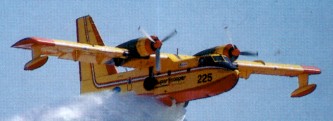
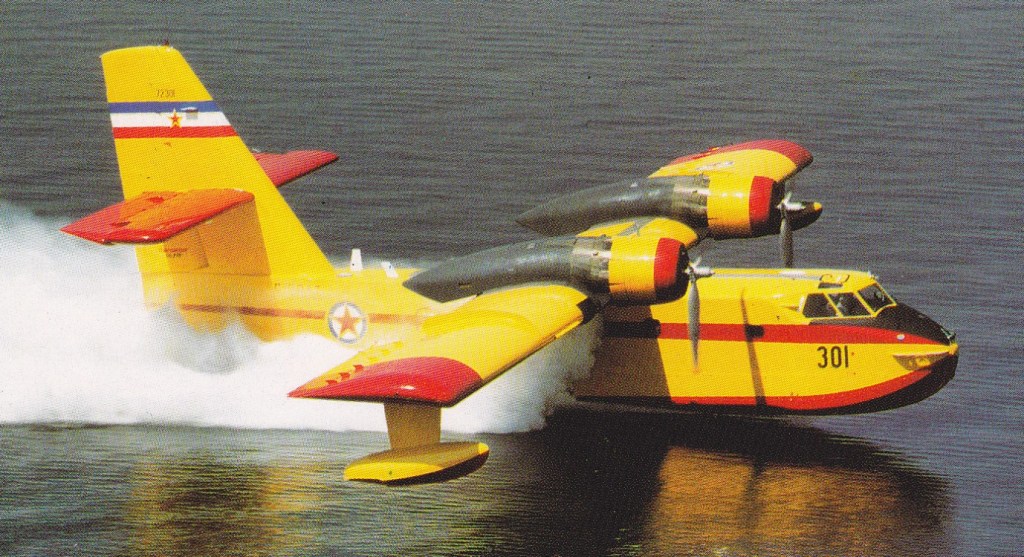
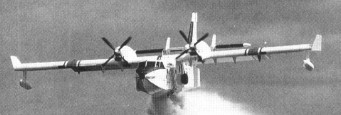
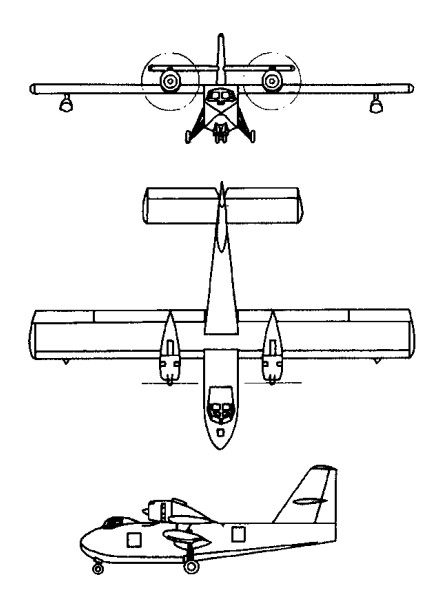
Designed principally for firefighting duties, the CL-215 twin-engined general-purpose amphibian also has military applications, including search and rescue and coastal patrol, Spain and Thailand use their CL-215s in both of these roles. The first prototype flew on October 23, 1967.
The CL-215’s two fuselage tanks hold 1412 USG / 5345 lt of water which can be scooped up in 10 seconds from a lake or sea surface, and can be dumped in one second.
Canadair offers a number of special military configurations, including flight inspection, maritime surveillance using an ALL AN/APS-128 search radar, electronic warfare support and training, cargo transport, and airborne early warning (AEW).
Production of the basic CL-215 was completed with delivery in 1990 of the 126th airframe, having been exported to France, Greece, Spain, Italy, Yugoslavia, Thailand and Venezuela.
CL-415T
In September 1986 Canadair announced the CL-215T turboprop development. Designed as a retrofit package for existing operators of the piston-engined aircraft and – if sufficient new orders were received – for full production, the CL-215T has two 2,380 shp (1 175 kW) PW123AF engines driving four-bladed propellers. As a water-bomber (its primary mission) the CL-215T will carry 6,132 litres (1,620 US gal).
The first CL-215T flew on 8 June 1989 powered by two 2380 shp / 1775 kW Pratt & Whitney Canada PW123AF turboprops, and could carry 1620 USG / 6132 lt of water.
CL-215 Engines: 2 x Pratt & Whitney R-2800-CA3, 1566kW, 2100hp Wingspan: 28.6 m / 93 ft 10 in Wing area: 100.33 sq.m / 1079.94 sq ft Length: 19.82 m / 65 ft 0 in Height: 8.92 m / 29 ft 3 in Max Take-off weight: 17100-19731 kg / 37699 – 43500 lb Empty weight: 12161 kg / 26811 lb Max level speed: 172 mph (293 kph) at 10,000ft/3050m Cruise speed: 291 km/h / 181 mph Initial ROC: 1000 fpm / 305 mpm Range: 2095 km / 1302 miles Payload: 5453kg 12,000 lb of water, 3864 kg / 8518 lb freight, or 26 passengers
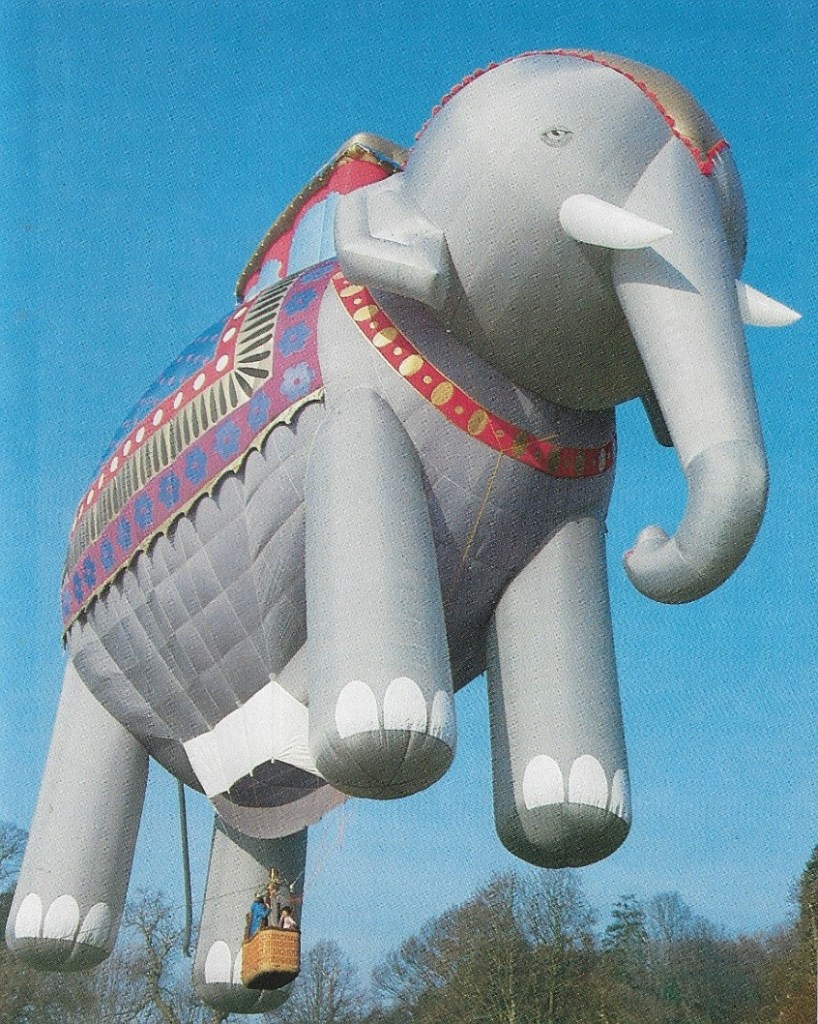
During the 1980s Malcolm Forbes, publisher of the Forbes magazine, built up a collection of special shape balloons. All built by Cameron Balloons in Bristol, Forbes had a special shape commissioned for each country he had visited. From the early 1980s balloonists from all around the world were invited to fly from Balleroy, his French estate, in Calvados, Northern France where he would unveil his newest creation. Nobody had ever seen hot air balloons like this before with only a very small number of shapes made before the most well-known of the fleet, the original Chateau de Balleroy.
The Chateau, registered G-BKBR and built in 1982, was just one of many other spectacular special shapes which followed, including:
the Minar-e-Pakistan (G-BKNN, 83)
Sphinx (G-BLFE, 84)
Thailand Elephant (G-BLRW, 85)
Harley Davidson (G-BMUN, 86)
Golden Temple (G-BMWN, 86)
Rosebud Egg (G-BNFK, 87)
Beethoven (G-BNJU, 87)
SulIman the Magnificent (G-TURK, 88)
Forbes Magazine (G-BPOV, 89)
Santa Maria (G-BPSP, 89)
Mcaw (G-BRWZ, 90)
Chateau de Balleroy no.2 (G-BTCZ, 91)
Cameron Balloons test inflated each of Malcolm Forbes’ balloons at Ashton Court Estate early in the morning, which is still done with new balloons to this day before they are shipped to their new home.
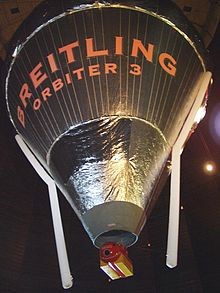
Breitling Orbiter was the name of three different Rozière balloons made by the Bristol based balloon manufacturer Cameron Balloons to circumnavigate the globe, named after the Swiss watchmakers Breitling. The third was successful in March 1999 of making the first nonstop flight around the world by balloon. It was piloted by Bertrand Piccard and Brian Jones.
The Cameron R-650 Breitling Orbiter 3 was a Rozier balloon of Kevlar and carbon fiber composite weave built in 1998. The Breitling Orbiter 3 combines the features of a hot-air balloon and a gas balloon, with a helium cell within a hot-air envelope. Initially, the helium cell is filled to approximately 47% of its maximum capacity. During ascent, warming by the sun causes the helium to expand even more than the surrounding air, which aids the balloon in gaining altitude (unlike the expansion caused by the drop in atmospheric pressure, which can even hinder that until the air and helium temperatures equalize).
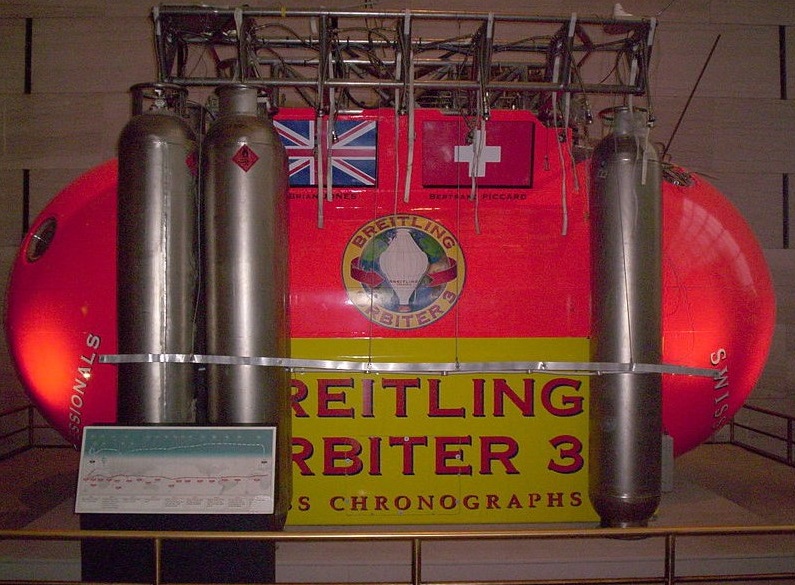
The propane gas that fueled its six burners was contained in 28 titanium cylinders mounted in two rows along the sides of the gondola. Concerned about fuel consumption, the team added four additional propane containers prior to launch; these additions proved necessary to complete the trip.
The Breitling Orbiter 3 gondola was constructed of a weave of Kevlar and carbon fiber material. After launching, the cabin was sealed at 1,800 m (6,000 ft) to trap the air within it. During the flight the cabin atmosphere was supplemented by nitrogen and oxygen; carbon dioxide was removed by lithium hydroxide filters. Cabin pressure was maintained at around 24 kPa (3.5 psi) by adding oxygen and nitrogen to the cabin air as necessary. At 10,000 m (33,000 ft), the cabin pressure equaled atmospheric pressure at 3,000 m (10,000 ft). Solar panels suspended beneath the gondola recharged the on-board lead-acid batteries that provided electrical power. Satellite-based systems enabled the crew to navigate via GPS as well as communicate.
Bertrand Piccard and Brian Jones launched from the Swiss Alpine village of Château-d’Oex at 8:05, GMT, March 1, 1999. They traveled southwest over the Mediterranean and then swung east over Mauritania on March 2 at a starting meridian of 9 degrees, 12 minutes west. They landed in the Egyptian desert after being aloft 19 days, 21 hours, and 55 minutes on March 21, 1999, having traveled a distance of 40,814 km (25,361 mi). During the course of the flight, the balloon had climbed to altitudes of up to 11,737 m (38,507 ft), and achieved speeds up to 123 knots. The official “finish line” of the circumnavigation occurred over Mauritania at 4:54 AM, EST on March 19. The goal of ending in Egypt had been to touch down near the Great Pyramids; however, high winds forced the pilots to land short of their target about 80 kilometers north of Mut. Aboard, they carried a copy of Guy de Maupassant’s A Life, which had been inscribed by Maupassant to Jules Verne, who had imagined such a flight in his novel, Five Weeks in a Balloon. The book had been loaned to the pilots to carry for good luck by a grandson of Jules Verne from the novelist’s personal library.
The daily routine was for each man to spend eight hours alone at the controls, eight hours working with his crewmate, and eight hours in the single bunk. A unique pressure-operated toilet was included in a curtained off area at the rear of the craft. Despite the use of heaters designed to maintain a cabin temperature of 59 °F (15 °C), temperatures occasionally decreased so much at night that drinking water froze and ice had to be chipped away from delicate electronic circuitry on the interior walls.
The Breitling-Orbiter III accumulated the following records: Flight duration: 19 days 21 h 47 min Maximum altitude: 11,755 meters Maximum ground speed: 240 km / h Distance traveled: 45,755 kilometers Number of countries flown over: 26 countries
When asked by reporter Howard Schneider about the fate of Breitling Orbiter 3, the project manager Alan Noble remarked that the sponsors and the team “…would probably donate the craft to a museum. Possibly the National Air and Space Museum or the Smithsonian.” And indeed the gondola was located for several years on the ground floor of the National Air and Space Museum in the Milestones of Flight Gallery, next to the Wright Brothers 1903 Flyer, Charles Lindbergh’s Spirit of St. Louis, the Mercury Friendship 7 capsule, the Gemini IV capsule, the Apollo 11 command module, and Space Ship One.
The gondola is now displayed at the Udvar-Hazy Center of the National Air and Space Museum, Dulles Airport outside Washington D.C.
A model of the Orbiter 3 constructed with a spare Orbiter 2 envelope was exhibited at Gasometer Oberhausen from 2004 to 2006.
Cameron R-650 Breitling Orbiter 3 Balloon height: 55 m (180 ft) inflated Fuel: Propane Gondola height: 3.1 m (10 ft 3 in) Gondola length: 5.4 m (17 ft 10 in) Weight: 2,000 kg (4,400 lb) empty Cabin Air: nitrogen-oxygen mixture Cabin Pressure: 24 kPa (3.5 psi) at altitude
Cameron Balloons is a company established in 1971 in Bristol, England by Don Cameron to manufacture hot air balloons. Cameron had previously, with others, constructed ten hot air balloons under the name Omega. Production was in the basement of his house, moving in 1972 to an old church in the city. In 1983 Cameron Balloons moved into its current premises in the former Robinsons paper bag/printing factory (built in 1887 in the Bedminster area of the city). In 1989 the company received the Queen’s Award for Export.
Output has grown to around 500 balloons per year. As of December 2007[update], Cameron Balloons accounted for 1,073 of the 1,553 hot air balloons registered with the United Kingdom Civil Aviation Authority.[1] Cameron Balloons is also famous for its special shapes, the first being Robertson’s Golly, constructed in 1975. Most special shapes are made for commercial advertising, but some have been bought privately. Notable amongst these private buyers is the late Malcolm Forbes of Forbes magazine, who commissioned a number of special shapes, including Harley-Davidson motorbike, Sphinx, bust of Beethoven, French Chateau, Pagoda and Minaret.
The Bedminster factory occupies three floors. Most factory space (first and second floors) is devoted to laying out the hundreds of yards of fabric which is sewn together by machinists. If the detail on the balloon is intricate, to save cost and weight, the designs may be sprayed or painted on instead.
The company also makes airships, helium balloons and static inflatables. It has been involved in record breaking balloon flight attempts including trans-Atlantic, altitude and distance records.
1982: Cameron Balloons, 3600 Elizabeth Road, Ann Arbor, Michigan 48103, USA. Cameron builds balloons varying in envelope size from 31,000 to 210,000 cubic feet (the company also built a 500,000 cubic foot, 32 ¬passenger monster for Heineken). Standard equipment includes an inflation scoop, instru¬ments in an oak case, appropriate number of tanks, fire extinguisher and envelope bag. Prices range from $7,285 to $24,000 in 1982.
Later in 1994, Airborne Group Plc (UK), and its various divisions, including Thunder & Colt Ltd., UK were placed into receivership. The hot air ballooning division, Thunder & Colt Ltd. (UK), was purchased in December 1994 by Cameron Balloons Ltd.
Cameron has integrated the Thunder & Colt product range, notably the AS-series hot air airships, into its own catalogue, while Sky’s products have been discontinued. Lindstrand Balloons continues to operate as an independent company with separate management and its own designs and products.
In the late-1990s, Cameron Balloons and its owner Don Cameron acquired two-thirds ownership of Lindstrand Balloons. Cameron bought the majority stake in Lindstrand Balloons from Rory McCarthy, a British industrialist associated with Richard Branson, who had invested in Lindstrand to support Branson’s series of record-setting balloon flights. The remaining third of the company is owned by its founder Per Lindstrand.
Despite Cameron’s ownership, Lindstrand Balloons continues to operate as an independent company with separate management and its own distinct designs and products. Per Lindstrand also independently operates a separate company, Lindstrand Technologies, which designs and builds gas balloons, innovative buildings, specialized aerospace equipment (including an advanced parachute for the Beagle 2 Mars-lander) and inflatable structures including aircraft hangars, plugs for fire-containment for road tunnels and flood prevention systems.
V-56L Wing area: 32 sq.m Certification: Afnor Pilot weight: 95-120 kg No. of cells: 56 Wing span: 13.15 m Aspect ratio: 5.4 Min sink: 1.1 m/s Max speed: 52 kph Price (1998) 21,100 Fr
V-56M Paraglider circa 1998. Wing area: 29 sq.m Certification: Afnor Pilot weight: 80-100 kg No. of cells: 56 Wing span: 12.51 m Aspect ratio: 5.4 Min sink: 1.1 m/s Max speed: 52 kph Price (1998) 20,500 Fr
V-56S Paraglider circa 1998. Wing area: 26 sq.m Certification: Afnor Pilot weight: 65-85 kg No. of cells: 56 Wing span: 11.85 m Aspect ratio: 5.4 Min sink: 1.1 m/s Max speed: 52 kph Price (1998) 19,900 Fr
V-42L Wing area: 30 sq.m Pilot weight: 85-105 kg No. of cells: 42 Wing span: 12.12 m Aspect ratio: 4.9 Min sink: 1.2 m/s Max speed: 4.7 kph Price (1998) 17,500 Fr
V-42M Wing area: 27.5 sq.m Pilot weight: 70-90 kg No. of cells: 42 Wing span: 11.61 m Aspect ratio: 4.9 Min sink: 1.2 m/s Max speed: 47 kph Price (1998) 16,900 Fr
Wing area: 42 sq.m Pilot weight: 150-200 kg No. of cells: 56 Wing span: 15.06 m Aspect ratio: 5.4 Min sink: 1.3 m/s Max speed: 45 kph Price (1998) 23,600 Fr