Cloud Dancer Jenny

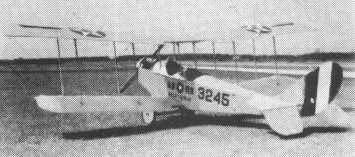
The Jenny is a three-quarter scale replica of the famous Curtiss JN4D Jenny Trainer. Although this ultralight version has a rear cockpit it is there purely for aesthetics and is non-functional. The airframe is gussett riveted aluminium tubing covered in a doped dacron finish. Centre mounted joy stick, rudder pedals.

I flew one many years ago here in Australia. A delightful short range aircraft. The ailerons do not exist. What there is are spoilers on the tops of the upper wings and controlled by a linen cord that pulled them up thus spoiling the air flow. Spoiler up and the lift on the other side raised that wing thus a turn. Real STOL take-off and landing. Mt first experience with a two stroke. Love to own this Curtiss Jenny! Now I can say that I have flown both a Curtiss Jenny and a Boeing! (A Stearman).
David Prossor

Engine: Cuyuna ULII-02 (429 cc) 35 hp.
Prop: 198cm.
Static thrust: 296 lbs.
Empty wt: 248 lbs.
Wing span: 28’4”.
Wing area: 186 sq.ft.
Height: 7’6”.
Length: 17’.
Fuel cap; 5 USG.
Construction: Alumnium, Dacron.
Max wt: 500 lbs.
Stall: 21 mph.
Max speed: 62 mph.
Vne: 69 mph.
Econ cruise speed: 45 kts.
Climb rate: 1000 fpm @ 40 mph.
Design limit: +4, -2g.
Glide ratio: 5.5-1.
Wing loading: 2.69 lbs/sq.ft.
Power loading: 14.29 lbs/hp.

Cloudbuster Cloudbuster

Single seat single engined high wing monoplane with conventional three axis control. Wing has unswept leading edge, swept forward trailing edge and tapering chord; cruciform tail. Pitch control by elevator on tail; yaw control by fin mounted rudder; roll control by one third span ailerons; control inputs through stick for pitch/roll and pedals for yaw. Wing braced from below by struts; wing profile; double surface. Undercarriage has three wheels in tricycle formation; steel ¬spring suspension on nosewheel and steel spring suspension on main wheels. Nosewheel steering connected to yaw control. Brake on nosewheel. Aluminium tube 6063-T6 framework, without pod. Engine mounted at wing height driving tractor propeller. Wing spar strut braced to the cage, ribs made of foam and unidirectional glass fibre and epoxy.

Cloudbuster Ultralights Cloudbuster Article

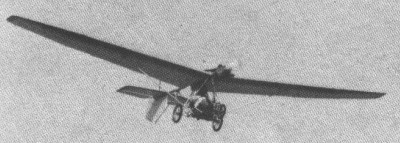
The Cloudbuster made its appearance in 1981. It is fitted with a rigid wing with duralumin tube spars and ribs of high density polyurethane foam, reinforced by a layer of unidirectional glass fibre and epoxy. Wing and tail surface covering is 1.7-ounce Dacron. The leading edge is vinyl and the trailing edge is aluminium sheet bonded to the back of the spars with epoxy. At the wing tips there are semi elliptic saumons and the ailerons are hinged from a false spar.
Undecarriage was tricycle with coil-spring independent suspension and a steerable nosewheel. The main wheels are 20”, and the nose wheel is 16”. A hand-operated bicycle-type brake is fitted to the nosewheel.
The prototype Cloudbuster was equipped with a Skylark Ultra 342 motor and a 2.0 reduction gear turning a two-blade Woody’s prop measuring 58×27”, which was dropped on the initial production models in favour of the Zenoah G25B developing 20 hp at 6500 rpm. Two other options were offered for this machine; the Cuyuna 215R (20hp at 5500 rpm) with a 2.5/1 reduction drive, or the Cuyuna 430R (30 hp at 5500 rpm).
Transport by road requires a trailer, the two half wings and the horizontal tail surfaces being de mounted.
The Cloudbuster is sold as a kit at various stages of finish with or without motor at the choice of the customer. The price was dependent on the kit chosen.

Engine displacement 430 Cuyuna or 342 Ultra (rated 35 and 30 hp).
Wingspan 36 ft.
Wing area 150 sq.ft.
Overall length 15 ft 6 in

Engine: Zenoah G25B, 20 hp at 6500 rpm.
Belt reduction, ratio 2.5/1.
Power per unit area 0.13 hp/sq.ft, 1.40 hp/sq.m.
Fuel capacity 3.5 US gal, 2.9 Imp gal, 13 litre.
Length overall 15.6 ft, 4.72 m.
Height overall 7.4 ft, 2.23 m.
Wing span 37 ft, 11.28 m.
Mean chord 4.1ft, 1.24 m.
Total wing area l53sq.ft, 14.2 sq.m.
Wing aspect ratio 8.9/1.
Nosewheel diameter overall 16 inch, 40 cm.
Main wheels diameter overall 20 inch, 50 cm.
Empty weight 248 lb, 112kg.
Max take off weight 532 lb, 241kg.
Payload 284 lb, 129kg.
Max wing loading 3.48 lb/sq.ft, 17.0kg/sq.m.
Max power loading 26.6 lb/hp, 12.0kg/hp.
Load factors; +4.5, 2.25 ultimate.
Max level speed 60 mph, 97 kph.
Never exceed speed 65 mph, 105kph.
Economic cruising speed 45 mph, 72 kph.
Stalling speed 25 mph, 40 kph.
Max climb rate at sea level 650 ft/min, 3.3 m/s.
Min sink rate 260 ft/min, 1.3 m/s.
Best glide ratio with power off 13/1 at 32 mph, 51 kph.
Take off distance 80 ft, 25 m.
Landing distance 100 ft, 30 m.
Service ceiling 10,000ft, 3050 m.
Range at average cruising speed 135 mile, 217 km.
Clince EJC 1       

A gyrocopter begun on 3 August 1995. The gyro has rotors by Jack Allen, a redrive made by C.M.A. in Christchurch, and rotor head built by Neil Hintz. The joystick, nose wheel, wheels, pedals and aluminium were purchased from Wayne Morgan in Australia. No plans were used, but the machine was built from photos of an Air Command. Test flown in February 1996 by Gary Belton. First registered ZK-RAX, to E.J.Clince, Stratford, New Zealand, on 24 December 1996.

Engine: Subaru EA81, 85 hp.
Rotor dia: 24 ft.
Prop: Warp Drive 68 in.
Cruise: 60 kt.
Max speed: 80 kt.

Cleva Kestrel Jorge

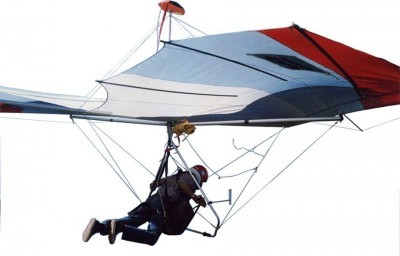
The 1980 Kestrel Jorge was built in Argentine by Jorge Cleva for Intermediate pilots.

Kestrel Jorge
Wing area: 17 m²
Wing span: 8.8 m
Hang glider weight: 30 kg
Maximum pilot weight: 130 kg
Minimum speed: 24 km/h
Maximum speed: 51 km/h
Max glide ratio speed: 40 km/h
Number of battens: 7
Nose angle: 110°

Cleary CL-1 Zipper

Single-seat light aircraft with twin booms and pusher propeller, designed and built by Laister Sailplanes and first flown 1983.

The CL-1 was powered with a 38 hp Kawasaki engine and had a power off glide ratio of 18-1.

The Zipper was first registered in 1983 as N3999C Serial Number X1.

I worked in building this aircraft with Jack Laister for Bill Cleary. Jack was the Engineer and I was the A&P. I’m trying to locate where this aircraft is. Both Jack and Bill have passed on now.
Timothy Blackmon

Classic Sport Aircraft S-18 / S-18T

John Thorp retired in 1985 and took the T-18 plans off the market. Lu Sunderland, having worked with John on a wider fuselage and folding wing option for the T-18, did a complete rework of the drawings and produced plans for the S-18. The S-18 is then a redesign of the Thorp T-18. The fuselage body is 2″ wider and 5″ longer than the standard T-18. Also it has a newer NASA computer designed Wing Airfoil, which is stated to lower the stall speed by 6-8 knots. This airfoil also allows a more gentle stall with adequate warning. The top and cruise speeds remain the same. An S-18 with an 160hp Lycoming IO-320 and Hartzel Constant Speed propeller will cruise around 180 mph at 8500 ft (MSL) on less than 7 GPH (gallons per hour of fuel).
The S-18, like the T-18 is an all metal 2 place side-by-side high performance aircraft. Control response is exceptional and control forces are well harmonized. The S-18 is a very capable cross-country airplane. It will carry 2 people and 80 lbs. of baggage. Powerplants range from Lycoming O-235 (115hp) to IO-360 (180).
Parts can be provided with matched holes so that parts fit together saving a lot of time in construction. Also parts are scribed to outer mold-lines or trim lines. No jigs are required. The airplane is built using 1/8″ solid aluminum rivets, but can be built using 1/8″ stainless steel pop rivets (but not recommended).
The S-18 has a folding wing designed by Lu Sunderland which can be swung around parallel to the fuselage making the airplane less than 8 feet wide. So that it can be trailered home or stored in small spaces.
Test Flights were completed on the S-18T Tri-Gear in May of 2003.

The S-18 was available in kit form from Classic Sport Aircraft. Pieces and parts for both the T-18 and the S-18 are available here also.

S-18T
Engine: Lycoming O-360
Propeller: constant speed
Wingspan 20′ 10″
Length 18′ 6″
Wing area: 86 sq.ft
Gross Weight 1600 lbs.
Empty Weight 1000 lbs.
Useful Load 600 lbs.
Fuel – Standard Tank 29 gallons
Fuel – Wing Tank 24 gallons
Rate of Climb 1500 fpm
Luggage Capacity 80 lbs.
Range (standard) 540 SM
Range (with optional wing tanks) 900 SM
Cruise – 75% power 180 mph
Top Speed 200 mph
Stall: 63 mph
Cockpit width; 40 in
Seating 2 side by side
Engine options: Lycoming 290, 320, or 360

Classic Fighter Industries

The first effort to make Me 262 copies, which began in the early 1990s and involved warbird fan Stephen L. Snyder and a Texas aircraft restoration company, Classic Fighter Industries, dissolved in acrimony. Snyder called on Bob Hammer to take over the work. The effort was barely under way when Snyder died in the crash of his North American F-86 jet fighter in 1999.

The aircraft were taken over by the Texas Aircraft Factory.