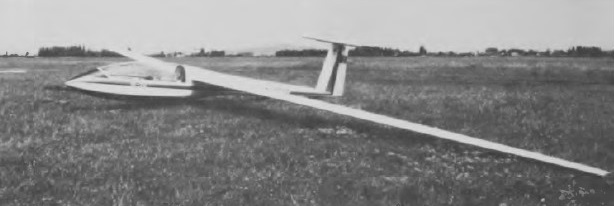
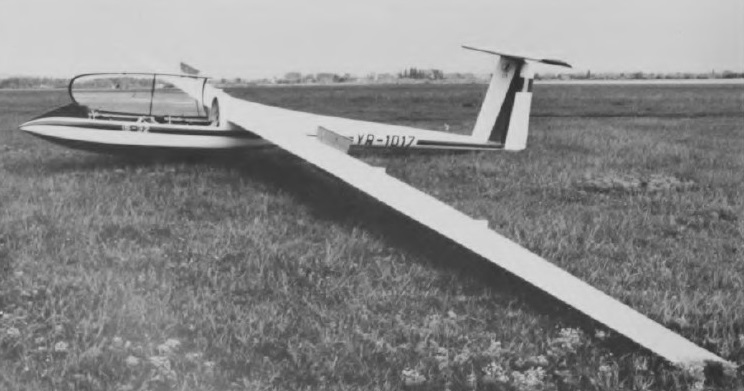
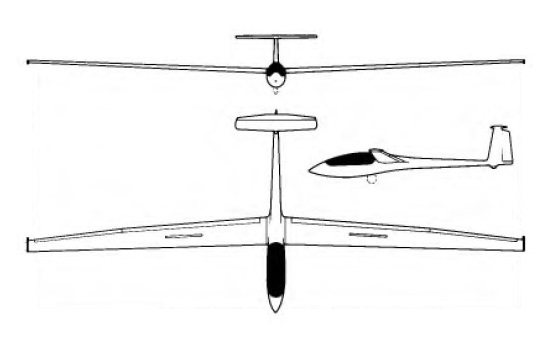
First shown publicly at the Paris Air Show in June 1977, and making its first flight that same month, the IS-32 Open Class tandem two-seater is developed by Iosif Silimon from the IS-28B2, having the same all metal fuselage as the latter married to an entirely new wing of 20m (65 ft 7.5 in) span with an improved aerofoil section, and a redesigned tail unit.
The new wing design employed double taper and externally hinged camber-changing flaps. The interconnected flaps and ailerons are also known as ‘flaperons’, the flaps working in conjunction with the ailerons in negative position for high speed cruising, and in the positive position for soaring in thermals, being disconnected for landing. A flap-aileron interconnect system is one of the features of the Lark I.S.32.A2. This is a 20-meter model.
Like the IS-28B2, Schempp-Hirth metal air brakes are fitted above and below each wing and there are water ballast tanks. A new landing gear is fitted, the main monowheel now being fully retractable instead of semi-retractable as on the IS-28B2. The one-piece tailplane has a new thinner section aerofoil. The IS-32 is of the same all-metal construction as the IS-28B2, and deliveries were due to commence late in 1978.
Despite reasonable performance, the IS-32 was not competitive with its large span composite two-place contemporaries. No. of aircraft built to 6/30/81 15. 1982 Standard price US$32,950.
Wing span: 20m / 65 ft 7.5 in Wing area: 14.68 sq.m / 158 sq.ft Length: 8.36 m / 27 ft 5.25 in Height: 6 ft 0.75 in Empty Weight: 400kg / 882 lb Payload: 190kg / 419 lb Gross Weight: 590kg / 1301 lb Water ballast: 416 lb. Wing Load: 40.2 kg/sq.m / 8.23lb/sq.ft Max speed: 144 mph / 125 kts / 232 km/h Stalling speed: 40 kts / 74 km/h L/D Max: 44 at 110 kph / 59 kt / 68 mph Best glide ratio: 46:1 at 61 mph / 46 kt MinSink: 0.62 m/s / 2.03 fps / 1.20 kt at 46 kt Min sinking speed: 1.74 ft/sec at 53 mph No. of Seats: 2 Aspect ratio: 27.25 Airfoil: Wortmann FX 67-K-170/1 50 Structure: all metal No. Built: 15
IAR-825TP Triumf – Retaining the wing and landing gear of the IAR-823, the turboprop powered Triumf has a new fuselage with two seats in tandem, and a new swept fin. Two underwing hardpoints are provided. The IAR¬825TP first flew on June 12, 1982, and series production for the Romanian Air Force, using uprated 559kW Pratt & Whitney Canada PT¬6A-25C engines, was due to begin in 1986.
IAR-825TP Triumf Engine: 1 x P&WAC PT6A, 560 kW. Span: 10.3 m. Length: 8.9 m. Wing area: 15 sq.m Empty wt: 1200 kg. MTOW: 2300 kg. Max speed: 470 kph. Initial ROC: 960 m / min. Ceiling: 9000 m. T/O run (to 15m): 250 m. Ldg run (from 15m): 300 m. Fuel internal: 360 lt. Range/Endurance: 1400 km / 3 hr.
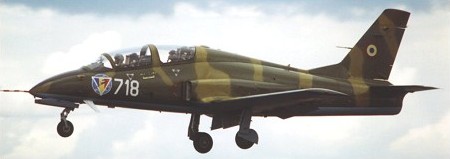
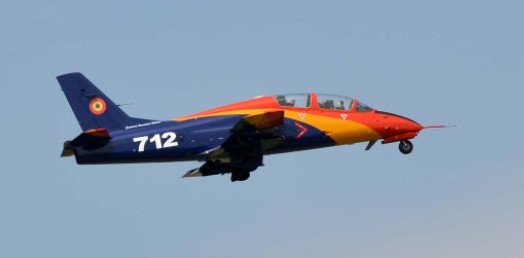
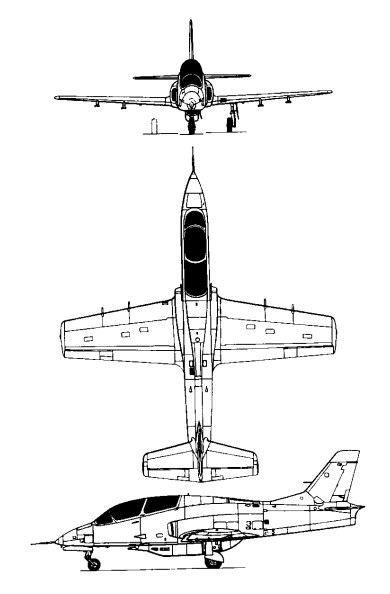
Making its first flight in December 1985, the IAR-99 Soim (Falcon) is designed as a basic jet trainer/light ground attack aircraft, the Soim has lateral intakes for the single 4,000 lb st (17,8 kN) R-R Viper Mk 632-41 turbojet. The wings are unswept, with provision for up to four attachment points, as well as a gun pod on the fuselage centreline. Maximum take-off weight is in the 5,500kg class, with a maximum level speed of 865km/hr (467kt) and a service ceiling of 13,900m (46,000ft).
The first prototype flew on December 21, 1985. The aircraft was in production for the Romanian Air Force to replace the L-29 Delfin in Romanian Air Force service.
IAR 99 Soim Engine: 1 x Rolls-Royce “Viper” Mk.632-41M, 1820kg Take-Off Weight: 4400-5560 kg / 9700 – 12258 lb Empty Weight: 3200 kg / 7055 lb Wingspan: 9.85 m / 32 ft 4 in Length: 11.01 m / 36 ft 1 in Height: 3.90 m / 12 ft 10 in Wing Area: 18.71 sq.m / 201.39 sq ft Max. Speed: 865 km/h / 538 mph Ceiling: 12900 m / 42300 ft Initial ROC: 2190 m / min. T/O run: 790 m. Ldg run: 750 m. Hardpoints: 4. Range: 970-1100 km / 603 – 684 miles Crew: 2 Armament: 1 x 23mm cannon, up to 800kg of weapons
The IAR-46 is a very light two-seater airplane for flight school, training and tourism, developed from the ICA IS-28. Construction is conventional riveted joints. Seats are arranged side by side, the left seat as the main, low trepezoidal wing, empennage in “T” semi-retractable landing gear, with skid wheel connected with the rudder.
Definition phase and marketing studies started early 1991 and detail design began late 1991.
DESIGN FEATURES: Low-wing monoplane; GA(W)-1 aerofoil section) with high aspect ratio; raked tips; T tail. Dihedral 2° from centre-section; incidence 4° at root; no twist. Foldable horizontal tail surfaces.
FLYING CONTROLS: Conventional and manual. Actuation by pushrods and cables; trim tab in each elevator. Manually operated plain trailing-edge flaps.
STRUCTURE: All-metal except fabric covering on elevators and rudder and GFRP for non-stressed fairings. Wing has main and auxiliary spars. Fluted aluminium skins on ailerons and flaps.
LANDING GEAR: Retractable (manual/mechanical) single mainwheels with hydraulic shock-absorbers and hydraulic, toe-operated disc brakes; steerable, non-retractable tailwheel rubber-in-compression shock-absorption. Rearward-retracting 5.00×5 Matco or Cleveland mainwheels, with 360×110 tyres, pressure 3.00 bar (43.5 lb/sq in). Tost 210×65 tailwheel and tyre, pressure 2.50 bar (36 lb/sq in).
POWER PLANT: One 59.6 kW (79.9 hp) Rotax 912 F3 (IAR-46) or 73.5 kW (98.6 hp) Rotax 912 S3 (IAR-46S) flat-four engine, with 2.43:1 reduction gearing to a Hoffmann HO-V352F/170FQ two-blade variable-pitch propeller (‘170FQ+6 in IAR-46S). Fuel in single tank in fuselage, capacity 70 litres (18.5 US gallons; 15.4 Imp gallons).
ACCOMMODATION: Two adjustable backrest seats side by side; dual controls standard; adjustable rudder pedals. Fixed windscreen and rearward-sliding jettisonable canopy. Baggage compartment aft of seats. Cockpit heated and ventilated.
SYSTEMS: Electrical power supplied by 250 W 14 V DC alternator and 12 V 25 Ah battery. Hydraulic system for mainwheel brakes only, with parking brake valve.
AVIONICS: Instrumentation: Standard VFR instrumentation to JAR 22.1303 and JAR 22.1305. Options include horizon and directional gyros, turn co-ordinator and Becker nav/com and transponder avionics package.
EQUIPMENT: Anti-collision and position lights standard; ground power receptacle optional.
A development phase was initiated mid-1992 with the first of two prototypes (YR-1037) shown at the Paris Air Show June 1993 and made first flight November that year.
Following flight test evaluation, static test and ground testing for JAR-VLA compliance, development of 02 second prototype began at end of 1995. This aircraft (YR-BVC) made first flight in April 1997.
The manufacturer’s preliminary flight test programme was completed in August 1999 and JAR-VLA certification (Utility category) by Romanian CAA, began mid-1998, was received November 1999, with YR-BVC registered to Airclub Romania in August 2000.
FAA certification was expected in September 2000 but apparently still awaited in mid-2003. Three further production aircraft were built and stored by late 1998, eventually registered in April 2001. The first three (c/n 03 to 05) were registered to Airclub of Romania in April 2001.
IAR-46 Engine: Rotax 912 F3/A3, 58 kW (78 hp) Propeller: 2-bladed Hoffmann HO-V352F/170FQ, 1.7 m (5 ft 7 in) diameter Wingspan: 11.42 m (37 ft 6 in) Wing area: 13.87 sq.m (149.3 sq ft) Aspect ratio: 9.403:1 Airfoil: GA(W)-1 Height: 2.15 m (7 ft 1 in) Length: 7.85 m (25 ft 9 in) Empty weight: 530 kg (1,168 lb) Max takeoff weight: 750 kg (1,653 lb) Fuel capacity: 78 L (21 US gal; 17 imp gal) G limits: +4.4, -2.2 Cruise speed: 150 km/h (93 mph, 81 kn) (econ cruise) Stall speed: 78 km/h (48 mph, 42 kn) Never exceed speed: 270 km/h (170 mph, 150 kn) Range: 800 km (500 mi, 430 nmi) (no reserve) Service ceiling: 5,000 m (16,000 ft) Rate of climb: 4.30 m/s (846 ft/min) Wing loading: 54.1 kg/m2 (11.1 lb/sq ft) Power/mass: 12.58 kg/kW (20.67 lb/hp) Rate of climb: 4.30 m/s (846 ft/min) Crew: 2
IAR-46S Engine: Rotax 912 S3, 73.5 kW (98.6 hp) Wingspan: 11.42 m (37 ft 6 in) Wing area: 13.87 sq.m (149.3 sq ft) Aspect ratio: 9.403:1 Airfoil: GA(W)-1 Height: 2.15 m (7 ft 1 in) Length: 7.85 m (25 ft 9 in) Empty weight: 530 kg (1,168 lb) Max takeoff weight: 750 kg (1,653 lb) Fuel capacity: 78 L Maximum speed: 215 km/h (134 mph; 116 kn) Cruising speed: 170 km/h (110 mph; 92 kn) (econ cruise) Stall speed: 78 km/h (48 mph; 42 kn) Never exceed speed: 280 km/h (170 mph; 150 kn) Range: 800 km (497 mi; 432 nmi) (no reserve) Service ceiling: 5,000 m (16,404 ft) Crew: 2
During the summer of 1982 in France, the CMV company produced a prototype based on the Easy Riser, using a canard. Its first flight was achieved in a fashion which was risky for the machine, but test pilot Bela Nogrady returned saying he had experienced some of the most marvellous feelings of his life.