Christian Pfeil began constructing paragliders in 1998. His first on the market being the Mono.
1998: Pramienstr. 1, D-52445 Titz, Germany
1980->
Cozza/Scholl Scorpion
Single seat single engined mid wing mono¬plane with conventional three axis control. Wing shape; tapering chord; no tail, canard wing. Pitch control by fully flying canard; yaw control by tip rudders on canard; roll control by half span ailerons. Cantilever wing; wing profile; double surface. Aluminium fuselage. Engine mounted at wing height driving pusher propeller.
The Cozza/Scholl Scorpion was only an experimental machine in 1982.
Chicago based designers Craig Cozza and Mark Scholl wanted to create an ultralight with good soaring ability and which would operate safely in temperatures low enough to weaken composites. So the Scorpion uses an all aluminium construction, with Dacron wing covering. Pitch control is by fully flying canard and yaw control by tip rudders mounted on the ends of the canard. Half span ailerons look after roll control.
Particularly novel is the wing construction which allows the pilot to rig the aircraft with 40.0 ft (12.19 m) wings for soaring, or to halve the span by removing a 10.0 ft (3.05 m) panel from outboard end of each wing, in which form the Scorpion will have a more ultralight-like feel. For ease of construction, the fuselage is triangular in cross section, allowing flap panels to be used.
The low drag shape has allowed the designers to use a small engine, and they have chosen the single cylinder Cuyuna 215R of 20 hp for the prototype.
Engine: Cuyuna 215R, 20 hp.
Wing span 20.0 or 40. ft (6.10 or 12.19m).
Empty weight 235 lb, 107 kg.
Max cruising speed 60mph, 97kph.
CO-z Development Cozy / Mk.IV

Cozy is designer Nat Puffer’s side-by-side version of Burt Rutan’s Long¬EZ. It has a larger instrument panel, full dual controls, a large baggage compartment and the same efficiency, speed and range as Long-EZ, allowing passenger to assist with piloting/navigating, and makes long trips more pleasant and less fatiguing, as well as adding a margin of safety in bad-weather flying.
The Cozy MK IV is a high-performance, four-seat canard aircraft which is comfortable, efficient, and economical to build. It has a range of about 1,000 miles and a top speed of 200 mph. When constructed according to plans and operated within the approval C.G. range, the canard configuration makes it highly resistant to stalls or loss of position control. The MK IV features full dual control and two-axis trim. The composite construction is very strong, resistant to corrosion and fatigue. The MKIV features the same moldless construction as the Cozy. It used the same basic materials of foam, glass, cloth, and epoxy.

AeroCad Inc also licence manufacture a development of the Cozy as the AeroCanard.
Aircraft Spruce & Specialty Co. has acquired all existing inventory, tooling, and drawings for the prefabricated metal parts used in construction of the popular Cozy III and Cozy Mark IV aircraft as of January 1, 2004. Ken Brock Manufacturing Co. of Stanton, CA produced the metal parts for the construction of the Cozy and Long-EZ aircraft since the mid-1970’s until ceasing business operations on December 31, 2005. As the owner of the design rights for the Cozy Mark IV and the source for plans and kits, Aircraft Spruce continues to sell Brock’s parts. There was no remaining inventory of some of the parts, but there are new alternate sources on most of them.
These designs are protected with U.S. copyrights, and Aircraft Spruce has licensed no one else to copy all or any part of these designs to sell, loan, or give to others.
Greg Richter converted his Cozy III from a Mazda RX7 motor car engine to General Electric T58 turbine jet engine power. The transformation was performed by Valerie Harris and Robert with EZJET at Covington, Tennessee, in 1991.

CO-z Development Cozy Article Nov 83
Cosy Classic
Engine 118-hp Lycoming 0-235.
Wingspan 26.1 ft
Gross Wt. 1500 lb.
Empty Wt. 850 lb
Fuel capaci¬ty 52 USG
Cruise (75 percent) 180 mph.
Climb rate (solo) 1500 fpm
Climb rate (gross) 900 fpm.
Takeoff run (solo) 670 ft
Takeoff run (gross) 1050 ft.
Range 1800 miles
Cosy Classic
Engine: Lycoming O-320, 160 hp.
HP range: 150-160.
Speed max: 225 mph.
Cruise: 187 mph.
Range: 1000 sm.
Stall: 67 mph.
ROC: 1500 fpm.
Take-off dist: 1480 ft.
Landing dist: 1640 ft.
Service ceiling: 20,000 ft.
Fuel cap: 52 USG.
Weight empty: 960 lbs.
Gross: 1750 lbs.
Height: 7.8 ft.
Length: 17.7 ft.
Wing span: 26.33 ft.
Wing area: 95.6 sq.ft.
Seats: 3.
Landing gear: retractable nose wheel.
Cosy III
Speed max: 225mph.
Cruise: 190 mph.
Range: 1000 sm.
ROC: 2000 fpm.
Take-off dist: 1500 ft.
Landing dist: 1500 ft.
Service ceiling: 20,000 ft.
Engine: Lycoming O-320, 160 hp.
HP range: 150-160.
Fuel cap: 52 USG.
Weight empty: 960 lbs.
Gross: 1750 lbs.
Height: 7.8 ft.
Length: 17 ft.
Wing span: 26.1 ft.
Wing area: 95.6 sq.ft.
Seats: 3.
Landing gear: nose wheel.
Cozy Mark IV
Engine: Lycoming O-360 180 hp.
Wing Span: 28.1 ft
Wing area: 88.3 sq.ft
Canard Span: 12.6 ft
Canard Area: 14.7 sq.ft
Length: 16.9 ft
Height: 7.9 ft
Cabin W/H: 42/39in
Max. front seat: 400 lbs.
Empty wt: 1050 lbs.
Gross wt.: 2050 lb
Take-off solo/gross: 1200/1700 ft.
Climb solo/gross: 2000/1200 fpm
Cruise 75% 8000 ft: 220 mph
Cruise 40% 12000 ft: 185 mph
Max. range 75%: 1000 mi
Max. range 40%: 1300 mi.
Ceiling: 20,000+ ft.
Ldg.Dist.solo/gross 1000/1300 ft.
Cozy Mark IV
Engine: Lycoming O-360A, 180 hp.
HP range: 160-180.
Height: 7.9 ft.
Length: 16.9 ft.
Wing span: 28.1 ft.
Wing area: 88.3 sq.ft.
Speed max: 220 mph.
Cruise 75% 8000 ft: 220 mph.
Cruise 40% 12,000 ft: 185 mph.
Range 75%: 1000 sm.
Range 40%: 1300 sm.
ROC SL: 1200 fpm.
Take-off dist: 1700 ft.
Landing dist: 1200 ft.
Service ceiling: 20,000 ft.
Fuel cap: 52 USG.
Weight empty: 1050 lbs.
Gross: 2050 lbs.
Seats: 4.
Cabin width: 42 in
Cabin height: 39 in
Front seats max: 400 lb
Landing gear: retractable nose wheel.
Cozy / Mk.IV
Engine: Lycoming
Wing span: 8.56 m
Wing area: 9.41 sq.m
MAUW: 930 kg
Empty weight: 476 kg
Fuel capacity: 197 lt
Max speed: 354 kph
Cruise speed: 306 kph
Minimum speed: 108 kph
Climb rate: 10 m/s
Seats: 4
Plan price (1998): $500
Kit price (1998): $14,000
CO-z Development Corp
Cosy Europe markets plans and kits to construct the mostly composites- built Cozy Classic, a two/three-seat pusher-engined canard monoplane having bought the rights for Cosy from Nathan Puffer of U.S.A. in 1987, original Cosy having flown in 1982.
Markets plans and components to construct the Cozy Mark III and higher-powered Mk IV four-seat canard monoplanes of composite construction, developed from Nathan Puffer’s side-by-side two-seat Cosy Classic, which itself was developed from the Rutan Long-EZ.
1998:
2046 North 63 rd Place
AZ 85215 Mesa
USA
Avions Jacques Coupe JC-01 / JC-2 / JC-3 / JC-200

Designed by Jaques Coupé, the Coupé-Aviation JC-01 is the first of a series of very similar designs of two seat, single engine sports aircraft, amateur built from plans in France from 1976. These provided a range of engine sizes and undercarriage layouts, but total production was small. Design emphasis was placed on ensuring that homebuilders would find it easy to construct, and plans became available through Coupé-Aviation.
The first was designated JC-01, a side-by-side two-seat light-plane. It had a non-retractable tail wheel type landing gear and was powered by a 65 hp Continental A65-8F flat-four engine. It was flown for the first time on March 16, 1976, registered as F-PXKV (c/n 01).
The JC-01 and its variants were designed as conventional two-seat side by side light aircraft that could be built from plans by amateurs. The different models are chiefly distinguished by engine choice, though undercarriage configurations vary and there are slight alterations to the vertical surfaces. Coupé subsequently began construction of a derivative of the JC-01 in September 1976. Designated JC-2, it was generally similar to the JC-01 but had a 90 hp Continental A65-8F flat-four engine. It flew for the first time on May 7, 1981, registered F-WYJI (c/n 01), after gaining its CofA it was reregistered F-PYJI.
Of wooden construction, covered with plywood and fabric, the J-01 and the J-2 have identical spans, wing areas and lengths, though the J-2, with a 90 hp rather than 65 hp engine and a tricycle rather than conventional undercarriage weighs more: empty, the J-01 weighs 330 kg (728 lb), the J-2 500 kg (1,103 lb).
The J-2 has a constant chord, one piece low wing. Its inner panels have no dihedral but the outer ones are set at 4°. Both the main box spar and the rear spar have spruce booms and plywood webs. The leading edge is ply covered and fitted with fixed slots. The wing, including ailerons and flaps is Dacron covered overall. The empennage of the J-2 is conventional and cantilever, with the horizontal tail mounted on top of the fuselage; both fin and rudder are swept, the latter only slightly. The fixed surfaces are ply covered but control surfaces are fabric covered. The elevator has a trim tab.
The fuselage of the J-2 is a three frame truss structure with a ply covered forward section and fabric covering aft. A 67 kW (90 hp) Continental C90 flat four engine in the nose drives a two-blade, fixed pitch propeller. Its fuel is stored in a tank immediately aft of the engine firewall. The cockpit, placed over the wing, seats two side by side under a large, rearward sliding canopy, with a space behind the seats which can take up to 20 kg (44 lbs) of baggage. The J-2 lands on fixed tricycle gear. The mainwheels have oleo-pneumatic damping and mechanical brakes; the nosewheel swivels.
Plans were available to amateur builders for the construction of the JC-01 and its variants and about a dozen JC-01s were built. Two remained on the French civil aircraft register in 2010, together one example of each of the other variants making the total number of all variants built at least fifteen. Some builders included their own name and initials in the aircraft description, for example the Dessevres-Coupé JCD 01 and the Coupé-Brault JCFB 01.
The JC-200 was a refined version of the JC-2, the first example was flown on August 18, 1989.

Variants:
JC-01
Original version with 48 kW (65 hp) Continental A65 engine and unswept rudder. Later the prototype was modified with a swept rudder. At least one was built with a Limbach 1700 engine. Tailwheel undercarriage. First flown 16 March 1976.
JC-2
Similar to JC-01 but with a 67 kW (90 hp) Continental C90, 50% heavier, swept vertical tail and tricycle undercarriage. First flown May 1981.
JC-3
Lightened JC-01 with swept vertical tail and 51 kW (68 hp) Limbach L 1700 or 60 kW (80 hp) L 2000 engine.
JC-200
“Refined” version of JC-2 with a 75 kW (100 hp) Rolls-Royce Continental O-200 engine, first flown 18 August 1989.
Specifications:
JC-01
Engine: 1 × 48 kW (65 hp) Continental A65
Empty weight: 330 kg (728 lb)
JC-01
Engine: 1 × Limbach 1700 engine
JC-2
Engine: 1 × Continental C90, 67 kW (90 hp)
Propellers: two-bladed fixed pitch wooden
Length: 6.40 m (21 ft 0 in)
Wingspan: 8.35 m (27 ft 5 in)
Wing area: 11.70 m2 (125.9 sq ft)
Aspect ratio: 5.95
Airfoil: NACA 23012
Empty weight: 500 kg (1,102 lb)
Max takeoff weight: 750 kg (1,653 lb)
Fuel capacity: 90 L (20 Imp gal; 24 US gal)
Baggage capacity: 20 kg (44 lbs)
Maximum speed: 200 km/h (124 mph; 108 kn)
Cruising speed: 160 km/h (99 mph; 86 kn) economical
Stall speed: 45 km/h (28 mph; 24 kn) flaps down
Capacity: two
Undercarriage: Tricycle
JC-3
Engine: 1 × 51 kW (68 hp) Limbach L 1700
JC-3
Engine: 1 × 60 kW (80 hp) L 2000 engine.
JC-200
Engine: 1 × 75 kW (100 hp) Rolls-Royce Continental O-200
Avions Jacques Coupe
Offers plans (1976) to construct JC-01 and more-powerful (and nosewheel undercarriage) JC-200 two-seat low-wing monoplanes.
Coughlin SE-5A replica
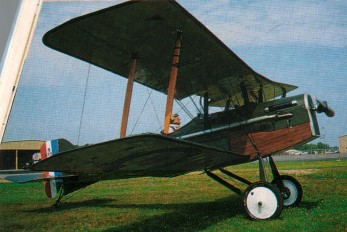
Dick Coughlin, a retired dentist, began building a full size SE-5A replica in the arly 1990s. Coughlin began with the original plans that he then revised for homebuilding.
Construction is of steel tube, wood and fabric. Power is supplied by a Dave Blanton conveted Ford V-6.
Cosmos Helios
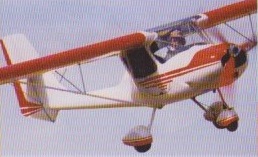
Built almost entirely of composited, it was planned, circa 198, to build the Helios from the new Cosmos factory at Darois Aerodrome.
Engine: Rotax 582, 64 hp
Wing span: 10.9 m
Wing area: 15.7 sq.m
MAUW: 450 kg
Empty weight: 154 kg
Fuel capacity: 60 lt
Max speed: 165 kph
Cruise speed: 130 kph
Minimum speed: 60 kph
Climb rate: 4 m/s
Fuel consumption: 10 lt/hr
Seats: 2
Price (1998): 142,500 Fttc
Kit price (1998): 122,280 Fttc
Cosmos Samba Topless

A small single seater for hang glider wings, circa 1998.
Empty weight: 79 kg
Wing span: 10.12 m
Wing area: 13.50 sq.m
Fuel capacity: 10 lt
Engine: Zenoah G25 B1, 22 hp
MAUW: 180 kg
Seats: 1
Max speed: 95 kph
Cruise speed: 60 kph
Minimum speed: 32 kph
Climb rate: 3 m/s
Fuel consumption: 4 lt/hr
Price (1998): 37 265 Fttc
Cosmos Phase

Manufactured in France, the strut-braced trike has gas shocks and can be fitted with factory options including floats, tow system, and spray system. The kit price includes engine and prop.

The Phase II 503 Chronos 16 uses the same basic trike unit and engine as the Zoom, but uses a double-surface wing.


The Phase II 618 ES Chronos 16 Float has the 76 hp Rotax and has enough power to handle floats. Without floats it is good for towing a hang glider.

Phase 2 / Zoom
Engine: Rotax 503, 52 hp.
HP range: 46-70.
Speed max: 75 mph.
Cruise: 48 mph.
Range: 175 sm.
ROC: 500 fpm.
Take-off dist: 150 ft.
Landing dist: 170 ft.
Service ceiling: 15,000 ft.
Fuel cap: 10 USG.
Weight empty: 315 lbs.
Gross: 750 lbs.
Height: 12 ft.
Length: 8 ft.
Wing span: 35 ft.
Wing area: 151 sq.ft.
Seats: 2.
Landing gear: nose wheel.
Cosmos Phase II 503
Empty weight: 130 kg
Wing span: 10.6 m
Wing area: 19 sq.m
Fuel capacity: 55 lt
Engine: Rotax 503 DCDI, 52 hp
MAUW: 350 kg
Seats: 2
Max speed: 105 kph
Cruise speed: 60 kph
Minimum speed: 40 kph
Climb rate: 5 m/s
Fuel consumption: 8 lt/hr
Price (1998): 80 900 Fttc
Phase II 503 Chronos 16
Empty weight: 132 kg
Wing span: 10.6 m
Wing area: 16 sq.m
Fuel capacity: 55 lt
Certification: Vz, B, NL
Engine: Rotax 503 DCDI, 52 hp
MAUW: 350 kg
Seats: 2
Max speed: 125 kph
Cruise speed: 90 kph
Minimum speed: 45 kph
Climb rate: 5 m/s
Fuel consumption: 7 lt/hr
Price (1998): 87 300 Fttc
Phase III 582 ES Top 12.9
Empty weight: 138 kg
Wing span: 9.87 m
Wing area: 13 sq.m
Fuel capacity: 55 lt
Certification: Vz, B
Engine: Rotax 582 DCDI, 64 hp
MAUW: 350 kg
Seats: 2
Max speed: 145 kph
Cruise speed: 100 kph
Minimum speed: 50 kph
Climb rate: 7 m/s
Fuel consumption: 9 lt/hr
Price (1998): 109 900 Fttc
Phase II 618 ES Chronos 16 Float
Empty weight: 158 kg
Wing span: 10.6 m
Wing area: 16 sq.m
Fuel capacity: 55 lt
Engine: Rotax 618 DCDI, 73 hp
MAUW: 400 kg
Seats: 2
Max speed: 130 kph
Cruise speed: 100 kph
Minimum speed: 55 kph
Climb rate: 4 m/s
Fuel consumption: 12 lt/hr
Price (1998): 176 000 Fttc

